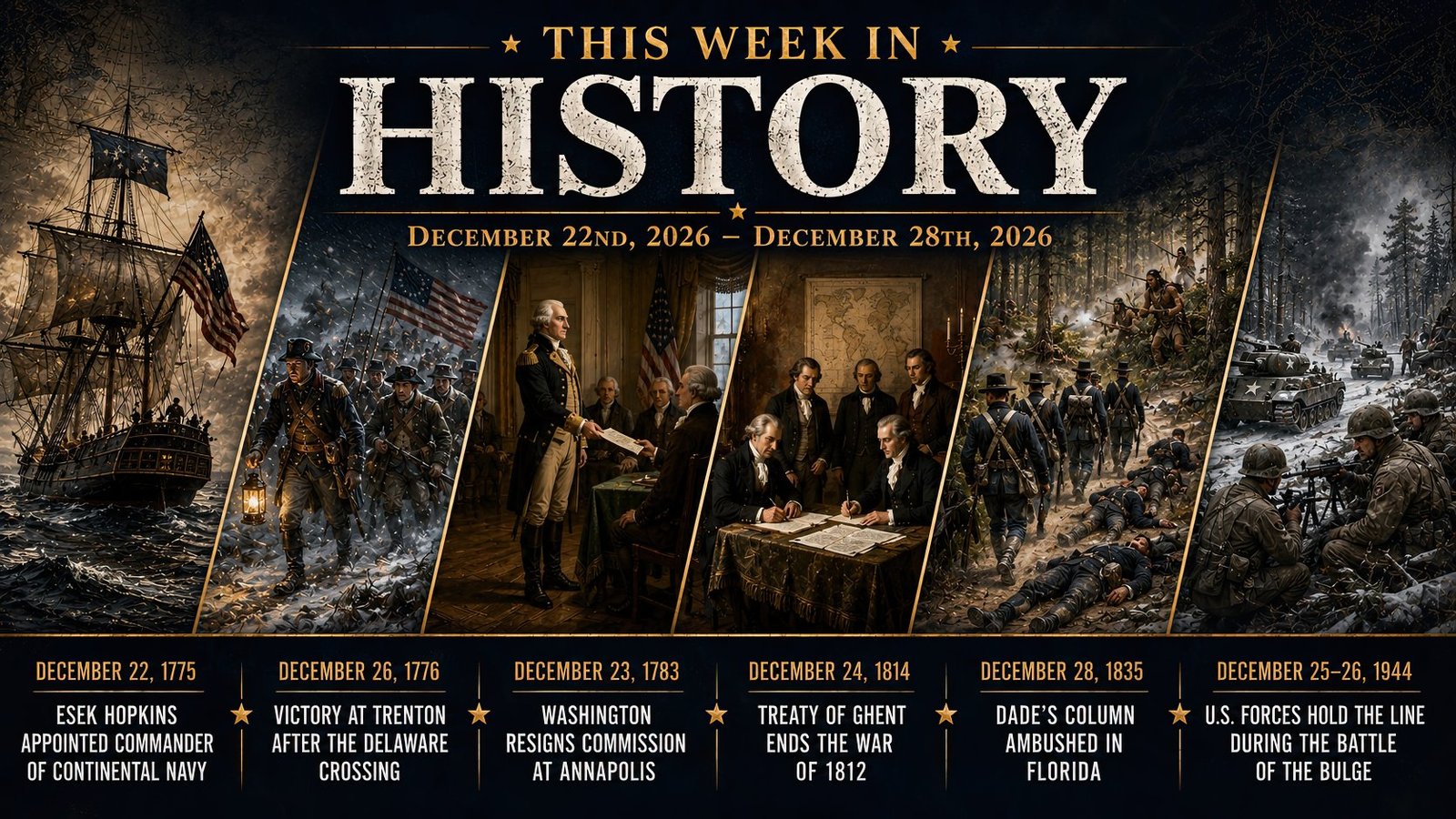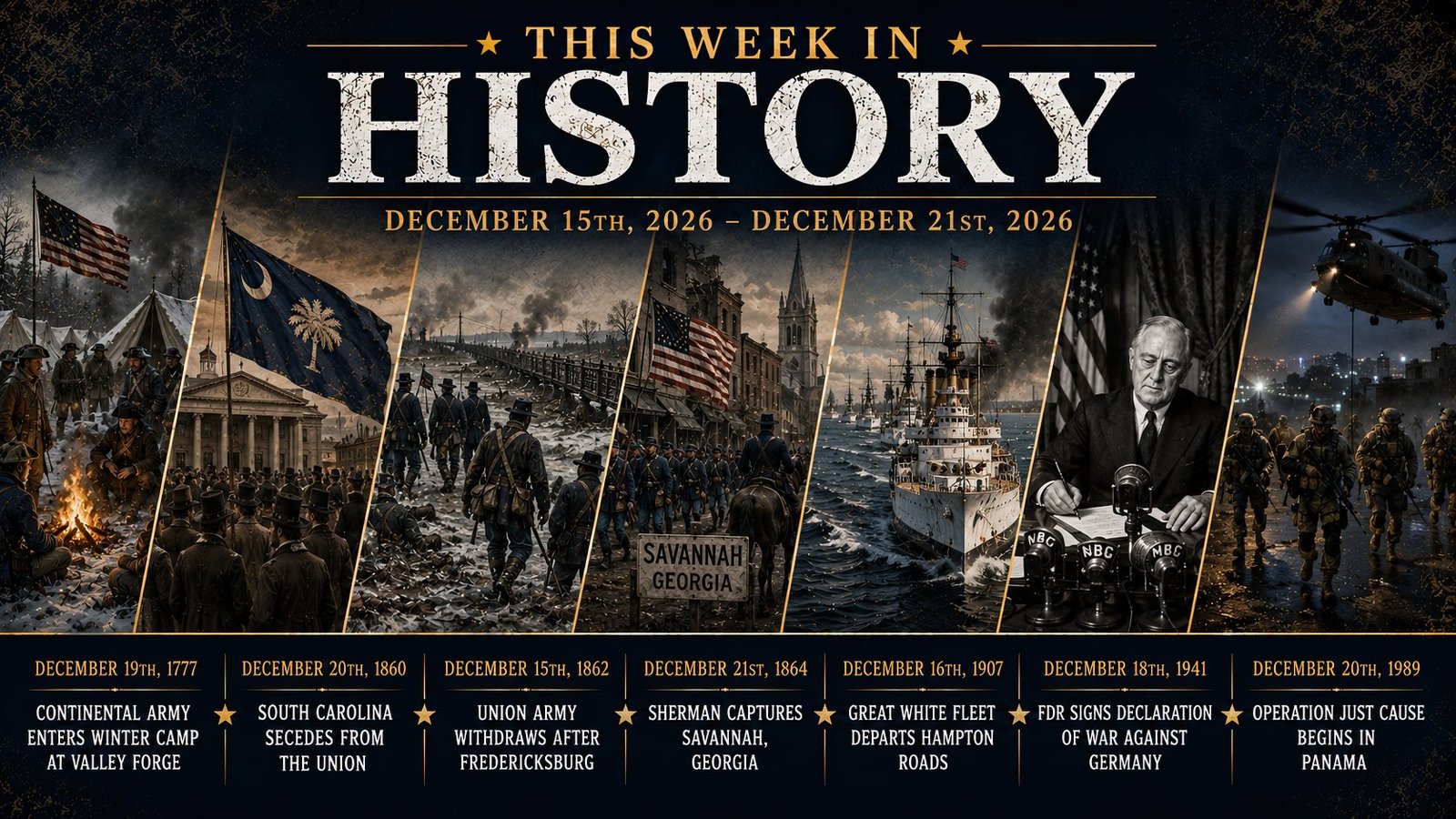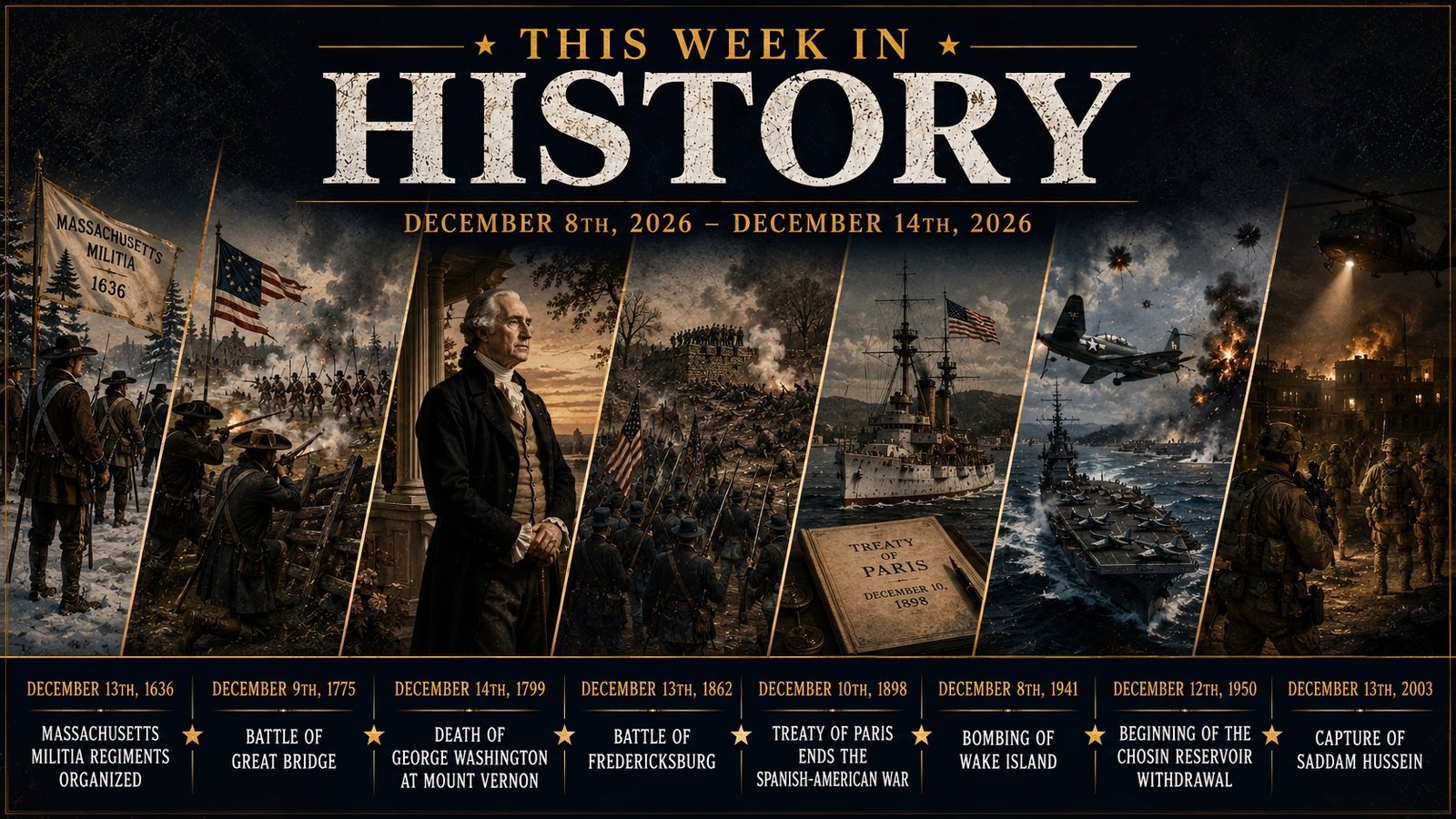
This Week in History · December 29, 2026
489 Populated Entries
Conflicts and historical periods that shaped military institutions and warfare.
Wars & Historical Eras
Every result opens a permanent subject record with its reference context and connected Dispatch coverage. Filter by record type, editorial collection, or a word in the entry.
489 entries found.
Just eight years after the Wright brothers’ first powered flight, naval officers were already asking what airplanes might do for fleets at sea. On January 18th, 1911, civilian pilot Eugene Ely approached the armored cruiser USS Pennsylvania in San Francisco Bay, aiming at a temporary wooden deck built over the ship’s stern.
The American Civil War produced acts of courage on both sides, but the Union government sought a formal way to recognize extraordinary valor in its ranks. On March 25th, 1863, in a ceremony at the War Department in Washington, the first Medals of Honor were presented to a group of Union soldiers known as Andrews’ Raiders.
Three years after major Confederate armies surrendered, the scars of the Civil War still marked towns and families across the reunited country. On May 30th, 1868, mourners gathered at Arlington National Cemetery and other burial grounds to decorate the graves of the war dead with flowers, flags, and wreaths. The observances followed a general order from a veterans’ organization calling for a national “Decoration Day” dedicated to remembering fallen soldiers from the Union ranks.
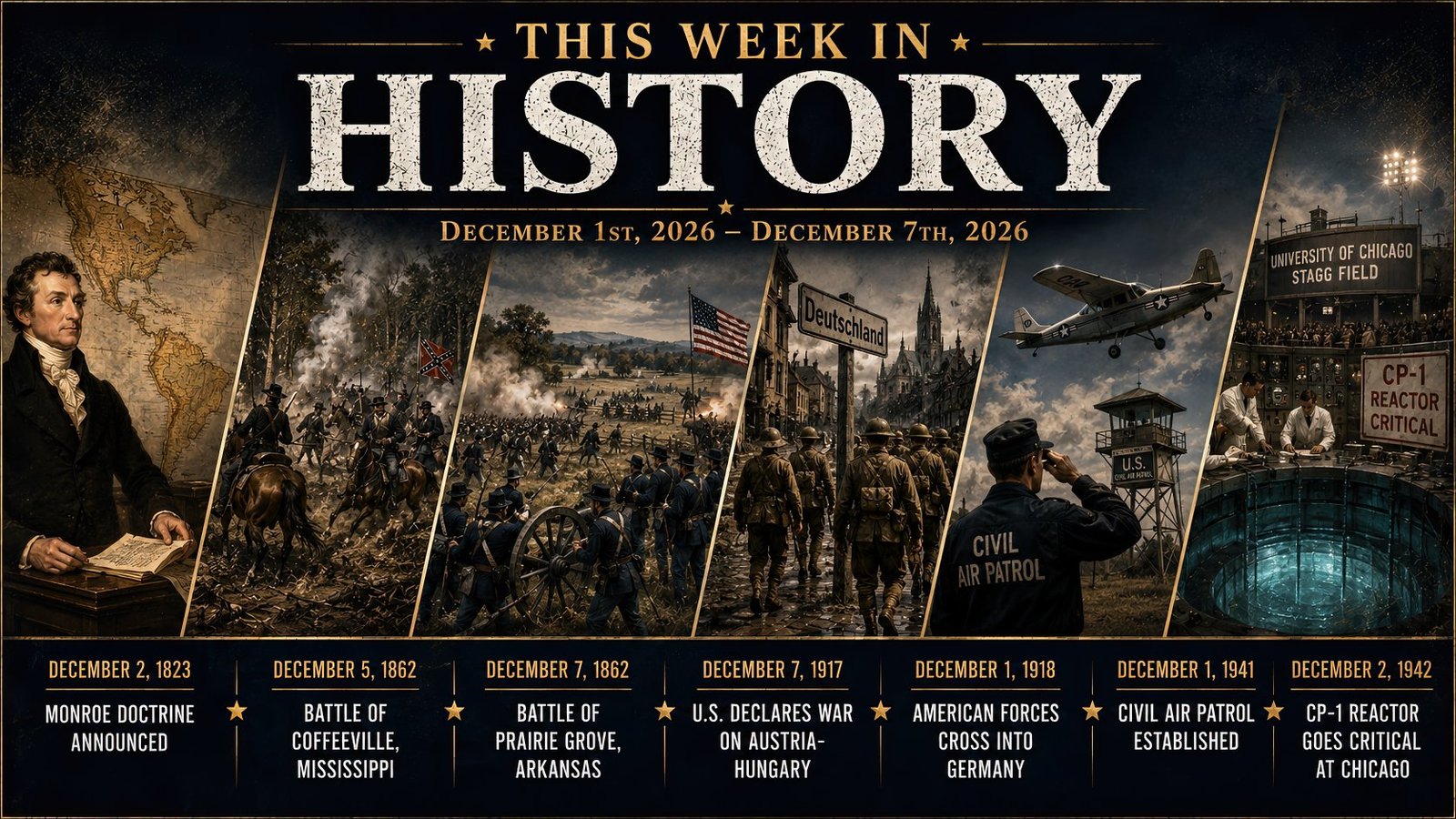
Exactly one year after Pearl Harbor’s date on the calendar, December 2nd, 1942, a small team of scientists and technicians gathered under a stadium in Chicago carried out an experiment that would change warfare forever.
With war raging in Europe and Asia, but before the United States formally entered the conflict, the government took a historic step by registering millions of men for possible military service under a new Selective Service law.
In early August 1950, the Korean War had entered a precarious phase as North Korean forces pushed United Nations troops back toward the southeastern tip of the peninsula. On August 7th, the First Provisional Marine Brigade, formed from elements of the First Marine Division, arrived at the port of Pusan to reinforce the hard-pressed defenders.
On May 15th, 1918, Army Air Service pilots take off from Washington, D.C., carrying sacks of mail on a timed route toward Philadelphia and New York. The flights mark the start of regularly scheduled airmail service, and while it is a civilian function, the work rests on military pilots, aircraft, and support crews. Flying fragile biplanes over unfamiliar routes and variable weather, the fliers must navigate with little more than maps, compasses, and prominent landmarks.
When the United States entered World War I in April 1917, its small regular army was nowhere near large enough to fight on the Western Front. Congress responded by passing the Selective Service Act, and on June 5th, 1917, the nation held its first massive draft registration day. Across cities, small towns, and rural crossroads, millions of men lined up at local boards, filling out forms under the eyes of community leaders and veterans.
On August 29th, 1949, far away on the Eurasian steppe, the Soviet Union detonated its first atomic device, abruptly ending the American monopoly on nuclear weapons.
On January 27th, 1943, Eighth Air Force B-17 Flying Fortress crews climbed into icy English skies and headed for the German port of Wilhelmshaven. The mission marked the first all-American heavy bomber raid deep into Germany, part of a growing campaign to hit U-boat bases, shipyards, and industrial centers. The crews flew in daylight formations, relying on tight discipline and concentrated defensive fire to survive fighter attacks.
Back in the United States on December 1st, 1969, millions of young Americans gathered around televisions and radios to watch a different kind of drawing.
Less than two weeks after the attack on Pearl Harbor, on December 18th, 1941, the First War Powers Act dramatically expanded the president’s authority to direct the national war effort.
Two days after Plattsburgh, another critical gateway came under fire when British warships bombarded Fort McHenry, guardian of Baltimore’s inner harbor.
On February 23rd, 1945, a patrol from the 28th Marine Regiment climbed Mount Suribachi, the volcanic peak dominating the southern end of Iwo Jima, and raised an American flag. A larger flag soon replaced the first, and an Associated Press photographer captured the moment that would become one of the most reproduced images in military history.
The Second World War was over by December 5th, 1945, but military aviation remained a dangerous profession even in training.
More than half a century later, another presidency faced the task of closing a different conflict. On August 20th, 1866, President Andrew Johnson issued a formal proclamation declaring that the insurrection in the former Confederate states was at an end, effectively marking the official conclusion of the Civil War. The great campaigns and bloody battles were already over, but this act drew a legal line under four years of rebellion and set the context for Reconstruction.
In the autumn of the Revolutionary War, George Washington’s army reeled from defeat around New York City.
On August 30th, 1813, in the pine woods of the Mississippi Territory, Red Stick Creek warriors tore into the poorly prepared post at Fort Mims.
As the world edged closer to global conflict, American leaders recognized that citizen-soldiers and long-service professionals alike would need support far beyond rifles and rations. On February 4th, 1941, several existing civilian welfare organizations joined together under a new umbrella: the United Service Organizations, or USO.
The ramps drop into waist-deep surf and chaos. It is the morning of October 20, 1944, on a stretch of shoreline the maps call Red Beach. Ahead lies a narrow band of sand, beyond it a low palm grove and flooded rice paddies. Somewhere in that green fringe, Japanese guns have the approaches bracketed. As the first waves of soldiers tried to cross, the beach turned into a killing ground.
High over Europe on Christmas Eve 1944, the sky is crowded with contrails. Hundreds upon hundreds of heavy bombers push east toward German airfields, the engines’ steady thunder mixing with clipped radio calls. At their head is a single Flying Fortress, the air commander’s ship, where Brigadier General Frederick Walker Castle studies the instruments and the grey cloud deck below.
The rain-soaked hills of Leyte were already torn open by days of fighting when Company A of the 306th Infantry pushed forward against a Japanese strongpoint that refused to break. Machine guns were dug into the slopes, firing down narrow approaches that funneled every American movement into sheets of bullets. A light tank inched ahead, meant to crack the defenses, but the infantry platoon walking behind it stalled under the storm of fire.
The fields near Anzio were bare and unforgiving—flat, freshly plowed earth broken only by shallow furrows and a few low dikes. On a May morning in 1944, Staff Sergeant George John Hall lay pressed into that thin cover with the rest of his company, the dirt shaking under the hammering of German machine guns. Every time a man tried to crawl forward, grazing fire stitched the ground in front of him. Sniper rounds cracked overhead.
Night on Iwo Jima never really felt dark. The sky glowed faintly from flares and burning wreckage, and the volcanic ash underfoot seemed to swallow every step. In a shallow foxhole—a rough, shoulder-deep fighting position scraped into that ash—Private George Phillips stood watch while the rest of his squad finally slept. They had spent the night trading grenades and rifle fire with Japanese troops slipping through the lines.
Related Dispatch
These current Dispatch articles connect directly to records in the Wars & Historical Eras directory.