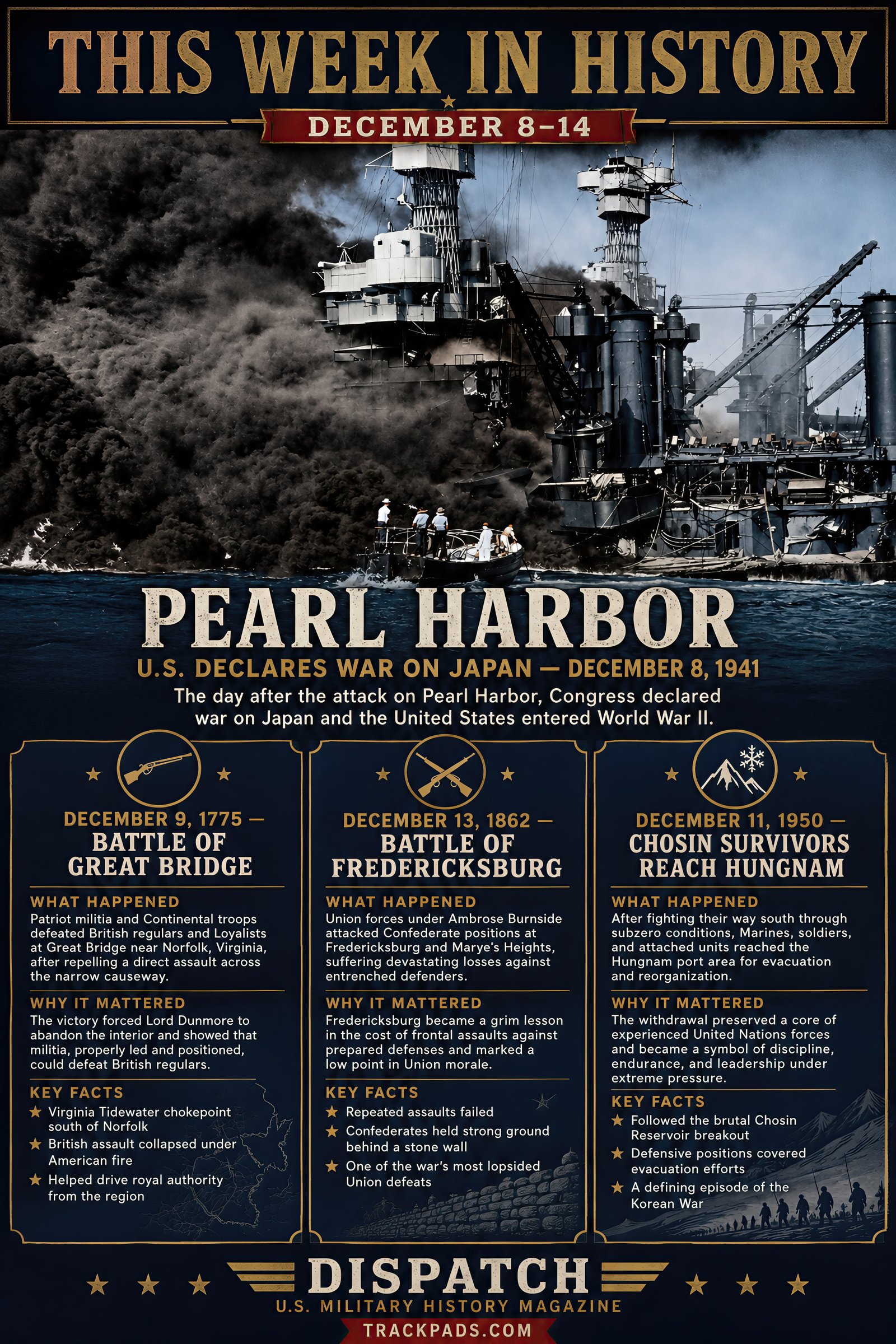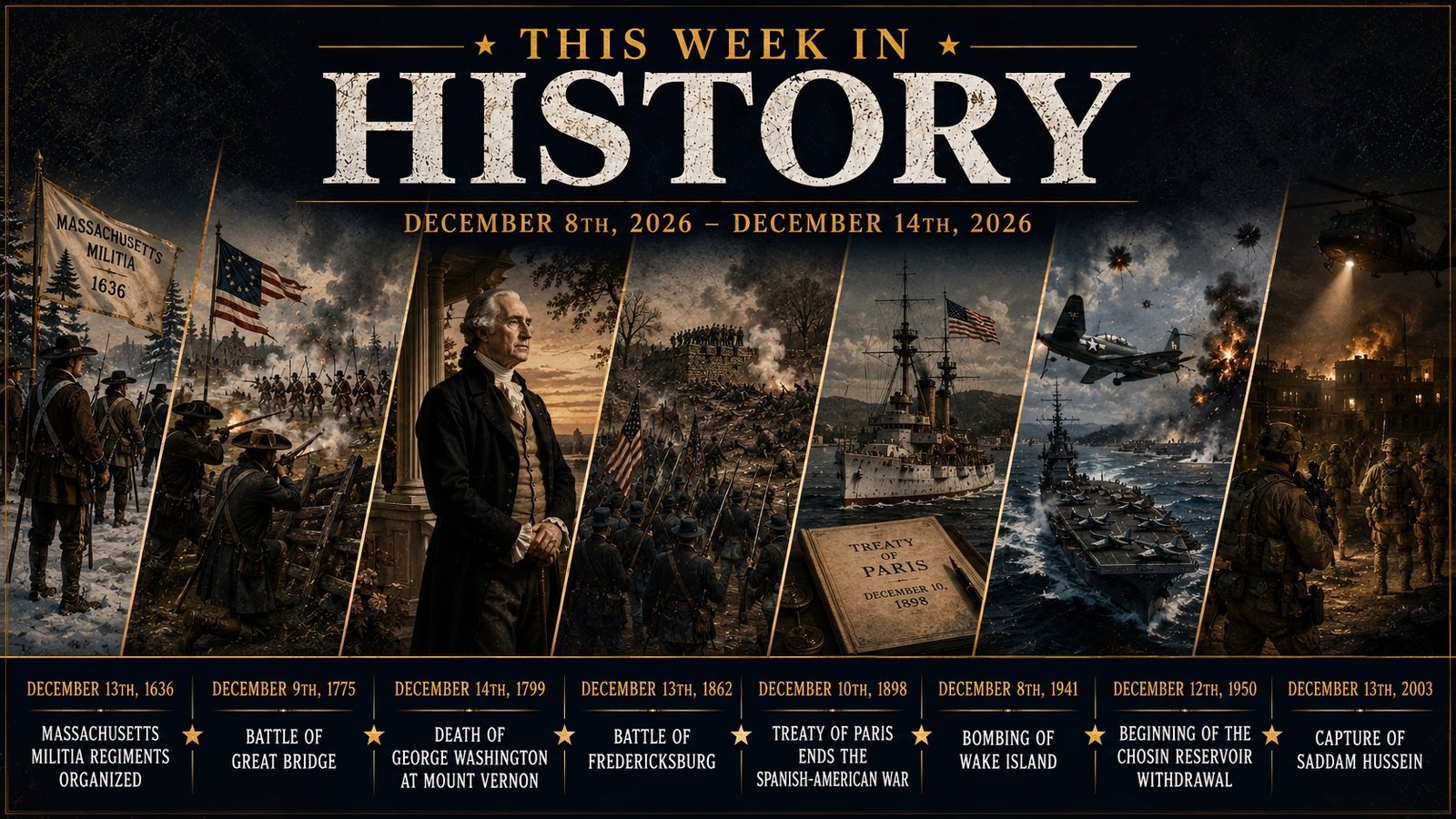
From December 8th, 2026 through December 14th, 2026, the calendar lines up with some of the most consequential moments in United States military history. Across these seven days we can trace a line from colonial militia musters and Revolutionary War skirmishes to Civil War bloodletting, imperial expansion, world war on multiple fronts, frozen withdrawal under fire in Korea, and the hunt for a modern dictator in Iraq. Each anniversary reminds us that strategy, politics, technology, and human character all meet at the sharp edge where soldiers, sailors, airmen, Marines, and guardians serve. In this edition of “This Week in U.S. Military History,” we move from small bridges and river crossings to global declarations of war and hard-fought withdrawals. Along the way, we see how decisions made in cramped council chambers, on the floor of Congress, and in field headquarters echo for generations in uniforms, traditions, and national memory.
Massachusetts militia regiments organized
In colonial New England, defense of scattered settlements depended on citizen-soldiers mustering with their neighbors rather than a standing army. On December 13th, 1636, the Massachusetts Bay Colony organized existing militia companies into three regional regiments, giving shape and structure to what had been a loose network of local bands. These regiments drilled periodically, elected some of their own officers, and stood ready to respond to Native resistance, foreign threats, or internal unrest. Over time, that date came to be honored as the “birthday” of the National Guard, a reminder that the citizen-soldier tradition runs deep in American life. Modern Guard units trace their lineage back through centuries of reorganizations and redesignations to formations like these. The story of December 13th, 1636 shows that from the beginning, American military power has depended on ordinary people willing to shoulder arms in defense of their communities.
Open the Wiki entryBattle of Great Bridge
Early in the Revolutionary War, control of the Tidewater region of Virginia hinged on a narrow causeway at Great Bridge, south of Norfolk. On December 9th, 1775, Patriot militia and Continental troops faced a column of British regulars and Loyalists sent out by the royal governor, Lord Dunmore, to break their growing siege lines. The American earthworks and sharpshooters made the most of the terrain, pouring disciplined fire into the advancing redcoats and cutting down officers at the head of the attack. Within a short time, the British assault collapsed and their force fell back in disorder toward Norfolk. The victory at Great Bridge forced Dunmore to abandon the interior and pushed royal authority back to the waterfront, where it would soon be burned out altogether. For American forces, this little-known clash proved that hastily raised militia, properly led and positioned, could beat British regulars in open fighting.
Open the Wiki entryDeath of George Washington at Mount Vernon
On December 14th, 1799, George Washington died at his home at Mount Vernon, closing the life of the commander who had led the Continental Army and then served as the first president. For officers and enlisted veterans of the Revolutionary generation, his passing felt like the loss of a living symbol of their shared struggle and sacrifice. Washington had resigned his military commission at the end of the war rather than hold onto power, reinforcing the ideal of civilian control over the armed forces that remains central to American life. In the years after his death, United States Army and militia units marched in memorial ceremonies, named posts and ships in his honor, and used his image to teach new soldiers about duty and restraint. The way the nation mourned him helped fix an enduring model of what military leadership should look like in a republic.
Open the Wiki entryBattle of Fredericksburg
On December 13th, 1862, the Army of the Potomac under Major General Ambrose Burnside hurled wave after wave of Union soldiers against Confederate positions at Fredericksburg, Virginia. After days of delay bringing pontoon bridges forward, Federal engineers finally laid crossings over the Rappahannock River while skirmishers and artillery fought from house to house. Once across, Union brigades advanced through town and up toward Marye’s Heights, only to find Robert E. Lee’s men strongly entrenched behind a stone wall and on the high ground above. The result was slaughter, as repeated frontal assaults struggled across open fields swept by canister and rifle fire, piling bodies in front of the Confederate line. By nightfall, the Union army had gained almost nothing in terrain while suffering heavy casualties that stunned the Northern public. Fredericksburg became a grim lesson in the cost of attacking prepared defenses and marked a low point in Union morale and confidence in its leadership.
Open the Wiki entryTreaty of Paris ends the Spanish-American War
The short but far-reaching Spanish-American War formally ended on December 10th, 1898, when representatives of Spain and the United States signed the Treaty of Paris. That agreement confirmed American victories in Cuba and the Caribbean, and transferred Puerto Rico, Guam, and the Philippines into United States hands. For the Army and Navy, the treaty meant a sudden shift from expeditionary campaigns to the challenges of garrisoning and governing far-flung islands. It also sparked intense debate at home over whether a republic founded on anti-imperial ideals should hold colonies at all. In the Philippines, the treaty set the stage for a bitter insurgency as Filipino fighters who had resisted Spanish rule now faced American occupation. Strategically, the new territories gave the United States coaling stations, bases, and responsibilities across two oceans, reshaping war plans, shipbuilding, and the careers of generations of officers.
Open the Wiki entryUnited States declares war on Japan
The day after Japanese aircraft and submarines attacked Pearl Harbor and other Pacific outposts, President Franklin Roosevelt addressed Congress in a joint session that would be remembered for its “day of infamy” language. On December 8th, 1941, legislators voted overwhelmingly to declare that a state of war existed between the United States and Japan. Even as Roosevelt spoke in Washington, Japanese forces were attacking American positions in the Philippines, Guam, and Wake Island, while striking British and Dutch holdings across Southeast Asia. For the United States military, the declaration marked the start of a vast mobilization that would turn peacetime fleets and scattered garrisons into a global war machine. Conscription expanded, factories retooled, and officers wrestled with how to fight across the largest ocean on earth. December 8th crystallized public resolve and gave legal shape to a conflict that would define an entire generation of service.
Open the Wiki entryGermany and Italy declare war on the United States
Just three days after Pearl Harbor, Adolf Hitler and Benito Mussolini chose to broaden the conflict by declaring war on the United States on December 11th, 1941. American leaders had already been edging toward open conflict with Germany through convoy protection and Lend-Lease aid to Britain and the Soviet Union. Now, with declarations exchanged, the United States found itself fully committed to a two-ocean war against all three Axis powers. Strategists in Washington debated how to allocate ships, aircraft, and divisions between the Pacific and European theaters, ultimately embracing a “Germany first” approach while still fighting desperate holding actions against Japan. For sailors in the Atlantic, the new status meant an immediate escalation in the Battle of the Atlantic as German submarines hunted American shipping close to home waters. December 11th turned a Pacific emergency into a truly global war that would demand unprecedented coordination with allies.
Open the Wiki entryChosin Reservoir survivors reach Hungnam
In the winter of 1950, United Nations forces in northeast Korea found themselves enveloped by massive Chinese attacks around the Chosin Reservoir. Over nearly two weeks, the First Marine Division, soldiers from the Seventh Infantry Division, and attached units fought their way south through mountain passes in subzero cold, bringing out their wounded and as much equipment as possible. By December 11th, 1950, battered columns reached the port area around Hungnam, where engineers and port crews began organizing a major evacuation by sea. United States Navy and Merchant Marine ships crowded the harbor as combat troops took up defensive positions to cover the loading of men, vehicles, and Korean civilians. The withdrawal from Chosin and the subsequent Hungnam evacuation did not feel like victory, but they preserved a core of experienced forces that would continue to fight in Korea. The march to Hungnam became a symbol of discipline, endurance, and leadership under extreme pressure.
Open the Wiki entryCapture of Saddam Hussein near Tikrit
Nearly nine months after the opening invasion of Iraq, United States forces were still hunting for Saddam Hussein, whose regime had collapsed but whose presence loomed over the growing insurgency. On December 13th, 2003, soldiers from the Fourth Infantry Division and special operations units launched raids near the town of ad-Dawr, close to Saddam’s hometown of Tikrit, under the codename Operation Red Dawn. They found the former dictator hiding in a concealed underground shelter, the now-famous “spider hole,” along with weapons and cash. His capture removed a major political and symbolic figure from the battlefield and allowed coalition authorities to present a concrete sign of progress to Iraqis and the world. On the ground, however, insurgent attacks and sectarian violence would continue, reminding commanders that seizing a leader did not automatically end a complex conflict. December 13th stands as a case study in how tactical success interacts with wider strategic and political challenges.
Open the Wiki entryAcross the Week
Across these seven days on the calendar, the stories range from muddy causeways and riverbanks to frozen Korean mountain roads and hidden bunkers in Iraqi farm country. Each moment shows a different facet of American military service: citizen-soldiers standing ready in the colonies, volunteers and draftees charging entrenched heights, sailors and Marines holding distant islands, and modern troops carrying out precision raids in the dark. Together, they trace a long arc of adaptation as the United States moved from a small coastal republic to a global power wrestling with the burdens that status brings. Remembering these anniversaries invites us to think about the people behind the dates, from nameless privates in winter coats to presidents and generals weighing terrible decisions. It also connects the work of today’s service members to a deep tradition of duty, sacrifice, and reflection that stretches far beyond a single week.