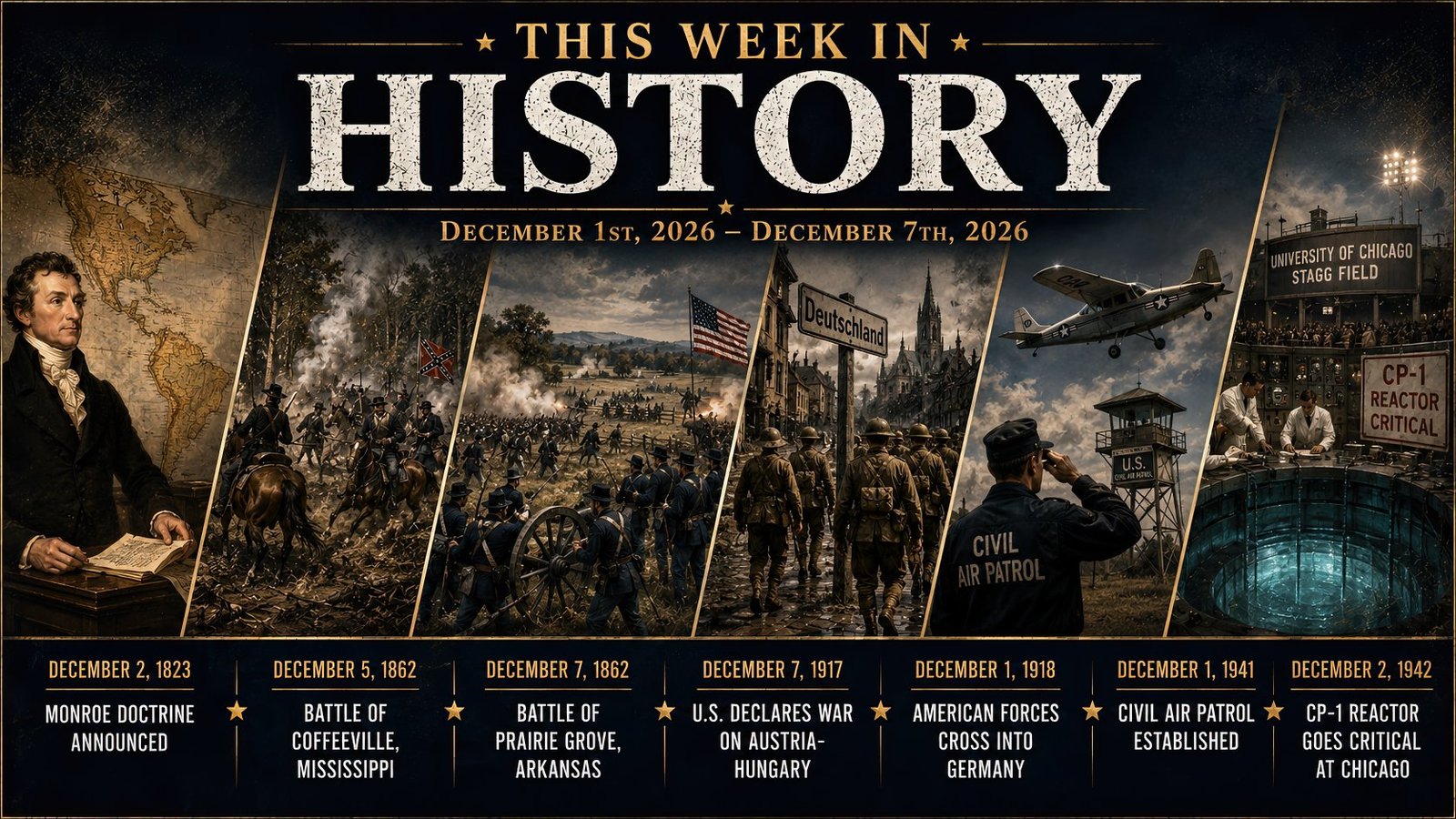
From December 1st, 2026 through December 7th, 2026, the calendar is thick with moments that reshaped the way the United States thinks about war, peace, and service. Some of these dates mark artillery duels on frozen hillsides, others carry the memory of surprise attacks or quiet diplomatic breakthroughs at sea. A few live in the home front’s memory instead, when a lottery number or a televised address pulled ordinary citizens closer to faraway conflicts. Across two centuries, these events stretch from the age of wooden sailing ships and European empires to nuclear reactors, global air power, and humanitarian interventions. Taken together, they show how decisions in Washington, battles in Arkansas and Korea, and experiments beneath a football stadium all flow into one story. This week’s edition walks that story day by day, following the men and women who stood on the front edge of those decisions.
Monroe Doctrine announced
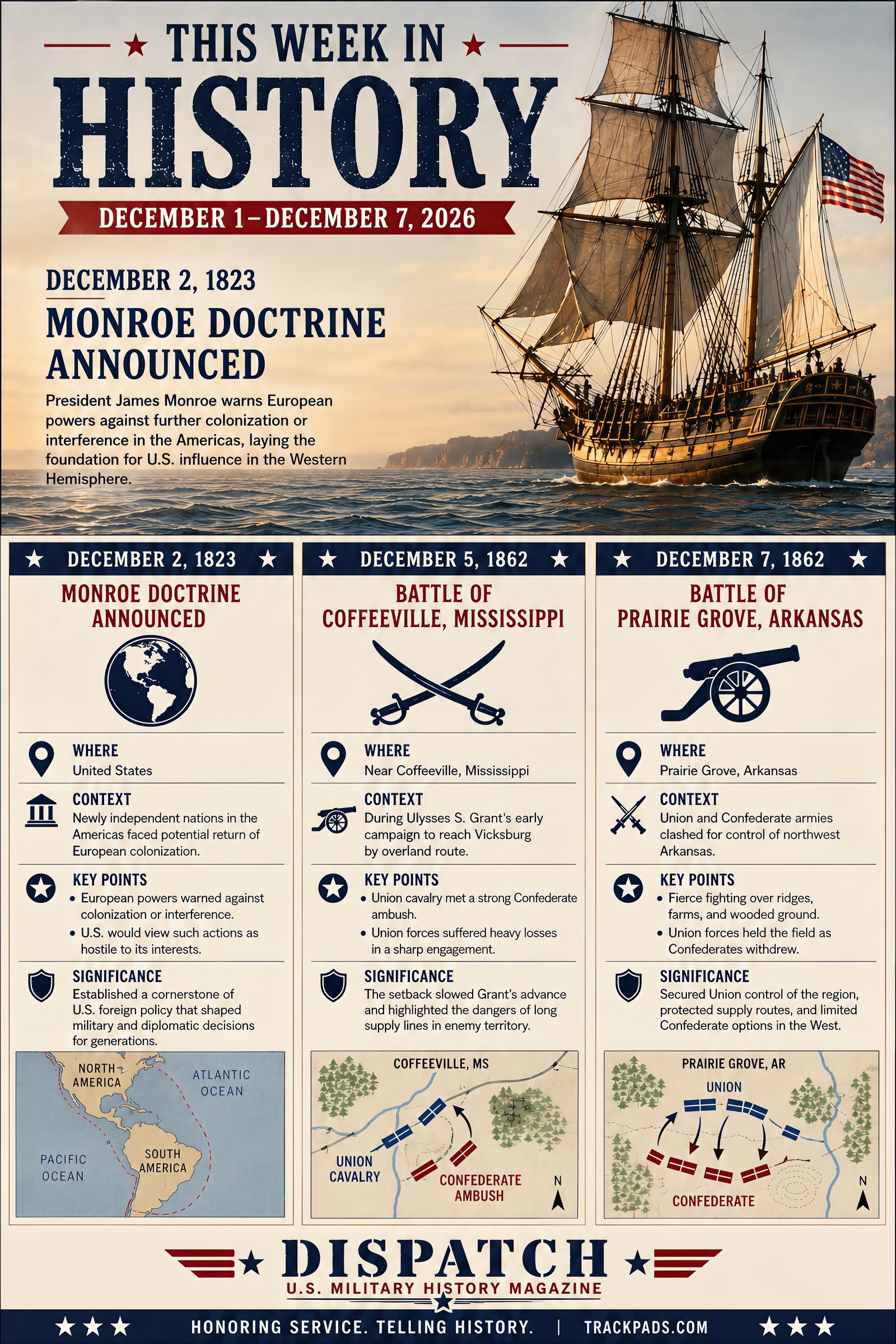
In his annual message to Congress on December 2nd, 1823, President James Monroe drew a bold line through the map of the Western Hemisphere. He declared that the era of European colonization in the Americas was over and warned that new attempts to dominate newly independent nations would be viewed as hostile to the United States. The statement did not immediately rest on a large standing army or a global fleet, but it laid down a principle that future generations of soldiers, sailors, and airmen would be asked to uphold. Over time, the Monroe Doctrine became a kind of strategic backdrop, shaping when and where American forces intervened or signaled resolve in the Caribbean and Latin America. For the modern reader, that December message shows how a few sentences of policy can echo for generations in deployment orders and contingency plans.
Open the Wiki entryBattle of Coffeeville, Mississippi
On December 5th, 1862, Union cavalry probing south in Mississippi ran into a determined Confederate ambush near Coffeeville during Ulysses S. Grant’s early attempt to reach Vicksburg by driving along the railroad. The skirmish was not massive by Civil War standards, but it struck the lead elements of Grant’s force hard and exposed how vulnerable long supply lines were in hostile territory. Confederate defenders used the wooded ground and prepared positions to bloody the advance before withdrawing, leaving Union commanders to reassess how fast they could push deeper into central Mississippi. In the short term, the setback contributed to the unraveling of this particular overland approach on Vicksburg. In the longer view, Coffeeville is a reminder that even small engagements can reroute entire campaigns and force generals to rethink how they protect the lifelines that feed their armies.
Open the Wiki entryBattle of Prairie Grove, Arkansas
Two days later on the calendar, December 7th, 1862, saw blue and gray forces collide in the hills near Prairie Grove, Arkansas. Union forces marching hard under commanders in the Trans-Mississippi met a Confederate army trying to reassert control over northwest Arkansas and threaten Missouri. The fighting unfolded across ridges, farms, and wooded ground, with artillery and infantry struggling for position as each side sought to turn the other’s flank. By day’s end the Union line held, and the Confederates withdrew, leaving the strategic initiative in Union hands west of the Mississippi River. The battle did not have the name recognition of Antietam or Gettysburg, but it helped secure a region, protected supply routes, and limited Confederate options for the rest of the war in that theater. Prairie Grove shows how regional victories, far from the Eastern headlines, still helped decide the conflict’s larger arc.
Open the Wiki entryUnited States declares war on Austria-Hungary
Fifty-five years later to the day, on December 7th, 1917, the United States again made a momentous move, this time with a declaration of war against Austria-Hungary. American troops were already training and sailing to fight Imperial Germany on the Western Front, but this declaration broadened Washington’s formal list of enemies in the First World War. It underscored that the conflict was not simply a grudge against one nation but a struggle against a wider alliance threatening European stability. For American soldiers and sailors, the practical effect lay in how resources and planning would be allocated, from shipping routes to intelligence priorities. In the long run, this decision helped cement the idea that when the United States went to war in Europe, it did so as part of a broader coalition effort, bearing responsibilities across multiple fronts and partners.
Open the Wiki entryAmerican forces cross into Germany
Less than a year later on the calendar, December 1st, 1918, American troops of the newly designated occupation forces began crossing into Germany itself. The guns on the Western Front had fallen silent only weeks earlier, and these soldiers now shifted from assaulting trenches to marching through towns as an occupying army. Their mission was to enforce the armistice terms, reassure allies, and signal to German leaders that the victors were present and watching the transition to peace. For the men on the ground, this meant learning a new balance between discipline and restraint, between deterrence and the need to avoid incidents in a defeated country. The occupation march into the Rhineland marked an early example of how the United States would use its military not only to win wars, but also to shape the fragile days that followed them.
Open the Wiki entryCivil Air Patrol established
On December 1st, 1941, just days before the attack on Pearl Harbor, the United States government formally created the Civil Air Patrol as a nationwide volunteer aviation organization. Civilian pilots, aircraft owners, and mechanics were brought together under a common structure to provide support to the Army Air Forces. In the months and years that followed, these volunteers flew coastal patrols looking for enemy submarines, ferried light cargo, and performed search-and-rescue missions. Their work freed up uniformed pilots and aircraft for combat deployment, and their low-flying patrols helped close gaps along vulnerable shorelines. The creation of the Civil Air Patrol illustrates how the United States mobilized not only regular forces but also civilian skill and initiative to meet the Second World War’s demands. It also left a permanent auxiliary that still links local communities to national defense.
Open the Wiki entryAttack on Pearl Harbor
The same week on the calendar, but in a different year, brought one of the most searing dates in United States military history: December 7th, 1941. That morning, Japanese carrier-based aircraft struck the Pacific Fleet at Pearl Harbor and airfields across Oahu, seeking to cripple American sea power in a single coordinated blow. Battleships were sunk or battered at their moorings, aircraft burned on the ground, and thousands of sailors, soldiers, and civilians were killed or wounded in a matter of hours. The shock of the attack ended any remaining debate about American involvement in the global war. Within days, the United States was formally at war with Japan, Germany, and Italy, and the armed forces began a rapid expansion that would carry soldiers, sailors, airmen, and Marines to every major theater. December 7th, 1941, remains a touchstone for discussions of readiness, surprise, and national resolve.
Open the Wiki entryFirst nuclear chain reaction at Chicago Pile-1
Exactly one year after Pearl Harbor’s date on the calendar, December 2nd, 1942, a small team of scientists and technicians gathered under a stadium in Chicago carried out an experiment that would change warfare forever. Working in a makeshift laboratory beneath the stands of an athletic field, they assembled and controlled the first self-sustaining nuclear chain reaction in a graphite-and-uranium device known as Chicago Pile-1. Although the people in that room were not wearing uniforms, their work was part of the closely guarded Manhattan Project, a wartime effort directed toward building an atomic bomb. The successful experiment proved that controlled fission was possible on a scale that could be harnessed for weapons. In the years that followed, nuclear arms reshaped military planning, deterrence strategies, and the very idea of what a “great power” war would mean. That quiet December milestone marks the hinge between conventional industrial war and the nuclear age.
Open the Wiki entryBattle of Ormoc Bay, Philippines
On December 7th, 1944, as Americans marked the third anniversary of Pearl Harbor, United States forces fought a different battle tied to that first “day of infamy.” Off the Philippine island of Leyte, United States Navy destroyers, escorts, and aircraft struck Japanese convoys trying to reinforce and resupply troops through Ormoc Bay. The clash blended surface gunnery, torpedoes, and air attack as American commanders sought to choke off the enemy’s last substantial attempts to hold the island. Sinking transports and escorts in these waters helped ensure that Japanese units ashore would be isolated, hastening the collapse of resistance on Leyte. The battle showed how, three years into the Pacific war, the United States had learned to combine sea control, air superiority, and intelligence to strangle an opponent’s logistics. Ormoc Bay is thus a reminder that victory often depends as much on cutting supply lines as on winning dramatic shoreline landings.
Open the Wiki entryFlight 19 disappears over the Atlantic
The Second World War was over by December 5th, 1945, but military aviation remained a dangerous profession even in training. That day, a formation of five Navy torpedo bombers, collectively remembered as Flight 19, departed a Florida air station on a routine navigation exercise over the Atlantic. Over the next hours, radio traffic suggested growing confusion about position, fuel state, and course as weather and human error combined. The aircraft never returned, and a search aircraft sent out to look for them was also lost. The disappearance became the subject of later legend, but for naval aviators it underscored familiar lessons: the unforgiving nature of overwater flying, the need for clear procedures and navigation aids, and the reality that peacetime training could still cost lives. Flight 19’s story is often told alongside combat tales to remind us that not all sacrifice happens under fire.
Open the Wiki entryBreakout battles around Hagaru-ri, Chosin
On December 1st, 1950, in the mountains of North Korea near the Chosin Reservoir, United States Marines and attached soldiers were fighting a different kind of battle for survival. Surrounded by large Chinese forces, they held a defensive perimeter around the crucial airstrip and supply hub at Hagaru-ri as they prepared a breakout to the south. Temperatures plunged well below freezing, weapons and vehicles struggled in the cold, and wounded men depended on air evacuation from a precarious strip under fire. The actions around Hagaru-ri that week were not an orderly retreat but a fighting withdrawal that inflicted heavy casualties on pursuing units while preserving a hard-core force. The Chosin campaign has since become a touchstone in Marine Corps history for resilience under extreme conditions, demonstrating how discipline, leadership, and combined arms can extract a surrounded force from a trap.
Open the Wiki entryFirst Vietnam-era draft lottery held
Back in the United States on December 1st, 1969, millions of young Americans gathered around televisions and radios to watch a different kind of drawing. For the first time since the Second World War, the government used a national lottery system to determine the order in which draft-age men would be called for potential military service, primarily in support of the Vietnam War effort. Capsules with birth dates were pulled from a container and read aloud, turning abstract policy into personal stakes for families across the country. For the armed forces, the lottery system aimed to make the obligation of service appear more transparent and evenly distributed. The event also deepened public debates about fairness, duty, and the human cost of distant conflicts. December 1st, 1969, is remembered as a night when military manpower policy touched nearly every living room in America.
Open the Wiki entryMalta Summit between Bush and Gorbachev
On December 2nd, 1989, President George H. W. Bush met Soviet leader Mikhail Gorbachev off the island of Malta in stormy winter seas. The summit came just weeks after the Berlin Wall began to fall and symbolized a dramatic easing of tensions in the long Cold War that had shaped American defense planning since the late 1940s. While no single treaty ended that confrontation, the conversations at Malta allowed both leaders to speak openly about reducing the risk of conflict and reorienting their militaries toward new realities. For the United States armed forces, the approaching end of the Cold War would mean shifting from preparing for a massive armored clash in Europe to facing regional crises and emerging threats elsewhere. The Malta meetings, launched on a December weekend aboard warships, sit at the border between two strategic eras.
Open the Wiki entryUnited States announces deployment to Somalia
Finally, on December 4th, 1992, President Bush addressed the nation to announce that American troops would deploy to Somalia as part of a multinational effort to secure humanitarian relief operations. Images of famine and civil war had shocked audiences, and previous relief efforts without armed protection had struggled. The decision to send Marines, soldiers, sailors, and airmen to open ports, secure supply routes, and protect aid convoys showed how military power could be directed toward stabilizing failed states and supporting international relief. For the units involved, this meant preparing for a mission where the immediate objective was not defeating an enemy army but creating enough security for food and medicine to reach civilians. That December announcement marked the beginning of Operation Restore Hope and foreshadowed future debates over the role of American forces in complex peace operations.
Open the Wiki entryAcross the Week
Across these seven days on the calendar, the United States military story runs from doctrine penned in an age of sailing ships to Marines stepping ashore for humanitarian missions and diplomats steering away from nuclear confrontation. Some of the dates mark clear-cut battles or surprise attacks, others highlight experiments, policy choices, and domestic decisions that quietly reshaped who serves and how the nation fights. Together they show a force that must adapt continually: to mountain cold, to new technologies, to popular expectations at home, and to shifting global responsibilities. Remembering these episodes side by side helps us see continuity beneath the change, from soldiers on Arkansas ridges to pilots patrolling coastal skies and sailors escorting relief ships. It also invites us to consider how today’s choices will appear on someone else’s “week in history” in years to come.