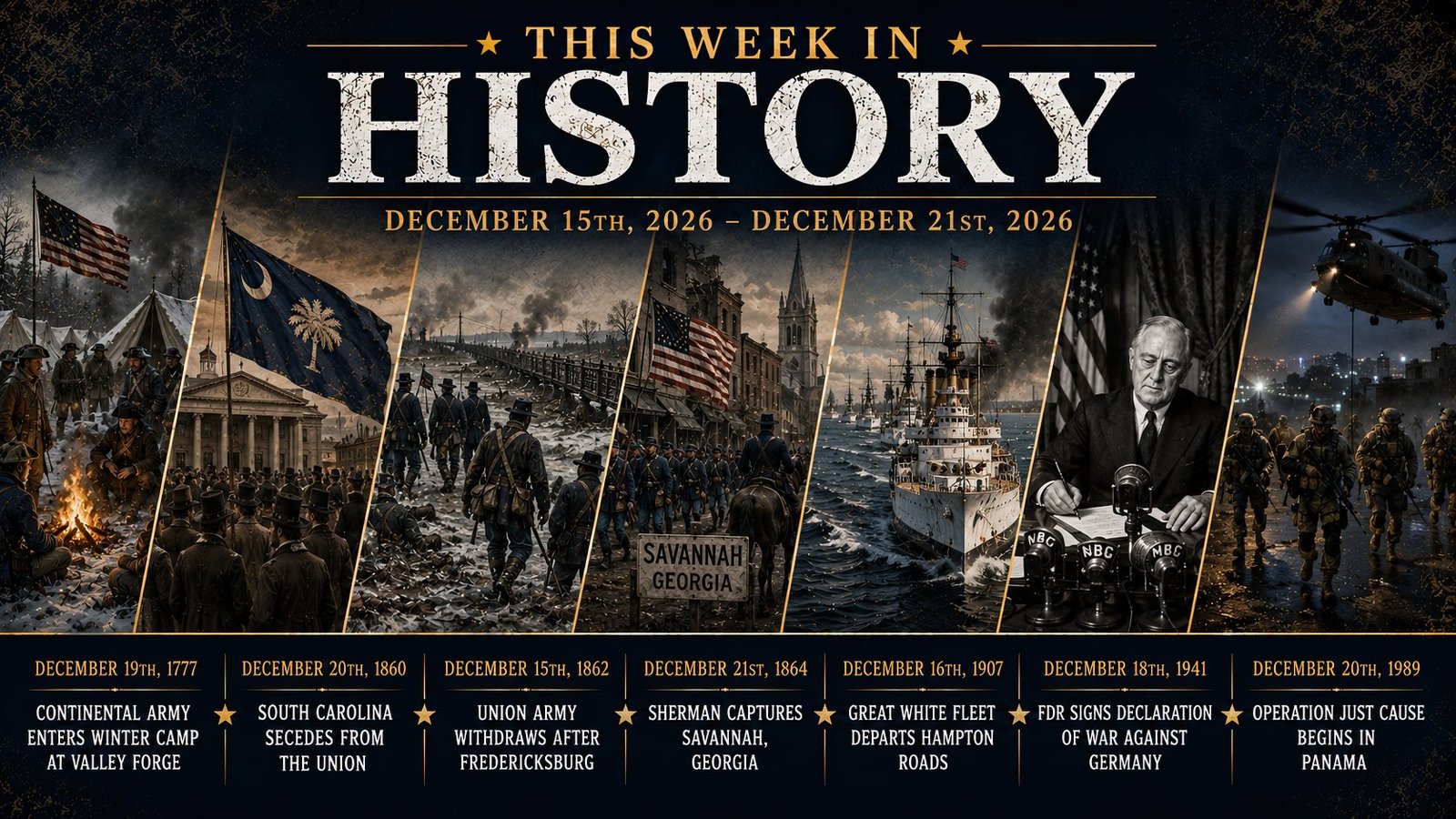
From December 15th, 2026 through December 21st, 2026, the calendar lines up with some of the most consequential weeks in United States military history. Across these days, soldiers shivered into winter quarters at Valley Forge, states walked out of the Union, and armies marched through Southern cities whose fall signaled the collapse of a rebellion. In later wars, American fleets steamed over the horizon to announce new naval power, while presidents reached for emergency authorities to fight on a global scale. These same dates also carry the weight of bitter winter battles in the Ardennes, air campaigns over Southeast Asia, and sudden night drops into Panama. Taken together, they show how decisions made in cold headquarters, on crowded decks, and in dimly lit cockpits can redirect entire wars. This week’s Dispatch: U.S. Military History Magazine walks through that arc, from early struggle to modern joint operations.
Continental Army enters winter camp at Valley Forge
On this day the Continental Army trudged into winter quarters at Valley Forge, west of Philadelphia, after a bruising campaign season. The location was close enough to shadow British forces in the city but far enough to avoid sudden attack, placing the army between the enemy and the interior of Pennsylvania. Conditions in camp quickly turned harsh, with shortages of food, clothing, and shelter exposing deep weaknesses in the young republic’s supply system. Over the winter, drilling and instruction, later associated with European officers who joined the cause, helped standardize training and discipline. The experience forged a more unified Continental Army capable of maneuvering and fighting as a national force rather than a loose collection of state contingents. In American memory, Valley Forge became a symbol of endurance and the willingness of soldiers and their families to sustain the revolutionary experiment through hardship.
Open the Wiki entrySouth Carolina secedes from the Union
When delegates in South Carolina voted on December 20th, 1860 to leave the Union, they set in motion a crisis that would soon reshape the United States military. The decision followed the election of Abraham Lincoln and reflected deep disputes over slavery, federal authority, and the balance of power between states and the national government. In practical terms, secession raised immediate questions about federal forts, arsenals, and custom houses scattered across the South. United States Army officers faced painful choices as some resigned to join their home states while others stayed under national colors. The struggle over installations such as Fort Sumter in Charleston Harbor foreshadowed the shooting war that would follow. For the armed forces, this political act marked the beginning of a period in which loyalty, command structure, and even the map of the country would be contested by force.
Open the Wiki entryUnion Army withdraws after Fredericksburg
By December 15th, 1862, the Army of the Potomac was pulling back across the Rappahannock River after the bloody defeat at Fredericksburg. In the preceding days, Union troops had fought their way into the town, then launched frontal assaults against Confederate positions on the heights behind it. Well-entrenched defenders, protected by stone walls and rising ground, inflicted devastating casualties on attacking brigades. The withdrawal underlined how costly it could be when command decisions underestimated prepared defensive positions in the age of rifled muskets and artillery. For Northern soldiers and civilians, Fredericksburg became a symbol of sacrifice apparently wasted by poor planning and rigid tactics. The defeat contributed to growing doubts about leadership at the top of the army, even as individual acts of courage on the field added new stories to the Civil War’s long roll of battlefield heroism.
Open the Wiki entrySherman captures Savannah, Georgia
On December 21st, 1864, Union forces under Major General William Tecumseh Sherman entered Savannah at the end of the famous March to the Sea. After leaving Atlanta in November, Sherman’s columns had cut a wide swath through Georgia, destroying railroads, factories, and other assets that fed the Confederate war effort. The fall of Savannah delivered a valuable port and logistics hub on the Atlantic, along with large quantities of captured supplies. Sherman's campaign demonstrated a strategy aimed not only at enemy armies but also at the economic and psychological foundations of resistance. The capture of Savannah signaled to the Confederacy and to observers abroad that Southern capacity to sustain the war was eroding. In a widely remembered message to President Lincoln, Sherman presented the city as a kind of holiday gift, underscoring how military success and national morale were intertwined during this phase of the conflict.
Open the Wiki entryGreat White Fleet departs Hampton Roads
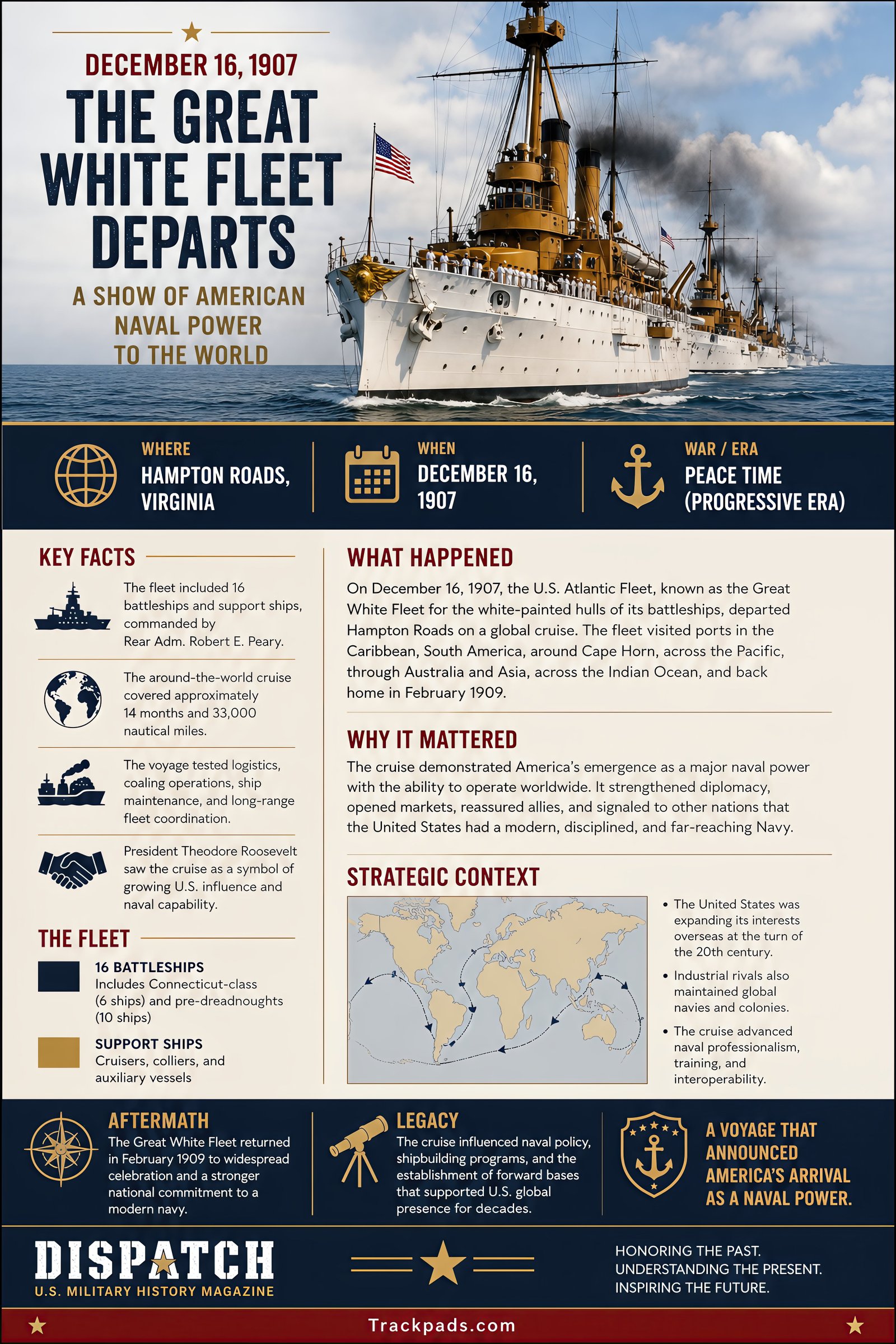
On December 16th, 1907, a column of gleaming white-painted American battleships steamed out of Hampton Roads to begin a world cruise that would last more than a year. Known as the Great White Fleet, the formation represented the growing reach of United States sea power in the early twentieth century. The voyage tested the Navy’s ability to sustain operations far from home ports through coaling, maintenance, and coordination with distant stations. It also served as a visible message to other world powers that the United States intended to play a major role in global maritime affairs. For sailors and officers, the cruise provided invaluable experience in navigation, gunnery, and fleet maneuvering on the open ocean. The lessons learned influenced ship design, base construction, and training programs, helping prepare the Navy for the demands of the coming world wars.
Open the Wiki entryFirst War Powers Act signed
Less than two weeks after the attack on Pearl Harbor, on December 18th, 1941, the First War Powers Act dramatically expanded the president’s authority to direct the national war effort. The legislation allowed broad reorganization of executive agencies involved in defense, procurement, and information control, making it easier to shift resources rapidly toward military needs. For the Army, Navy, and Marine Corps, this meant faster decisions on equipment, industrial contracts, and personnel policies, though it also placed tremendous responsibility in a smaller number of hands. The act reflected an understanding that fighting a global conflict would require unprecedented coordination between the armed forces, industry, and civilian agencies. It also set precedents for later debates about emergency powers and civil liberties in wartime. In practical terms, the law helped create the administrative framework that would support massive mobilization, from shipyards and airfields to training camps across the country.
Open the Wiki entryGerman Ardennes offensive begins
On December 16th, 1944, German forces launched a surprise offensive through the forests of the Ardennes, striking thinly held American lines in Belgium and Luxembourg. The attack aimed to split Allied armies, capture key road hubs, and force negotiations by driving toward the port of Antwerp. Heavy fog and winter weather limited Allied air support, while inexperienced or exhausted American units bore the first blows. Initial German advances created a deep “bulge” in the front, overrunning some positions and capturing prisoners under harsh conditions. Yet scattered American resistance at crossroads and villages, along with rapid staff work at higher headquarters, slowed the momentum. The resulting Battle of the Bulge became the largest and costliest ground battle fought by United States forces in Europe, testing the resilience of infantry divisions, armored units, and logistics networks operating in brutal winter terrain.
Open the Wiki entryEisenhower approves Patton’s turn toward Bastogne
On December 19th, 1944, senior Allied commanders met to assess the Ardennes crisis, and General Dwight D. Eisenhower approved George Patton’s proposal to pivot his Third Army north. This decision unlocked one of the most dramatic operational maneuvers of the European campaign. Patton’s staff had already sketched contingency plans, allowing units that had been attacking east to swing toward the besieged road hub of Bastogne in a remarkably short time. Inside the town, airborne and armored troops dug in against surrounding German forces, relying on a shrinking ring of defenses and limited supplies. The promise of relief from the south strengthened their resolve to hold through snow, artillery fire, and direct assaults. By authorizing the turn, Eisenhower accepted short-term risks on other fronts to stabilize the most dangerous penetration. The movement showcased how flexible planning, disciplined logistics, and determined field units could blunt a surprise offensive.
Open the Wiki entryDeath of General George S. Patton
On December 21st, 1945, General George S. Patton died in Germany from injuries suffered in a car accident, months after the guns in Europe had fallen silent. Patton had become one of the most recognizable American commanders of the war, associated with aggressive armored operations from North Africa to Sicily and across France. His leadership style combined hard driving demands on subordinates with a deep interest in history, doctrine, and the mechanics of mobile warfare. Controversies over his public statements and treatment of soldiers meant that opinions about him were sharply divided, even among fellow officers. His death ensured that his battlefield reputation would not be reshaped by later peacetime assignments or political roles. Over time, Patton’s campaigns and speeches became touchstones in discussions of initiative, discipline, and the human cost of high-tempo offensive operations in modern war.
Open the Wiki entryOperation Linebacker II begins over North Vietnam
On December 18th, 1972, United States bombers and supporting aircraft began a concentrated air offensive often known as the “Christmas bombing” of North Vietnam. The operation followed a breakdown in peace negotiations and was designed to pressure the other side back to the table by striking targets in and around Hanoi and Haiphong. Crews flying large, heavily loaded aircraft faced dense anti-aircraft fire, surface-to-air missiles, and the psychological strain of repeated night missions over defended cities. Losses in the early days of the campaign prompted adjustments in tactics, routing, and escort arrangements. For many airmen, Linebacker II represented one of the most intense periods of flying in the entire conflict. The campaign remains a subject of debate regarding its necessity and effectiveness, but it clearly signaled that American airpower could still be brought to bear at scale even as ground combat was winding down.
Open the Wiki entryOperation Just Cause begins in Panama
In the early hours of December 20th, 1989, American forces launched Operation Just Cause, a large joint operation to remove Panamanian leader Manuel Noriega and secure key sites. Airborne troops conducted night drops onto airfields, while Rangers, Marines, and Army units targeted command centers, barracks, and infrastructure. Special operations forces played important roles in seizing critical nodes and protecting American citizens. The operation unfolded in dense urban and jungle terrain, raising challenges in identifying threats and limiting harm to noncombatants. Within days, organized resistance collapsed, and Noriega took refuge before eventually surrendering. For the United States military, Just Cause showcased precision night operations, rapid joint deployment, and the growing prominence of special operations capabilities. It also foreshadowed discussions about post-conflict responsibilities and the long-term implications of regime-change missions in the post-Cold War era.
Open the Wiki entryOperation Desert Fox strikes Iraq
On December 16th, 1998, American and British forces began a four-day air and missile campaign against Iraqi targets known as Operation Desert Fox. The strikes followed disputes over weapons inspections and were intended to degrade programs linked to prohibited weapons and to punish noncompliance. Aircraft flying from carriers and regional bases, along with cruise missiles launched from ships and submarines, hit command facilities, air defense sites, and other selected objectives. The operation demonstrated the ability to project power quickly without deploying large ground formations, relying instead on precision munitions and detailed target planning. For pilots, sailors, and planners, Desert Fox was part of a pattern of periodic enforcement actions designed to contain a hostile regime between larger wars. The campaign raised continuing questions about the limits of airpower alone and about how best to measure success when objectives focus on capability denial and signaling rather than territorial gains.
Open the Wiki entryAcross the Week
Across these seven days on the calendar, the thread that runs from Valley Forge to Desert Fox is one of adaptation under pressure. Commanders and civilian leaders repeatedly confronted new problems, whether they involved feeding a barefoot army, responding to secession, or managing the risks of air campaigns in crowded skies. Soldiers, sailors, aircrews, and Marines carried out decisions whose full implications they could not always see, but their actions shifted the course of wars and the shape of the armed forces that followed. The events of this week reveal how American military power has moved from muskets and winter cabins to global fleets and precision strike systems while still depending on human judgment and resilience. As readers look back across these anniversaries, they can also consider the service members deployed today, inheriting both the tools and the burdens forged in earlier Decembers.