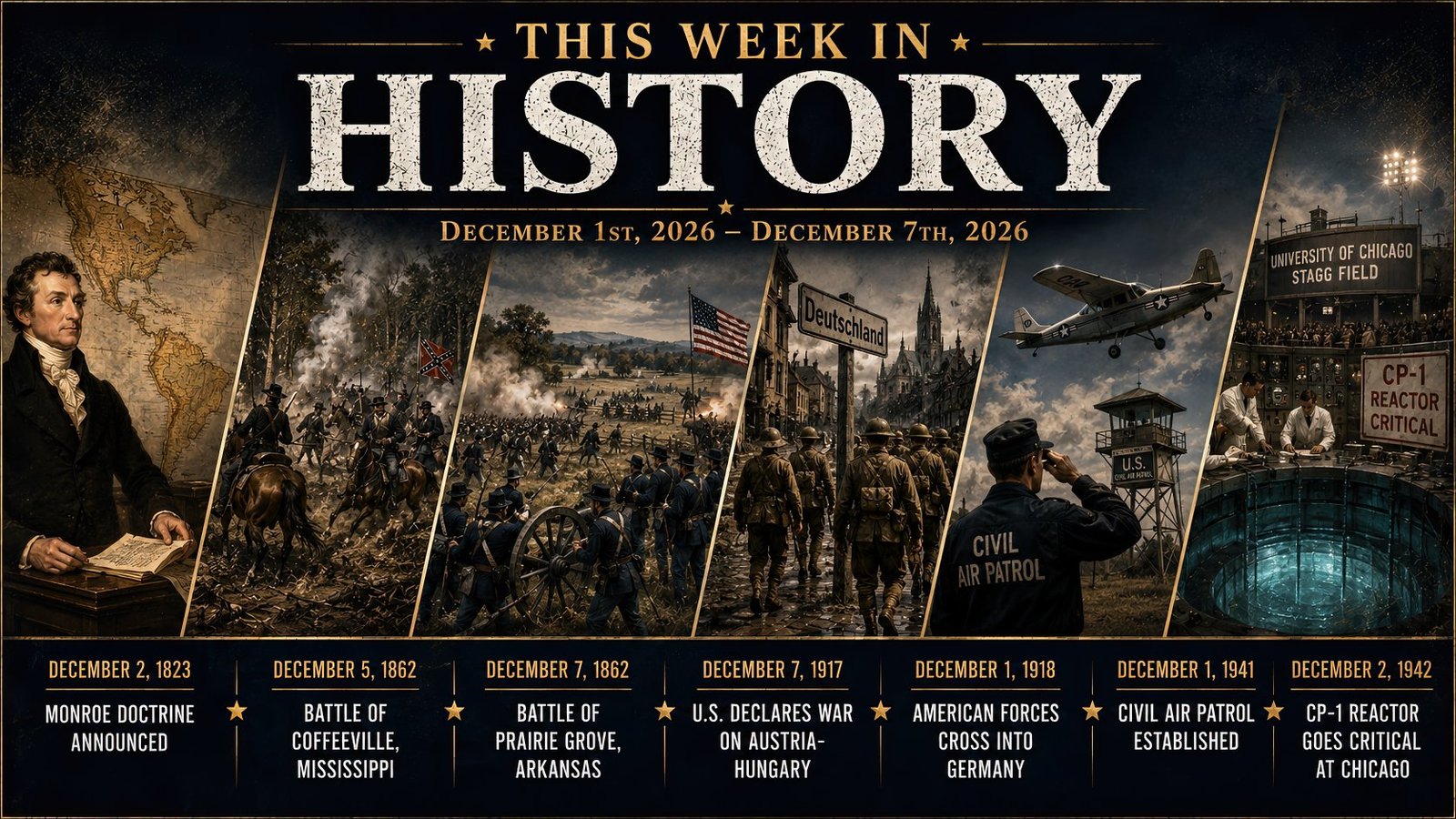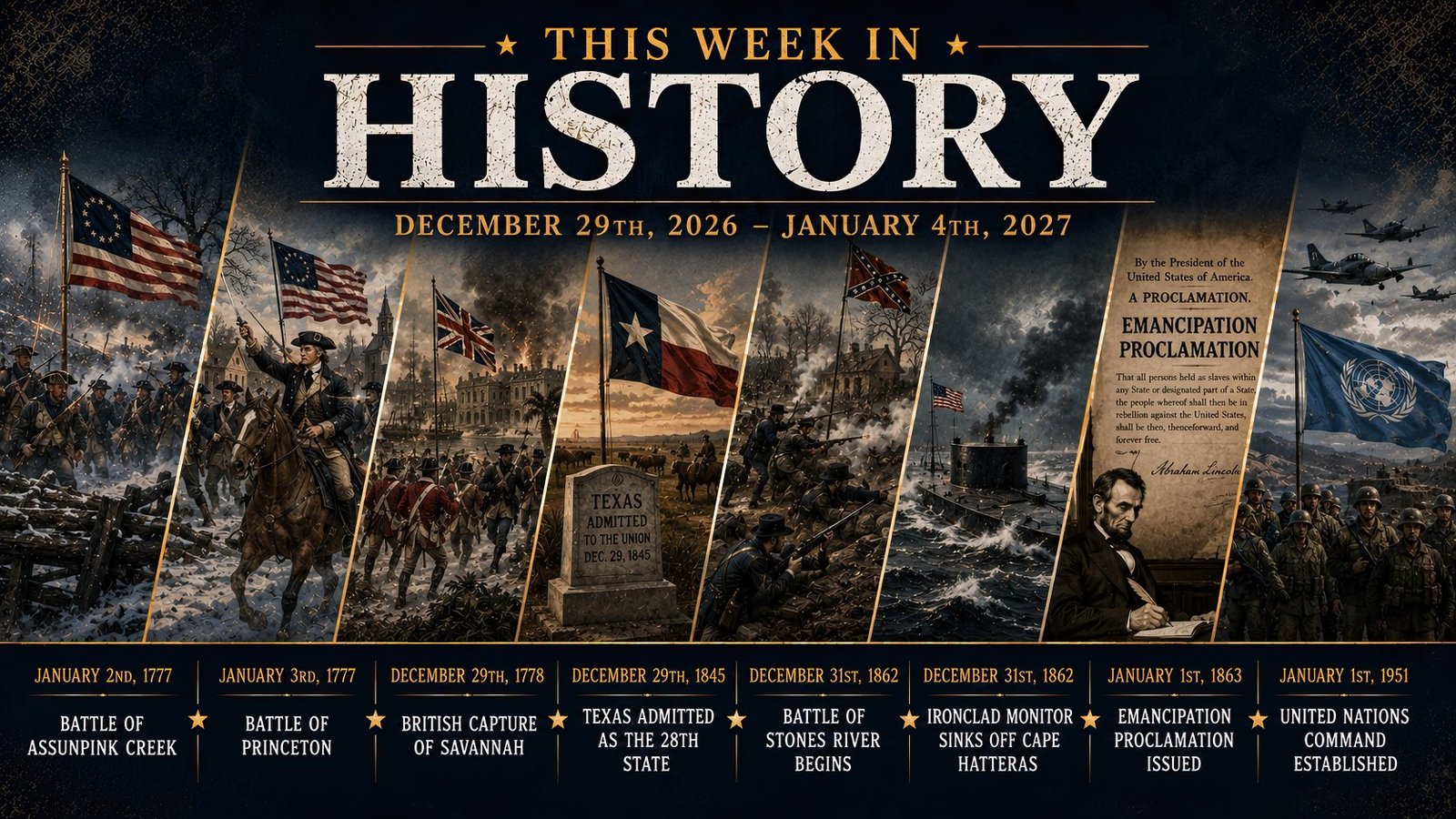
This Week in History · December 29, 2026
489 Populated Entries
Conflicts and historical periods that shaped military institutions and warfare.
Wars & Historical Eras
Every result opens a permanent subject record with its reference context and connected Dispatch coverage. Filter by record type, editorial collection, or a word in the entry.
489 entries found.
Just one day after creating a Continental Army, Congress turned to the problem of who should lead it and selected George Washington of Virginia as commander in chief. Washington had experience from the French and Indian War, a reputation for personal courage, and the political advantage of coming from a southern colony at a moment when most fighting was in New England. His appointment helped weld together regional interests by placing a Virginian at the head of largely New England troops.
After nearly two years of brutal fighting up the Italian peninsula, German Army Group C formally laid down its arms to the Allied command on May 2nd, 1945. United States Fifth Army and its partners had slogged through mountains, rivers, and heavily fortified defensive lines, from Salerno and Anzio to the Gothic Line in the north.
When German forces crossed into Poland on this date, they triggered a European war that would ultimately reshape American security policy.
Four months after the smoke cleared from the fields around Gettysburg, the small Pennsylvania town hosted a ceremony to dedicate a national cemetery for Union dead.
A year later to the day, July 1st, 1863, the opening clash at Gettysburg began almost by chance as Confederate troops moving into Pennsylvania met Union cavalry west of town. Brigadier General John Buford’s troopers used dismounted tactics and carbines to delay the advance, buying time for Union infantry of the First Corps to arrive. As more Confederate divisions came onto the field from the north and west, fighting surged along ridges, farms, and the town’s outskirts.
On July 2nd, 1863, both armies were now largely concentrated, and the second day at Gettysburg turned into a brutal struggle for the flanks of the Union position. Confederates under James Longstreet pushed against the Union left, targeting places that would become famous: Devil’s Den, the Wheatfield, the Peach Orchard, and Little Round Top. Union units shifted under intense pressure, some arriving just in time to plug gaps and counterattack up rocky slopes.
The climactic third day, July 3rd, 1863, is best remembered for the Confederate infantry assault later called Pickett’s Charge. After an intense artillery bombardment meant to weaken Union positions on Cemetery Ridge, several Confederate divisions stepped off from the tree line on Seminary Ridge and marched across open fields under heavy fire. Union cannon and rifles tore into their ranks, yet the attackers closed to the stone wall in places, fighting hand to hand before being driven back.
In the early years of the Cold War’s nuclear standoff, Strategic Air Command kept bombers airborne or on quick alert around the clock. On January 24th, 1961, a B-52 carrying two powerful thermonuclear bombs broke apart in the skies near Goldsboro, North Carolina, after suffering structural failure. The weapons fell to earth, and one descended with its parachute deploying, while the other plunged into soft ground.
Four days after Fort Stedman, the initiative swung decisively to the Union side. On March 29th, 1865, General Ulysses S. Grant launched a wide-ranging offensive west of Petersburg, sending Union corps toward key roads and crossroads along the Confederate right flank. Battles at places like Lewis’s Farm, White Oak Road, and Dinwiddie Court House unfolded over the next days as Union troops pressed around the end of Lee’s line.
Two years later, another turning point arrived when Ulysses S. Grant began work in his new role as general-in-chief of all Union armies. Having made his reputation at places like Fort Donelson, Vicksburg, and Chattanooga, Grant now carried the rank of lieutenant general, a grade not held since George Washington. From this position he could coordinate the Army of the Potomac in Virginia with campaigns in the West, aiming to pressure Confederate forces on every front at once.
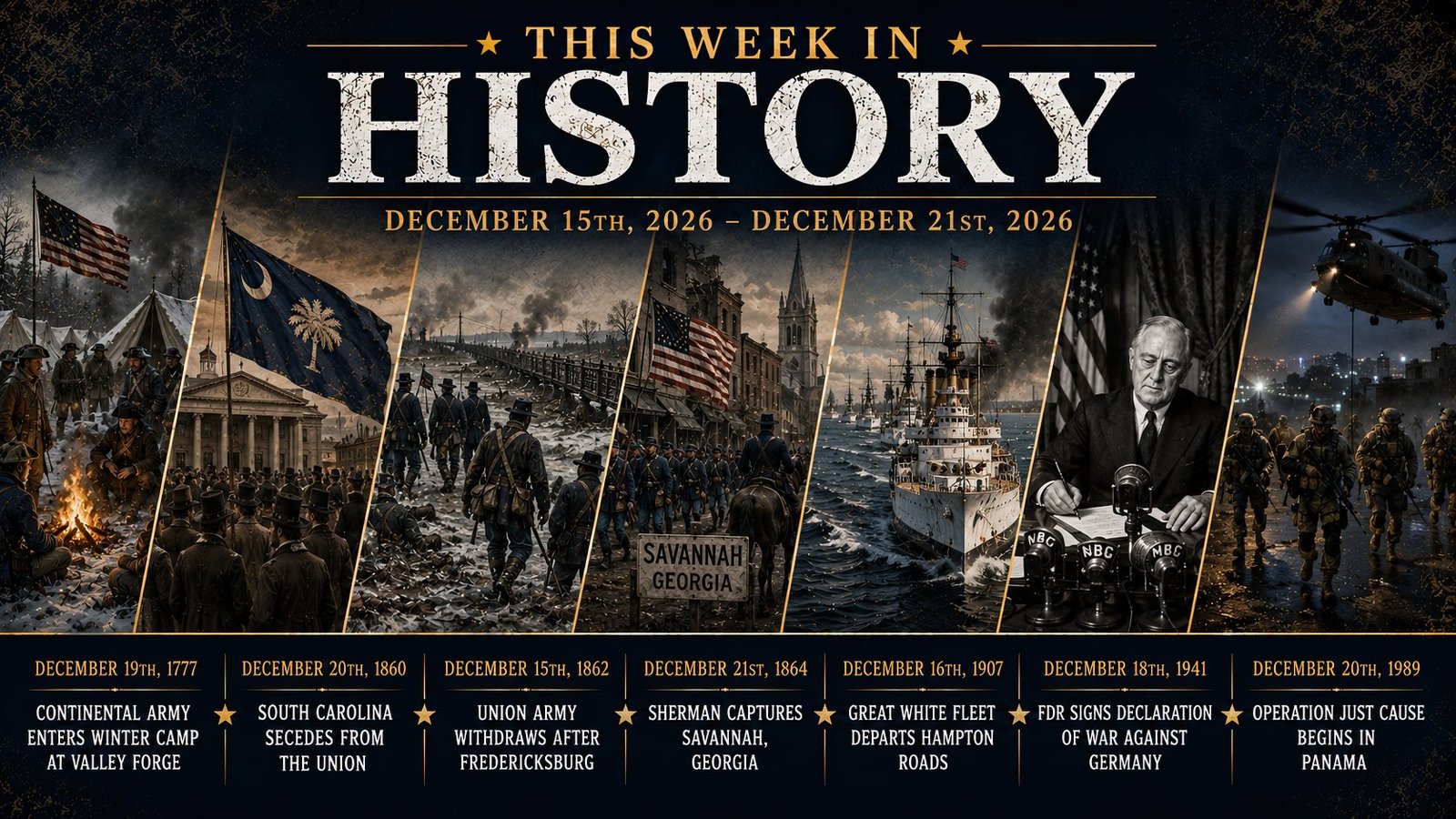
On December 16th, 1907, a column of gleaming white-painted American battleships steamed out of Hampton Roads to begin a world cruise that would last more than a year.
On the far side of the Pacific, another struggle over sea lanes and airfields was drawing to a close. By February 9th, 1943, American commanders were confident enough to declare the island of Guadalcanal secure after months of brutal fighting against Japanese forces. What began in August 1942 as a risky landing to seize an unfinished enemy airstrip had turned into a grinding campaign by land, sea, and air, where both sides committed ships, aircraft, and infantry in repeated offensives and…
On August 10th, 1944, American commanders declared Guam secured after nearly three weeks of brutal fighting that began with landings in late July. The island, seized by Japan shortly after the attack on Pearl Harbor, lay in a position that made it a natural forward base for the United States in the central Pacific.
A story of murky signals, political urgency, and how a confusing night on the water widened a war.
On August 7th, 1964, the United States Congress passed what became known as the Gulf of Tonkin Resolution, a short but far-reaching measure tied to contested events earlier that week. American destroyers operating off the coast of North Vietnam had reported an attack on August 2nd and a second, disputed encounter on August 4th, prompting the Johnson administration to order retaliatory air strikes, known as Operation Pierce Arrow, on August 5th.
On May 10th, 1969, paratroopers of the 101st Airborne Division began a series of assaults against a steep, jungle-covered height in the A Shau Valley that would become known as Hamburger Hill. The Vietnamese Army defenders were dug into bunkers and trenches woven into the slopes, forcing American units to climb under fire again and again through mud, foliage, and concealed obstacles.
The fuel gauges in Harold Bauer’s Wildcat fighter were already edging toward empty when the coastline of Guadalcanal slid beneath his wings. He had just finished leading a long, tense, overwater flight of Marine fighters up from Espiritu Santo, six hundred miles of nothing but ocean and cloud. Henderson Field, the hard-bitten airstrip the Marines called home, lay ahead as a thin strip of coral and mud, promising rest, repairs, and—most of all—gasoline.
After years as a United States territory and a key overseas outpost, Hawaii formally entered the Union as the fiftieth state on August 21st, 1959. Long before that date, the islands had already become central to American strategy in the Pacific, from the attack on Pearl Harbor to the vast network of airfields and naval bases that supported World War II operations.
At the turn of the twentieth century, American leaders viewed an isthmian canal as essential to both commerce and naval strategy.
The black volcanic sand of Iwo Jima offered no cover, only shallow shell holes and the hulks of stalled tanks. Late on February 23, 1945, Marines of the 21st Regiment lay pinned down, staring across a short stretch of open ground that felt a mile wide. Ahead of them, a maze of reinforced concrete pillboxes spat machine-gun fire in crossing patterns, every burst chewing fresh craters into the sand.
A story of a retreat turned into a deadly gauntlet, and how air power reshaped the end of the Gulf War.
Two years later, the Central Highlands again saw fierce engagements as American commanders tried to disrupt enemy concentrations near the Cambodian and Laotian borders.
On January 31st, 1865, as Union armies pressed the Confederacy on multiple fronts, the United States House of Representatives finally passed the Thirteenth Amendment to the Constitution. The Senate had approved it the previous year, but the House vote had stalled until battlefield victories and political pressure shifted the margin.
On the night of February 17th, 1864, off Charleston, South Carolina, the Confederate submarine H. L. Hunley moved slowly toward the Union sloop of war USS Housatonic. The Hunley was a dangerous experiment: a hand-cranked, cigar-shaped boat with a spar torpedo mounted on its bow. Its crew had already died in earlier test accidents, but on this sortie the submarine reached its target, detonated its explosive charge, and sent Housatonic to the bottom in minutes.
Related Dispatch
These current Dispatch articles connect directly to records in the Wars & Historical Eras directory.