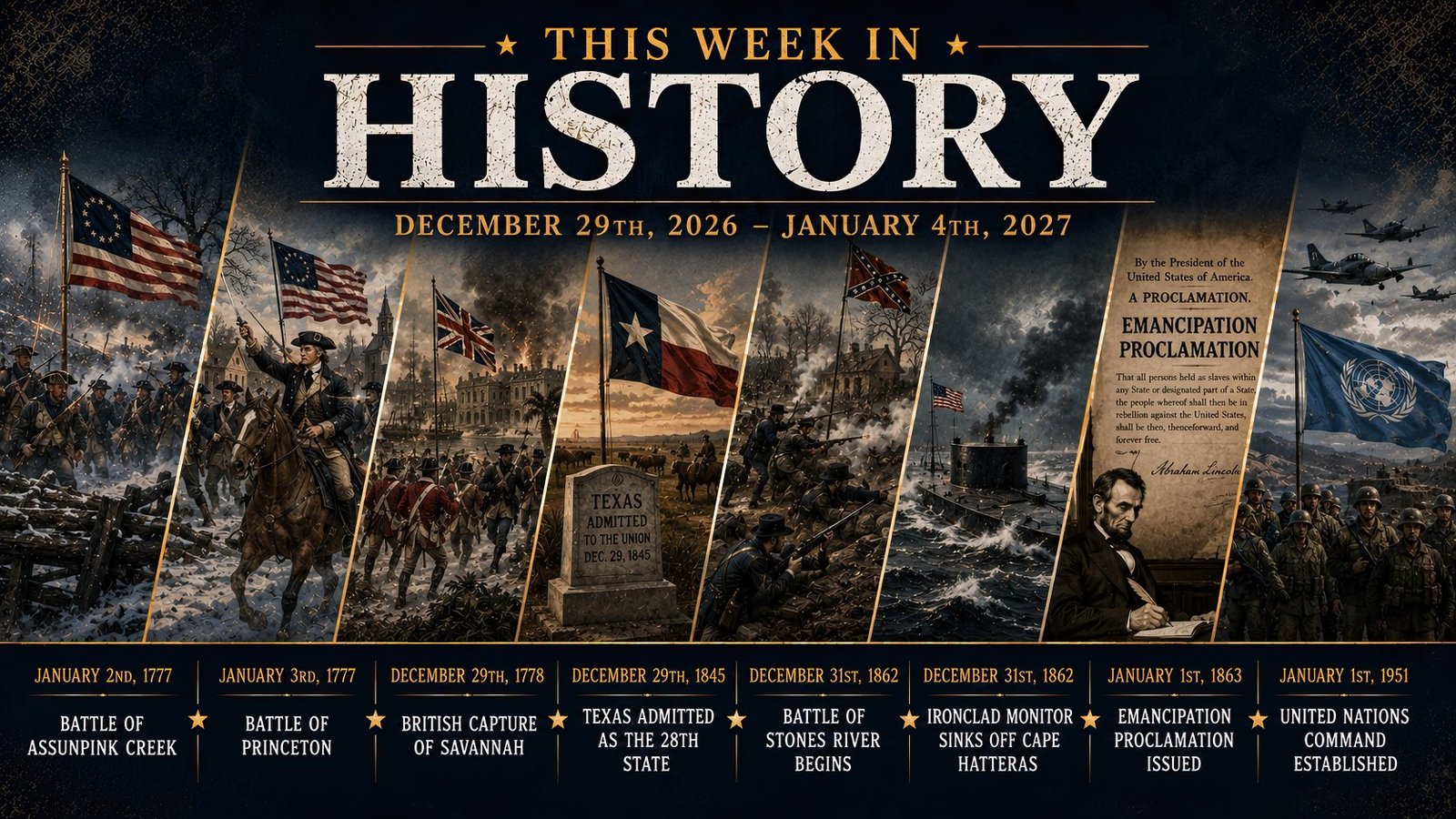
From December 29th, 2026 through January 4th, 2027, the calendar links moments of crisis, adaptation, and transformation across United States military history. In this Tuesday edition of “This Week in U.S. Military History” from Dispatch: U.S. Military History Magazine, we follow Continental soldiers on frozen New Jersey roads, ironclad sailors battling storms, and aircrews flying against dense defenses over Hanoi. Along the way, we see how law and policy, from Texas statehood to the Emancipation Proclamation, reshaped the nation’s armed forces and the wars they fought. The week also highlights the painful closing chapter of the Indian Wars at Wounded Knee and the birth of the Allied coalition under the banner of the “United Nations.” Taken together, these episodes trace how geography, technology, and ideas repeatedly pushed the United States to redefine who served, why they fought, and how far the nation would go to defend its interests and its principles.
Battle of Assunpink Creek
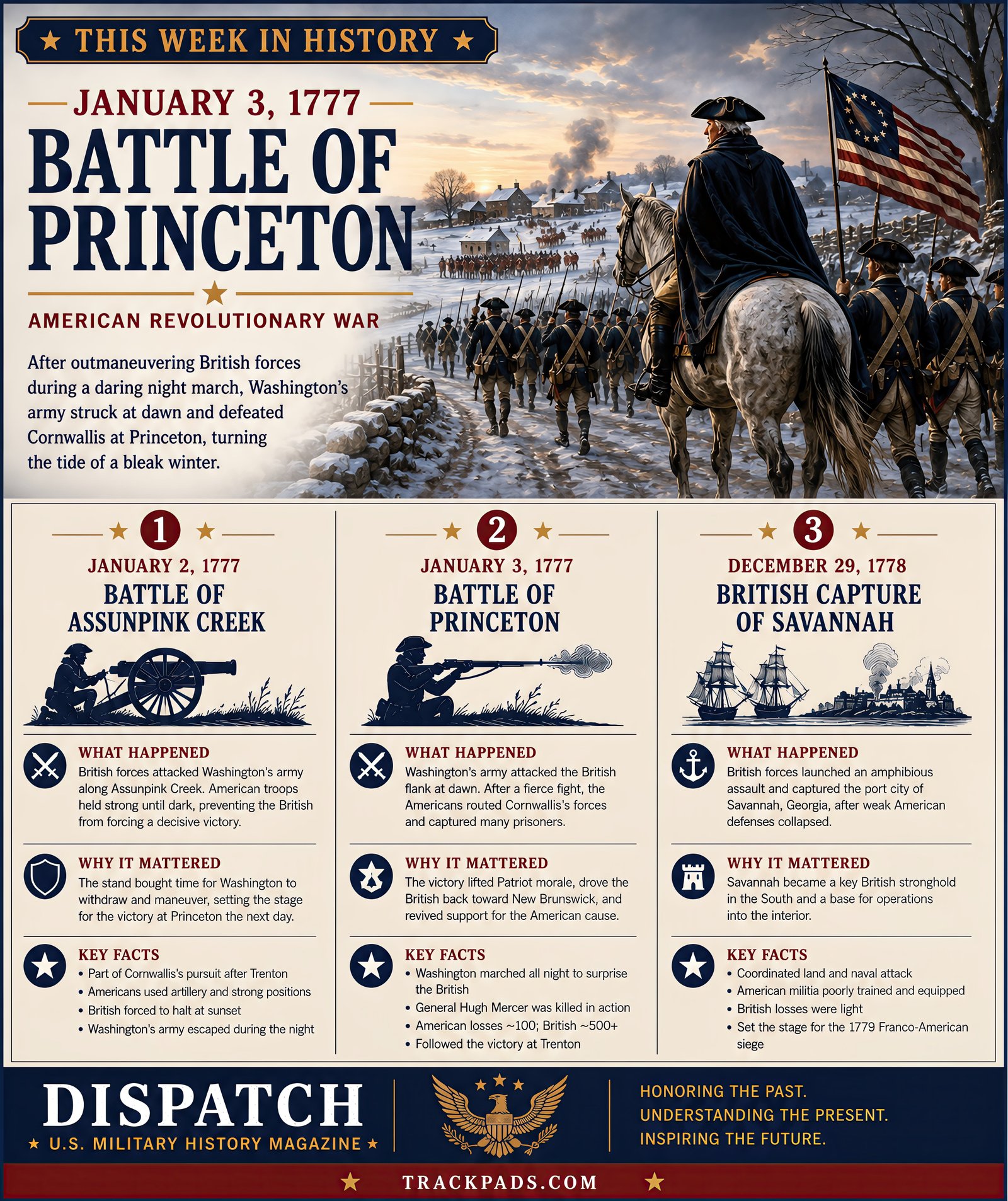
In the winter following the disastrous losses around New York, George Washington’s army clung to survival around Trenton. On January 2nd, 1777, British forces under Charles Cornwallis advanced to drive the Continentals into the Delaware River, attacking along the frozen banks of Assunpink Creek. American artillery and infantry, dug in behind the creek and makeshift defenses, repulsed repeated assaults as dusk fell. Washington’s line held, denying the British the decisive blow they sought and showing that his soldiers could stand against veteran regulars when properly positioned. That night, under cover of the standoff, the Continental army slipped away around the British flank, setting the stage for the surprise at Princeton and turning Assunpink Creek into a hard-fought prelude to a larger victory.
Open the Wiki entryBattle of Princeton
The very next morning, January 3rd, 1777, Washington’s army appeared on the British flank near Princeton, New Jersey, in a bold march that outmaneuvered Cornwallis. A sharp engagement unfolded as British regulars tried to block the road and protect their garrison, and early in the fighting General Hugh Mercer’s brigade was driven back in confusion. Washington personally rode forward to steady the line, famously exposing himself to enemy fire as he rallied the Continentals for a counterattack. American troops pushed the British from the field and took prisoners, turning what had seemed like a winter of defeat into a string of victories. The Battle of Princeton, coupled with the earlier victory at Trenton, helped drive British forces back toward New Brunswick, boosted Patriot morale, and persuaded many fence-sitters that the Continental cause remained viable.
Open the Wiki entryBritish capture of Savannah
On December 29th, 1778, British forces returned in strength to Georgia, targeting the port city of Savannah as the opening move in a renewed Southern strategy. A well-coordinated amphibious landing allowed British regulars and their allies to outmaneuver American defenders, many of whom were militia with limited training and unreliable equipment. The defenses around Savannah collapsed quickly under the combined pressure, and the city fell into British hands with comparatively light losses for the attackers. Savannah became a crucial Loyalist stronghold and base for operations into the interior, altering the balance of power in the Southern colonies. For the Patriot side, the loss underscored the challenges of defending long coastlines and managing internal divisions, and it set the stage for the costly and unsuccessful Franco-American siege of Savannah the following year.
Open the Wiki entryTexas admitted as twenty-eighth state
When Texas formally entered the Union on December 29th, 1845, a long-simmering question about the republic on the southwestern frontier finally came to a head. The annexation brought a vast, sparsely settled territory into the United States, along with unresolved border claims that Mexico still disputed. United States forces would soon be ordered into the contested region between the Nueces River and the Rio Grande, a deployment that helped trigger the Mexican-American War. That conflict not only redrew the map of North America but also served as a proving ground for a generation of officers who would later command armies on both sides of the Civil War. Texas statehood, therefore, was not merely a political milestone; it was a strategic shift that extended supply lines, opened new posts and forts, and drew the Army into a continental struggle with lasting consequences.
Open the Wiki entryBattle of Stones River begins
As the year 1862 closed, Union fortunes looked dim after setbacks in Virginia, but in central Tennessee a different story was beginning. On December 31st, 1862, the Battle of Stones River opened near Murfreesboro as Confederate forces under Braxton Bragg launched a massive dawn attack against the Army of the Cumberland led by William Rosecrans. The Confederate assault smashed into the Union right, rolling up brigades and driving soldiers back through fields and cedar thickets in chaotic, close-quarters fighting. Yet the Union line refused to break completely, anchoring itself along strong positions near the Nashville Pike and vital supply routes. Over several days of brutal combat, both sides suffered staggering casualties, but Bragg ultimately withdrew, leaving the Union in control of Middle Tennessee. Stones River became one of the war’s bloodiest battles by percentage of forces engaged and offered the North a badly needed strategic and psychological boost after a grim winter.
Open the Wiki entryIronclad Monitor sinks off Cape Hatteras
While soldiers bled at Stones River, sailors on the pioneering ironclad Monitor fought the sea itself. On the night of December 31st, 1862, the low-freeboard warship was under tow off Cape Hatteras, moving from Hampton Roads toward new duty along the southern coast. Heavy seas pounded the vessel, overwhelming her pumps and flooding compartments through vents and hatches that had never been designed for such conditions. As water rose and the ship wallowed, crewmen clung to lines in the darkness while rescue boats from the towing ship Rhode Island tried to pull them aboard. The Monitor went down with a portion of her crew, a stark reminder that technological breakthroughs often carry hidden vulnerabilities. Her earlier duel with CSS Virginia had announced the arrival of ironclads, but her loss at sea drove home lessons about seaworthiness, ventilation, and damage control that would shape future naval design.
Open the Wiki entryEmancipation Proclamation takes effect
On January 1st, 1863, Abraham Lincoln’s Emancipation Proclamation officially took effect, transforming the nature of the Civil War. Building on a preliminary announcement issued after the Union victory at Antietam, the proclamation declared enslaved people in areas still in rebellion to be free, while leaving slavery untouched in loyal border states and regions already under firm Union control. Its immediate practical impact varied from place to place, depending on the presence of Union troops, but its military implications were stark. The Union now openly invited Black men to enlist, and over time nearly two hundred thousand would serve in United States Colored Troops and in the Navy. Internationally, the proclamation made it far harder for European powers to justify supporting the Confederacy, since the conflict had been explicitly tied to slavery. For soldiers in the field, the war’s stakes now clearly included the destruction of an institution that had long shaped American society and its armies.
Open the Wiki entryWounded Knee Massacre
On December 29th, 1890, troops of the 7th Cavalry surrounded a band of Miniconjou Lakota near Wounded Knee Creek in South Dakota, seeking to disarm them amid fears surrounding the Ghost Dance movement. What began as a tense standoff spiraled into chaos when a shot rang out and soldiers opened fire at close range. Machine guns and rifles tore through the camp, killing not only warriors but large numbers of women and children who were trying to flee. By the time the guns fell silent, hundreds of Lakota lay dead or dying, and dozens of soldiers were also killed or wounded, some by their own side’s fire. Official accounts long framed the event as a battle, and many Medals of Honor were awarded, but later generations came to view Wounded Knee as a massacre and a symbol of the violent closing of the American frontier.
Open the Wiki entry“Arsenal of Democracy” fireside chat
As war raged in Europe and Asia, President Franklin Roosevelt took to the radio on December 29th, 1940, to explain why events overseas mattered deeply to American security. In this “Arsenal of Democracy” fireside chat, he argued that Nazi expansion threatened not only distant lands but also the safety and freedom of the Western Hemisphere. Roosevelt promised that the United States would become the great supplier of weapons, aircraft, and ships to those fighting the Axis, even as the nation formally remained outside the war. The speech laid crucial political groundwork for measures such as Lend-Lease, which would funnel vast amounts of material aid to Britain, China, and later the Soviet Union. It also signaled to industry and labor that a massive defense buildup was not only necessary but urgent. For the armed forces, the address foreshadowed a rapid expansion in personnel, training, and equipment that would soon transform the peacetime military into a global warfighting institution.
Open the Wiki entryDeclaration by United Nations signed
On January 1st, 1942, representatives of the United States, Britain, the Soviet Union, China, and many other Allied nations signed a joint pledge in Washington, known as the Declaration by United Nations. Building on the principles laid out in the earlier Atlantic Charter, the signatories vowed to pool their resources against the Axis and to forgo separate peaces that might fracture the coalition. For American commanders, this agreement reaffirmed that the war would be fought as part of a broad partnership, not as a series of isolated national campaigns. The declaration also gave a formal name—“United Nations”—to the alliance that would later evolve into the postwar international organization bearing the same title. Operationally, it helped underpin combined planning structures and joint commands that coordinated everything from convoy escorts to major theaters of operations. The document thus tied diplomatic commitments directly to the practical work of waging global war.
Open the Wiki entryManila falls to Japanese forces
The momentum of Japan’s early offensives reached the Philippine capital on January 2nd, 1942, when Japanese troops entered Manila. United States and Filipino forces under Douglas MacArthur had declared the city an open city in an attempt to spare civilians and historic structures, withdrawing most of their combat units toward the Bataan Peninsula and the island fortress of Corregidor. Japanese occupation of Manila nonetheless marked a crushing psychological blow, underscoring how unprepared Allied defenses had been for the speed and coordination of the enemy advance. For soldiers and sailors retreating to Bataan, the fall of the capital meant weeks of hard fighting and privation still lay ahead, with dwindling supplies and little hope of immediate relief. Back home, Americans read headlines announcing the loss of Manila as a stark contrast to the optimism that had followed the declaration of war, reinforcing the sense that the early phase of the Pacific War would be a struggle for survival.
Open the Wiki entryTruman proclaims end of hostilities
More than a year after victory in Europe and the Pacific, President Harry Truman issued a proclamation on December 31st, 1946, formally declaring the end of hostilities in the Second World War for the United States. This legal step did not erase the scars of conflict or instantly demobilize every unit, but it did close the book on wartime emergency powers and special measures that had shaped American life since 1941. The proclamation cleared the way for adjustments in military law, veterans’ benefits, and occupation policies, while also signaling that the nation was shifting from global war to a new era of tension with the Soviet Union. For service members still stationed in Europe, Asia, and at bases around the world, the declaration underscored that their roles were changing from frontline combatants to occupiers, advisors, and deterrent forces. In Washington, planners were already wrestling with how large a peacetime military the United States should maintain in this emerging Cold War environment.
Open the Wiki entryAlaska becomes forty-ninth state
When Alaska entered the Union as the forty-ninth state on January 3rd, 1959, it brought with it a vast expanse of territory that had already played an important strategic role in the Second World War. During the Aleutian campaign and the long air routes to the Soviet Far East, the region had proven its value as a northern staging ground and early-warning barrier. Statehood solidified the United States presence along thousands of miles of Arctic and sub-Arctic coastline, giving the armed forces more secure access to airfields, ports, and training ranges in a region that would matter greatly in any confrontation with the Soviet Union. Radar networks and air defense sites across Alaska formed a key part of the early-warning system against potential bomber attacks over the pole. The new state thus represented not just a political milestone but an enduring shift in the geography of American defense planning.
Open the Wiki entryLinebacker II bombing halted
On December 29th, 1972, the United States halted the intense B-52 and tactical bomber campaign known as Linebacker II against targets around Hanoi and Haiphong in North Vietnam. For nearly two weeks, American aircrews had flown through heavy anti-aircraft fire and surface-to-air missiles in a concentrated effort to pressure North Vietnamese leaders back to the negotiating table. The raids inflicted significant damage but also resulted in notable aircraft losses and stirred controversy at home and abroad. When the bombing paused, it did so against the backdrop of renewed talks in Paris, where both sides edged toward the agreement that would be signed the following month. Linebacker II remains one of the most debated air operations of the Vietnam War, cited both as an example of strategic bombing’s potential leverage and as a reminder of its limits and human costs. The decision to stop the campaign on December 29th marked a turning point on the road to a negotiated American withdrawal.
Open the Wiki entryAcross the Week
Across this week on the calendar, United States military history moves from fragile winter encampments in New Jersey to distant Pacific islands, from ironclad decks awash in seawater to bombers streaking through flak-lit skies over Hanoi. The events touch on expansion and conquest, as in Texas statehood and the opening of Alaska, but also on deep moral questions raised by the Emancipation Proclamation and the tragedy at Wounded Knee. Speeches and signatures—the “Arsenal of Democracy” address, the Declaration by United Nations, and the formal end of hostilities—remind us that wars are shaped as much by political commitments as by firefights. Each moment also highlights individuals making hard decisions in uncertain times, whether Washington gambling on another night march or aircrews braving dense defenses in the last days of a long war. As we look back from December 29th, 2026 through January 4th, 2027, these stories invite reflection on how strategy, technology, and national purpose have evolved, and on the enduring weight carried by those who serve.