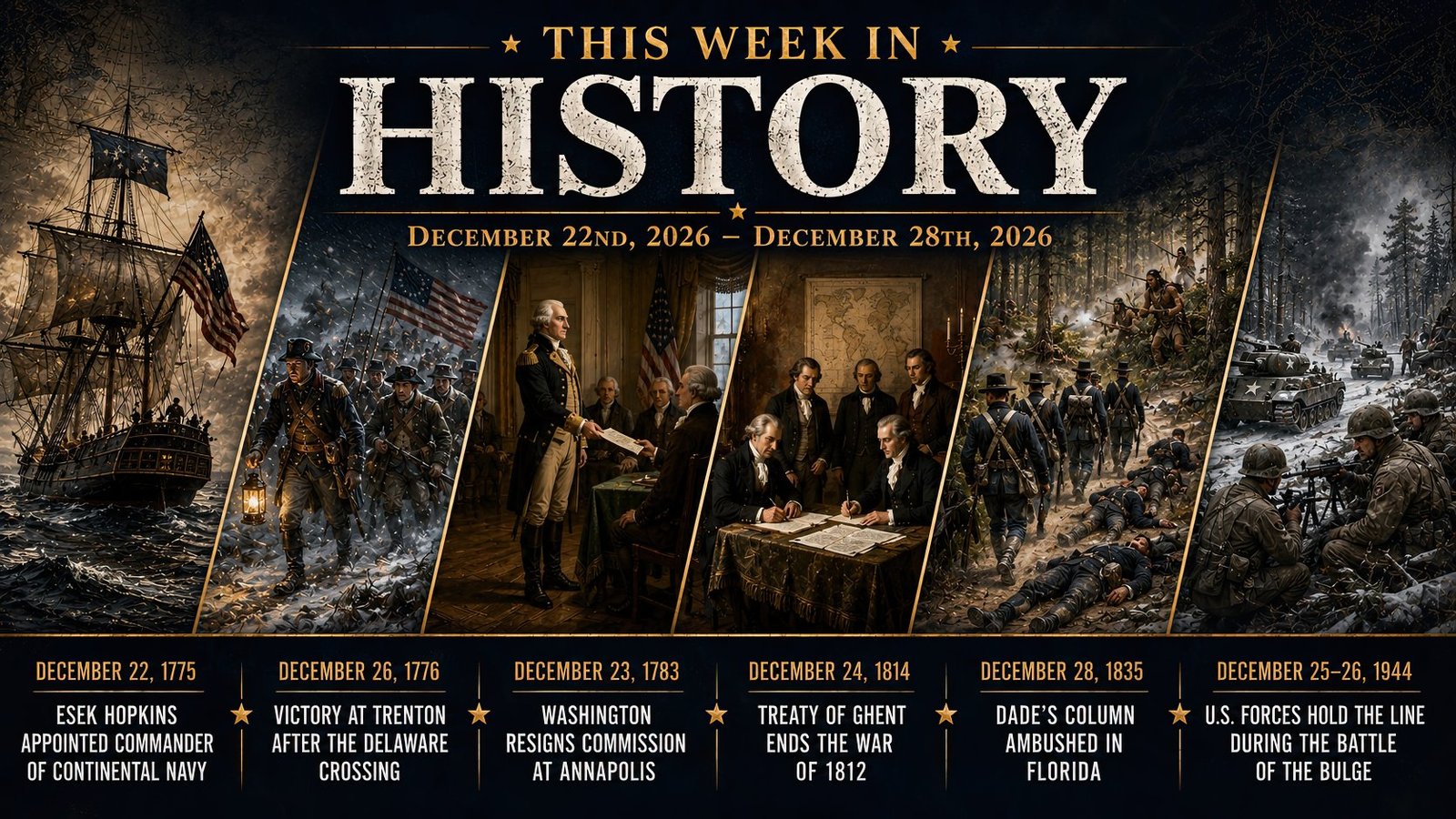
From December 22nd, 2026 through December 28th, 2026, the calendar lines up with a week crowded with turning points in United States military history. Across these seven days we see a young republic building its first navy, a future nation saved on a snowy New Jersey road, and a general willingly laying down power instead of grasping for more. We watch the United States emerge from a hard-fought war with Britain, expand across the continent amid brutal frontier conflict, and fight a civil war whose scars still shape the country. The same dates later mark desperate stands and hard-won victories in the Pacific and in the snowbound forests of Belgium during the Second World War. This issue of “This Week in U.S. Military History” walks through those moments and asks what they reveal about leadership, sacrifice, and the long, uneven path of the American military story.
Esek Hopkins and the first American fleet commander
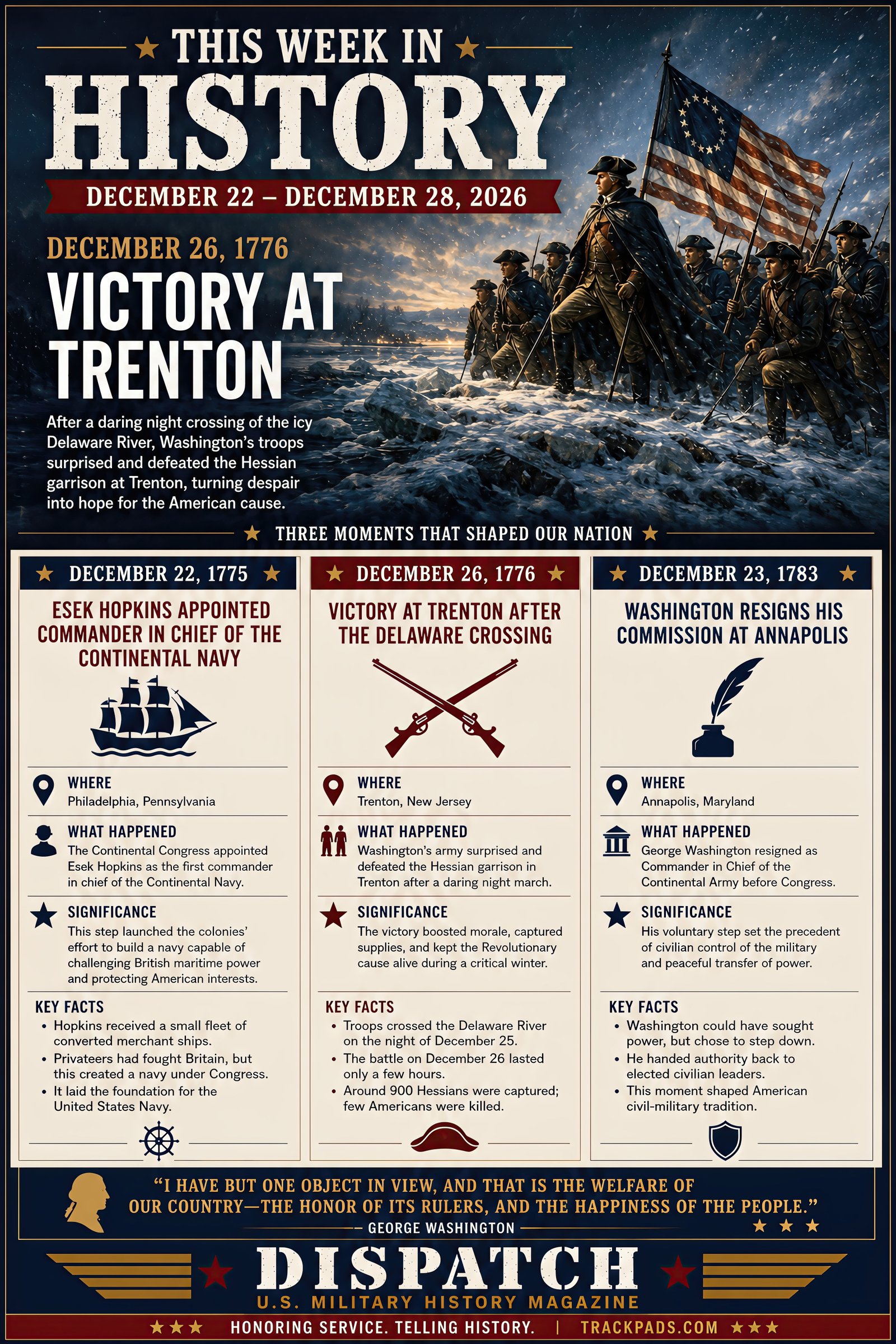
In the early months of the Revolution, the Continental Congress moved from ad-hoc privateers to something closer to a real navy by appointing Esek Hopkins as commander in chief of the Continental Navy. American leaders knew they could not match the Royal Navy ship for ship, but they hoped a small fleet could raid British commerce, escort vital supplies, and show that the rebellion was more than a loose uprising on land. Hopkins received a motley collection of converted merchantmen and hastily armed vessels, along with a roster of ambitious captains. His record at sea would be mixed, and politics ashore would eventually end his tenure, yet the step was still crucial. By designating a single naval commander and creating a fleet under congressional authority, the revolutionaries laid down an early marker for the maritime arm of the American military that would later grow into the United States Navy.
Open the Wiki entryVictory at Trenton after the Delaware crossing
On a bitter, stormy Christmas night, George Washington led a force of Continental soldiers and militia across the ice-choked Delaware River, gambling that a surprise strike could salvage a collapsing cause. The men pushed heavy boats through wind, snow, and freezing rain, then trudged toward Trenton in the dark with muskets that sometimes would not fire properly in the cold. At dawn on December 26th, 1776, they fell on the Hessian garrison, German troops hired by Britain to fight in America, and shattered it in a sharp battle that lasted only hours. Hundreds of enemy soldiers were killed, wounded, or captured, and the Americans seized badly needed weapons and supplies. Strategically, the victory did not decide the war, but it changed the mood of a struggling army and a doubtful population. Trenton proved that the Continental Army could still strike hard and win, and it gave Washington the momentum to continue a winter campaign that kept the Revolution alive.
Open the Wiki entryWashington resigns his commission at Annapolis
With the Revolutionary War effectively over and peace in sight, George Washington appeared before Congress in Annapolis on December 23rd, 1783 to resign his commission as commander in chief. The act itself took only a short speech, but it carried enormous meaning in a world where victorious generals often turned themselves into rulers. Washington could have used his popularity and the loyalty of veterans to demand power or carve out a special role above civilian leaders. Instead, he handed authority back to the representatives of the states and retired to Mount Vernon. For the young republic, this moment helped fix a crucial norm: the American military would be powerful but subordinate, commanded by civilians and bound to the decisions of elected government. Generations of officers and enlisted personnel would later point to this quiet ceremony as an example of restraint and duty that defined what service in the United States should mean.
Open the Wiki entryTreaty of Ghent ends the War of 1812
On December 24th, 1814, American and British negotiators agreed to the Treaty of Ghent, formally ending the War of 1812 even as fighting continued thousands of miles away. The treaty essentially restored the prewar boundaries, leaving neither side with major new territory but bringing an end to a conflict that had seen British invasions, the burning of Washington, and hard-fought American defenses on the Great Lakes and the Atlantic coast. Maritime issues such as impressment of American sailors faded with the defeat of Napoleon in Europe, and the treaty focused on stopping the fighting and setting up commissions to work out disputes. News of the agreement would travel slowly across the ocean, arriving in North America after dramatic battles still to come, including the defense of New Orleans. Over time, many Americans remembered the war less for the treaty text than for the sense that the United States had stood up to a great power and emerged with its independence and honor intact.
Open the Wiki entryDade’s column ambushed in Florida
On December 28th, 1835, a column of United States soldiers under Major Francis Dade marched through the pine woods of Florida on what officers believed was a relatively routine movement between forts. Seminole warriors, determined to resist forced removal from their lands, watched the column for days and chose a stretch of road where the soldiers were exposed and poorly covered. Their ambush devastated Dade’s command, killing most of the roughly one hundred men in intense and bewildering fighting. Only a handful of survivors made it back to tell the story. The attack, soon known among Americans as the Dade Massacre, became one of the opening shocks of the Second Seminole War, a long and brutal conflict in the swamps and hammocks of Florida. For the United States Army, the battle was a sobering reminder of the challenges of fighting in unfamiliar terrain against determined Indigenous opponents who knew the ground and the stakes far better than most soldiers marching through it.
Open the Wiki entryThe mass execution at Mankato, Minnesota
The aftermath of the Dakota War of 1862 reached a grim climax on December 26th, 1862, when thirty-eight Dakota men were hanged at Mankato under United States Army supervision. After weeks of fighting in Minnesota, hundreds of Dakota prisoners had been tried in hurried military tribunals that produced more than three hundred death sentences. President Abraham Lincoln reviewed the cases and reduced the number approved for execution, but the hanging at Mankato remained the largest single execution in United States history. Thousands of settlers and soldiers gathered to watch as a specially built gallows dropped, ending dozens of lives at once. For many Dakota people, the event became a symbol of dispossession, broken promises, and the crushing power of the federal government on the frontier. For historians of the United States Army, it stands as a stark example of how military authority can be used in domestic crises, with consequences that echo long after the guns fall silent.
Open the Wiki entrySherman’s “Christmas gift” telegram from Savannah
After cutting a swath across Georgia in the famous March to the Sea, Major General William Tecumseh Sherman captured the port city of Savannah in December 1864. On December 22nd, he sent a brief, memorable telegram to President Abraham Lincoln, presenting Savannah as a “Christmas gift” along with its heavy guns and thousands of bales of cotton. Behind the simple phrase lay weeks of hard marching, skirmishing, and destruction aimed at breaking the Confederacy’s will and its ability to sustain war. By seizing Savannah largely intact, Sherman secured a vital harbor for future operations against the Carolinas and showed that Confederate armies could not protect every key city. The psychological impact was just as important. For Northerners weary of war, Savannah’s fall was a sign that victory was drawing closer. For Southerners, it underscored how deeply Union forces could penetrate and how vulnerable their interior lines had become.
Open the Wiki entryJapanese landings at Lingayen Gulf, Luzon
Just two weeks after the attack on Pearl Harbor, Japanese forces struck another major blow by landing large invasion forces along the shores of Lingayen Gulf in northern Luzon on December 22nd, 1941. American and Philippine troops under General Douglas MacArthur had already faced air attacks and smaller landings, but the Lingayen operation brought in the main body of enemy troops, with tanks, artillery, and experienced infantry. The defenders fought delaying actions, but they were short of aircraft, armor, and supplies, and their defensive plans faltered under the weight of the assault. As Japanese units pushed inland, American and Philippine commanders began planning a withdrawal toward the Bataan Peninsula and the island fortress of Corregidor. The landings at Lingayen Gulf marked the beginning of the end for organized Allied defense of Luzon, setting the stage for a bitter campaign that would end in siege, surrender, and harsh captivity for many United States and Philippine soldiers.
Open the Wiki entryThe fall of Wake Island
In the central Pacific, a small Marine garrison and civilian contractors turned Wake Island into a symbol of resistance in the opening days of the Pacific War. For nearly two weeks after Pearl Harbor, the defenders repelled air raids and even sank Japanese ships, using coastal guns and a handful of fighter aircraft to make the attackers pay dearly. On December 23rd, 1941, however, a reinforced Japanese invasion force finally managed to land troops and overwhelm the island’s defenses. Fighting raged across the narrow coral atoll as Marines, sailors, and civilians tried to hold improvised positions. With no realistic hope of relief and ammunition running low, the surviving defenders were eventually forced to surrender and went into captivity. Although Wake Island fell, its stand resonated across the United States. Newspapers told of the outnumbered garrison inflicting heavy losses, and the story offered a measure of pride and determination at a time when news from the Pacific was otherwise dominated by setbacks.
Open the Wiki entryRelief of Bastogne in the Battle of the Bulge
In the bitter winter of 1944, the Belgian town of Bastogne became a focal point of the last major German offensive in the West. Paratroopers of the 101st Airborne Division, along with armored and infantry units, held the town as German forces surrounded them and demanded surrender, only to receive the famous one-word reply, “Nuts!” By late December, the defenders were low on supplies and facing relentless artillery and ground attacks. On December 26th, 1944, tanks and infantry of the United States Third Army’s 4th Armored Division broke through to the town, opening a narrow corridor and ending the full encirclement. The relief did not end the fighting in the Ardennes, but it preserved a vital road hub and lifted morale across Allied lines. Bastogne’s defense and relief came to symbolize stubborn American resistance and the ability to recover and counterattack even after a surprise blow, themes that have echoed in United States Army history ever since.
Open the Wiki entryAcross the Week
In this week’s dates, we can trace a set of connecting threads that run from the Revolution to the snow-covered forests of the Second World War. We see leaders taking enormous risks, whether Washington betting the army on a winter attack or Sherman marching across Georgia to split the Confederacy. We see the power of restraint in Washington’s resignation and the grim weight of coercive power in events like Mankato and the long wars against Indigenous nations. We watch the United States move from a fragile coastal republic to a continental power and finally to a global force fighting on distant islands and in European towns with unfamiliar names. For readers today, especially those who have worn the uniform or supported someone who has, these stories offer both inspiration and caution. They remind us that the American military story is not a straight line of triumphs, but a complex mix of courage, hardship, controversy, and change written into each passing week of the calendar.