Sunrise Over Battleship Row
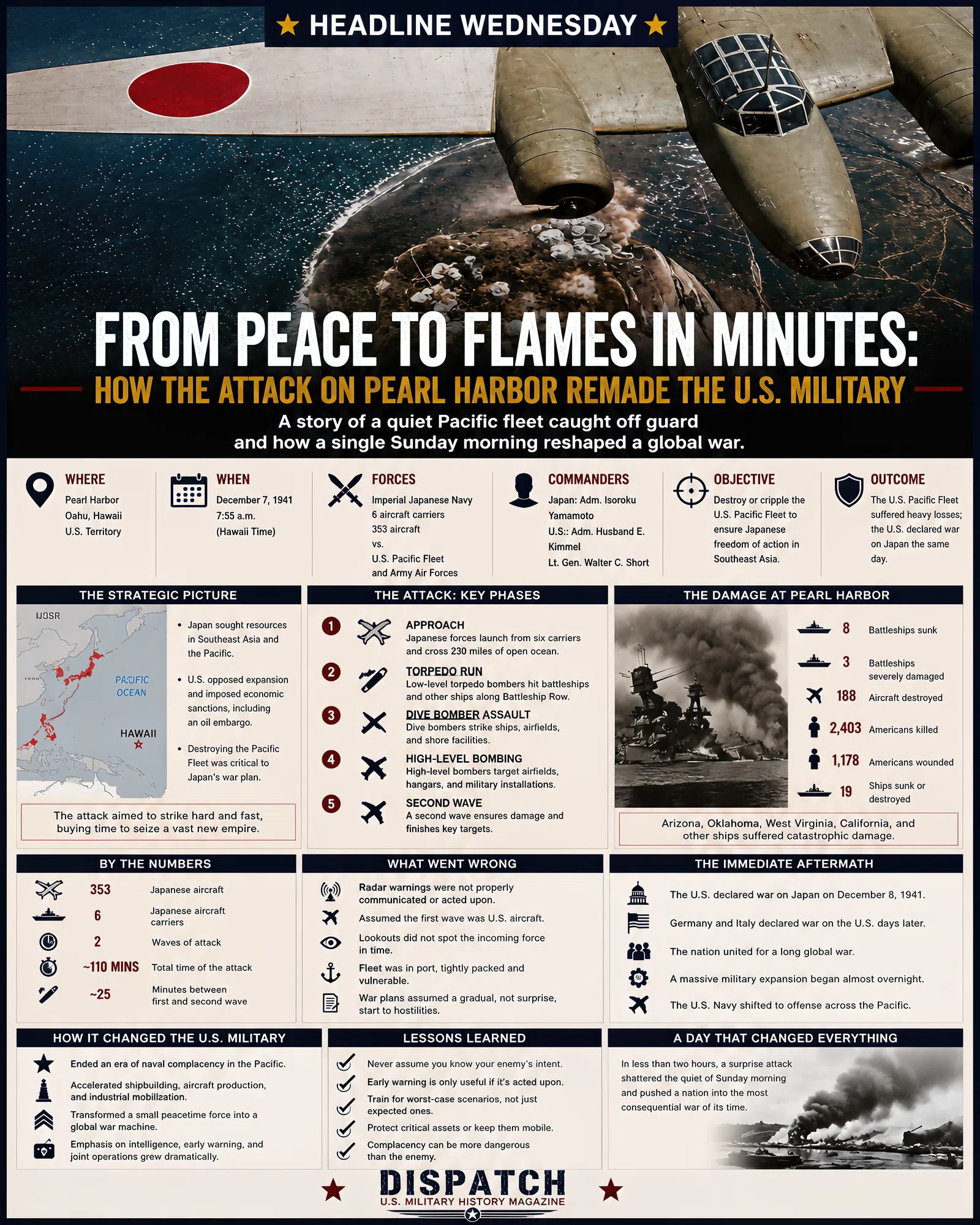
Just after dawn on December 7th, 1941, Pearl Harbor looked like any other sleepy Sunday in peacetime Hawaii. Battleships lay moored in neat lines along Ford Island, gray hulls reflected in still water, signal flags hanging limp in the mild breeze. On Arizona, Oklahoma, West Virginia, California, and the other big ships at their moorings, some sailors were just coming off watch, others were thinking about breakfast, chapel, or a rare slow morning. The clang of hatches, the murmur of conversation, the distant sound of a band rehearsing on one of the decks all blended into a routine most of the fleet could have described by heart.
Over the harbor, however, the sky was about to change. Pilots from the Imperial Japanese Navy were already inbound over Oahu, engines humming steadily as they descended through scattered clouds. Torpedo bombers lined up on the long, narrow approaches to the harbor, adjusting speed and altitude for a run that would send deadly weapons skimming just above the water. High-level bombers and dive bombers formed up behind them, each crew carrying target photos and simple, brutally clear orders. Below, lookouts on the battleships occasionally glanced skyward, seeing what they thought were friendly aircraft or training flights.
The first explosions came suddenly and close. Low-flying planes roared over the harbor, torpedoes splashing into the water and racing toward the anchored battleships in long, white wakes. Men on deck stared in disbelief for a heartbeat before training took over and alarms began to howl through the steel hulls. Within minutes, Arizona’s forward magazine erupted in a towering fireball that seemed to tear the ship apart, while Oklahoma lurched and began to roll as multiple torpedoes found her side. The calm of a Sunday morning was gone, replaced by smoke, fire, and a rising sense among the crews that this was no drill, and that the fate of the Pacific fleet was being decided at their moorings.
If the Pacific Fleet Falls Here
To understand why those minutes at Pearl Harbor mattered so much, you have to pull back from the smoke and flames and look at the map. In late 1941 the United States Pacific Fleet was the main visible check on Japanese expansion across East Asia and the Pacific islands. Battleships at Pearl Harbor were symbols as much as weapons, meant to show that if Japan pushed too far, there was heavy steel ready to respond. Washington had moved the fleet to Hawaii in part as a warning, hoping the sight of so many big guns and armored hulls would make Tokyo think twice about provoking a wider war.
At the same time, the fleet was not built or positioned with surprise attack in mind. Many American leaders still imagined that if war came, it would unfold slowly, with diplomatic signals and mobilization giving fair warning. The battleships moored along Ford Island were powerful but vulnerable: anchored close together, with limited room to maneuver, and dependent on shore facilities for much of their protection. Around them, the base supported destroyers, cruisers, submarines, and airfields, all part of a wider network meant to sustain operations across the Pacific. If that network collapsed, it would not just be a local disaster; it would open the ocean to enemy advances.
For Japan, the stakes were just as high but pointed in the opposite direction. Its leaders had already committed to a broad offensive aimed at seizing resource-rich territories and building a defensive perimeter. The Pacific Fleet at Pearl Harbor was the biggest immediate obstacle to that plan. If those battleships could be sunk or crippled at their moorings, Japanese forces would have time to surge south and west, grabbing ground before the United States could fully react. That meant the Sunday morning attack was more than a raid. It was an attempt to redraw the balance of power in the Pacific in one blow, and to force the United States to fight a long war from far behind.
Oil, Warnings, and Misread Signals
The road to that Sunday morning in Pearl Harbor ran through years of rising tension and a series of choices on both sides. Through the nineteen thirties Japan pushed deeper into China and eyed European colonies in Southeast Asia, chasing oil, rubber, and other resources to fuel its growing empire. The United States watched with increasing concern and tried to apply pressure without going to war. Step by step, Washington tightened economic screws, including critical restrictions on oil exports that Japanese leaders saw as an existential threat. On maps in Tokyo, planners shaded in the territories they believed they needed to seize simply to keep their war machine running.
Diplomacy continued on the surface, but underneath, both nations were preparing for the possibility that negotiations would fail. The United States had moved the Pacific Fleet from the West Coast to Pearl Harbor in part to signal resolve. At the same time, there were serious doubts and debates within American circles about how ready that fleet really was for a modern, fast-moving conflict. War plans existed on paper, but those plans assumed time to mobilize, units warned in advance, and battles fought at sea between battle lines that had a chance to form up and choose the ground.
In Japan, a different kind of planning took shape. Naval air leaders, convinced that aircraft carriers and massed air power were the keys to a quick, stunning opening blow, crafted the idea of a surprise strike deep into American territory. To make it work, they trained pilots relentlessly in long-range navigation, torpedo runs in shallow water, and bombing from altitude against ships at anchor. They modified torpedoes so they would not dive too deep in Pearl Harbor’s relatively shallow harbor. The result was a carrier striking force that could range far across the Pacific and deliver carefully choreographed waves of attack aircraft.
Meanwhile, American intelligence picked up hints that something was coming in the Pacific, but those hints were scattered and incomplete. Messages were intercepted, war warnings were issued, and commanders in Hawaii were told to be alert for sabotage and possible hostile moves. Yet the most dangerous course of action, a carrier strike directly against Pearl Harbor itself, still seemed improbable to many officers. Radar stations were only just coming into use, antiaircraft defenses were not fully manned on quiet weekends, and exercises against surprise air attack were limited. By early December, diplomats in Washington were still trading notes even as Japanese carriers slipped across the North Pacific under radio silence, heading toward a rendezvous with history.
Torpedoes, Bombs, and Burning Steel
When the first wave of Japanese aircraft swept down on Pearl Harbor shortly before eight in the morning, it split into groups with distinct tasks. Torpedo bombers flew low over the water, skimming into the harbor to launch their weapons at the battleships lined along Ford Island. Dive bombers climbed and rolled into steep attacks, lining up on individual ships and key facilities. High-level bombers aimed for larger target areas. Over Oahu’s army airfields, other attackers focused on parked aircraft, trying to keep American fighters and bombers pinned to the ground. The plan was to cripple the fleet and its air cover before the defenders could fully respond.
On the battleships, the shock was immediate and personal. Torpedoes slammed into Oklahoma and West Virginia, tearing open hulls and flooding compartments in seconds. Oklahoma, struck repeatedly on one side, rolled over as water poured in faster than damage-control teams could respond. Arizona took a bomb that pierced its forward area and ignited the magazine, producing the massive explosion that became one of the enduring images of the attack. Nevada, further down the row, was hit but managed to get steam up and move, only to be targeted by additional aircraft as she tried to head for open water. Sailors who had been thinking about breakfast suddenly found themselves in darkness, wading through oil-covered water or scrambling to man guns that had never expected to go from peacetime drills to real combat in a single breath.
As the minutes passed, the defensive picture began to change. Antiaircraft gunners shook off the initial shock, broke open ammunition lockers, and started filling the sky with fire. Some guns had their sights properly set; others fired by eye and instinct, crews shouting corrections over the roar of engines and explosions. At shore installations, officers and enlisted personnel dragged machine guns into place and tried to find clear fields of fire among the palm trees and buildings. A few American fighters managed to get airborne from surviving airfields, climbing into a chaotic sky filled with smoke and attacking planes, looking for any opening to strike back.
By the time the second wave of Japanese aircraft arrived, the harbor and airfields were already a landscape of flames, overturned hulls, and wrecked planes. The attackers pressed their runs, scoring additional hits on ships and facilities but also facing a more alert, angry defense. Some of their planes were shot down over the harbor or the island, crashing into the water or the hills beyond. The attack itself lasted only a few hours from first bomb to withdrawal, but for those on the receiving end it felt like a lifetime. When the last enemy aircraft finally turned away and silence began to creep back in, smoke columns still rose over Battleship Row, fuel and oil burned on the surface of the water, and crews on surviving ships and shore stations counted the cost, not yet fully aware of how much had changed in a single morning or how the missing American carriers and intact base infrastructure would shape the next chapters of the war.
Carriers Missing, Bases Still Standing
For all the horror and destruction visible in Pearl Harbor’s burning waters, the attack did not deliver everything Japanese planners had hoped. The great American battleships along Ford Island were sunk or battered, but the Pacific Fleet’s aircraft carriers were not in the harbor that morning. Enterprise and Lexington were at sea, while Saratoga was on the West Coast. The Japanese aircrews hit what they could see, not what was absent, and the survival of those carriers would shape every major Pacific battle that followed. In the days after the attack, as loss reports came in, American leaders gradually realized that the tools for a new kind of naval war had survived.
Other targets were also left essentially intact. The immense fuel tank farms near the harbor, the drydocks, the machine shops, and the submarine base suffered far less than the battleships. Damaging or destroying those facilities would have made Pearl Harbor unusable as a forward base, forcing the United States to operate much farther east for months or years. Instead, once fires were brought under control and immediate rescue work ended, sailors, yard workers, and engineers turned to salvage and repair. Ships that looked lost on December 7th were refloated, patched, and sent to the mainland for reconstruction. The Pacific Fleet would not be rebuilt overnight, but the infrastructure to support that rebuilding remained in American hands.
Equally important, the human response turned a tactical disaster into the beginning of a much larger contest. On the day itself, countless acts of courage on damaged ships and in burning facilities saved lives and preserved fighting capability. In the weeks that followed, the shock of the attack jolted American institutions, from intelligence organizations to training commands, into rethinking assumptions about surprise, air power, and joint operations. The Japanese had hoped that striking a heavy blow at Pearl Harbor would discourage the United States and buy a long window of freedom of action. Instead, the attack galvanized a vast industrial nation to fight a prolonged, all-out war in which carriers, submarines, and air power would take center stage.
From Harbor Flames to Global War
In the hours after the attack ended, rescue and recovery became the priority. Small boats moved among the shattered ships, pulling survivors from oil-slicked water. On capsized hulls like Oklahoma, crews hammered from the inside while rescue teams cut through steel from the outside, racing the clock to reach trapped men. Fires burned for days on some vessels and around fuel-spill areas. When the smoke finally thinned, the scale of the loss was stark: thousands of Americans killed or wounded, a battleship force wrecked, and a sense of invulnerability shattered. Yet the core of the base remained alive, and the surviving ships, submarines, and shore commands began turning from shock to preparation for the next phase.
The political and strategic consequences moved just as quickly. On December 8th, the United States declared war on Japan with overwhelming support in Congress and across the country. Within days, Germany and Italy declared war on the United States, fully connecting the Pacific attack to a global conflict already raging in Europe and North Africa. Pearl Harbor thus became not just a local disaster, but the doorway through which the United States entered World War Two as a fully committed belligerent. Mobilization orders followed, draft numbers grew, factories shifted to wartime production, and training centers expanded to absorb a flood of recruits.
Over the longer term, the lessons of Pearl Harbor deeply influenced American doctrine and culture. The vulnerability of battleships at anchor highlighted the need for dispersed forces, air warning networks, and ready antiaircraft defenses. The relative safety of the carriers and submarines at the time of the attack accelerated a shift toward carrier task forces and undersea campaigns as the main tools of Pacific strategy. In classrooms, staff rides, and museum exhibits today, Pearl Harbor is used to study surprise, intelligence warning, and resilience in the face of sudden loss. The image of burning battleships at their moorings still speaks to the cost of complacency, but also to a moment when a single morning’s tragedy helped transform a peacetime fleet into the core of a wartime navy that would cross the Pacific and help end a global war.