Reference Entry
FIRST NUCLEAR CHAIN REACTION AT CHICAGO PILE-1
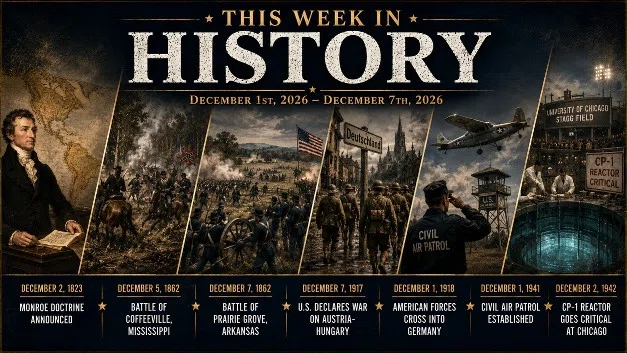
Exactly one year after Pearl Harbor’s date on the calendar, December 2nd, 1942, a small team of scientists and technicians gathered under a stadium in Chicago carried out an experiment that would change warfare forever.
Dated Historical Context
A RECORDED MOMENT IN HISTORY
First nuclear chain reaction at Chicago Pile-1
Exactly one year after Pearl Harbor’s date on the calendar, December 2nd, 1942, a small team of scientists and technicians gathered under a stadium in Chicago carried out an experiment that would change warfare forever. Working in a makeshift laboratory beneath the stands of an athletic field, they assembled and controlled the first self-sustaining nuclear chain reaction in a graphite-and-uranium device known as Chicago Pile-1. Although the people in that room were not wearing uniforms, their work was part of the closely guarded Manhattan Project, a wartime effort directed toward building an atomic bomb. The successful experiment proved that controlled fission was possible on a scale that could be harnessed for weapons. In the years that followed, nuclear arms reshaped military planning, deterrence strategies, and the very idea of what a “great power” war would mean. That quiet December milestone marks the hinge between conventional industrial war and the nuclear age.
Read the complete weekly DispatchTrackpads Source Register