This Week in History · December 29, 2026
489 Populated Entries
Conflicts and historical periods that shaped military institutions and warfare.
Wars & Historical Eras
Every result opens a permanent subject record with its reference context and connected Dispatch coverage. Filter by record type, editorial collection, or a word in the entry.
489 entries found.
As the Second World War in Europe approached its end, converging Allied armies squeezed the shrinking territory of Nazi Germany from east and west. On April 25th, 1945, elements of the United States 69th Infantry Division, advancing eastward, encountered units of the Soviet 58th Guards Rifle Division near the town of Torgau on the Elbe River. Soldiers from both sides crossed the ruined landscape to shake hands on a destroyed bridge and along the riverbanks.
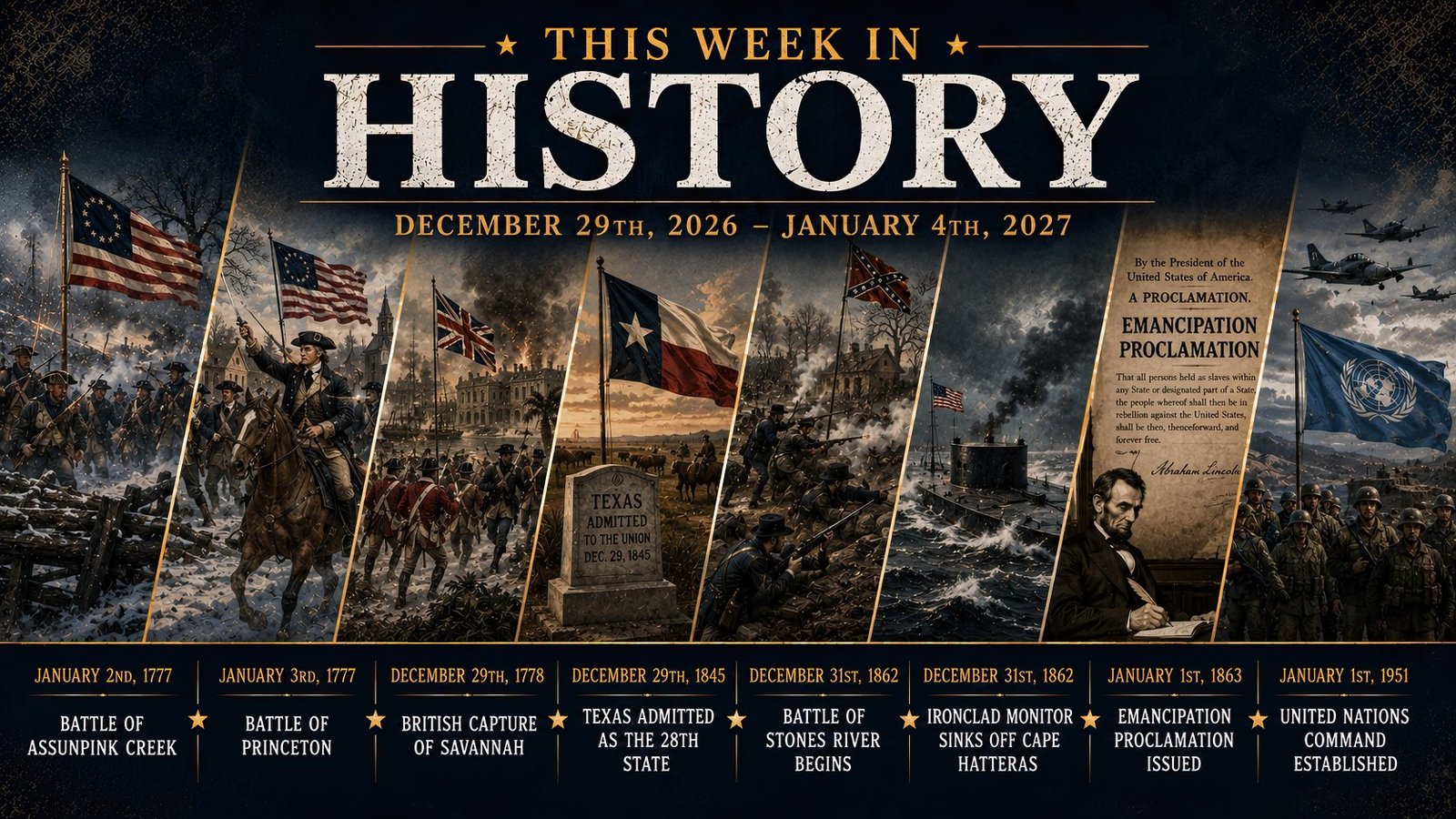
On January 1st, 1863, Abraham Lincoln’s Emancipation Proclamation officially took effect, transforming the nature of the Civil War.
While armies crossed rivers in Europe, Marines in the Pacific were still locked in some of the war’s most brutal island battles. United States forces had landed on Iwo Jima in February 1945, attacking a volcanic fortress where Japanese defenders used tunnels, caves, and concrete bunkers to make every yard of ground costly. The famous flag raising on Mount Suribachi took place early in the campaign, but heavy fighting continued across the northern part of the island for weeks.
As the Civil War ground into its third year, the Union’s volunteer pool began to thin, and the government faced the reality that enthusiasm alone would not sustain huge field armies. On March 3rd, 1863, the Enrollment Act became law, creating the first nationwide system of conscription in United States history.
The winter sky over the Anzio beachhead was a low, gray lid, pressing the sound of guns back down onto the men below. Along a shallow drainage ditch called the Fossa Femminamorta, muddy water slid past tufts of grass and shattered reeds. Somewhere ahead, beyond the next bend, German machine guns covered the open fields that stretched away from the ditch, anchoring a strongpoint that threatened the entire attack.
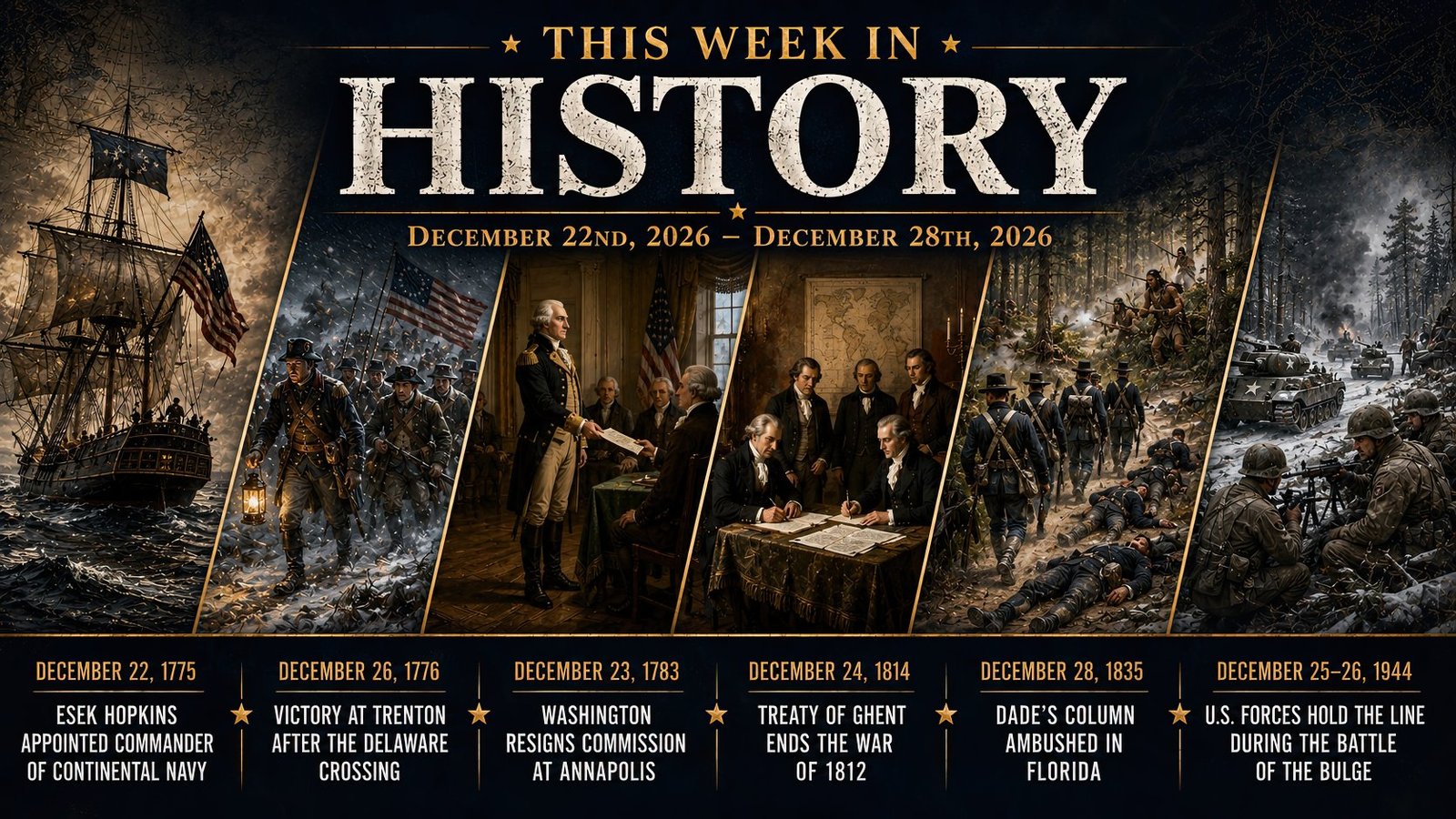
In the early months of the Revolution, the Continental Congress moved from ad-hoc privateers to something closer to a real navy by appointing Esek Hopkins as commander in chief of the Continental Navy.
On August 4th, 1790, the young federal government took a practical step to secure both its finances and its coasts. Responding to proposals from Secretary of the Treasury Alexander Hamilton, Congress authorized the construction of a small fleet of revenue cutters to enforce customs laws and combat smuggling. These fast sailing vessels and their crews patrolled harbors and coastal routes, boarding ships, checking cargoes, and ensuring that customs duties reached the federal treasury.
Almost a year into the Revolutionary War, the siege of Boston had ground on with neither side able to deliver a decisive blow. General George Washington’s Continental troops ringed the city while British regulars and Royal Navy ships held the harbor and town, each side suffering from supply problems and disease.
Near the Hudson River, the Revolutionary War’s most famous betrayal came fully into view when British Major John André, captured behind American lines, was executed as a spy.
On February 19th, 1942, a little more than two months after the attack on Pearl Harbor, President Franklin Roosevelt signed Executive Order 9066. The order authorized military commanders to establish exclusion zones and remove people from them, a power soon applied mainly along the West Coast. In practice, this meant that more than one hundred thousand people of Japanese ancestry, the majority of them American citizens, were forced from their homes and sent to inland camps under guard.
On the Bataan Peninsula in the Philippines, exhausted American and Filipino troops laid down their arms after months of siege, disease, and dwindling supplies. Cut off from reinforcement and resupply, the defenders had fought a stubborn delaying action, buying time for the wider Pacific war effort even as their own situation deteriorated. When surrender became unavoidable, many soldiers were already weakened by malnutrition, malaria, and dysentery.
In the early weeks of the Korean War, United States forces rushed to slow a North Korean advance that threatened to overrun the entire peninsula. Around the city of Taejon, elements of the 24th Infantry Division fought a desperate delaying action, outnumbered and facing tanks and artillery in unfamiliar terrain. Over several days of close combat and street fighting, American troops inflicted significant losses but gradually found themselves cut off and forced to withdraw.
On March 6th, 1836, after nearly two weeks of siege, Mexican forces under Antonio López de Santa Anna stormed the old mission compound at the Alamo in San Antonio. The defenders, a mixed group of Texian settlers and volunteers from the United States, had chosen to stand in place despite orders to withdraw, hoping to delay the Mexican advance. In the final assault, the garrison was overwhelmed and killed almost to the last man, including figures such as William B.
In the American Civil War, control of the Mississippi River and its great port cities was central to Union strategy. On the night of April 24th, 1862, Flag Officer David Glasgow Farragut led a Union fleet past the Confederate strongholds of Fort Jackson and Fort St. Philip, which guarded the river approach to New Orleans. Under heavy fire, Union ships dodged chains, obstructions, and burning rafts while trading blows with Confederate gunboats.
On August 30th, 2021, the last American military transport lifted off from Kabul’s runway, ending nearly twenty years of continuous American combat operations in Afghanistan.
Off the coast of Vietnam, the supercarrier USS Forrestal was preparing to launch another round of strikes when disaster struck. A malfunction caused a rocket on a parked fighter to fire across the crowded flight deck, smashing into another jet loaded with fuel and bombs. The resulting fires, explosions, and shrapnel tore through aircraft, equipment, and the sailors struggling to fight the blaze.
In the closing years of the Vietnam War, the nuclear–powered aircraft carrier USS Enterprise operated as a key platform for strikes into Southeast Asia. On January 14th, 1969, during flight operations near Hawaii, a rocket accidentally detonated on the flight deck, triggering a chain of explosions among fueled and armed aircraft.
As the naval war closed in on Japan, United States fast carrier task forces struck airfields, shipyards, and industrial targets across the home islands. On March 19th, 1945, the carrier USS Franklin was operating relatively close to the enemy coast, her flight deck crowded with fueled and armed aircraft being readied for another strike. A lone Japanese dive bomber slipped through the defenses and dropped bombs that penetrated into the hangar deck, touching off a chain of explosions and fires.
Barely seven weeks after the attack on Pearl Harbor, the first major contingent of American ground troops landed in Northern Ireland. Soldiers from the 34th Infantry Division disembarked in cold, damp weather to the sound of bands and the sight of cheering crowds who knew the war in Europe had entered a new phase. Until then, the British had fought on in the west with limited direct American military presence.
Farther west, control of the Mississippi River became a central Union objective. After a bold overland campaign that saw victories at Port Gibson, Raymond, Jackson, Champion Hill, and the Big Black River, General Ulysses S. Grant brought his army up to the defenses of Vicksburg, Mississippi. On May 19th, 1863, he ordered an immediate assault, hoping to capitalize on Confederate disarray and seize the fortress city by storm.
The same date that Marines were struggling ashore on Saipan also saw the debut of a new weapon in the air war over Asia. On June 15th, 1944, Boeing B-29 Superfortress bombers of the United States Army Air Forces flew from forward bases in China to strike industrial targets in Japan in the first mission of its kind.
On this day delegates from twelve colonies gathered in Philadelphia to respond to what they called the Coercive or Intolerable Acts, punitive measures imposed after the Boston Tea Party.
Four days after the creation of that new engineering district, another milestone unfolded in the skies over occupied Europe on August 17th, 1942. That day, B-17 Flying Fortress bombers of the Eighth Air Force launched the first American heavy bomber raid against a target in occupied France, striking railyards and industrial facilities around Rouen.
On November 14th, 1910, civilian pilot Eugene Ely coaxed his fragile Curtiss pusher airplane down a narrow wooden platform built over the bow of the cruiser USS Birmingham off Hampton Roads, Virginia.
Related Dispatch
These current Dispatch articles connect directly to records in the Wars & Historical Eras directory.