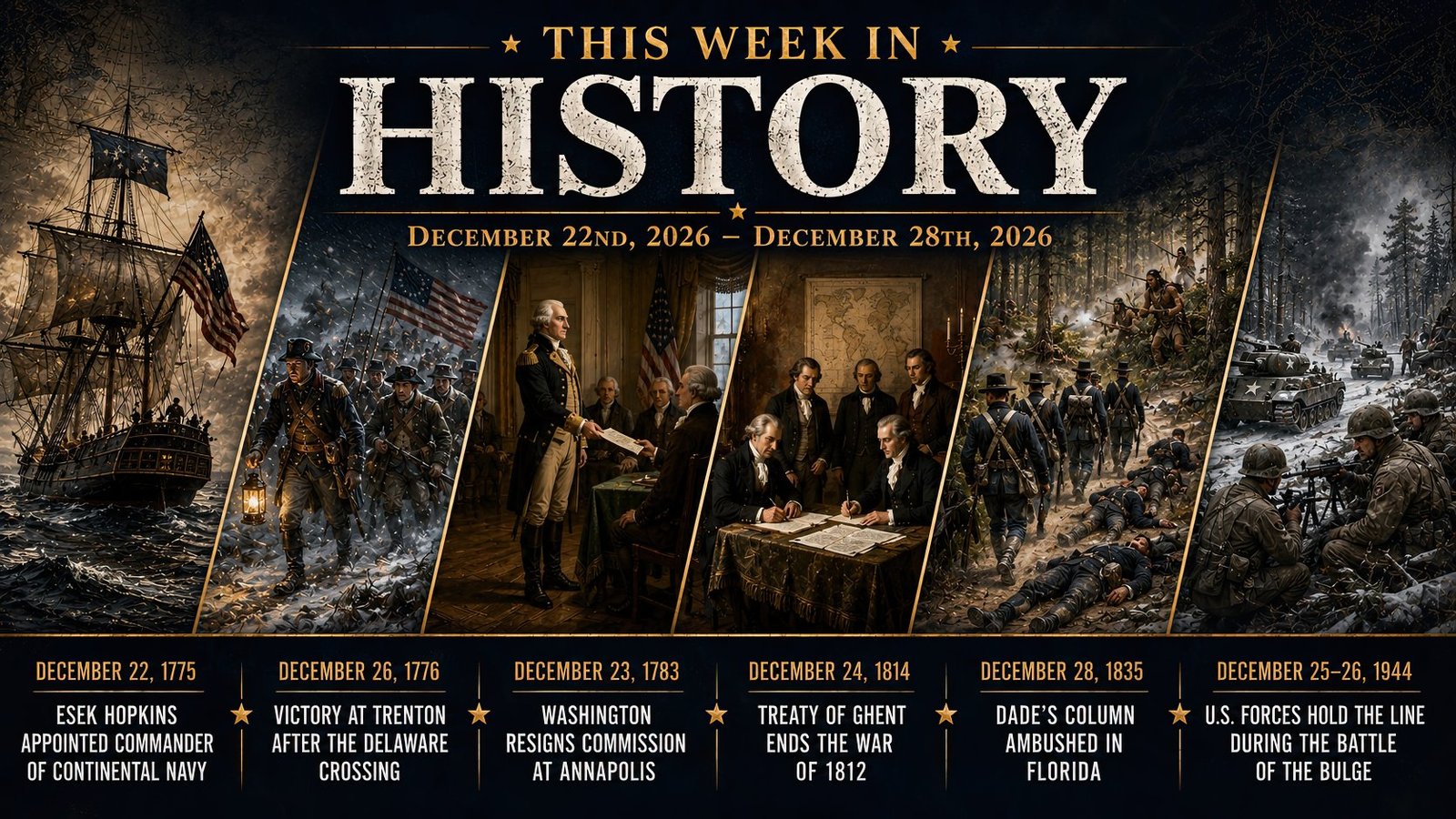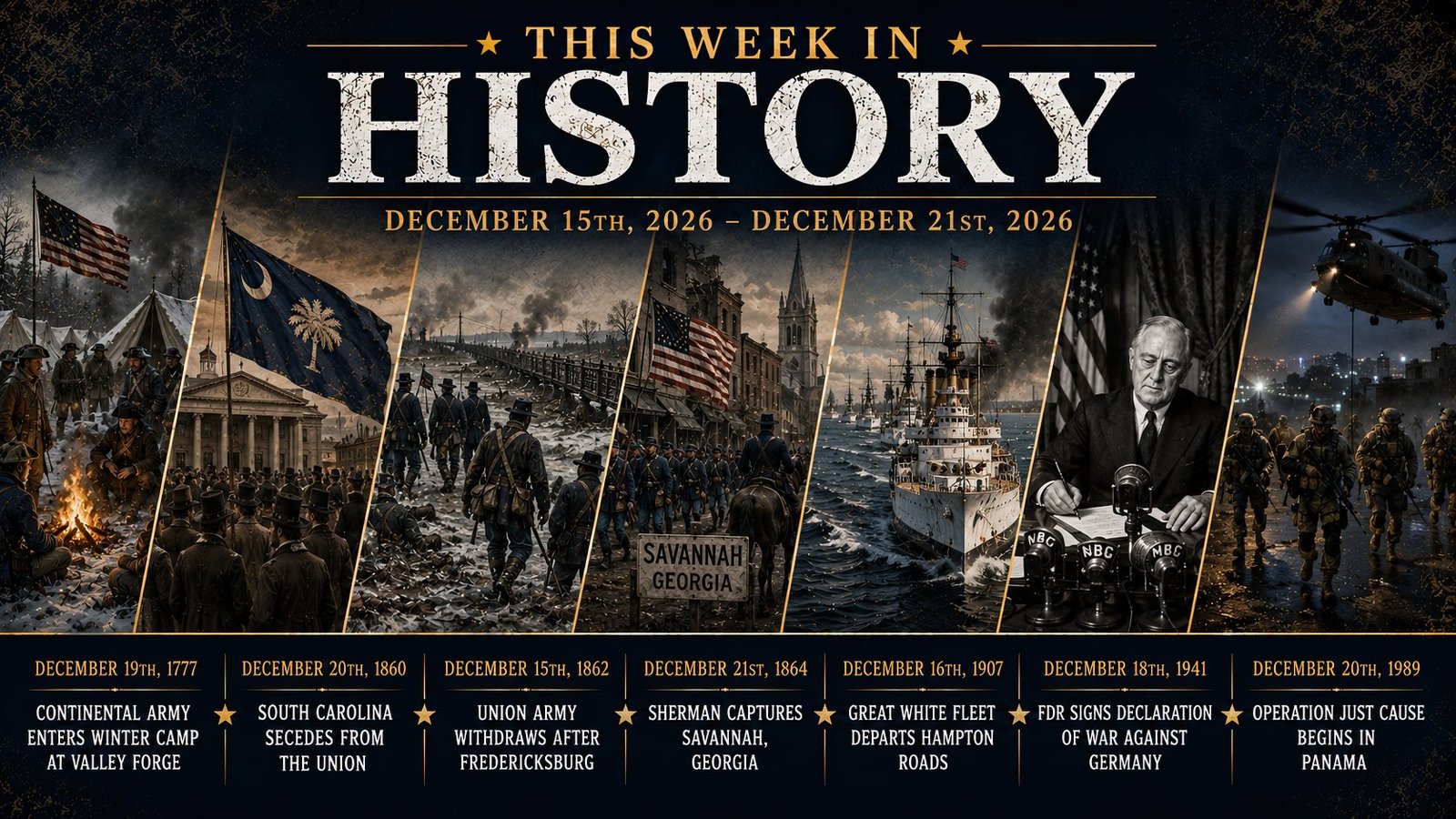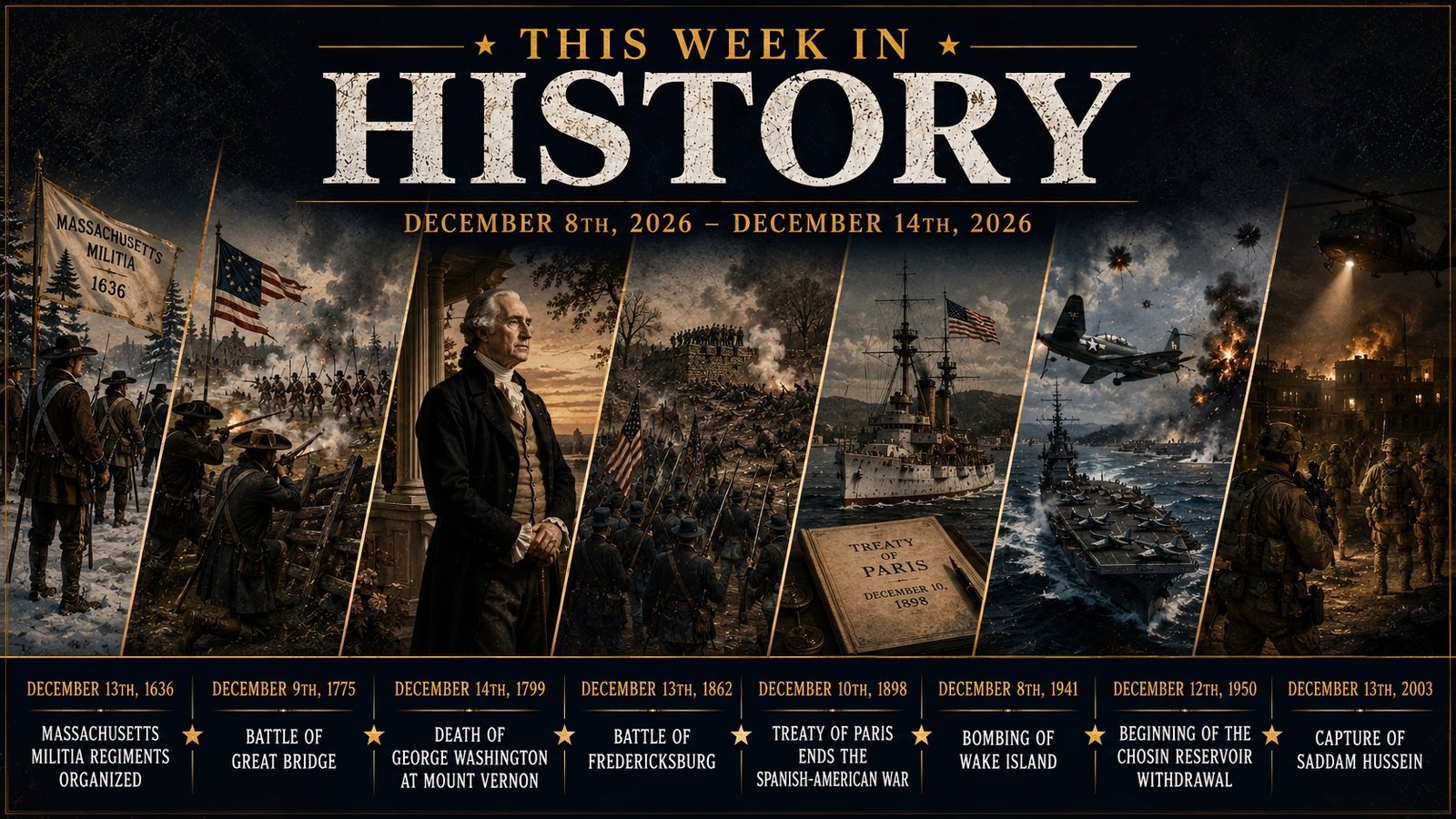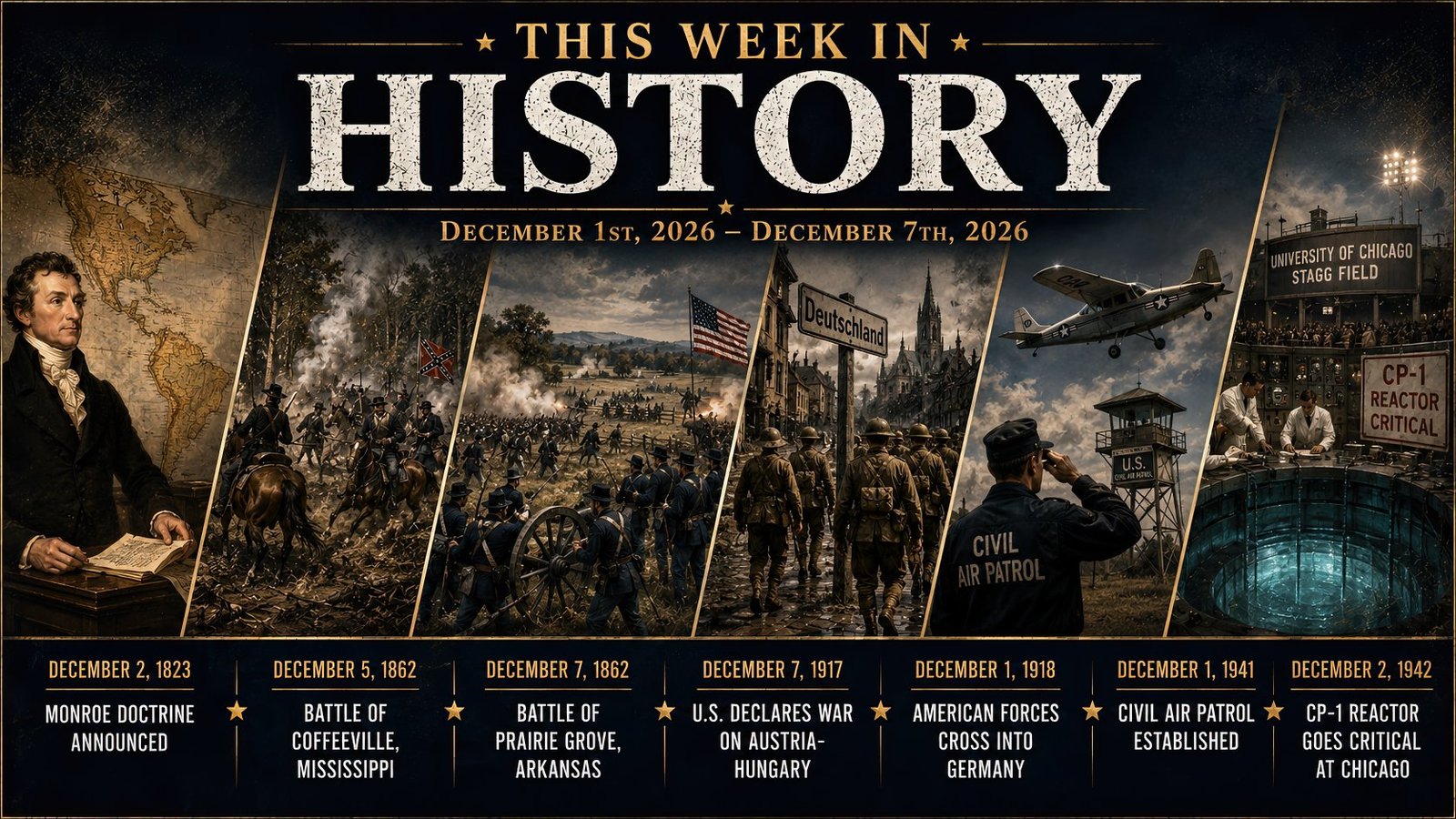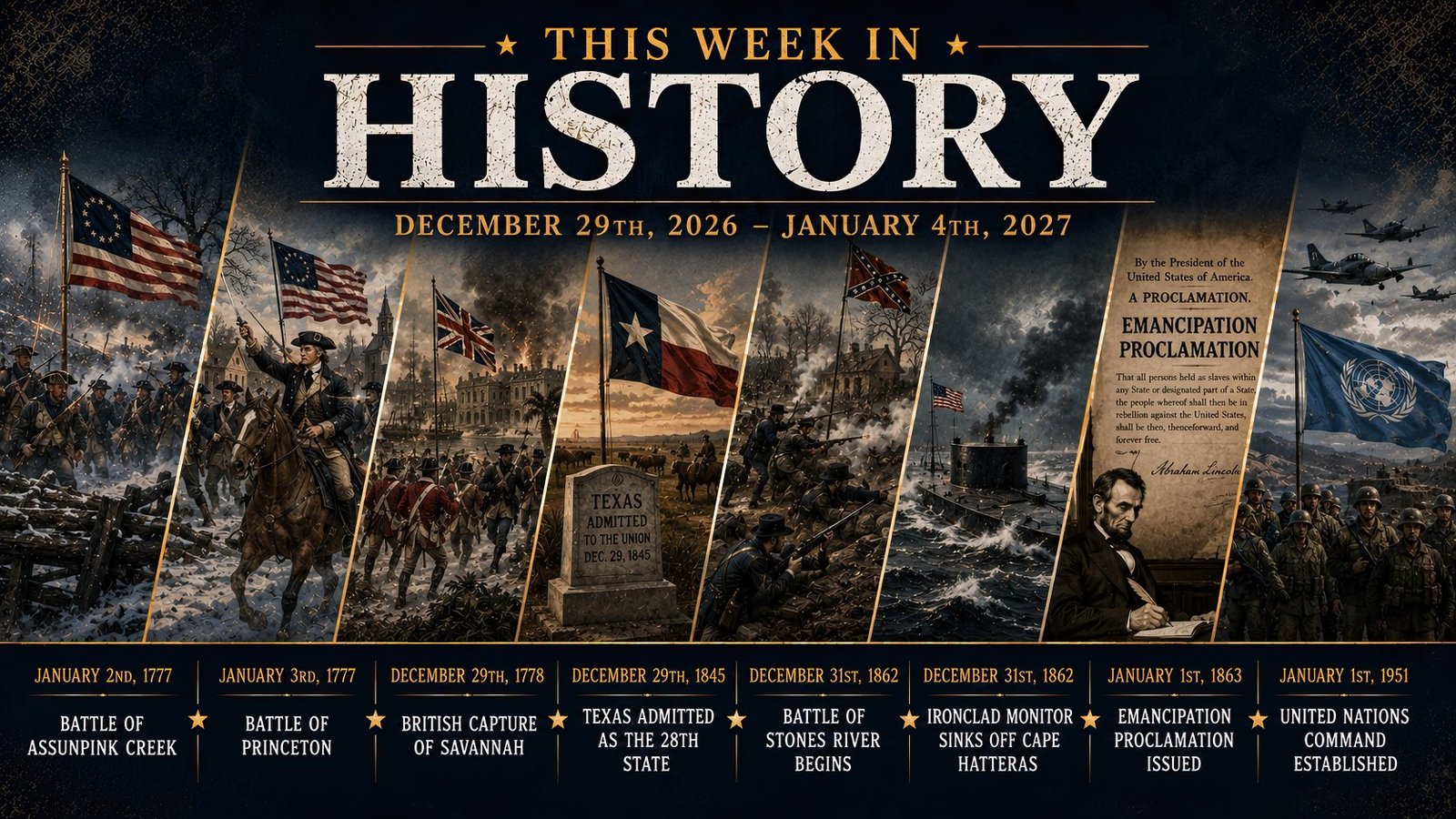
This Week in History · December 29, 2026
489 Populated Entries
Conflicts and historical periods that shaped military institutions and warfare.
Wars & Historical Eras
Every result opens a permanent subject record with its reference context and connected Dispatch coverage. Filter by record type, editorial collection, or a word in the entry.
489 entries found.
The January sky over eastern Belgium is the color of steel, low clouds pressing down on snow-covered fields. An American armored task force eases forward along a narrow road when the world ahead of it suddenly erupts. Antitank rounds smash into the frozen earth, machine guns rake the ditches, and rifle fire lashes out from a ridgeline roughly two hundred yards in front of the column. Inside one of the lead tank destroyers, Corporal Arthur O.
Just a year later in war-time June, Union and Confederate armies were locked in the Overland Campaign, a grinding series of battles as Ulysses S. Grant tried to force Robert E. Lee’s Army of Northern Virginia back toward Richmond. On June 3rd, 1864, Grant launched a massive frontal assault at Cold Harbor, where entrenched Confederate troops held strong positions behind earthworks and rifle pits.
Outside Charleston, South Carolina, a sand and earth fortification called Fort Wagner guarded the approaches to the harbor and symbolized Confederate defiance. On the evening of July 18th, 1863, the 54th Massachusetts Volunteer Infantry, one of the first African American regiments raised in the Union Army, led a frontal assault across a narrow strip of beach under heavy artillery and rifle fire.
In the summer of the Revolutionary War, British forces held a fortified outpost at Stony Point on the Hudson River, threatening American communications and morale. General George Washington approved a bold plan for a nighttime assault led by General Anthony Wayne and a specially selected light infantry corps. With unloaded muskets and fixed bayonets, Wayne’s men advanced in silence, relying on discipline and surprise to overwhelm the British defenses.
On February 16th, 1945, United States forces launched a daring combined airborne and amphibious assault to retake Corregidor, the rocky island guarding the entrance to Manila Bay in the Philippines. Corregidor had become a symbol of resistance when United States and Filipino defenders held out there in 1942 before surrendering to Japanese forces. Three years later, with the liberation of the Philippines well underway, recapturing the “Rock” carried both strategic and symbolic weight.
On the morning of August 6th, 1945, a B-29 bomber of the United States Army Air Forces dropped the first atomic bomb used in war over the Japanese city of Hiroshima. In seconds, a blast and firestorm devastated much of the urban area, killing tens of thousands of people outright and leaving many more injured or exposed to radiation.
Three days after Hiroshima, on August 9th, 1945, a second atomic bomb fell on the city of Nagasaki, delivered by another B-29 that had originally set out for a different target. Weather, fuel concerns, and mission decisions brought the bomber over Nagasaki, where the “Fat Man” device detonated with power even greater than the first weapon.
The same week on the calendar, but in a different year, brought one of the most searing dates in United States military history: December 7th, 1941.
Two decades later, in the highlands of South Vietnam, another attack on Americans far from home became a turning point in policy. On February 7th, 1965, Viet Cong forces struck Camp Holloway near Pleiku, a base used by United States Army aviation units and advisors. The assault involved mortar fire and ground infiltrators who damaged aircraft, facilities, and barracks, killing and wounding American personnel.
Not all early June anniversaries involve declared wars. On June 8th, 1967, during the Six-Day War in the Middle East, the United States signals intelligence ship USS Liberty was operating in international waters in the eastern Mediterranean. In the confusion of fast-moving ground and air fighting ashore, Israeli aircraft and torpedo boats mistook the ship for a hostile vessel and attacked, inflicting severe damage and killing dozens of American sailors.
In the remote Aleutian Islands off Alaska, American and Japanese forces fought in some of the harshest conditions of the Second World War. On May 30th, 1943, after weeks of bitter combat on steep, fog-shrouded slopes, United States commanders declared the island of Attu secure. Japanese defenders had launched a massive final attack only days earlier, leaving tangled lines of casualties in a brutal close-quarters battle.
On a cold day near the village of Holtzwihr in eastern France, a young Texas-born lieutenant named Audie Murphy faced a German attack with his infantry company badly outnumbered. After calling in artillery and ordering most of his men to fall back to prepared positions, Murphy remained forward, climbing onto a burning tank destroyer that could still bring its heavy machine gun to bear.
Only a week after the attacks of September 11th, lawmakers and the president moved to define the legal framework for military response.
By May 13th, 1943, the last major pockets of German and Italian troops in Tunisia have laid down their arms, bringing the North African campaign to an end. For United States forces, the road to this day has run through early setbacks such as the defeat at Kasserine Pass and subsequent reorganization and training under new leadership.
On Saipan in the Mariana Islands, July 7th, 1944 witnessed one of the largest Japanese infantry charges of the Pacific War. In a desperate attempt to break American lines, thousands of Japanese soldiers, along with wounded men and support personnel formed into improvised units, launched a massive banzai attack against positions held by United States Army troops, notably elements of the 27th Infantry Division.
A story of a jungle airstrip, thin lines of Marines and soldiers, and how local air power reshaped the Pacific war.
A story of a blood-soaked cornfield, a shallow creek, and a battle that reshaped the Union’s war.
Early in the Civil War, Union and Confederate forces clashed near Big Bethel Church in southeastern Virginia in one of the first significant land battles of the conflict. On June 10th, 1861, mostly inexperienced Union volunteers attempted a night march and dawn attack against Confederate positions but suffered from confusing orders, difficult terrain, and misidentification of friendly units.
Just outside Manassas, Virginia, the first major land battle of the Civil War tore away any illusion of a quick, clean victory. Union forces under Brigadier General Irvin McDowell marched out from Washington hoping to strike inexperienced Confederate troops and end the rebellion in a single blow. Instead they found determined opposition and a battlefield that quickly grew chaotic, with brigades feeding in piecemeal and terrain that broke up neat formations.
Before sunrise on November 20, 1917, the British attack began without the usual warning. There was no long preliminary bombardment to announce that an offensive was coming. No days of shellfire tearing the battlefield apart in advance. Instead, the opening movement at Cambrai depended on secrecy, timing, and the strange mechanical presence of hundreds of tanks moving toward the German line.
When the United States entered the First World War, many allies wondered how quickly American units could adapt to the brutal demands of the Western Front. On May 28th, 1918, the Army’s 1st Division attacked the German-held village of Cantigny in France, supported by tanks, artillery, and aircraft. The assault seized the shattered village and, more importantly, held it against persistent counterattacks and heavy shelling.
Hooker’s spring offensive crossed the Rappahannock with an ambitious plan but ended in withdrawal. The main battle, Jackson’s flank march, and Sedgwick’s separate advance formed one campaign whose local actions cannot be reduced to a single surprise attack.
Read Entry →Battle · 2026-01-14Battle of Chosin ReservoirA story of a frozen fighting withdrawal and how it reshaped the war in Korea.
The November 1967 fighting around Dak To involved several hills, formations and successive actions. Hill 875 became its best-known episode, but the wider battle also depended on reinforcement, medical evacuation and support from outside the immediate battlefield.
Read Entry →Related Dispatch
These current Dispatch articles connect directly to records in the Wars & Historical Eras directory.