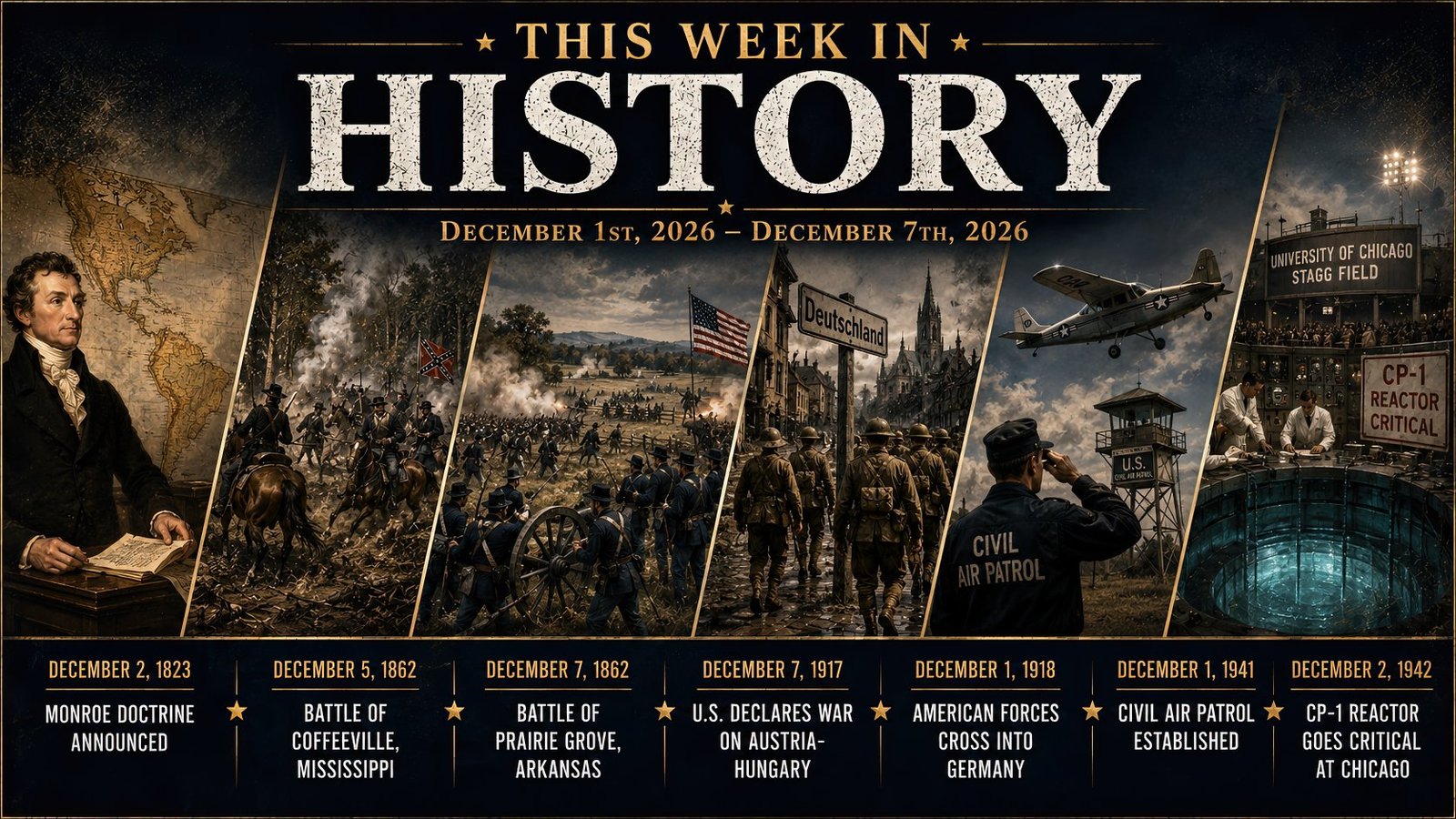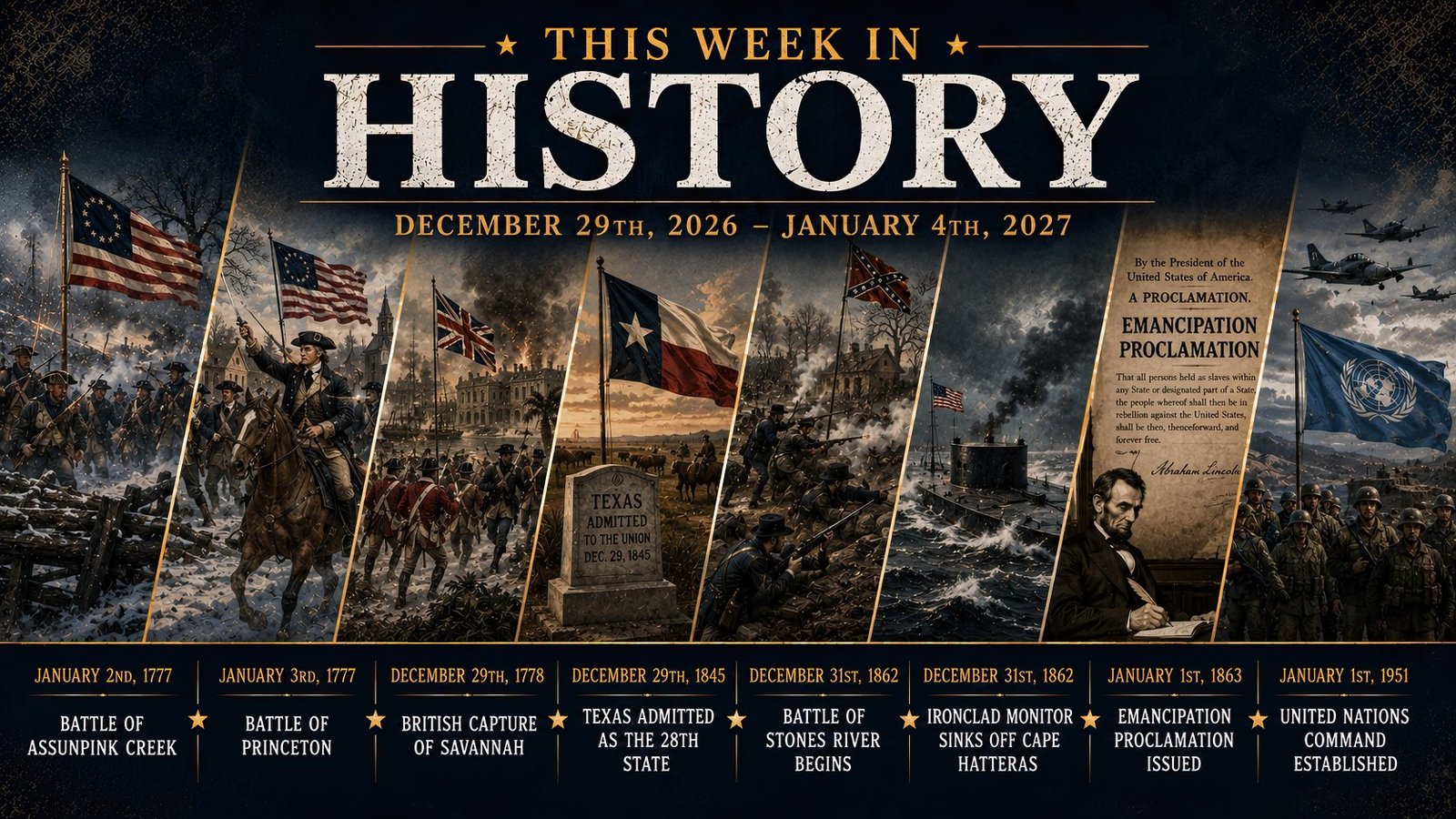
This Week in History · December 29, 2026
489 Populated Entries
Conflicts and historical periods that shaped military institutions and warfare.
Wars & Historical Eras
Every result opens a permanent subject record with its reference context and connected Dispatch coverage. Filter by record type, editorial collection, or a word in the entry.
489 entries found.
Less than a week after the D-Day landings in Normandy, paratroopers of the 101st Airborne Division fought their way into the town of Carentan. On June 12th, 1944, after days of brutal combat across causeways and among hedgerows, airborne infantry entered and secured the battered town, which sat at a vital road and rail junction between Utah and Omaha Beaches.
A story of secret overflights, Cold War nerves, and the moment a “untouchable” spy plane finally fell from the sky.
The 1st Marine Division’s history connects Pacific amphibious campaigns, Korea, Vietnam and later expeditionary operations. Its recipient records include Marines and supporting Navy personnel whose documented unit relationships span different eras and task organizations.
Read Entry →Unit History · 2026-09-0733rd Infantry Division in World War IIThe Illinois division’s wartime service led through Hawaii, New Guinea and Morotai to northern Luzon, where difficult terrain, combined operations and widely separated small-unit actions defined its contribution.
Read Entry →Event · 2026-08-11Acceptance of Japanese surrender terms (V-J Day)The following summer, August 14th, 1945 became known to many Americans as V-J Day, the day news broke that Japan had accepted Allied surrender terms. After years of island campaigns, submarine warfare, strategic bombing, and the unprecedented use of atomic bombs, word finally spread across ships at sea, foxholes in the Pacific, and hometown streets that the fighting would soon end.
One year later, the Shenandoah Valley became the stage for a fast-moving campaign that kept Union leaders off balance. On May 23rd, 1862, Confederate forces under Thomas “Stonewall” Jackson struck the small Union garrison at Front Royal, a town guarding key road and rail links in the lower Valley. The defenders, including a Union Maryland regiment, were surprised by the sudden appearance of their Confederate counterparts and pressured from multiple directions.
On February 22nd, 1819, American and Spanish negotiators signed the Adams–Onís Treaty, transferring Spanish Florida to the United States and settling a long-troublesome frontier. For years, the border had been a patchwork where runaway enslaved people, Native communities, smugglers, and raiding parties moved in and out of reach of American authorities.
Two years into the Revolution, Congress resolved that the flag of the thirteen United States would consist of thirteen stripes, alternating red and white, with thirteen stars on a blue field. This decision on June 14th, 1777 formalized a symbol that Continental soldiers and sailors could rally around as they marched and sailed under a single national standard.
Two decades later, the focus of competition and security concerns had shifted beyond the atmosphere. On May 5th, 1961, naval aviator Alan Shepard climbed into the cramped Mercury capsule Freedom Seven atop a Redstone rocket in Florida. His suborbital flight lasted only about fifteen minutes, but it made him the first American to travel into space and demonstrated that the United States could send a person safely into and back from this new domain.
When Alaska entered the Union as the forty-ninth state on January 3rd, 1959, it brought with it a vast expanse of territory that had already played an important strategic role in the Second World War.
The valley offered almost no cover. Shallow folds of earth and shattered shrubs were all that shielded the Marines of 1st Battalion, 5th Marines as they tried to push forward on Okinawa Shima on May 7, 1945. Ahead of them, on a high ridge at the valley’s mouth, a Japanese machine gun hammered the slopes, stitching bullets across every patch of ground where a helmet or sleeve dared to move. The air vibrated with the clatter of automatic fire and the flat crack of rounds striking rock.
On February 13th, 1945, Allied bombers began a series of attacks on the German city of Dresden that would continue into the following days and become one of the most debated episodes of the air war in Europe. Dresden had been a cultural center with limited heavy industry compared to some other German cities, but by early 1945 it also served as a transportation hub feeding the German Eastern Front.
In Vietnam’s Central Highlands, the fighting around the Ia Drang Valley marked one of the first large-scale clashes between American airmobile forces and North Vietnamese regulars.
Two years after Guadalcanal, American forces were fighting their way back into the Philippines, determined to liberate a key Allied nation and reclaim a major strategic hub. On February 3rd, 1945, elements of the United States Sixth Army, advancing from the Lingayen Gulf landings, reached the outskirts of Manila and began pushing into the city. Filipino guerrillas and local residents helped guide units toward key objectives, including internment camps holding civilian prisoners.
Only days after Cantigny, the German army surged toward the Marne River, aiming for a breakthrough that might force France to its knees. On May 31st, 1918, elements of the American 3rd Division moved into position near the town of Château-Thierry, where bridges over the Marne became critical chokepoints.
A generation after New Providence, the United States undertook a much larger and more complex amphibious operation on March 9th, 1847, when General Winfield Scott’s army came ashore near the Mexican port of Veracruz. Supported by a strong naval flotilla, thousands of soldiers landed by surfboat in carefully planned waves along an open beach, establishing a ring around the city with remarkably few casualties in the initial assault.
On July 7th, 1898, as the United States waged war against Spain, Congress approved a joint resolution to annex the Hawaiian Islands. American sugar interests and political figures in Hawaii had pushed for closer ties for years, but the Spanish–American War threw the strategic value of the islands into sharp relief.
With the Second World War over but tensions rising, leaders in Washington faced new questions about how far the United States should go in supporting other nations against pressure from powerful neighbors. On March 12th, 1947, President Truman addressed Congress to request aid for Greece and Turkey, framing the issue as a wider commitment to assist free peoples resisting subjugation.
In the dark hours of February 25th, 1942, only weeks after Pearl Harbor and just days after a Japanese submarine shelled an oil facility near Santa Barbara, air raid sirens wailed across the Los Angeles area. Searchlights probed the sky, and anti-aircraft batteries opened fire on what many believed were incoming Japanese bombers. For hours, crews unleashed thousands of rounds, filling the night with noise, smoke, and confusion, yet no confirmed enemy aircraft were found.
The air over Balete Pass crackled with small-arms fire and the flat explosions of grenades. On the steep slope of Hill B, a narrow finger of ground jutting out above the zigzag road that threaded the Caraballo Mountains, five exhausted American infantrymen hugged the earth around a captured Japanese trench. It was 8 May 1945, deep in the Battle of Luzon, and Private First Class Anton L.
In the early Cold War, the United States joined with Australia and New Zealand to sign a mutual security pact known as the ANZUS treaty.
Although conducted by a civilian space agency, the Apollo program drew heavily on rocket, guidance, and communications technology developed alongside the United States military during the Cold War. On July 20th, 1969, the lunar module Eagle descended to the Moon’s surface while the command module Columbia orbited overhead, all under the watchful eyes of controllers on Earth.
A story of high-tech American armor meeting Soviet-designed tanks in the desert and how it reshaped modern ground warfare.
At the dawn of military aviation, the United States Army experimented with powered flight on a parade ground at Fort Myer, Virginia.
Related Dispatch
These current Dispatch articles connect directly to records in the Wars & Historical Eras directory.