Reference Entry
HAY–BUNAU-VARILLA TREATY SIGNED
At the turn of the twentieth century, American leaders viewed an isthmian canal as essential to both commerce and naval strategy.
Dated Historical Context
A RECORDED MOMENT IN HISTORY
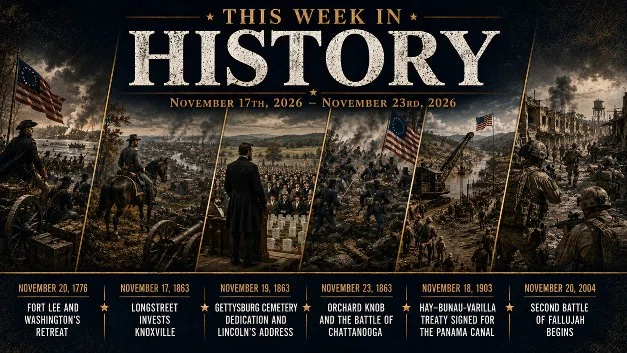
Hay–Bunau-Varilla Treaty signed
At the turn of the twentieth century, American leaders viewed an isthmian canal as essential to both commerce and naval strategy. After political turmoil and a revolution in Panama, United States diplomats moved quickly to secure construction and operating rights. On November 18th, 1903, the Hay–Bunau-Varilla Treaty was signed, granting the United States a wide canal zone and long-term control over a strip across the new republic. For the Army and Navy, the agreement promised a faster transfer of ships between the Atlantic and Pacific, shorter reinforcement routes, and a more flexible global posture. Building and defending the canal would draw in engineers, medical officers, Marines, and coastal artillery, turning the zone into a showcase of American power and problem solving. The treaty also carried long-term diplomatic complications, but in purely military terms it marked a major investment in the logistical backbone needed for a modern, ocean-spanning fleet.
Read the complete weekly DispatchTrackpads Source Register