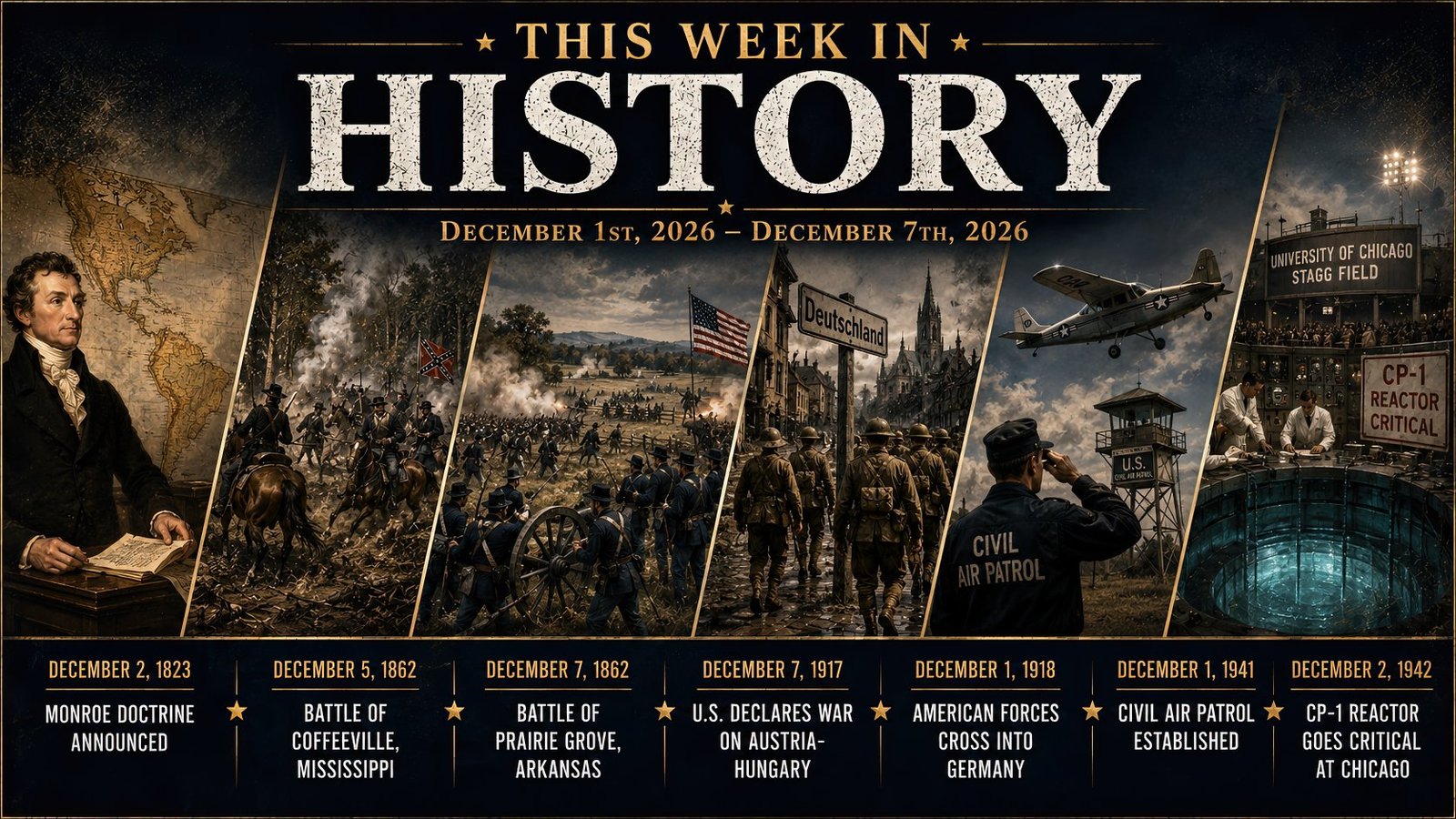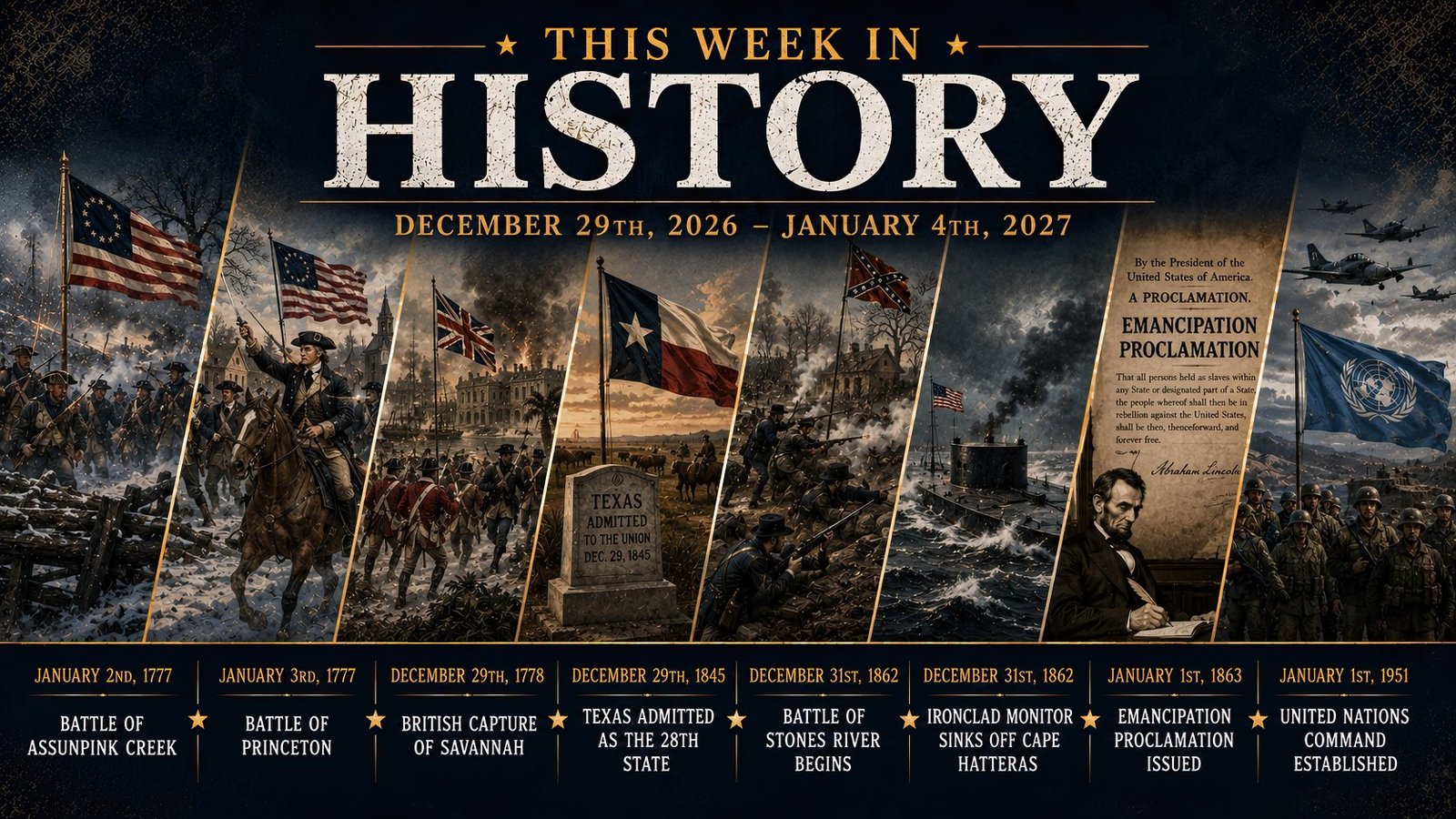
This Week in History · December 29, 2026
489 Populated Entries
Conflicts and historical periods that shaped military institutions and warfare.
Wars & Historical Eras
Every result opens a permanent subject record with its reference context and connected Dispatch coverage. Filter by record type, editorial collection, or a word in the entry.
489 entries found.
As war raged across Europe and Asia, the United States still officially stood neutral in January 1941, but the lines were beginning to blur. On January 10th, 1941, President Franklin Roosevelt’s administration saw the Lend-Lease bill introduced in Congress, proposing that the United States could lend or lease war material to nations whose defense was deemed vital to American security.
In the Central Pacific, United States forces opened a new phase of the war against Japan with the amphibious assault on Saipan in the Mariana Islands. On June 15th, 1944, Marines of the 2nd and 4th Marine Divisions, supported later by soldiers of the 27th Infantry Division, hit the beaches under fire from well-prepared Japanese defenses dug into coral, caves, and ridges.
On July 3rd, 1988, during tense operations in the Persian Gulf, the guided-missile cruiser USS Vincennes mistook a civilian Iran Air Airbus ascending along a commercial route for a hostile military aircraft. Believing the plane to be an attacking fighter and amid conflicting reports about altitude and identification, the ship fired surface-to-air missiles that destroyed the airliner, killing all passengers and crew.
On November 4th, 1979, the line between diplomatic tension and outright crisis was crossed at the United States embassy in Tehran.
The final events in this week’s window unfolded in the shifting landscape of the post–Cold War world. In the early hours of August 2nd, 1990, Iraqi armored and mechanized units crossed the border into Kuwait, quickly overwhelming the small country’s defenses and seizing its capital. The invasion stunned the region and set off a wave of diplomatic and military responses.
In the wake of the September 11th attacks and years of tense inspections and sanctions, the United States and a coalition of partners confronted Iraq over weapons of mass destruction and compliance with international demands. After issuing a final ultimatum to Saddam Hussein’s regime, American forces launched the opening strikes of what would become known as the Iraq War on March 19th, 2003.
While soldiers bled at Stones River, sailors on the pioneering ironclad Monitor fought the sea itself.
Just two days after Pea Ridge opened, another kind of revolution unfolded in the waters off Virginia. On March 9th, 1862, the Union ironclad Monitor met the Confederate ironclad Virginia (rebuilt from the scuttled Merrimack) in the confined waters of Hampton Roads, one day after the Virginia had mauled wooden Union warships. For hours the two armored vessels circled, rammed, and fired at close range, with shots that would have shattered older hulls glancing off thick iron plating.
On February 19th, 1945, the beaches of Iwo Jima filled with landing craft as Marines of the 4th and 5th Marine Divisions came ashore under fire. The island was small but strategically important, lying between the Marianas and the Japanese home islands and hosting airfields that could threaten American bombers.
The draw is narrow and steep, its sides scoured by months of shellfire and rain. At the bottom, the earth is churned to powder. Above it, hidden in the scrub and broken stone near Cisterna di Littoria, German machine guns wait for anything that moves. Private James Henry Mills can hear them before he sees them—the clatter of automatic fire, the sharper crack of rifles, the dull thump of grenades exploding somewhere ahead.
The ground in front of Sugar Loaf Hill is already chewed into mud and craters when Corporal James Lewis Day crawls forward to look for cover. It is May 1945 on Okinawa, and the Marines trying to cross this open killing ground are being shredded by Japanese mortar and artillery fire. The air is thick with pulverized coral dust. Fragments of shattered ammunition boxes and discarded packs lie where men dropped them running for their lives.
On this day representatives of Imperial Japan signed an instrument of surrender on the deck of the battleship Missouri, anchored in Tokyo Bay and surrounded by Allied warships.
Early June took on new meaning in 1942, as the Pacific War reached North American shores. On June 3rd, 1942, Japanese carrier aircraft struck the United States Navy and Army installations at Dutch Harbor in the Aleutian Islands of Alaska Territory. The attack damaged fuel facilities, barracks, and anti-aircraft positions, and it was followed by further strikes the next day.
The ridge near San Jose Hacienda rose steep and stubborn out of the jungle, a wall of earth and rock that dominated the valley floor. Somewhere up there, hidden in spider holes—small, camouflaged fighting pits—and pillboxes, Japanese soldiers waited behind interlocking bands of machine-gun fire. To reach the crest, Company I of the 160th Infantry Regiment had only one narrow approach, a trail that funneled men into a killing zone. Staff Sergeant John C.
On February 20th, 1962, Marine Corps officer John Glenn rode the spacecraft Friendship 7 into orbit atop an Atlas rocket, becoming the first American to orbit the Earth. The mission lasted only a few hours and three circuits of the planet, but it carried enormous importance in the Cold War competition for space. Glenn’s background as a fighter and test pilot linked early spaceflight directly to the skills and cultures of military aviation.
Three years later, on the same date of the calendar, an American naval squadron under Captain John Paul Jones fought one of the most celebrated sea battles of the war off the English coast near Flamborough Head.
In the spring of the Revolutionary War, the Continental Navy’s most famous captain carried the fight directly to Britain’s own shores. Sailing the sloop Ranger, John Paul Jones led a small landing party into the harbor at Whitehaven on England’s west coast. His men spiked coastal guns and attempted to set several ships ablaze, causing little physical damage but a great deal of alarm.
The B-24 shook as it skimmed over the Romanian countryside, treetops flashing beneath the wings and church steeples knifing up toward the formation. Ahead, the sky over Ploesti was already boiling with black bursts of antiaircraft fire and thick columns of oily smoke. Colonel John Riley Kane, commanding the third element of heavy bombers in a massive low-level strike, peered through the haze and realized something was wrong. The main force that should have been ahead of him was gone.
In a televised address during the Vietnam War, President Lyndon B. Johnson announced a partial halt to the bombing of North Vietnam and, in a stunning closing, declared that he would not seek nor accept his party’s nomination for another term. The speech came in the wake of the Tet Offensive, a widespread enemy campaign that had shaken public confidence despite heavy Communist losses.
After the disastrous Union defeat at Fredericksburg and the swampy failure of the so-called “Mud March,” President Abraham Lincoln decided he could no longer keep Ambrose Burnside in charge of the Army of the Potomac. Orders issued in late January placed Major General Joseph Hooker, a combative and outspoken corps commander, in charge of the Union’s main eastern field army.
The black volcanic sand of Iwo Jima offered no cover, only shallow shell holes and jagged rock. On the morning of March 9, 1945, Platoon Sergeant Joseph R. Julian lay there with the rest of his company, pressed into the ash while enemy fire tore long furrows across the slope. Ahead of them, a line of Japanese trenches and pillboxes guarded a critical rise. Machine guns hammered from narrow firing slits.
On August 26th, 2021, as crowds of desperate Afghans pressed toward Kabul’s Hamid Karzai International Airport, a suicide bomber struck near Abbey Gate.
Standing before a large crowd in West Berlin on June 26th, 1963, President John F. Kennedy used a few carefully chosen phrases to encapsulate American support for a divided city. The Berlin Wall, erected nearly two years earlier, loomed as a concrete symbol of Cold War confrontation, and residents of the Western sectors lived each day with the knowledge that Soviet and East German forces stood just across the barrier.
On the Korean peninsula, three years of brutal fighting ended with signatures on a document at Panmunjom, not with a victory parade. Delegates representing the United Nations Command, North Korea, and China agreed to a cease-fire that froze front lines near where they had started, around the Thirty-Eighth Parallel. The agreement established the Demilitarized Zone, a fortified strip of land that remains one of the most heavily guarded borders in the world.
Related Dispatch
These current Dispatch articles connect directly to records in the Wars & Historical Eras directory.