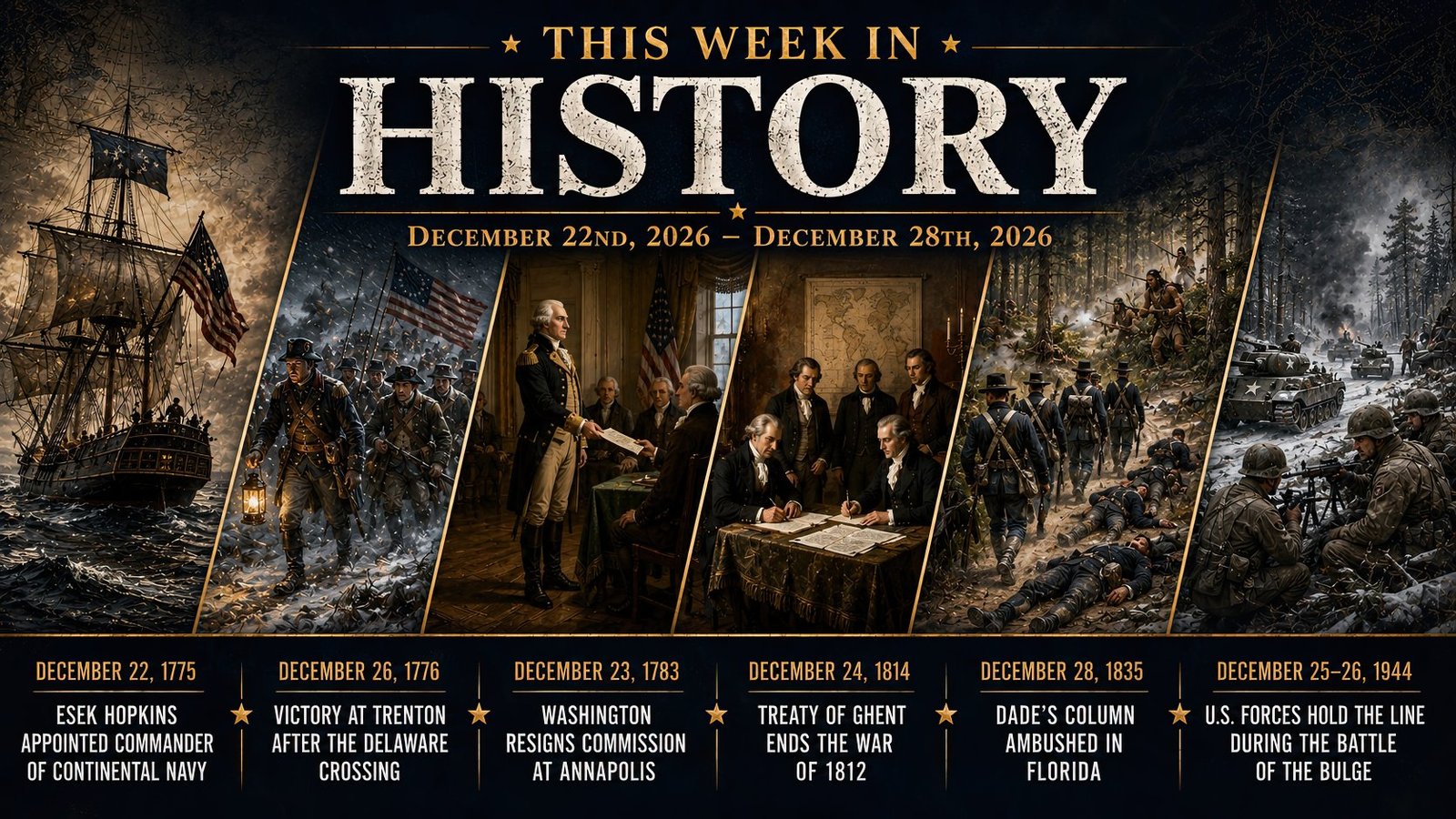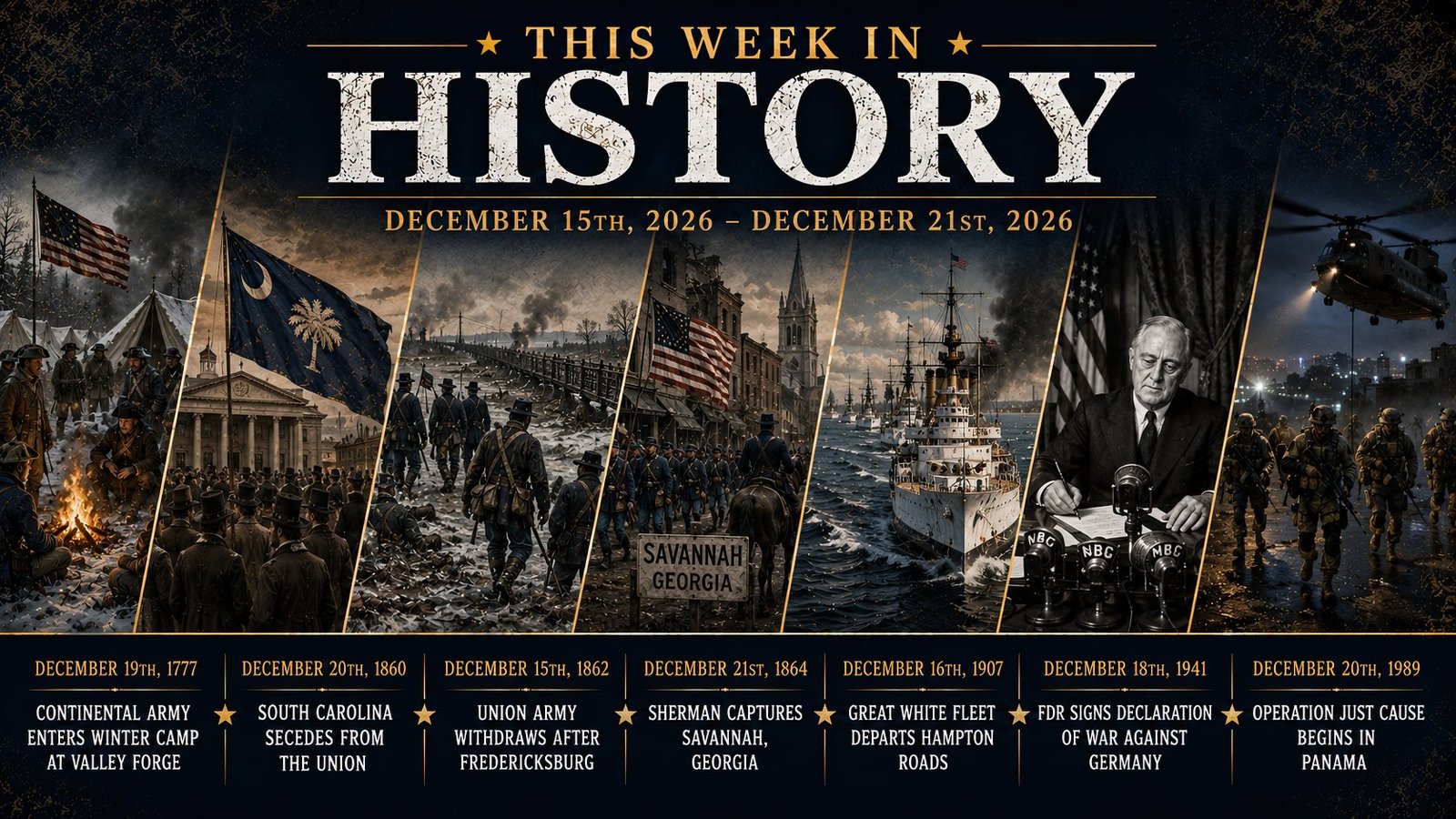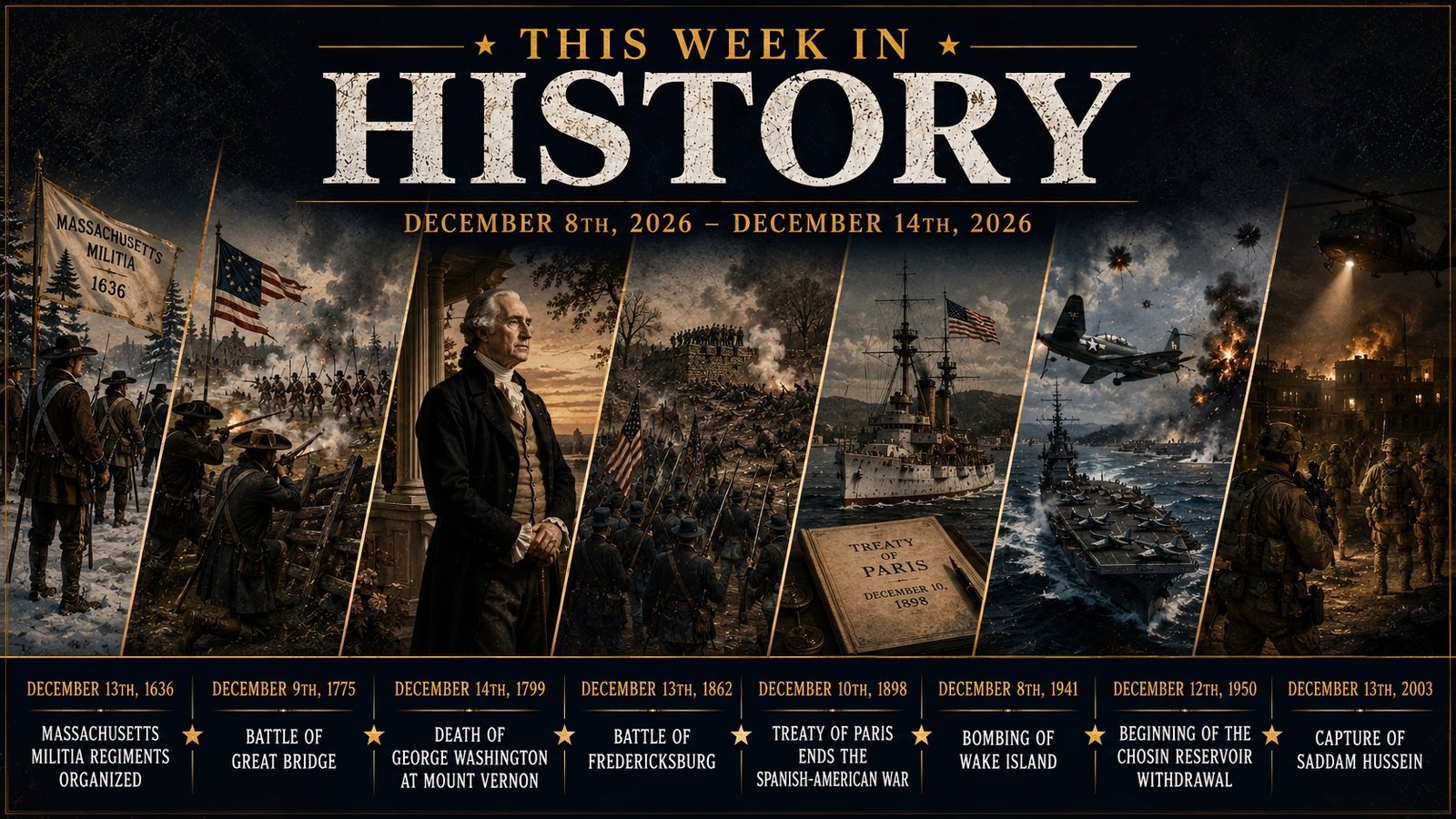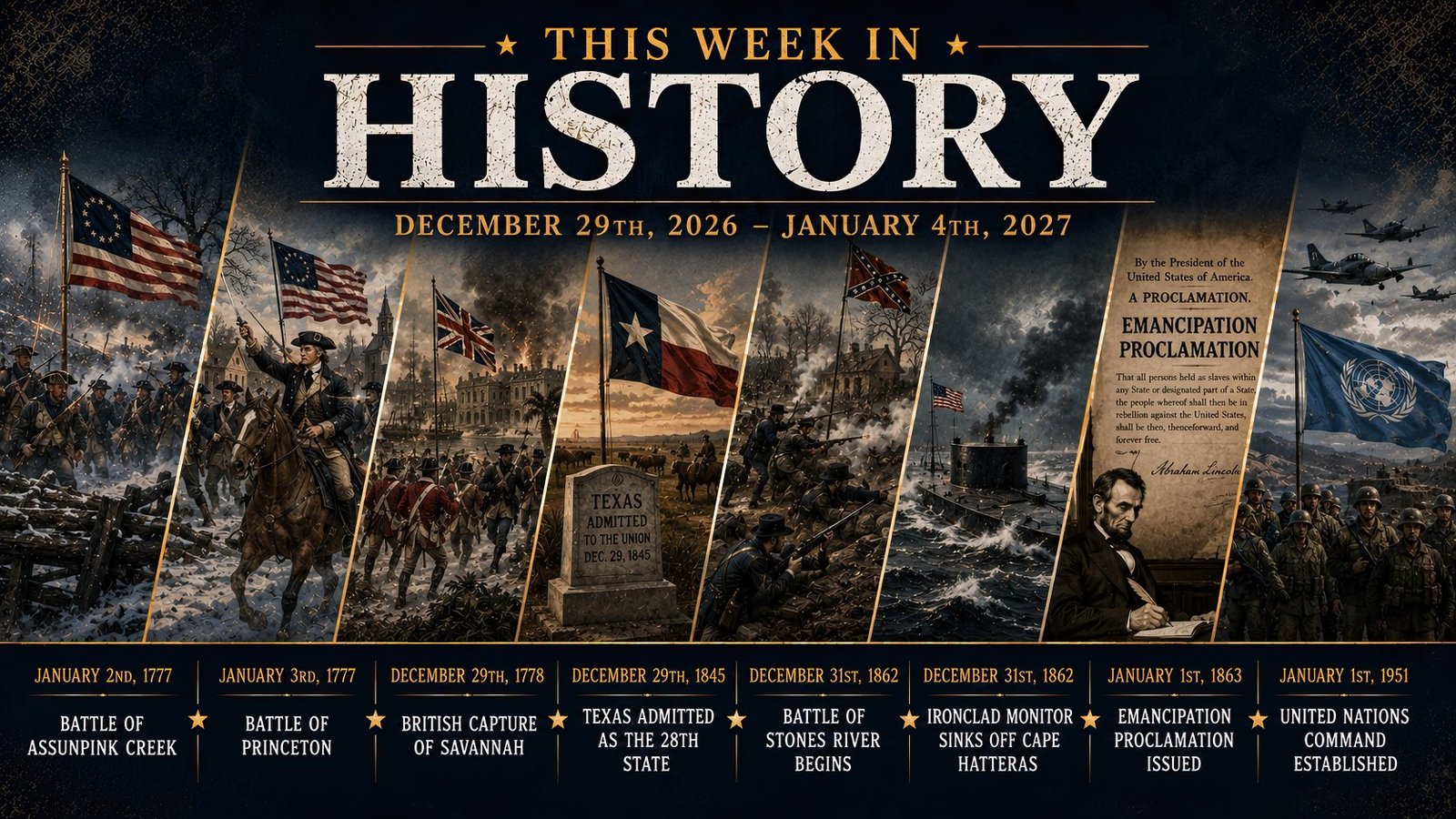
This Week in History · December 29, 2026
489 Populated Entries
Conflicts and historical periods that shaped military institutions and warfare.
Wars & Historical Eras
Every result opens a permanent subject record with its reference context and connected Dispatch coverage. Filter by record type, editorial collection, or a word in the entry.
489 entries found.
On August 13th, 1942, the United States Army Corps of Engineers officially established the Manhattan Engineer District, better known by the shortened phrase that would later describe the atomic bomb project. The district’s creation gave the Army formal responsibility for coordinating a vast, secret effort that drew together physicists, chemists, industrial firms, and military planners.
As the demands of World War II grew, the United States Navy struggled to man new ships, bases, and shore commands. On July 30th, 1942, a law created Women Accepted for Volunteer Emergency Service, better known as WAVES, within the Naval Reserve. For the first time, women could serve as commissioned officers and enlisted sailors in the Navy in large numbers, though they were limited mainly to shore-based roles.
On July 2nd, 1926, the Air Corps Act transformed the Army’s air arm from the Air Service into the United States Army Air Corps, giving aviation a more formal place in the nation’s defense structure. The law did not create an independent air force overnight, but it acknowledged that aircraft had become essential for reconnaissance, bombing, and support of ground troops.
In the early twenty-first century, American defense planners adjusted organizational charts to match emerging challenges, including terrorism, fragile states, and competition for influence in new regions. On February 6th, 2007, the Department of Defense announced the creation of United States Africa Command, often abbreviated as AFRICOM, as a unified combatant command responsible for military relations with most nations on the African continent.
By early 1945, Allied forces in Western Europe had driven the Wehrmacht back to the Rhine, the last great natural barrier before the German heartland. Several crossings were already underway or planned, including the famous seizure of the Remagen bridge, but General George S. Patton’s Third Army sought its own foothold.
In October 1962, the discovery of Soviet nuclear missiles in Cuba put United States forces on some of the highest alert levels in their history.
The snow was hard as concrete on the Belgian hillside, the January cold locking the ground into a sheet of ice. Staff Sergeant Curtis F. Shoup and the soldiers of his company lay sprawled on that frozen slope, their dark uniforms stark against the white as German machine guns raked the hillside. The attack had stalled almost as soon as it began. The enemy gun on the rising ground ahead had perfect fields of fire, sweeping every fold and hollow where the Americans tried to move.
Two days later, early June turned into one of the most famous dates in world history. On June 6th, 1944, Allied forces stormed the beaches of Normandy in northern France in the opening phase of Operation Overlord. United States troops landed primarily at Utah and Omaha Beaches, facing a mix of flooded terrain, beach obstacles, and entrenched German defenders.
On December 28th, 1835, a column of United States soldiers under Major Francis Dade marched through the pine woods of Florida on what officers believed was a relatively routine movement between forts.
The ridge ahead looked less like a battlefield and more like a shattered hillside of rock, clay, and smoke. It was early May 1945 on Okinawa, and the Marines of Company E had stalled below Hill 60. Japanese machine guns chattered from hidden bunkers. Mortar rounds crashed into the slope, showering the men with dirt and splinters of coral. Every attempt to move up the ridge drew a fresh burst of fire that pinned them flat.
Early in the Civil War, Colonel Elmer Ellsworth led the 11th New York “Fire Zouaves,” a regiment drawn from New York City firefighters, across the Potomac River to occupy Alexandria, Virginia. On May 24th, 1861, Ellsworth personally took down a large Confederate flag flying above the Marshall House inn, a banner that could be seen from the White House and that deeply angered President Lincoln.
In the early hours of January 6th, 1919, Theodore Roosevelt died in his sleep at Sagamore Hill, closing the life of a man who had left a deep imprint on American military history. As a young politician, he had resigned his post to help raise the volunteer cavalry regiment that would be remembered as the Rough Riders in the Spanish-American War. His charge up the hills above Santiago, alongside regular Army units and fellow volunteers, became part of the nation’s martial legend.
Decades after Appomattox, the nation marked the passing of the general who had borne so much of the Union’s burden in the Civil War. Ulysses S. Grant died at a mountaintop cottage in New York after a long illness, having raced the clock to complete his memoirs and provide for his family. The former lieutenant general and eighteenth president had guided the Union armies through the brutal Overland Campaign, siege of Petersburg, and final pursuit of Robert E. Lee.
In the dark waters off Tripoli on February 16th, 1804, a young United States Navy officer, Stephen Decatur, led a small boarding party into one of the most celebrated raids in early naval history. The frigate USS Philadelphia had run aground and been captured months earlier, and Tripolitan forces now held her as a valuable prize in the First Barbary War.
On January 1st, 1942, representatives of the United States, Britain, the Soviet Union, China, and many other Allied nations signed a joint pledge in Washington, known as the Declaration by United Nations.
On this day in Philadelphia, delegates of the Continental Congress formally adopted the Declaration of Independence, transforming an armed rebellion into a war for national survival. Fighting had already broken out at Lexington and Concord, Bunker Hill, and along the Canadian frontier, but now the Continental Army, Navy, and Marine forces served an independent United States rather than protesting colonies.
On a July evening in New York, Continental soldiers assembled to hear the newly adopted Declaration of Independence read aloud. Many of these men had been fighting British regulars for more than a year, but this moment tied their service to a clear political break with the Crown. The words about unalienable rights and government by consent took on a sharper meaning for troops who faced invasion from the sea as British forces massed around the city.
In the early 1960s, as Cold War crises multiplied from Berlin to Southeast Asia, American leaders recognized that military intelligence needed more unified direction.
A story of a desperate hilltop stand, a fixed bayonet charge, and how it helped turn a Civil War invasion back.
The jungle pressed in on both sides of the Ormoc Road, a narrow ribbon of mud and broken pavement cutting through the hills near Limon on the island of Leyte. December rain had turned the ditches into brown pools. American infantrymen crouched behind a hasty roadblock of felled trees, sandbags, and wrecked vehicles, listening to the grinding approach of steel.
In the Maryland countryside, as Confederate General Robert E.
Two days after MacArthur’s departure, the Army formalized something more modest but surprisingly far-reaching by authorizing a program for military working dogs, often called the K-9 Corps. Until then, dogs had occasionally served in ad hoc roles, but wartime needs for better guard forces, patrols, and messengers pushed leaders to standardize training and employment.
A story of a long-shot bombing raid, a borrowed carrier deck, and how one gamble shifted the course of a global war.
Barely four months after the attack on Pearl Harbor, the United States planned a strike to carry the war to the Japanese home islands. On April 18th, 1942, sixteen B-25 medium bombers led by Lieutenant Colonel James Doolittle took off from the carrier USS Hornet in the Pacific, a feat never attempted before with aircraft of that size. Spotted early by enemy patrol vessels, the task force launched the bombers farther from Japan than planned, forcing the crews to stretch their fuel to the limit.
Related Dispatch
These current Dispatch articles connect directly to records in the Wars & Historical Eras directory.