Headline Wednesday · December 16, 2026
210 Populated Entries
The terrain, installations, cities, seas, and landscapes where military history occurred.
Places, Bases & Battlefields
Every result opens a permanent subject record with its reference context and connected Dispatch coverage. Filter by record type, editorial collection, or a word in the entry.
210 entries found.
On the night of February 23rd into February 24th, 1991, after weeks of intensive air strikes, coalition ground forces launched the main land offensive of Operation Desert Storm. U.S. Marine divisions attacked into Kuwait from the south, while U.S. Army armored corps and allied units executed a broad “left hook” across the desert into western Iraq to outflank Iraqi forces.
On August 15th, 1944, Allied forces, including a substantial American component, stormed ashore along the southern coast of France in Operation Dragoon. While public attention and many soldiers’ memories focused on the earlier landings in Normandy, this Mediterranean assault opened a second front on French soil, aimed at seizing ports and driving north to link up with forces advancing from the Normandy beachhead.
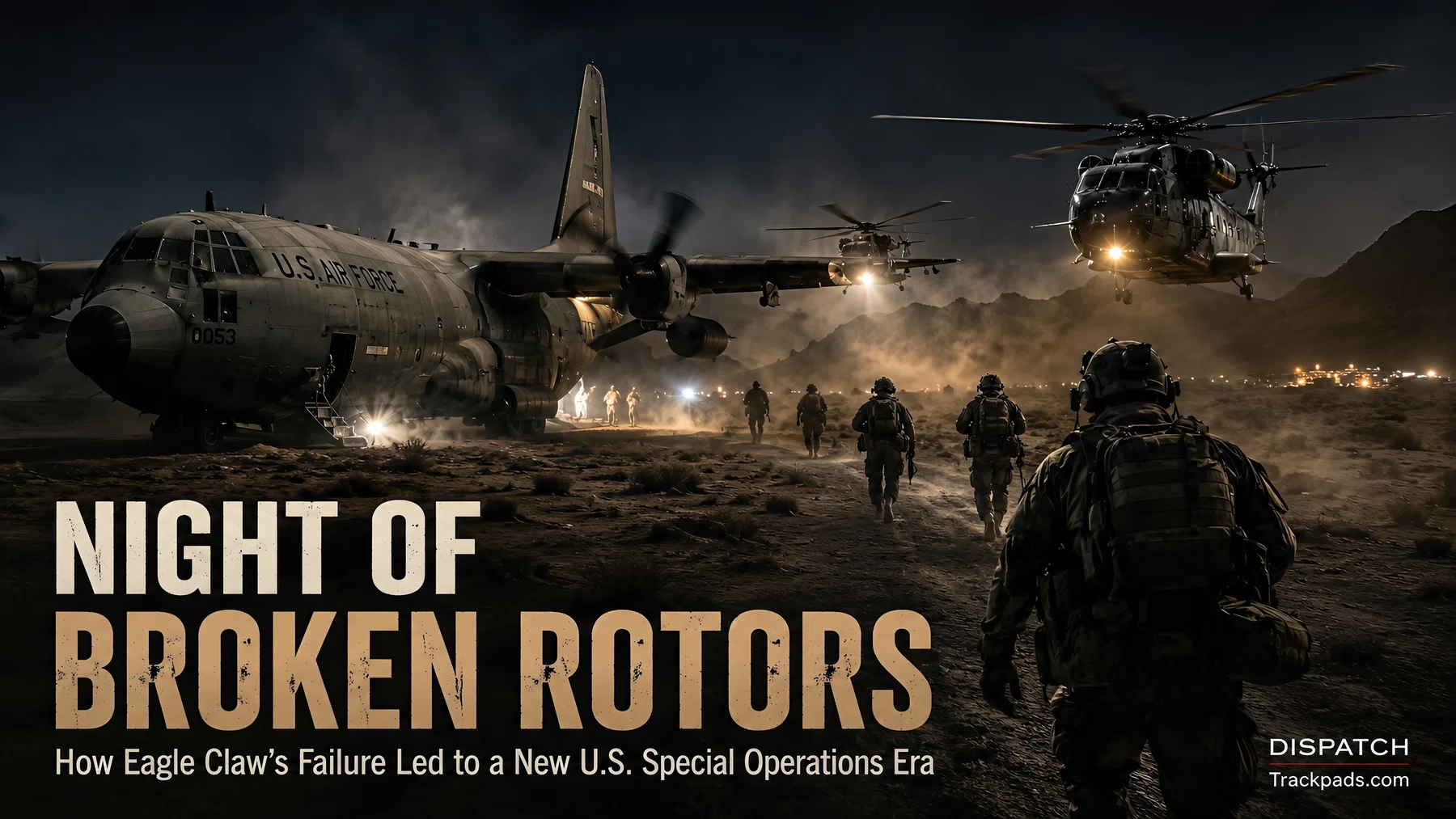
During the Iran hostage crisis, the United States attempted a daring special operations mission to rescue embassy personnel held in Tehran. Code-named Operation Eagle Claw, the plan called for long-range transport aircraft and helicopters to rendezvous at a remote desert staging site, then move on toward the capital under cover of darkness. On April 24th, 1980, mechanical problems, dust, and the challenges of coordinating complex movements over great distances began to undermine the mission.
Two years after Midway, the United States Army Air Forces were striking deep into Axis-held Europe, and June brought another innovation. On June 2nd, 1944, heavy bombers based in Britain launched the first “shuttle bombing” mission of what became known as Operation Frantic. Instead of returning to their original airfields, the bombers hit rail yards and other targets in Eastern Europe and then continued on to land at air bases in the Soviet Union.
At the close of the twentieth century, another August date saw the United States respond to terrorist attacks with long-range strikes. Following the bombings of American embassies in East Africa, United States forces launched Operation Infinite Reach, firing cruise missiles at suspected terrorist training camps in Afghanistan and a facility in Sudan believed to be tied to chemical weapons.
Three years later, the focus in Vietnam had shifted from large American ground offensives toward air power as the main tool for influencing events. On May 9th, 1972, the United States began a new phase of bombing known as Operation Linebacker, paired with the mining of North Vietnam’s principal harbors to cut the flow of supplies.
Nearly a decade after the attacks of September 11th, American intelligence and special operations forces converged on a compound in Abbottabad, Pakistan, believed to shelter al-Qaeda’s leader. In a carefully rehearsed nighttime raid, United States Navy special operators flew in by helicopter, breached the walls, and fought their way through the building, killing Osama bin Laden and collecting valuable documents and electronic media.
As the Vietnam conflict deepened, American leaders turned to the air campaign as a tool of pressure and signal. On March 2nd, 1965, the United States began Operation Rolling Thunder, a sustained bombing effort against North Vietnam that was intended to deter aggression, reduce support to Viet Cong forces in the South, and reassure allies of American resolve.
On the western coast of Italy, Allied planners launched Operation Shingle with the hope of breaking the stalemate along the Gustav Line and speeding the capture of Rome. In the early hours of January 22nd, 1944, American and British troops came ashore near the small port of Anzio under a protective naval and air umbrella. The initial landings met relatively light opposition, and beachheads were established quickly, raising hopes that the operation might trap German forces farther south.
After months of retreat and uncertainty in the Korean War, the Eighth Army under Lieutenant General Matthew Ridgway prepared to strike back. On January 25th, 1951, United Nations forces launched Operation Thunderbolt, an offensive aimed at pushing north from positions south of Seoul and testing the strength of Chinese and North Korean units.
The summer of 1943 found the United States Army Air Forces looking for ways to hit the Axis where it hurt most: oil. From airfields in North Africa, more than one hundred heavy bombers took off for a long-range, low-level mission against refineries around Ploesti, Romania, a key supplier of fuel to Germany. Flying at treetop height to evade radar and fighters, the crews encountered dense flak, smoke, and confusion around the target.
In the second year of the Korean War, United Nations forces under Lieutenant General Matthew Ridgway were pushing north in a series of offensives to reclaim ground lost during earlier Communist advances. As part of this effort, planners designed an airborne operation to cut off retreating North Korean and Chinese units and support the drive across the Han River.
By March 1945, Allied armies had reached the last major natural barrier in western Germany, the River Rhine. In coordination with a large river crossing called Operation Plunder, planners organized an ambitious airborne assault code-named Operation Varsity, using British and American paratroopers and glider-borne troops.
Before dawn on Leyte, the world was reduced to shadows, muzzle flashes, and the flat crack of Japanese rifles. Company A of the 382nd Infantry had clawed its way to the edge of the enemy‑held Buri airstrip, then stalled. Out in front, less than a hundred yards away, Japanese soldiers were dug into bomb craters and a drainage ditch, their machine guns perfectly sighted on every patch of open ground. Anyone who tried to move was met with bursts of fire that snapped past at chest height.
By February 1945, much of Pearl Harbor had returned to the business of war. Battleships and carriers came and went; convoys formed up and headed west toward Iwo Jima and Okinawa. But in a side channel called West Loch, the harbor still hid a graveyard. Months earlier, a chain of explosions had torn through a cluster of tank landing ships loading ammunition for the Pacific campaign.
On July 4th, 1946, in Manila, the United States formally recognized the independence of the Republic of the Philippines, ending decades of colonial rule that had begun after the Spanish-American War. The ceremony marked a major shift in America’s role in the western Pacific, as a territory that had seen fierce fighting during the Second World War now stood as a sovereign partner.
As fighting still raged in the Pacific, leaders of the United States, Britain, and China issued a stark ultimatum to Japan from their conference outside Berlin. The Potsdam Declaration called on Japan to surrender unconditionally or face “prompt and utter destruction,” while also sketching the outlines of postwar occupation, disarmament, and the rebuilding of Japanese society.
A story of a shrinking beachhead, exhausted troops, and how their stand kept South Korea from collapsing in 1950.
A story of small ships on lonely stations, taking the worst hits so the Okinawa invasion could hold together under fire.
In the middle years of the Vietnam War, American leaders sought ways to weaken the enemy’s ability to move troops and supplies down long, fragile lines of communication. On June 29th, 1966, U.S. Air Force and Navy aircraft carried out major attacks on petroleum storage facilities near Hanoi and Haiphong, striking targets that had previously been off-limits or only lightly hit.
The first year of the Korean War saw dramatic swings, from the near collapse of South Korean defenses to daring landings and then to sudden counterattacks by Chinese forces. By early 1951, United Nations units, including large American formations, had regrouped under new leadership and planned an offensive to regain the initiative.
In June 1918, United States Marines and soldiers of the American Expeditionary Forces were committed to stopping a German drive toward Paris near a patch of forest called Belleau Wood. On June 11th, 1918, Marine units launched renewed assaults into the dense, shell-torn woods after earlier attacks had been thrown back with heavy losses.
A 22-year-old heavy machine gunner who held back a German attack in the Battle of the Bulge
A story of exposed convoys, hidden fighters, and the soldiers and medics who kept moving through an urban kill zone.
Related Dispatch
These current Dispatch articles connect directly to records in the Places, Bases & Battlefields directory.