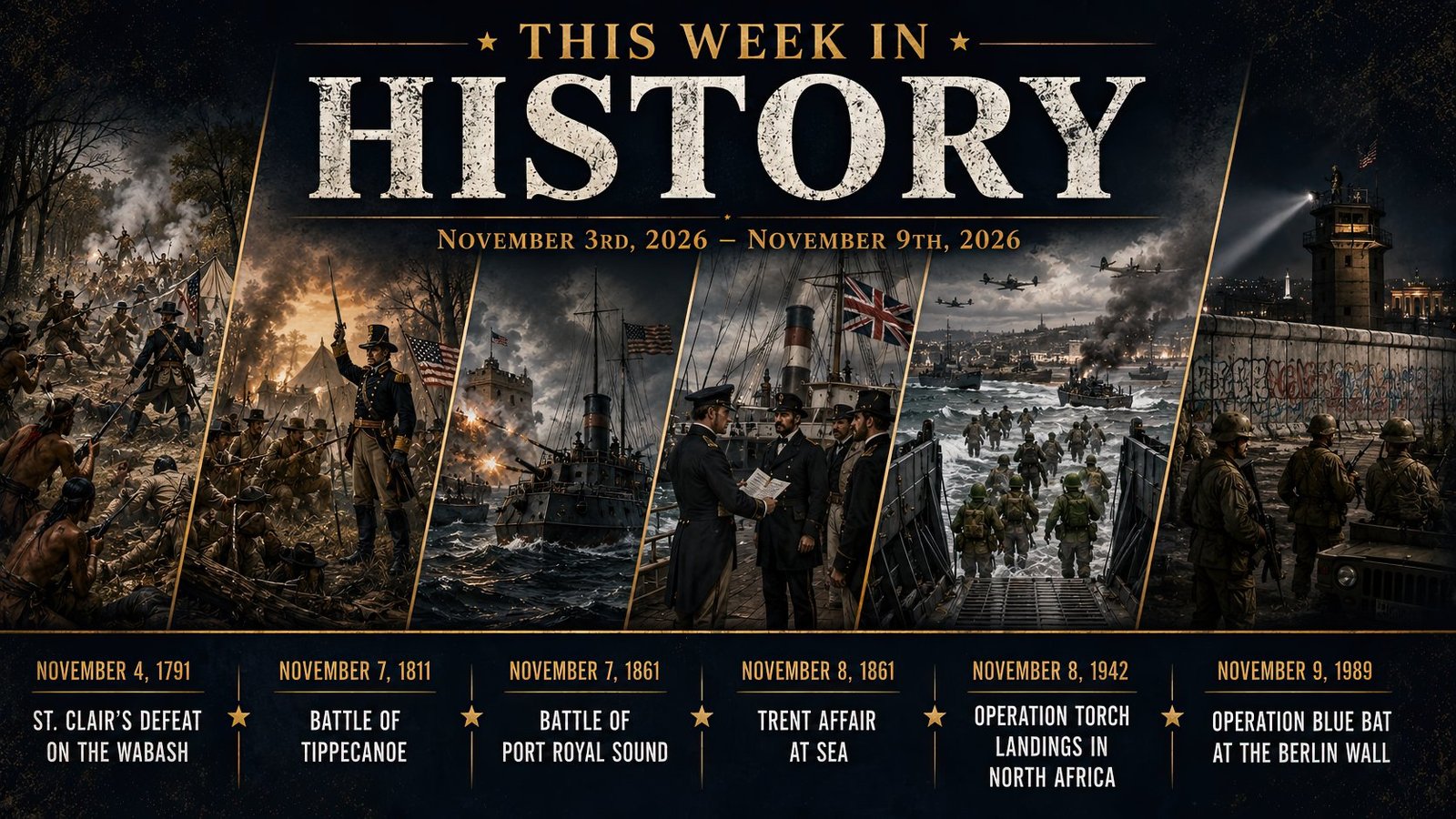
From November 3rd, 2026 through November 9th, 2026, the calendar links frontier skirmishes, blue-water fleets, Cold War walls, and house-to-house fighting in the Middle East. For the United States, these dates trace a long arc from the struggle to control the early republic’s frontiers, through civil war and global conflict, into the uneasy mix of diplomacy and crisis that defined the late twentieth century and beyond. In this edition of “This Week in U.S. Military History,” we follow that arc across battlefields, embassies, and city streets. The stories include crushing defeats that forced reform, amphibious victories that secured sea lanes, and urban offensives that demanded hard lessons in joint operations. Along the way, they remind us that military history is not only about tactics and technology but also about decisions under pressure, alliances managed carefully, and the lives of those who carried rifles, staffed radios, or guarded gates while history shifted around them.
St. Clair’s Defeat on the Wabash
On this day a fledgling United States Army marched into disaster along the Wabash River in the Northwest Territory. Major General Arthur St. Clair led a force of regulars, militia, and camp followers intent on breaking a Native confederation resisting American expansion into what would become Ohio. Poor training, weak supply, and bitter cold left the column vulnerable. At dawn, warriors led by figures such as Little Turtle and Blue Jacket struck the encampment with coordinated attacks that quickly shattered the American lines. Artillery pieces were overrun, and casualties among United States troops and followers were catastrophic, making this one of the worst battlefield defeats the young republic ever suffered. The shock of the loss spurred investigations in Philadelphia and convinced leaders that the nation needed a more professional standing army, paving the way for the Legion of the United States under Anthony Wayne and, in time, a more permanent United States Army.
Open the Wiki entryBattle of Tippecanoe
Two decades later, another fight in the Old Northwest underscored the stakes of American expansion. In the Indiana Territory, Governor William Henry Harrison led a mixed force of regulars and militia toward Prophetstown, a Native town associated with Tecumseh’s growing confederation and his brother Tenskwatawa, often called the Prophet. Before dawn on November 7th, Native warriors launched a sharp assault on the American camp, hoping to break the line before the soldiers could properly form. The fighting was close and confused, with volleys traded at short range and officers struggling to keep units steady in the dim light. Harrison’s men eventually held the field, and Prophetstown was abandoned and burned soon after. Although not a clear strategic knockout, the battle weakened the confederation’s position and deepened frontier hostility, helping push many Native fighters toward alliance with Britain when the War of 1812 erupted and linking this date to a wider continental conflict.
Open the Wiki entryBattle of Port Royal Sound
As the Civil War entered its first winter, Union planners sought a deep-water harbor along the Confederate coast to support a tightening blockade. On November 7th, 1861, a powerful Union naval squadron under Flag Officer Samuel F. Du Pont steamed in disciplined circles through Port Royal Sound, South Carolina, trading fire with Confederate forts guarding the channel. The operation was amphibious in nature, meaning it combined naval gunfire and the planned landing of troops to seize shore defenses. Union shells pounded the Confederate positions with growing accuracy, while the defenders struggled to adjust to the mobile ships. Eventually the forts were abandoned, and the harbor fell into Union hands. Port Royal became a major base for blockading operations against Charleston and Savannah, as well as a logistical hub for future coastal campaigns. The victory also opened an early foothold for experiments in educating and employing formerly enslaved people, tying a naval success to the broader transformation of the South.
Open the Wiki entryTrent Affair at Sea
Only one day after the Port Royal victory, another Union action at sea nearly widened the war in a dangerous direction. On November 8th, 1861, the United States warship San Jacinto, commanded by Captain Charles Wilkes, stopped the British mail steamer Trent in international waters. Wilkes removed two Confederate commissioners, James Mason and John Slidell, who were traveling to Europe in search of diplomatic recognition and support. The seizure thrilled many in the Union public, who saw it as a bold stroke against Confederate diplomacy, but it outraged the British government, which viewed the act as a violation of neutral rights. British forces prepared for possible conflict, and the prospect of facing both the Confederacy and the British Empire at once suddenly became real. After tense weeks, President Abraham Lincoln’s administration agreed to release the envoys, accepting that the legal case was shaky and that “one war at a time” was the wiser course, showing how naval operations and diplomacy were tightly bound together.
Open the Wiki entryOperation Torch Landings in North Africa
On November 8th, 1942, the United States undertook its first major offensive in the European–North African theater of the Second World War. In Operation Torch, American and British forces launched amphibious landings along the coasts of French Morocco and Algeria, striking beaches and ports near Casablanca, Oran, and Algiers. Amphibious warfare meant coordinating convoys, landing craft, naval gunfire, and air support to put troops ashore against uncertain resistance. The attackers faced not the German army directly but forces of Vichy France, whose officers and crews were themselves divided about whether to fight the landings. Confused clashes, hurried negotiations, and hard fighting all unfolded within the first days. Ultimately, the landings succeeded well enough to give the Allies a foothold, setting the stage for the Tunisia campaign and later invasions of Sicily and mainland Italy. For the United States Army and Navy, Torch was a costly but invaluable classroom in large-scale coalition warfare and amphibious operations far from home ports.
Open the Wiki entryOperation Hump in Vietnam
Another November 8th, separated by two decades, found American paratroopers pushing through thick jungle rather than surf. In 1965, the 173rd Airborne Brigade conducted Operation Hump, a search-and-destroy mission in the harsh terrain of War Zone D northeast of Saigon. Search-and-destroy operations were designed to find enemy units, inflict casualties, and then withdraw rather than hold ground. The paratroopers inserted by helicopter and soon encountered a sizable Viet Cong force, triggering sharp firefights at close range where visibility was poor and the enemy knew the ground intimately. Units became scattered, casualties mounted, and the burden fell heavily on junior leaders and medics trying to keep wounded soldiers alive under fire. One of those medics, Specialist Five Lawrence Joel, moved again and again through enemy fire to treat and evacuate casualties despite being wounded himself, actions for which he later received the Medal of Honor. The day’s toll underscored both the bravery of individual soldiers and the limits of attrition-focused operations in such terrain.
Open the Wiki entryIran Hostage Crisis Begins
On November 4th, 1979, the line between diplomatic tension and outright crisis was crossed at the United States embassy in Tehran. Iranian students aligned with the country’s new revolutionary leadership surged over the compound’s walls and seized dozens of American diplomats, Marines, and staff members. The captives were paraded before cameras, and the embassy’s records and spaces fell under the control of the occupiers. What might have been a brief incident instead hardened into a prolonged hostage crisis that lasted for more than a year. In Washington, military and civilian leaders wrestled with how to apply pressure while avoiding a wider war, eventually approving a complex rescue attempt that ended in tragedy in the desert. The ordeal reshaped American thinking about terrorism, irregular threats, and the need for standing special operations capabilities, while leaving deep marks on the hostages, their families, and a generation of service members who watched the drama unfold.
Open the Wiki entryOpening of the Berlin Wall
On November 9th, 1989, the emblem of Cold War division in Europe suddenly became porous. For decades, United States soldiers had served in and around West Berlin, helping to guarantee access to the city and to deter the Soviet Union and its allies. That evening, after confusing announcements by East German officials about new travel rules, crowds surged toward crossing points in the wall that had split families, streets, and neighborhoods since the early 1960s. Border guards, facing growing numbers and unclear orders, chose not to fire and began allowing people to pass. Images of East and West Berliners embracing and chipping away at the concrete flashed around the world. For American troops stationed in Germany, the moment signaled that the containment strategy they had supported for so long was entering a new phase. Within a few years, the wall’s ruins would mark not a fortified frontier but the memory of a confrontation the United States and its allies had endured for decades.
Open the Wiki entrySecond Battle of Fallujah
On the night of November 7th, 2004, Marines and soldiers moved toward the Iraqi city of Fallujah for what would become one of the most intense urban battles fought by United States forces since the Vietnam War. Insurgents had turned the city into a stronghold of fortified houses, improvised explosive devices, and interlocking fields of fire after an earlier operation had been halted. The Second Battle of Fallujah, sometimes called Operation Phantom Fury, aimed to break that stronghold with a coordinated assault by United States Marine Corps regiments, United States Army units, and Iraqi government forces. Urban combat demanded clearing buildings block by block, dealing with booby traps, and facing an enemy who could slip through alleys and underground routes. Casualties were significant, and the fighting placed enormous strain on small units and their leaders. Yet the operation also produced hard-won lessons in joint planning, intelligence integration, and the moral and practical challenges of high-intensity fighting amid civilian neighborhoods, lessons that continued to influence training and doctrine long after the last patrols left the city.
Open the Wiki entryAcross the Week
Across these November dates, United States military history reveals a pattern of challenge and adaptation. Frontier defeats forced leaders to rethink how they raised and trained armies, while naval victories and diplomatic crises showed that what happened at sea could influence whether great powers joined or stayed out of war. Amphibious assaults in North Africa and urban battles in Iraq both demanded close cooperation among services and allies, even though they were separated by generations and technology. The opening of the Berlin Wall and the trauma of the Iran hostage crisis, though not conventional battles, reminded Americans that strategy and service extend far beyond defined front lines. Taken together, these episodes show a military that has repeatedly had to learn, adjust, and carry forward under changing circumstances, a story shared by the veterans and families who still feel the echoes of decisions made on weeks like this one.