Dust, Darkness, and a Mission on the Line
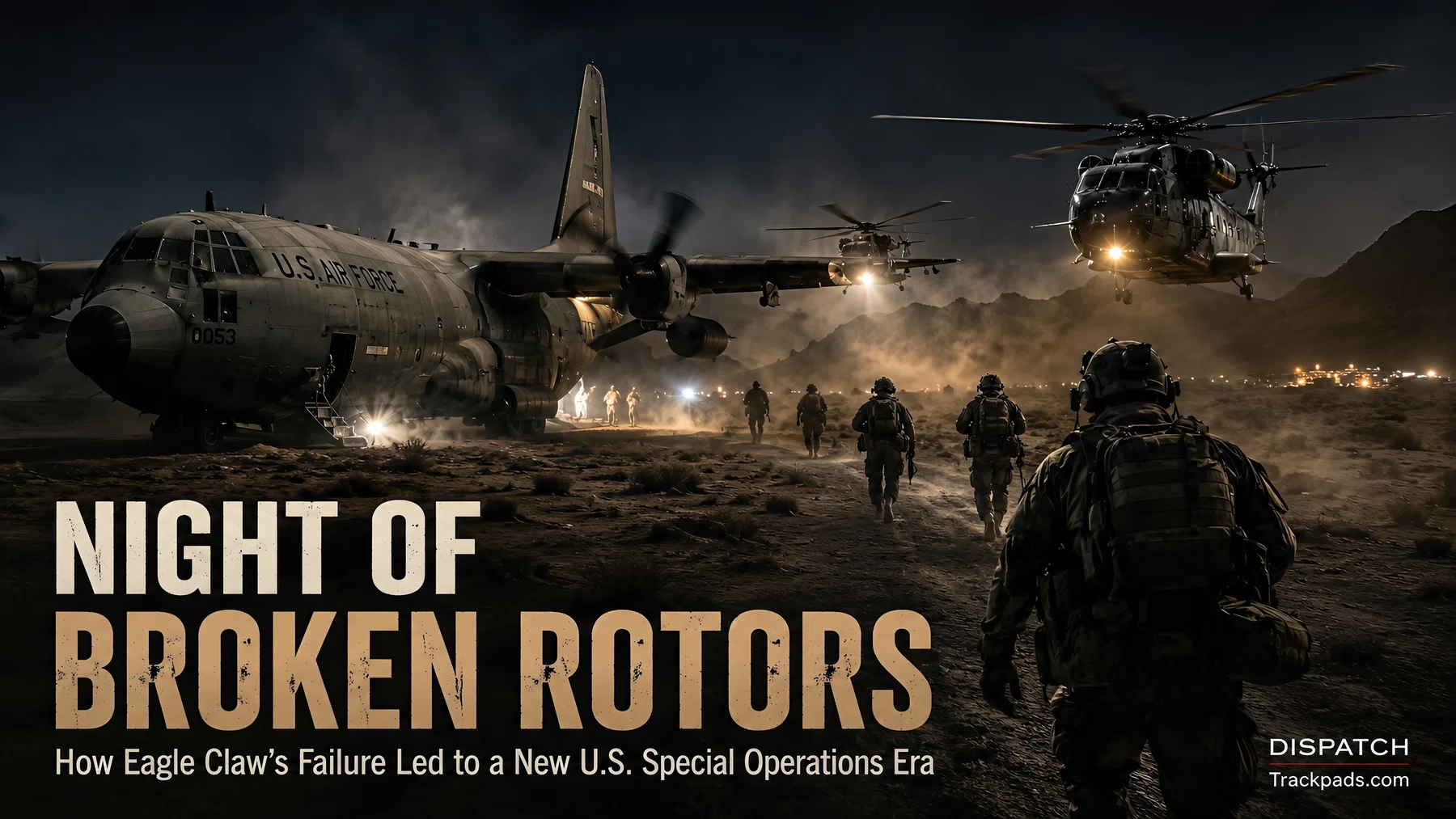
Shortly before midnight on 24 April 1980, a lonely stretch of Iranian desert called Desert One flickered to life with infrared beacons and the muted growl of engines. Transport aircraft from the United States Air Force squatted low on the sand, their cargo bays open to the night, while special operators and Rangers stepped down into a world of dust, darkness, and uncertainty. The men had flown in low and long, lights out, across hostile territory to reach this secret refueling and rendezvous point. Somewhere out in the black, Marine helicopter crews were fighting their way through violent sandstorms to join them.
At ground level the air tasted like talc. Rotor wash whipped up blinding clouds as the first of the big RH-53 helicopters finally appeared, their outlines ghostly in the swirling grit. Operators shielded their faces with scarves and goggles, trying to make out tail numbers and hand signals, shouting over the noise of turbines and roaring blades. They were here to begin a daring rescue of American hostages held in Tehran, a mission that had been rehearsed for months and debated for even longer at the highest levels of government. Tonight was the night it would either launch or die in the sand.
The plan was fragile by design: a carefully timed sequence of air movements, refuelings, and linkups that depended on enough helicopters making it to Desert One. As minutes stretched into an hour and more, officers and enlisted men watched the horizon and listened to scratchy radio calls that carried equal parts static and bad news. One helicopter had turned back with mechanical trouble. Another was missing in the storm. Every report chipped away at the margin for error that was already perilously thin.
On the ground, the operators checked weapons, rechecked maps, and tried to stay focused while the situation eroded around them. A civilian bus blundered into the site and had to be stopped and controlled. Fuel trucks maneuvered dangerously close to spinning rotors in the murk. The scene that had looked clean and choreographed on planning slides now felt chaotic and cramped. By the time the last helicopter limped in, damaged and late, the question was no longer how to push the mission forward, but whether it could safely continue at all.
Hostages, Politics, and a Nation’s Credibility
The chaos at Desert One only made sense against the backdrop of the Iran hostage crisis that had gripped the United States for months. In November 1979, Iranian militants seized the American embassy in Tehran and took dozens of diplomats and staff hostage, turning them into bargaining chips in a revolution still settling its scores. Every night, Americans saw images of blindfolded hostages and chanting crowds on television. The crisis humiliated Washington, poisoned relations with Tehran, and became a running test of the Carter administration’s resolve. Diplomatic efforts dragged on without results, while the hostages grew older in captivity with each passing day.
Inside the Pentagon and the White House, the stakes were measured in more than headlines. If the hostages could be rescued by force, it might restore some measure of American credibility in the region and reassure allies who wondered whether the United States could still protect its people. If the mission failed or triggered a wider war, it could cost lives, inflame anti-American sentiment, and deepen instability in a part of the world where oil, sea lanes, and Cold War competition were already tightly wound together. Every option looked bad; doing nothing looked worse.
The men gathering at Desert One represented a new kind of American capability that was still finding its shape. Delta Force, the Army’s dedicated counterterrorism and hostage rescue unit, had been built for exactly this sort of operation but had never been used on this scale. They were joined by Rangers for security, Air Force special operations aviators skilled at low-level flight, and Marine helicopter crews tasked with pushing heavy, aging airframes to their limits. These units came from different services, cultures, and chains of command, stitched together for a one-time mission that demanded flawless coordination.
For them, the stakes were personal as well as strategic. Success meant bringing fellow Americans home alive from the heart of a hostile capital and proving that this new special operations tool could work under the harshest conditions. Failure meant dead comrades in the desert or in the streets of Tehran, a political firestorm back home, and a long shadow over every future attempt to use such forces. As fuel levels, aircraft readiness, and time all began to work against the rescuers at Desert One, the weight of those stakes bore down on every decision, turning a dark patch of Iranian sand into the pivot point of a national crisis.
Building a One-Shot Rescue Machine
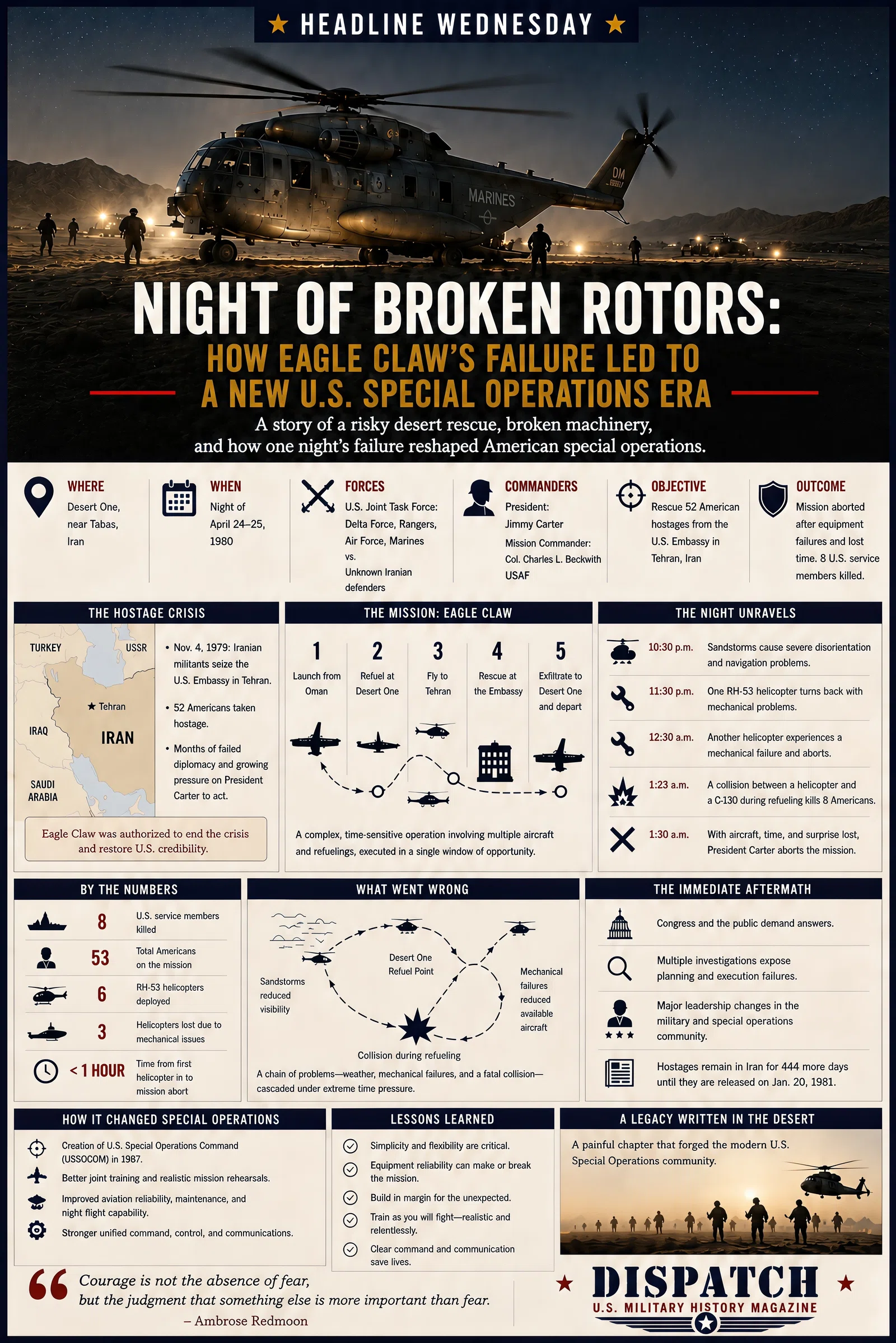
Operation Eagle Claw did not spring up overnight. In the months after the embassy was seized, planners inside the Pentagon and the newly formed Delta Force worked through a series of concepts that veered from simple to wildly complex. A direct raid by aircraft landing at the embassy, an armored thrust from a neighboring country, even covert efforts to extract a few hostages at a time were sketched and discarded. Tehran sat deep inside a hostile country, ringed by air defenses and patrolled by a revolutionary regime on high alert. Any rescue attempt would require slipping forces across long distances, hitting hard in the center of the capital, and then vanishing again before the Iranians could react in strength.
The plan that emerged was intricate and fragile. Special operators and Rangers would fly into a remote desert landing zone aboard specially modified C-130 transports, refuel Marine RH-53 helicopters there, and then push forward. The helicopters would carry Delta Force toward a hide site closer to Tehran, where the team would rest during daylight. On the following night, they would move into the city, assault the embassy compound, and free the hostages. Meanwhile, Rangers would seize a nearby airfield so that larger transports could land, load everyone, and fly them out. Every phase depended on the previous one working with almost no slack.
Underneath the bold arrows on the planning maps lurked real friction. The services involved had different cultures, equipment, and command chains, and there was no standing joint special operations command to bind them together. Helicopter pilots trained at sea had to learn to navigate deep inland at night. Ground forces rehearsed mock assaults on replica embassy compounds built in the American Southwest, but they could not fully simulate Tehran’s streets, crowds, and revolutionary guards. Intelligence on Iranian air defenses and internal security was solid in some areas and alarmingly thin in others.
Yet as winter turned to spring, momentum built. The hostages had been held for months, negotiations showed no breakthrough, and domestic pressure on the administration tightened with every news broadcast. The plan’s many moving parts were refined, rehearsed, and briefed until they felt, at least on paper, achievable. Key leaders accepted that there would be risk, but they believed surprise, professionalism, and careful timing could offset it. In that atmosphere, the requirement that at least six helicopters arrive safely at Desert One became more than a planning figure. It became the thin numerical line separating a desperate but possible rescue from a mission that should be called off.
When Plans Collapsed in Desert One
On the night of the launch, the first stages went roughly as scripted. The C-130 transports skimmed across the region at low altitude, following long, dark routes into Iran to avoid radar and fighters. At Desert One, their crews marked out landing lanes with small lights and infrared beacons, then settled into the dirt one by one, engines idling as fuel and equipment were prepared. Special operators and Rangers stepped off into the choking dust, spreading out to secure the perimeter and establish roadblocks on the nearby track that passed for a highway. For a while, the desert was quiet enough that they could hear their own gear clink.
The helicopter leg unraveled more quickly. Flying from a carrier over the Arabian Sea, the RH-53 crews ran into towering walls of dust and sand that degraded instruments and visibility. One helicopter turned back with mechanical trouble before ever reaching the rendezvous. Another pressed on but lost its bearings, adding to the confusion on the radios. A third developed serious issues that raised questions about its ability to continue. By the time the remaining aircraft began arriving at Desert One, crews were already tired, and the force was below its planned strength.
On the ground, the textbook choreography of refueling and repositioning had to share space with unwelcome surprises. A civilian bus rolled up the road and into the outer security arc, its passengers blinking in shock at the sight of armed Americans and large aircraft in the supposedly empty desert. The bus was stopped and its occupants detained, adding a human complication and a new clock: the longer the force stayed, the more likely someone would notice people and vehicles missing. Later, a fuel truck stumbled toward the site, and warning shots and fire set it ablaze, sending flames and smoke twisting into the night.
Inside the small command circle, the numbers no longer worked. Only a handful of helicopters sat on the desert, and one of those was discovered to have a critical hydraulic problem after landing. The minimum of six airworthy aircraft that planners had insisted on was now out of reach. Commanders weighed the risks of pressing on with too few helicopters against the prospect of breaking contact and withdrawing before Iranian forces could react. After tense discussion and calls back to higher authority, the decision came down: the mission would be aborted. The rescue would not move forward to Tehran.
Aborting did not end the danger. In the cramped, dusty landing area, transports and helicopters had to maneuver close to each other for refueling and departure. Visibility was poor, fatigue was rising, and the margin for error was razor thin. As one RH-53 tried to reposition, it collided with a waiting C-130, tearing into the larger aircraft and touching off an explosive fireball. In an instant, fuel, metal, and flame turned part of Desert One into a killing ground. Eight American servicemen lost their lives in that collision and fire, and others were injured as crews scrambled to escape the burning wreckage.
With heat from the blaze licking at nearby aircraft and the risk of further explosions growing, the surviving aircrews and operators made a hasty, painful choice. They evacuated the site as quickly as they could, leaving behind bodies, wrecked aircraft, and equipment that could not be safely recovered under the circumstances. As the transports clawed back into the night sky, the desert below flickered with the flames of ruined machines and the first threads of a story that would soon circle the globe. The fight at Desert One had not been a conventional battle, but it had become something just as consequential: a failed rescue that exposed deep gaps in how America planned and executed its most sensitive missions.
Abort, Fire, and Hard Lessons
The formal turning point of Operation Eagle Claw came with the decision to abort, but the real hinge lay in everything that decision revealed. When commanders at Desert One and higher headquarters agreed that too few helicopters remained airworthy to continue, they upheld the safety margins built into the plan. At the same time, that call exposed how fragile the entire structure had been. A mission that depended on a specific number of airframes surviving storms, mechanical issues, and navigation challenges without meaningful backup was always one bad night away from collapse. In the harsh light of hindsight, what happened in the desert was not just misfortune. It was a demonstration of how thin the line had been from the start.
The deadly collision between the RH-53 and the C-130 turned a failed mission into a national trauma. In seconds, an already painful retreat became a scene of fire, exploding fuel, and lost lives. The image of burning aircraft in a remote Iranian desert, men scrambling clear with burns and injuries while comrades lay dead, became the most searing symbol of the operation. It showed how quickly a complex plan could unravel once friction and fatigue pushed people and machines past the edge of safe performance. No enemy fire had struck the force at Desert One. The casualties came from the mission’s own complexity and the constrained environment in which it played out.
Yet even in failure, the conduct of individual aircrews and ground personnel at Desert One pointed to what could be built from the wreckage. Pilots and loadmasters moved toward flames to pull survivors free. Special operators and Rangers shifted from a poised assault force to an improvised rescue team in seconds, helping to evacuate wounded, account for their people, and salvage what they could before the remaining aircraft had to leave. Their actions under extreme stress underscored that the human component of the plan had not been the weak link. The weakness lay in how they had been organized, equipped, and commanded.
The true turning effect of Eagle Claw did not arrive on the night sanded eyes stared at wrecked machines. It arrived in the months and years that followed, as leaders studied what had gone wrong and what had actually gone right. They found that courage and skill had not been enough to overcome gaps in joint planning, dedicated special operations aviation, and unified command. Those hard lessons, written in fire at Desert One, became the seed of a fundamentally different approach to American special operations.
From Desert One to a New Special Operations Era
News of the failed rescue mission broke across the United States with a mixture of shock and grief. The public learned that eight servicemen had died in Iran before ever reaching Tehran, and that the hostages remained in captivity. President Carter took public responsibility for the operation, and the already intense political pressure around the hostage crisis sharpened further. For many Americans, the images from Desert One seemed to capture a broader sense of drift and frustration at the end of a difficult decade. Critics saw the failure as proof of weakness; supporters argued that at least the country had tried. Either way, the costs were clear.
Inside the military, the aftermath took a different shape. Investigations and reviews mapped out the chain of decisions that had led to Eagle Claw’s structure and failure. They highlighted the lack of a standing joint special operations headquarters, the limited pool of aviators trained specifically for long-range, night, low-level infiltrations, and the ad hoc way in which elite units from different services had been stitched together. Delta Force, the Rangers, Marine aviators, and Air Force crews had brought professional skill and courage. What they had lacked was a unified system designed from the ground up to support missions like this one.
Out of that realization grew new institutions and capabilities. A permanent joint special operations command was established to bring together elite units under one roof for planning, training, and execution. Specialized aviation units were built to provide dedicated, highly trained helicopter and fixed-wing support for special operations forces, including crews who would make night, low-level flying with heavy loads their craft. Over time, these efforts would feed into broader reforms, including changes to how the services shared resources and authority for special operations. The shadow of Desert One lay behind every chart and directive that pushed those reforms forward.
The impact reached beyond organizational wiring diagrams. Doctrine and training began to treat complex, deep-penetration missions not as rare one-offs but as tasks that needed structured rehearsal, realistic joint exercises, and robust contingency planning. Future operations, from Grenada and Panama to the long campaigns after September 11, drew on units, aircraft, and command arrangements that traced their lineage to the lessons of Eagle Claw. When Americans watched later hostage rescues or special operations raids unfold with apparent precision, they were seeing the distant, altered echo of that night in 1980.
For students of military history, staff officers on planning teams, and visitors standing in front of a display about Desert One in a museum, the story of Operation Eagle Claw offers more than a tale of failure. It shows how a single, painful episode can force a great power to confront its own limitations and invest in real change. Night of broken rotors in a remote desert became the dark starting point for a new American special operations era, one built on the idea that courage in the field must be matched by coherent structures, realistic preparation, and hard-earned humility at the top.