In Action
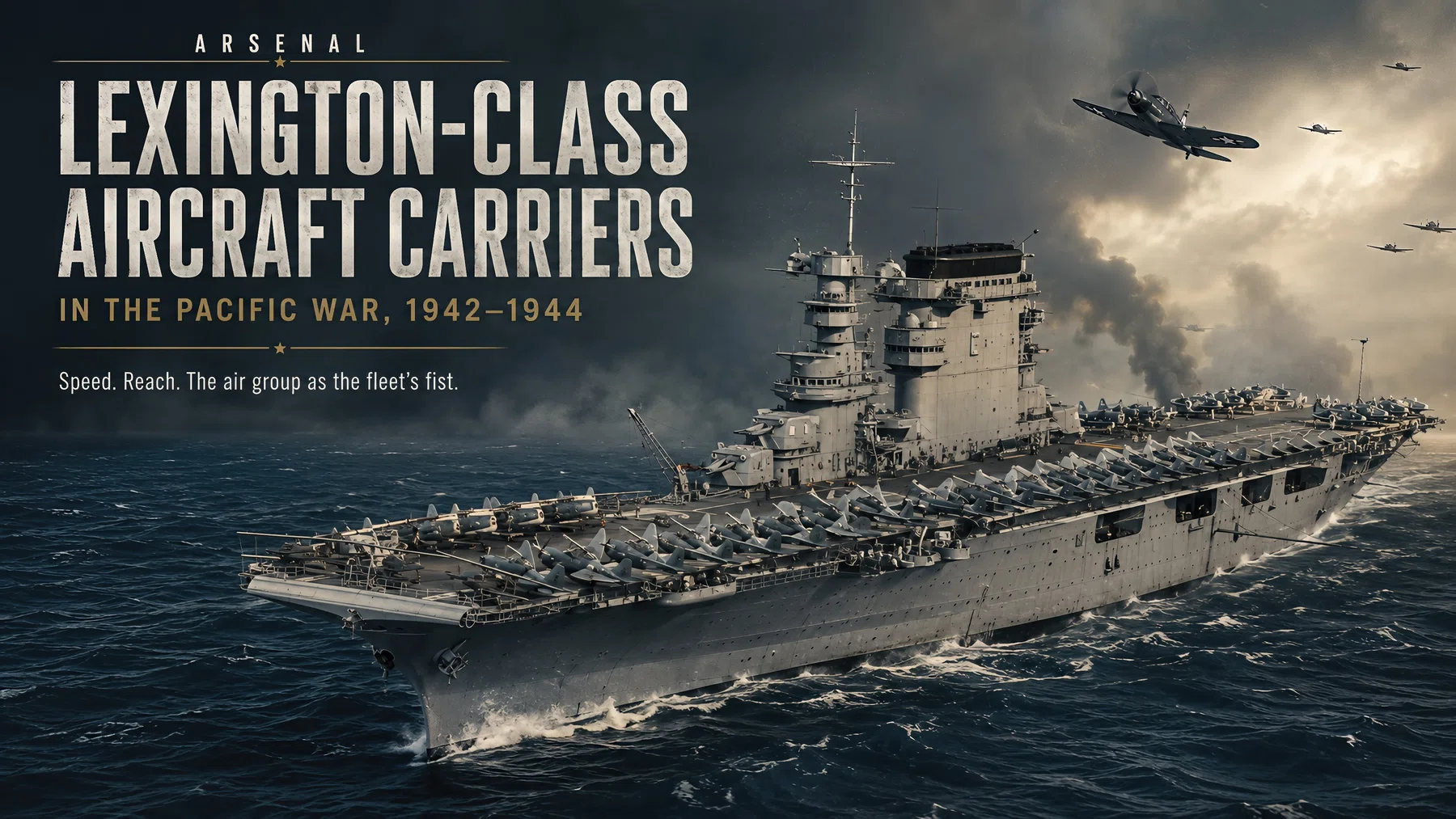
Dawn over the Coral Sea comes up gray and low, a smeared horizon where sky and water blend together. On the flight deck of USS Lexington, men in colored jerseys jog between parked aircraft, shouting over the steady thunder of the ship’s turbines and the shriek of spinning propellers. The big carrier leans gently into the swell, her bow cutting a white V through the Pacific as the wind over the deck builds to launch speed.
An SBD Dauntless claws into the air, then another, then a string of TBD Devastator torpedo bombers, each one taking a short, shuddering run before dropping off the bow and lifting away. Below, in the hangar deck, aircraft handlers wrestle spare planes into position, fueled and armed, waiting for the word that the Japanese carrier force has been found. The ship hums with compressed energy: radios crackle, plotting boards fill with grease-pencil tracks, and down in engineering the temperature climbs as Lexington pushes for every knot of speed she can give.
Hours later, the pressure snaps into violence. Lookouts call incoming raids. The calm gray sky fills with glittering specks that grow into attacking dive-bombers and torpedo planes. The ship heels as the helmsman throws her into hard turns, wake curling high off the stern. Bombs slam into the sea around her, great pillars of water showering the deck. Then a torpedo hits home, then another, the shock thudding through steel and bone alike. Fires bloom, smoke thickens, and the crew fights to keep their floating airfield alive.
By the time Lexington’s men abandon ship, lowering themselves into an oil-streaked sea as their carrier settles by the bow, it is clear that this is more than one ship’s story. It is the proving ground for a new kind of naval warfare, fought at ranges where opposing fleets may never see each other, and it rests on the shoulders of the big, fast carriers that replaced battleships as the centerpiece of the fleet.
The Problem It Was Built To Solve
The Lexington class began as an answer to a different question. In the years after the First World War, the United States Navy worried about fast enemy raiders and battlecruisers threatening its sea lanes and the battle line. The original Lexington and Saratoga were laid down as battlecruisers, meant to be swift, heavily armed scouts and flankers for the battleship fleet. Then came naval arms limitation treaties, tonnage caps, and the realization that the next war at sea might not be decided at battleship gunnery ranges.
Aviation was the disruptive force that refused to be ignored. Experiments showed that aircraft could find ships far beyond the horizon and deliver bombs and torpedoes at distances no gun could match. The problem was not just to put planes on ships; that had already been tried with smaller early carriers. The challenge was to create a fast, long-legged “floating airfield” that could keep up with the fleet, carry a large air group, and strike first across the wide reaches of the Pacific.
Existing carriers like Langley were conversions of collier hulls, slow and limited in capacity. They could prove concepts but not anchor a war plan. Planners inside the Navy began to see aircraft carriers as more than scouts; they could be the main striking arm of the fleet, provided they were fast enough, big enough, and tough enough to operate in blue water alongside cruisers and battleships.
Converting the unfinished Lexington and Saratoga from battlecruisers into carriers offered a way around treaty limits while solving several problems at once. The large hulls promised high speed and generous flight deck space. Their machinery could give them the legs to operate across the Pacific without constant refueling. The Navy needed a pair of ships that would test whether carrier air power could truly take the lead in fleet engagements. With that decision, the Lexington class became a bridge between the battleship age and the carrier era, setting the stage for the Pacific War that would soon demand everything they could deliver.
From Design Board To Production
Turning Lexington and Saratoga from half-finished battlecruisers into aircraft carriers was not a simple paper exercise. Naval architects had to marry a hull designed for big guns and armor with the very different needs of flight operations. The Washington Naval Treaty limited capital ship tonnage but allowed a certain amount to be assigned to carriers, and converting the two large hulls kept valuable work in American shipyards while staying inside treaty rules. Designers stripped away the planned heavy turrets and much of the armor, then added a long, unobstructed flight deck, hangar spaces, aviation fuel systems, and workshops to support a full air group.
Tradeoffs appeared everywhere. The battlecruiser hull offered speed and range, but the large machinery and armor weight limited how much could be added above. Stability and strength were constant concerns, especially once a long wooden flight deck and island superstructure were placed high on the hull. Designers had to balance the need for generous hangar volume and aviation fuel storage against the danger of fire and explosion if those spaces were hit. They kept a battery of eight-inch guns for a time to give the carriers some surface punch, but these weapons and their handling rooms took space and weight that might otherwise have gone to anti-aircraft defenses and more aircraft support.
From the Navy’s perspective, the payoff justified the compromises. The Lexington class emerged as fast fleet carriers able to steam at well over thirty knots and keep pace with cruisers and destroyers across the Pacific. Their turbo-electric drive systems gave smooth power control and long endurance, even if they were complex to maintain. At a glance, the Lexington class were large fleet carriers of the United States Navy, serving mainly in the Pacific during the early years of the Second World War. Each ship displaced on the order of forty thousand tons at full load, stretched more than eight hundred feet long, carried a typical wartime crew of several thousand officers and enlisted men, and could operate roughly seventy to ninety aircraft depending on the period and mix of fighters, dive-bombers, and torpedo planes. Built in the late nineteen twenties and early nineteen thirties, they entered service as the Navy’s first truly fast carriers, setting patterns that later classes would refine.
Inside The Weapon
Seen from the sea, a Lexington-class carrier looked like a long, high-sided island of steel moving at improbable speed. The blunt bow rose above the waterline, leading back to a vast flight deck that seemed to run to the horizon. On the starboard side stood the island, a tower of bridges, masts, and funnels that housed the bridge, flag bridge, navigation spaces, and the control positions from which air operations and ship maneuvers were directed. Smoke from the great boilers vented through trunked funnels, angled to keep exhaust away from the landing area as much as possible. The wooden planking of the flight deck absorbed the pounding of aircraft wheels and the constant scuff of boots and chocks.
Just beneath that open expanse was the hangar deck, the real heart of the carrier. It was a long, enclosed space where aircraft were parked, serviced, and armed, with overhead cranes, workbenches, and racks of spare parts. Elevators cut through both decks, raising and lowering planes between hangar and flight deck in a steady cycle. Aviation fuel lines, bomb and torpedo magazines, and ammunition hoists fed this system, and their protection became a matter of life and death once the ships went into combat. Fire doors, ventilation systems, and damage control stations were threaded through the ship to contain and fight any blaze that might start in these vulnerable spaces.
Crew life and workflow revolved around this flying factory. On the flight deck, teams of plane handlers, ordnance crews, and fuel parties moved aircraft into position, loaded bombs and torpedoes, and checked every control surface before launch. Colored jerseys marked roles so that pilots and officers could read the deck at a glance. Pilots and aircrew waited in ready rooms just off the flight deck, where they received last-minute briefings over diagrams and maps before climbing into their machines. Below, in squadron spaces and berthing compartments, they shared cramped bunks, swapped stories, and tried to snatch sleep between launches.
Deeper in the hull, far from sunlight or fresh air, engineers and machinists tended the massive boilers and turbo-electric machinery that drove the ship. Their world was noise, heat, and gauges, a place where a missed valve setting or unnoticed leak could cost the ship vital knots at the wrong moment. Elsewhere, radar operators and lookouts fed information into plotting rooms where officers tracked friendly and enemy forces on grease-pencil boards. The carriers’ early radar sets, combined with radio communications and fighter direction procedures, gave the Lexington class the ability to see and strike beyond visual range, though those systems were still evolving when war came.
For the crew, “inside the weapon” meant more than compartments and equipment. It meant learning the choreography that turned thousands of individual tasks into a coordinated launch or recovery cycle. It meant trusting that the massive ship under their feet could take sharp turns at high speed without losing aircraft over the side, and that the deck crews would be ready with crash barriers and fire hoses when landings went wrong. Training ashore could only hint at the reality; it was long days at sea, drills, and the harsh education of combat that taught men how this huge, complex ship actually behaved when the seas were up, the decks were slick, and enemy aircraft were on the way.
Baptism Of Fire
When war came to the Pacific in late nineteen forty one, the Lexington-class carriers shifted overnight from peacetime exercises to hard combat operations. Lexington missed the attack on Pearl Harbor at sea, then began a series of raids and covering missions across the Central and South Pacific. In May nineteen forty two she sailed into the Coral Sea alongside Yorktown, tasked with stopping a Japanese thrust toward Port Moresby that threatened the sea lanes to Australia. Instead of closing to gun range, the opposing fleets hunted each other with aircraft, trading blows over hundreds of miles of ocean. For the first time, carrier task forces on both sides launched large, coordinated strikes at an enemy they could not see from their own decks.
Lexington’s air group helped locate and attack Japanese carriers and support ships, striking with dive-bombers and torpedo planes that had been practicing such attacks for years but had never executed them on this scale. At the same time, her fighters climbed to meet incoming Japanese raids, weaving in and out of tight defensive formations while gunners on the carrier’s decks filled the sky with bursts of flak. Pilots came back with stories of burning ships on the horizon, but also of crippling losses among the slow torpedo bombers and the strain of long flights over the featureless sea. The carrier’s ability to launch, recover, refuel, and rearm waves of aircraft under pressure became the decisive factor, more important than any gun broadside.
The price was brutal. Bomb and torpedo hits tore into Lexington’s hull during the battle, damaging fuel lines and electrical systems. Fires broke out deep in the ship, spreading through spaces packed with aviation fuel vapors and munitions despite desperate damage control efforts. For hours the crew fought to save their ship, manning hoses and pumps in smoke-choked compartments while topside crews tried to keep the flight deck clear and aircraft moving. Eventually the fires became uncontrollable, and the order was given to abandon ship. The big carrier rolled slowly as the crew went over the side, later finished off by friendly torpedoes to prevent capture. Coral Sea was not a clean victory, but it halted the Japanese advance and proved that carrier task forces could blunt and redirect a major offensive.
Saratoga’s path through the war was different but no less instructive. Torpedoed early in nineteen forty two and forced into repairs, she returned to support the Guadalcanal campaign, learning under fire how to sustain air operations in a grinding, attritional fight where pilots flew multiple sorties daily. Later, she served as a testbed and reinforcement carrier, bringing new aircraft and doctrines into the fleet. Between them, Lexington and Saratoga gave the Navy its first real taste of large-deck carrier warfare and showed in blood and steel what this new weapon could and could not do.
Strengths And Weaknesses
The crews who served on the Lexington-class carriers remembered them as big, fast, and capable ships that could carry a heavy striking force far across the ocean. Their speed allowed them to choose when to engage and, sometimes, when to disengage, a crucial advantage in a theater where distance and timing ruled every operation. The large hulls meant generous hangar space, workshops, and stores, which kept air groups flying longer without immediate resupply. Pilots appreciated the long, wide flight decks, which offered more margin for error in takeoffs and landings, especially in rough seas or low visibility. As the war went on and anti-aircraft batteries multiplied, the ships could throw up dense defensive fire, combining radar direction, fighters, and guns into layered protection.
Yet these strengths came with harsh weaknesses. The very size that made the carriers effective also made them prominent targets, and the conversion from battlecruisers left them without the sort of armored flight decks some later designs would carry. Their internal arrangements, with large volumes devoted to aviation fuel and munitions, made them vulnerable to torpedoes and bomb hits that breached protective systems. Lexington’s loss at Coral Sea highlighted how quickly fires could spread when fuel vapors and damaged electrical systems fed explosions below decks. Saratoga’s repeated torpedo damage underlined the limits of their underwater protection scheme and the risk of relying on complex machinery in a ship that had to keep moving to survive.
Enemy aviators respected the Lexington-class carriers as high-value prizes. Japanese pilots sought them out whenever possible, knowing that sinking a big deck could remove an entire air group from the fight in a single blow. At the same time, they learned that American carrier defenses were improving, with better fighter direction and more lethal anti-aircraft guns making attacks increasingly costly. Compared to smaller early carriers, Lexington and Saratoga offered far more striking power and endurance, but they were not yet the refined weapons represented by later wartime classes. They were powerful transitional ships, impressive but imperfect, whose strengths and flaws became lessons for the designs that followed.
Variants And Evolution
There were only two Lexington-class carriers, and their “variants” were measured less in distinct subclasses and more in the steady evolution of their equipment, air groups, and defensive suites. Early in their careers they carried a mix of biplane fighters and bombers, reflecting the aviation technology of the late nineteen twenties. By the time war came, those had been replaced by modern monoplanes: fighters with enclosed cockpits, dive-bombers that could plummet almost straight down on their targets, and torpedo planes capable of carrying heavy loads over long distances. The balance among these types shifted as the Navy learned which mixes worked best against enemy fleets, land targets, and submarines.
Above the decks, antennas and radar arrays sprouted as the war advanced, turning the carriers into floating sensor platforms as well as airfields. Early radar sets were crude by later standards but revolutionary for spotting incoming raids and directing fighters to their intercept points. Anti-aircraft batteries changed as well. Older, slower-firing guns gave way to faster automatic weapons with better fire control, turning the ships’ perimeters into zones of concentrated fire. The original eight-inch cruiser-style guns, once kept as a hedge against surface action, lost their justification and were eventually removed in favor of more anti-aircraft firepower and improved flight operations.
Inside, procedures and spaces shifted to match new doctrines. Ready rooms were reconfigured, communications gear upgraded, and damage control practices rewritten based on hard experience with fires and flooding. Saratoga, surviving longer in the war, saw more of these changes, at times serving as a test platform for new types of aircraft and experimental tactics. Her later service included roles in training and in supporting amphibious operations, showing how a big carrier could be adapted from pure fleet combat toward broader tasks. In this way, the Lexington class did not spawn a family of near-identical sisters, but it did shape the blueprint for the Yorktown and Essex classes that became the backbone of the wartime carrier fleet.
Legacy And Where To See It Today
The Lexington-class carriers left a legacy far larger than their small numbers suggest. They proved that big, fast carriers could operate as the core striking arm of a fleet, rather than as auxiliary scouts for battleships. Lessons from their design and combat record fed directly into the next generations of American carriers, influencing hull size, machinery choices, hangar arrangements, and the integration of radar and fighter direction into ship design. Operational experience aboard Lexington and Saratoga refined doctrines for task force organization, deck cycles, and the coordination of air strikes, setting patterns that would carry into the late twentieth century.
Their physical presence is mostly gone, but echoes remain. The original Lexington rests on the seabed, while Saratoga went down after postwar nuclear tests, her battered hull a silent witness to the new atomic age. Divers and undersea surveys have documented their remains, offering haunting glimpses of hangar spaces, guns, and flight deck structures now home to sea life. On the surface, the name Lexington lives on in a later carrier preserved as a museum ship in Texas, where visitors can walk a flight deck and explore compartments similar in function and feel to those of the earlier class, even if the details belong to a younger design.
For students of naval history, photographs, film, and archival material help fill in the picture of what these pioneering carriers were like in their prime. Collections such as those highlighted through Trackpads and Dispatch features bring together images of flight deck operations, maintenance work, and daily life aboard, showing the human scale of these vast machines. Stories in companion series like Beyond the Call and Living History add voices and memories to the hardware, linking the steel to the sailors and aviators who rode it into danger. Behind the tonnage figures and aircraft counts, the true legacy of the Lexington class lies in those people, and in the way their experience transformed the carrier from an experiment into the centerpiece of modern naval warfare.
