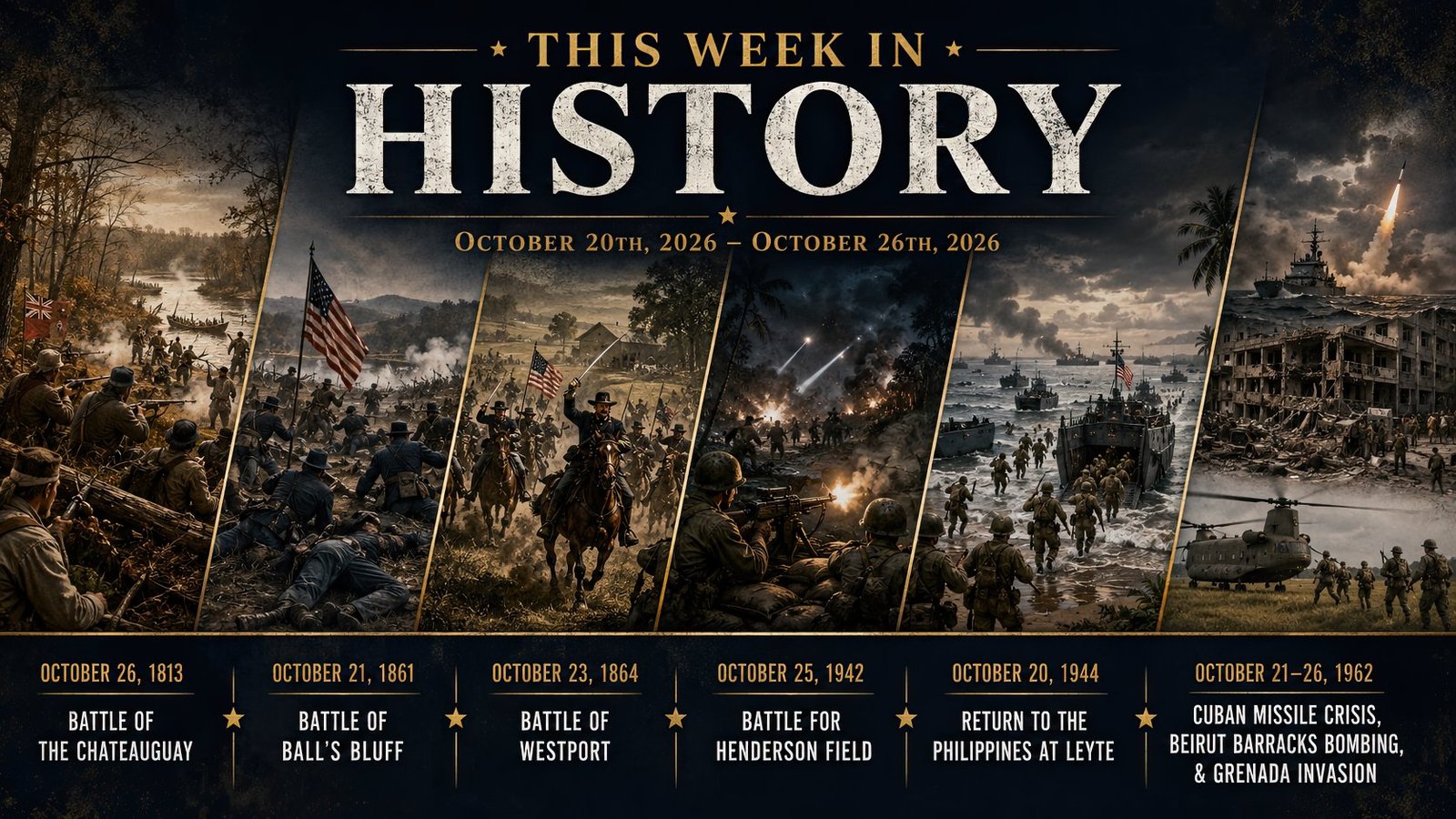
From October 20th, 2026 through October 26th, 2026, the calendar lines up with some of the most consequential moments in United States military history. Within these seven days you can trace a path from wooded riverbanks on the Canadian frontier to the beaches of the Philippines, from the nuclear brink in the Caribbean to a shattered barracks in Beirut and a sudden landing on Grenada. The week’s anniversaries include battles where small units stood against overwhelming odds, strategic decisions that reshaped wars, and tragedies that forced hard questions about missions and risk. Together, they show American forces adapting to new technologies, new forms of conflict, and new responsibilities well beyond the traditional battlefield. This edition of “This Week in U.S. Military History” walks through a handful of those moments, keeping an eye on what they meant to the people on the ground and to the nation they served.
Battle of the Chateauguay
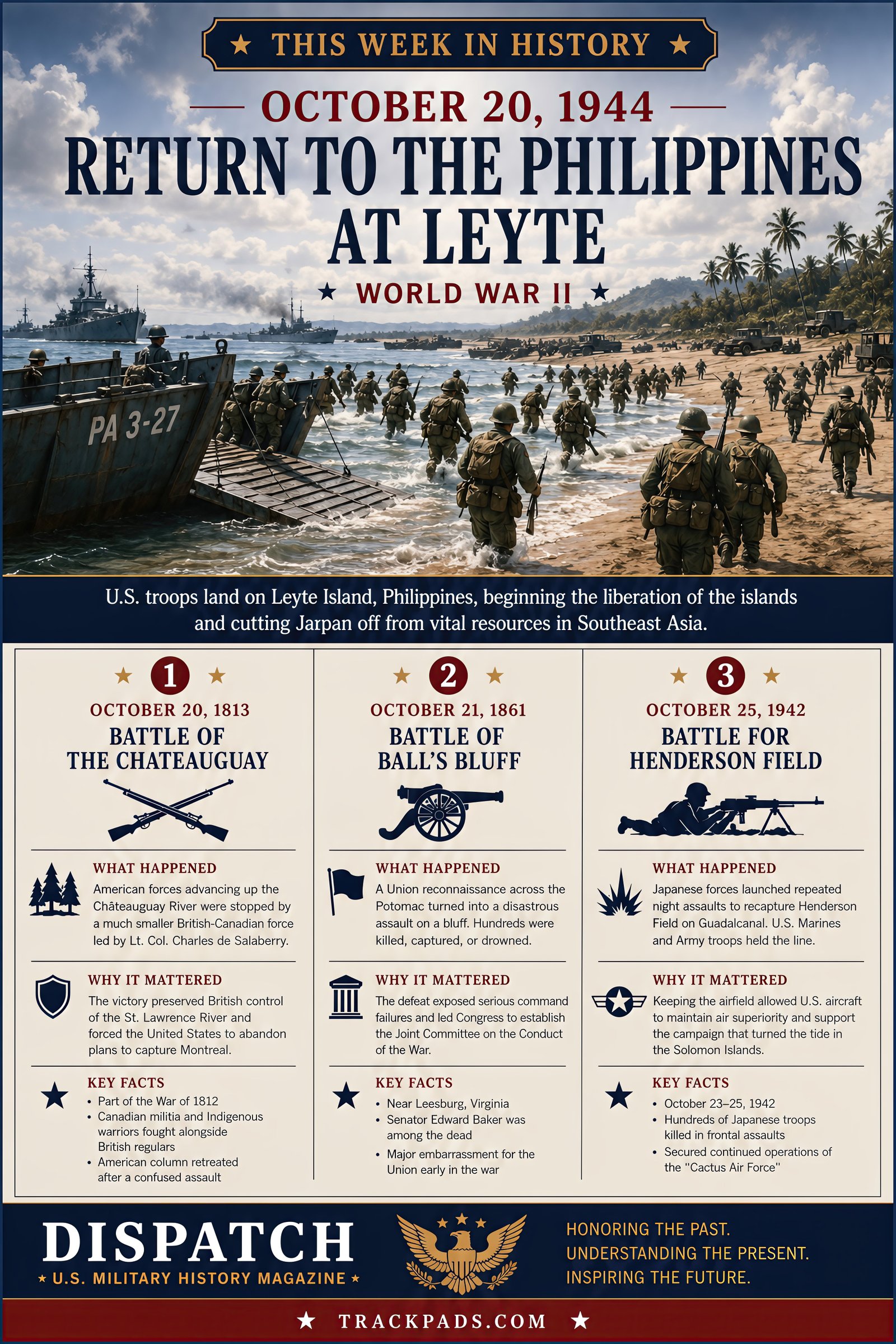
In the fall of the War of 1812, American planners hoped to capture Montreal by sending a column up the Châteauguay River in Lower Canada. On October 26th, 1813, that force ran headlong into a much smaller defensive line of Canadian militia, light infantry, and Indigenous warriors under Lieutenant Colonel Charles de Salaberry. Using the forest, abatis obstacles, bugle calls, and careful fire discipline, the defenders created the illusion of a much larger force. Confused by the terrain and worried about being flanked, the American column broke off the attack and retreated. The failed advance helped preserve British control of the St. Lawrence River line and forced Washington to rethink the feasibility of major operations against Montreal. For American officers, the setback underscored the difficulty of campaigning in thick woods against an enemy who knew every bend in the river and had no intention of fighting on conventional terms.
Open the Wiki entryBattle of Ball’s Bluff
Early in the Civil War, the Union still believed a quick, aggressive push might bring the rebellion to a close. On October 21st, 1861, a small reconnaissance across the Potomac near Leesburg, Virginia, turned into a disastrous assault at Ball’s Bluff. Poor intelligence, limited crossing sites, and a lack of clear command left Union troops crowded on a high bluff above the river as Confederate forces counterattacked. With no way to reinforce or retreat in good order, many soldiers were killed, captured, or swept away as boats capsized under fire. Among the dead was Senator Edward Baker, a close friend of President Lincoln. The shock of losing a senator in battle and the obvious command failures prompted Congress to create the Joint Committee on the Conduct of the War. For the Army, Ball’s Bluff became a harsh lesson in how quickly a minor probe, mishandled, could turn into a bloody embarrassment.
Open the Wiki entryBattle of Westport
By late 1864, Confederate General Sterling Price launched a sweeping mounted raid into Missouri, hoping to capture cities, inspire recruits, and shift attention from collapsing fronts elsewhere. On October 23rd, near the town of Westport—today within Kansas City—Union forces under Major General Samuel Curtis and Major General Alfred Pleasonton met Price’s column in a sprawling, confused battle. Militia units, volunteers, and cavalry fought across farm fields, wooded ravines, and river crossings along the Big Blue River and Brush Creek. A well-timed Union flanking maneuver turned the Confederate line and forced Price to retreat south. Two days later, Union cavalry hammered his rearguard at Mine Creek, wrecking the raid’s remaining combat power. Often dubbed the “Gettysburg of the West,” Westport ended Confederate hopes of reclaiming Missouri and underscored how western cavalry operations could still influence national strategy even as the main armies grappled in Virginia and Georgia.
Open the Wiki entryBattle for Henderson Field
In the Pacific War, Guadalcanal became a brutal test of endurance for both sides. Between October 23rd and October 25th, 1942, Japanese ground forces launched powerful night assaults aimed at recapturing Henderson Field, the airstrip that allowed American aircraft to dominate the surrounding seas. On October 25th, the fight reached its peak as Marines and newly arrived Army units manned foxholes, machine-gun nests, and artillery positions along the approaches to the field. Japanese infantry attacked in waves, often closing to within yards of American lines in the darkness. Coordinated artillery fire, interlocking machine guns, and desperate small-unit actions held the line, leaving hundreds of attackers dead in front of the positions by morning. Keeping Henderson Field in American hands ensured that the “Cactus Air Force” could continue to fly, striking Japanese ships and transports. The victory helped shift the Guadalcanal campaign from a precarious foothold into a slow but decisive American advance.
Open the Wiki entryReturn to the Philippines at Leyte
Two years later, American forces carried that growing momentum back to the Philippines. On October 20th, 1944, soldiers of the United States Sixth Army stormed ashore on the island of Leyte under the protection of an enormous naval and air armada. Amphibious planners had to manage tides, reefs, and narrow landing beaches while coordinating support from battleships, cruisers, and carrier aircraft. As troops pushed inland through rice paddies and coconut groves, General Douglas MacArthur came ashore for the famous moment in which he waded through the surf and declared, “I have returned.” Beyond the symbolism, the landings aimed to cut Japan off from vital resources in Southeast Asia and to liberate the Filipino people after years of occupation. Establishing a firm beachhead on Leyte set off a wider campaign across the archipelago and provoked Japan into launching what would become the largest naval battle of the war.
Open the Wiki entry“Taffy 3” at the Battle off Samar
That massive naval struggle reached its most dramatic moment off Samar. On October 25th, 1944, the small escort carriers and screening ships of Task Unit 77.4.3—nicknamed “Taffy 3”—found themselves suddenly confronted by a powerful Japanese surface force that included battleships and heavy cruisers. The American carriers carried only thin armor and light guns, and their destroyers and destroyer escorts were designed for screening, not slugging it out at close range. With little choice, the destroyers Johnston, Hoel, and Heermann, along with several escorts, laid smoke and charged straight at the enemy, firing guns and launching torpedoes at point-blank range. Carrier pilots joined in, making repeated attacks with whatever bombs and ammunition they had left. The ferocity of the defense convinced Japanese commanders they were facing a much larger fleet, and they eventually broke off. Several American ships were lost, but the invasion fleet off Leyte remained safe. The stand of Taffy 3 became one of the Navy’s classic examples of courage against overwhelming odds.
Open the Wiki entryCuban Missile Crisis address and “quarantine”
In October 1962, reconnaissance photographs revealed Soviet ballistic missiles being installed in Cuba, within range of American cities and bases. On October 22nd, President John F. Kennedy addressed the nation on television and radio, displaying the evidence and announcing a “quarantine,” or naval blockade, around the island. Behind that word stood a massive mobilization: Air Force squadrons dispersed and went on alert, Navy task forces surged into the Atlantic and Caribbean, and Strategic Air Command bombers and missile crews moved closer to war readiness. Over the following days, American warships established a line at sea and prepared to intercept Soviet vessels approaching Cuba. The crisis brought the world as close to nuclear conflict as it had ever been, yet it also showcased disciplined restraint under extreme pressure by sailors, airmen, and policymakers. The standoff’s peaceful resolution owed much to firm, visibly backed military posture paired with cautious diplomacy.
Open the Wiki entryBeirut barracks bombing
Two decades later, American troops faced a different kind of threat while on peacekeeping duty in Lebanon. On October 23rd, 1983, a suicide bomber drove a truck packed with explosives into the building housing the headquarters and barracks of the Marine and Navy contingent at Beirut International Airport. The blast leveled much of the structure, killing 241 American service members and injuring many more in a single devastating moment. Survivors and nearby units scrambled to dig through rubble, pull out wounded comrades, and secure the area against further attacks. The bombing shocked the United States and raised painful questions about force protection, mission clarity, and how to handle nontraditional adversaries willing to use suicide tactics. In the months that followed, American forces withdrew from Beirut, but the attack influenced how the United States thought about terrorism, intelligence, and security for deployed troops in unstable regions.
Open the Wiki entryOperation Urgent Fury in Grenada
Just two days after the Beirut bombing, American forces launched a very different operation in the Caribbean. On October 25th, 1983, troops from the United States and several Caribbean nations landed on Grenada after a violent coup toppled the island’s government. The stated goals were to protect American medical students, restore a more stable political order, and counter growing Cuban military activity on the island. Army Rangers parachuted onto an airfield, Marines came ashore from the sea, and special operations units seized key sites, all while dealing with incomplete maps, difficult communications, and unexpected resistance. Fighting at locations such as Fort Frederick and along key roads tested small units and leaders on the ground. The operation ended quickly in military terms, but it exposed serious problems in how the services communicated and coordinated joint missions. Lessons from Grenada later fed into reforms that reshaped American joint command and planning for decades.
Open the Wiki entryAcross the Week
Taken together, the events that share this late-October week reveal how American forces encounter danger in many forms, from wooded ravines and island airstrips to city streets and distant seas. At Chateauguay and Westport, commanders grappled with the limits of ambition and the power of terrain and local defenders. On Guadalcanal, Leyte, and off Samar, sailors and soldiers learned that air, sea, and land battles were tightly linked, and that small units might be asked to stand against overwhelming firepower to protect a larger purpose. In Cuba and Beirut, the stakes stretched from nuclear war to sudden terrorist attack, reminding leaders that decisions in Washington and deployments overseas can carry global consequences. Grenada showed how even short, successful interventions can expose weaknesses in how a military thinks and fights together. For today’s readers and service members, these stories offer a chance to reflect on judgment, preparation, and courage when the outcome is far from certain.