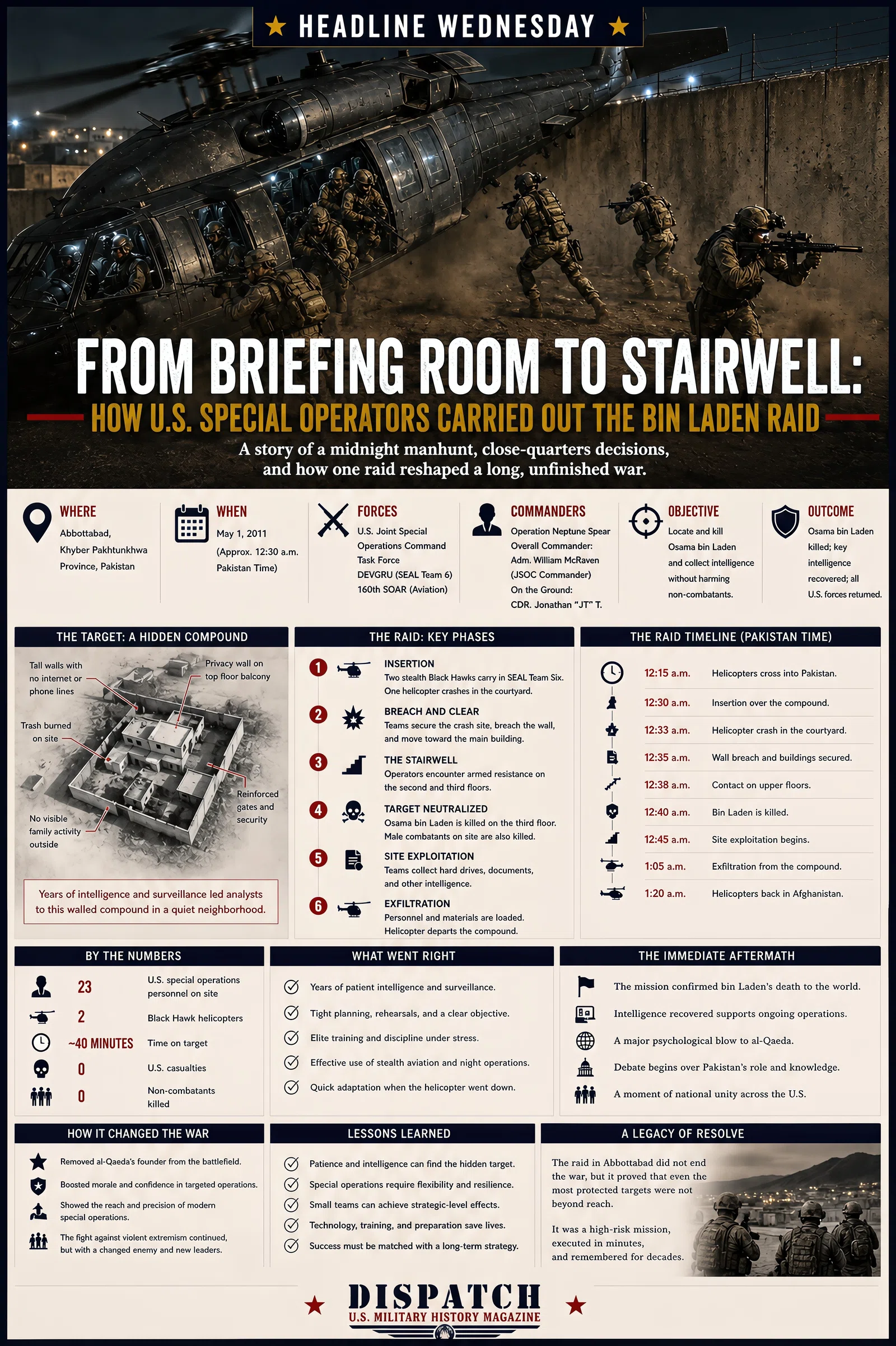
Black Hawks Over Abbottabad
Just before midnight in Pakistan, the lights inside a walled compound in Abbottabad glowed like any other late-night household. Inside, family members drifted toward sleep, a television flickered, and the quiet of a garrison town settled in around the high walls and darkened streets. Over the horizon, though, two stealth-modified Black Hawk helicopters slipped in low, their rotors beating the air in a heavy, controlled thrum, holding just above the ridgelines to stay out of sight and sound as long as physics would allow. On board, American special operators checked weapons, night-vision goggles, and breaching gear for what had been described as a once-in-a-generation mission.
The pilots eased the lead helicopter toward a practiced hover inside the courtyard, and then the plan met the real world. The aircraft lost lift as the rotor wash swirled in the tight walls, and in a hard, sudden tilt it slammed down into the compound instead of hanging in the air. In seconds that felt much longer, a rehearsal refined over months fractured into a tangle of dust, metal, and shouted commands. The operators inside kicked free, spilled out, and shifted instantly from planned air assault to improvised entry, clearing rotors, securing the crash site, and pushing toward their objectives.
Across the compound, the second helicopter put its team down outside the walls as briefed, and they moved in through an exterior breach, cutting through the concrete-and-brick perimeter that had made this house stand out to analysts studying satellite images. Dogs barked, neighbors stirred, and lights snapped on as the first explosions and gunshots echoed through the night. Every step toward the main building, from courtyard to stairwell, carried a simple expectation: this might be the place where the most hunted man in the world waited at the top of the stairs, or it might be another near miss. Either way, there was no turning back now.
Why This Night Had to Work
To understand the weight riding on those rotor blades, it helps to pull back from the compound and look at the decade that led to this night. Nearly ten years earlier, the September 11 attacks had killed thousands in New York, Washington, and over a Pennsylvania field, dragging the United States into a global hunt for the men who planned and protected the operation. Osama bin Laden became more than a single target; he turned into a symbol of unresolved trauma, unfinished business, and the limits of American power in an age of shadowy networks and safe havens. Every year that passed without a clear trail made the search feel more urgent and more politically charged.
By the time intelligence analysts pieced together the pattern of couriers, safe houses, and daily routines that pointed toward Abbottabad, the war in Afghanistan had ground on far longer than anyone in that first autumn of 2001 expected. American forces had toppled regimes, dispersed training camps, and chased fighters into mountains and across borders, but bin Laden remained an open wound. This compound, sitting in a Pakistani city with a military academy nearby, represented both a possible breakthrough and a diplomatic minefield. Striking there meant trespassing, without permission, into the airspace of a nuclear-armed partner already deeply suspicious of American intentions.
The stakes of the raid ran in several directions at once. If the man inside turned out not to be bin Laden, the United States would have violated another nation’s sovereignty for a dry hole, with little to show the world except wreckage and anger. If the mission failed publicly, with helicopters shot down or operators captured on the ground, it would hand enemies a propaganda victory and raise hard questions about judgment all the way back to the Oval Office. If it succeeded, though, it could close a chapter that had defined American security policy for a decade, show that long, quiet intelligence work could still deliver results, and send a message to allies and adversaries about reach, patience, and resolve. That is what rode with the men moving from briefing room to stairwell on that night in Abbottabad.
From Courier Trail to Walled Compound
The road to that courtyard began far away from Abbottabad, in years of slow, frustrating work to track human beings instead of radio traffic. After the initial invasions in Afghanistan and pressure on known safe havens, bin Laden stopped using electronic devices that could be traced and relied on trusted couriers who carried messages in person. Intelligence officers spent years trying to match nicknames, scraps of intercepted conversation, and fragments from captured documents to real individuals moving through the world. One of those names, tied to a man believed to be especially close to bin Laden, kept surfacing often enough to become a priority target.
When that courier’s circle finally narrowed, analysts followed him, not with headlines but with patient surveillance and pattern analysis. The route led to a distinctive compound: high walls topped with barbed wire, no telephone or internet connection, residents who burned their trash instead of putting it out for collection. Children inside did not attend local schools, and the building’s top floor had a privacy wall shielding a balcony from outside view. None of those details proved anything on their own, but taken together they added up to a picture that looked very different from a normal family home. Around conference tables in Langley and Washington, the working question shifted from “Is this worth watching?” to “Is this the place?”
Even then, certainty remained out of reach. Photographs, pattern-of-life reports, and modeling exercises suggested a high-value target, but they did not offer a clear image of bin Laden himself. Leaders faced choices that balanced risk, trust in intelligence, and possible fallout with Pakistan. A missile strike might destroy the compound but also obliterate any chance to confirm who had been inside, as well as endangering civilians nearby. A ground raid promised a live identification and the chance to collect materials but exposed pilots and operators to every hazard from small arms to international incident. In the end, the decision landed on a small group of helicopters, a handpicked special operations team, and a narrow window of darkness over a garrison town in Pakistan.
Room by Room Through the Dark
Once the first helicopter hit the courtyard, the raid shifted from carefully rehearsed sequences to practiced flexibility. The team spilling out of the downed aircraft did not pause to debate options. They pulled security around the wreck, ensured no one was trapped inside, and began blowing openings where doors and windows had been mapped and measured in a full-scale mock-up thousands of miles away. Breachers went to work on gates and walls, clearing lanes for teammates to push toward the main building. Every second spent wrestling with steel and concrete felt longer under the knowledge that Pakistani response forces might already be waking up to radar blips and noise complaints.
The element that landed outside the compound, untouched by the crash, moved along its planned path, cutting through the outer wall with explosives and tools. They surged into the courtyard from a different angle, cross-covering sectors and making sure no one slipped out in the confusion. A separate detachment peeled off to secure the smaller guesthouse, where a courier and his family were believed to live. Shots erupted there as armed men confronted the intruders, and the operators answered with lethal speed, clearing rooms that blended family spaces with fighting positions. Women and children were separated and moved under guard as the assault teams pushed onward.
Inside the main house, stairwells and hallways squeezed the raid down to a few men at a time. Night-vision goggles turned the darkness into grainy green, but every doorway still hid uncertainty. On lower floors, they encountered more residents, some armed, some panicked, all in close quarters where fractions of a second separated perceived threat from terrible mistake. The operators moved methodically but quickly, climbing toward the top level where intelligence analysts had marked a reclusive figure’s suspected living space. Every flight of stairs climbed without finding their target increased pressure and doubt, but the plan remained the same: keep going up.
Higher in the building, the team closed on a final set of rooms behind another door, another corner, another narrow threshold. Outside the compound, the pilots kept their remaining aircraft ready, engines hot, listening to terse radio updates that never quite captured the immediacy of men turning door handles with rifles raised. Back in the command centers far away, leaders watching the feed heard only fragments: callsigns, room counts, confirmations that floor after floor was secure. The moment where an operator would confirm or deny the presence of their target now rested just beyond the next doorway, with the clock still ticking toward possible interception from the skies over Pakistan.
Training, Luck, and a Doorway
In the end, the turning point of the raid came down to a mix of long preparation and a few seconds at the top of a stairwell. Months of rehearsals on a full-scale mock-up had given the special operators a mental map of a building they had never seen in person, allowing them to move with purpose even after the helicopter crash forced improvisation. The teams knew which floors likely held families, which rooms might contain armed men, and where the most guarded space was expected to be. That background work did not erase uncertainty, but it narrowed the search and kept the raid from dissolving into a chaotic house-to-house sweep in the dark.
When the assault element reached the upper floor, they faced the moment every briefing had pointed toward. Behind that door, an operator would have to make rapid judgments: threat or surrender, target or bystander, shoot or hold. The man inside did not come out with his hands raised, and the team reacted as they had been trained to do in close quarters. In a short exchange, bin Laden was killed, his presence confirmed by physical features and later by more formal methods. What could have become a firefight dragging through multiple rooms instead turned into a swift, decisive encounter, contained before it spilled into prolonged resistance inside the house.
Even after that moment, the raid could still have gone badly. The operators had to secure the body, continue clearing spaces, and gather whatever materials they could find that might shed light on networks, plans, and contacts. Outside, one helicopter sat wrecked in the courtyard, its stealth modifications now visible to anyone who might approach with a camera or a tape measure. The team set charges to destroy sensitive equipment, turning a high-tech aircraft into twisted metal before Pakistani forces could arrive. Another helicopter was called in to replace it, the teams redistributed weight and personnel, and the entire package lifted off into the night, racing for the border with minutes shaved from every step.
A Single Night, Long Shadows
The tactical outcome of the raid was clear by the time the helicopters crossed back into friendly airspace: the target the United States had hunted since 2001 was dead, his body in American custody, his final safe house stripped of what intelligence officers could grab in the time available. Within hours, leaders announced the result to the public, and images of celebrations in American cities ran alongside footage of the compound still smoking in Abbottabad. Bin Laden was buried at sea from a United States Navy vessel, both to deny any physical gravesite the power of a shrine and to close this chapter quickly. Inside intelligence circles, the focus shifted to hard drives, papers, and devices recovered from the raid, each one a possible thread leading to other figures and plots.
Strategically and politically, the night in Abbottabad reshaped how many people thought about the war that had begun after September 11. The raid did not end the broader struggle against violent extremist groups, but it removed a symbolic figure whose continued survival seemed to mock years of effort. It also highlighted the reach of American special operations forces and the kind of joint intelligence-military campaigns that had developed over a decade of war. At the same time, the operation strained already fragile relations with Pakistan, whose leaders had not been informed in advance and now had to explain how the world’s most wanted man had lived steps away from a military academy.
In military circles, the raid became a case study in balancing risk, secrecy, and preparation. Planners examined the helicopter crash, the flexibility of the assault teams, and the way decision-makers had weighed airstrikes against a ground raid. Staff rides and classroom discussions returned to that combination of slow, patient intelligence work and a single, high-risk mission that relied on human judgment in tight spaces. For readers and listeners today, the story of Operation Neptune Spear is a reminder that the most famous moments in modern war often hinge on details that never make it into quick headlines: a courier’s habits, a pilot’s split-second adjustment, an operator’s decision at a doorway in the dark.