First Light Over the High Valley
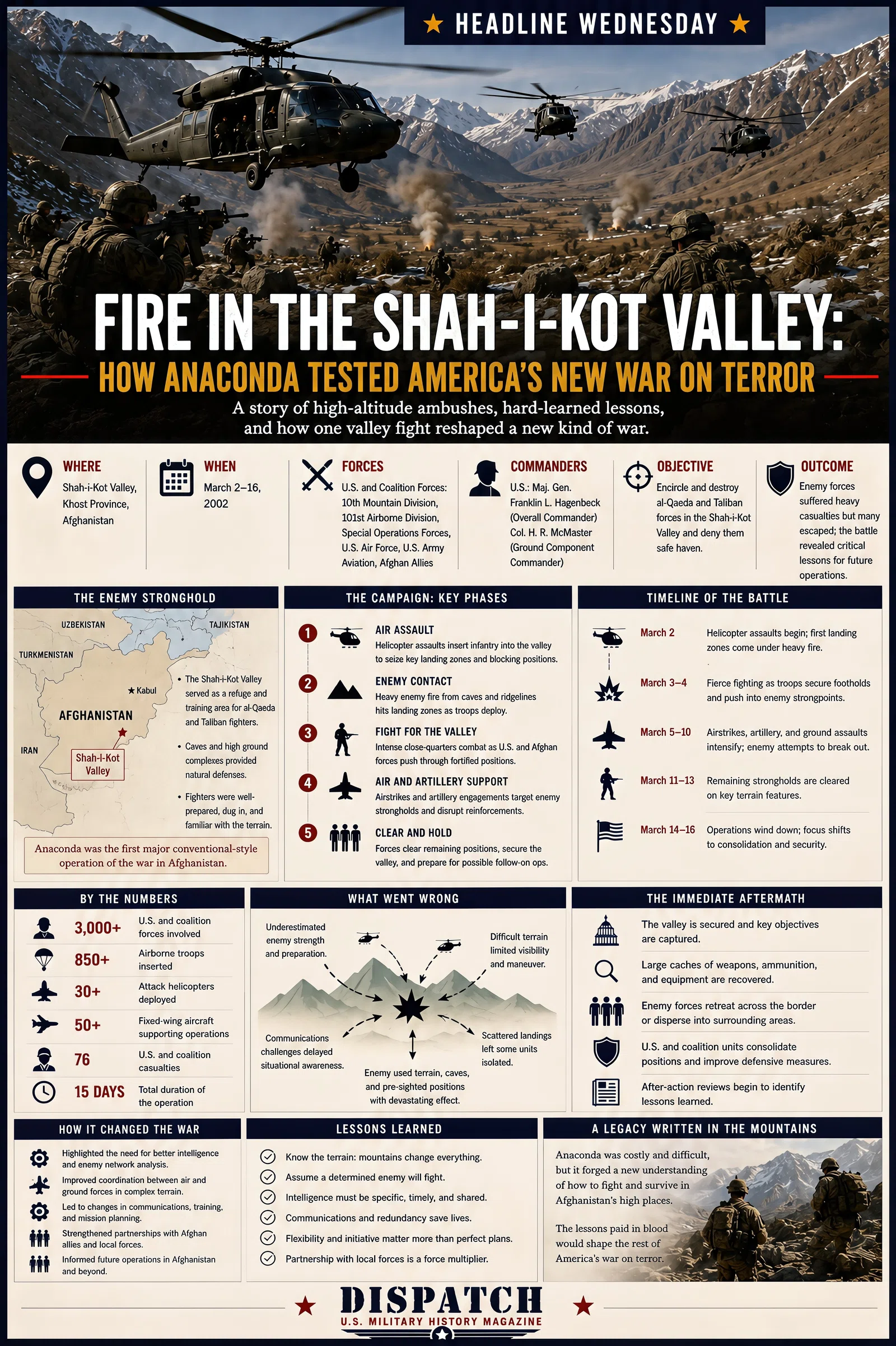
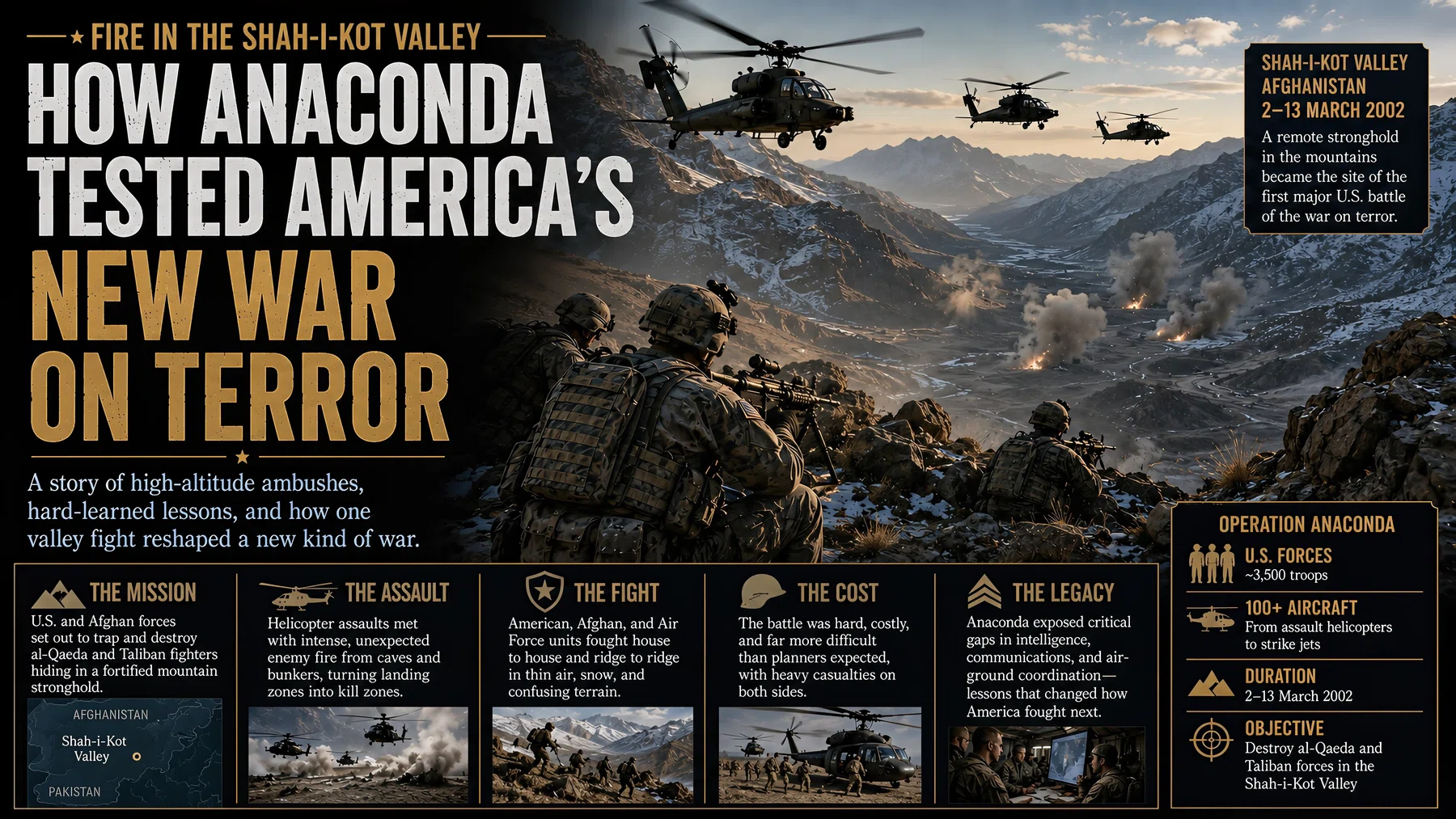
Just before dawn in early March 2002, the Shah-i-Kot Valley was still and bitterly cold. Snow clung to the ridges that ringed the high basin, and the air at more than 8,000 feet felt thin enough to cut. Down in the darkness, Afghan fighters loyal to the new government waited alongside American soldiers, stamping their feet, checking weapons, and glancing toward the sound they knew was coming. Above them, the first assault helicopters swept in, their rotors beating the thin mountain air as they carried infantry toward landing zones with names that sounded almost casual on a map but were about to become deadly real.
Inside those helicopters, soldiers from the 101st Airborne Division and the 10th Mountain Division sat in tight rows, packed in with rucksacks and ammo cans, listening to the thump of the blades and the clipped updates over the intercom. They had rehearsed this mission as a sweep: land, move into blocking positions, help Afghan allies push through the valley, and crush what was believed to be a pocket of remaining al-Qaeda and Taliban fighters. The expectation was resistance, but not a major set-piece battle. Many in the assault force believed the enemy would try to slip away rather than stand and fight.
The first sign that this would be different came as the helicopters flared toward their landing zones. Tracer fire clawed up from the valley floor and the surrounding slopes, stitching the air around the aircraft, forcing pilots to yank their machines into evasive moves in the thin air. Mortar rounds and heavy machine guns opened up from caves and bunkers that had been carefully dug into the terrain. Landing zones that looked open from the air were suddenly swept with fire. Some helicopters diverted, others left troops scattered and under fire in snow-covered fields and rocky hollows, trying to find cover where there was almost none.
On the ground, squads and platoons realized that instead of catching fleeing stragglers, they had dropped into a well-prepared killing zone. Fire came from multiple directions, from positions that had clearly been sighted long before. Radios crackled as leaders tried to figure out who had made it onto the ground, who was pinned down, and how far away the nearest friendly element actually was in that broken terrain. At first light in the Shah-i-Kot, Operation Anaconda was already veering away from its neat plan and into something far more chaotic and costly. And the fight was only beginning.
A Valley That Could Not Be Lost
To understand why that cold morning mattered so much, you have to pull the camera back from the individual foxholes and helicopter cabins. It was just months after the attacks of September 11th and the collapse of the Taliban regime in Kabul. The United States and its allies had toppled the government that had sheltered al-Qaeda, but large numbers of fighters had escaped into the eastern mountains near the border with Pakistan. The Shah-i-Kot Valley, southeast of Gardez, had long been a refuge and training ground. Intelligence suggested that a significant concentration of al-Qaeda and Taliban forces were regrouping there, using the caves and high ground as both sanctuary and staging area.
For American commanders, Operation Anaconda was meant to be the first major, conventional-style battle of the new war. Special operations forces and airpower had helped Afghan partners topple the Taliban, but this mission would combine those tools with a larger sweep by regular infantry units. The goal was to encircle the valley, trap the fighters, and destroy them before they could slip back across the border or threaten the fledgling Afghan government. Success would show that the United States could deny its enemies any safe haven in Afghanistan’s rugged interior and that the new way of war, blending precision airstrikes with agile ground forces, could close the net.
The stakes on the ground were equally personal for the soldiers and aircrews committed to the operation. Units from the 10th Mountain Division and the 101st Airborne Division were still adjusting from peacekeeping and training missions to the harsh reality of mountain combat at altitude. Aircrews flying attack helicopters and strike aircraft were expected to deliver close support in terrain that limited visibility and communications. Afghan militias, led by local commanders, were counted on to push up from the valley floor while American units sealed the exits and blocked escape routes along the high ground.
If the plan worked, a pocket of hardened fighters would be broken, their leaders killed or scattered, and a message sent to others hiding in the mountains that they could no longer count on remote valleys as permanent havens. If it failed, or even faltered, the consequences reached far beyond one operation. Entrenched al-Qaeda and Taliban units could slip away to fight another day, reinforcing the sense that they could outlast foreign armies by using terrain and patience. A costly, confused battle would also raise hard questions about how well the United States understood the enemy, the terrain, and the demands of high-altitude warfare. Operation Anaconda was not just about one valley; it was an early test of how the new war on terror would actually be fought.
Assumptions on Paper, Mountains in Reality
In the weeks before soldiers and helicopters entered the Shah-i-Kot, the battle existed as a series of briefings, maps, and estimates. Intelligence pointed to a cluster of al-Qaeda and Taliban fighters using the valley and its ring of high ridges as a sanctuary after earlier fights in eastern Afghanistan. Some reports put their numbers in the low hundreds, dug into bunkers and caves left over from the Soviet war years. Others warned that the enemy might be far stronger and better positioned than the charts suggested. Commanders had to make decisions based on incomplete information, betting that rapid action and overwhelming firepower could make up for uncertainty in the exact enemy count.
The plan that emerged divided responsibilities between Afghan forces and American units. Afghan fighters, led by local commanders and advised by special operations teams, would push into the valley floor from the south and east, clearing villages and lower slopes. American conventional units, including elements of the 10th Mountain Division and the 101st Airborne Division, would be lifted by helicopter onto high ground and along likely escape routes. From those blocking positions, they would cut off retreat, call in airstrikes, and pressure the enemy from above while Afghan allies pressed from below. Overhead, attack helicopters and fixed-wing aircraft were expected to be on call, ready to hit any strongpoint that held out.
On paper, the design looked like a textbook example of combining local allies, airpower, and light infantry. In practice, the terrain and the enemy’s preparations pushed back against every assumption. The valley lay at altitude, with ridges rising even higher, which meant thin air for helicopters and heavy loads for soldiers who were not yet fully acclimated. Communications between Afghan units, special operations teams, and conventional headquarters were complicated by distance, language, and equipment. Estimates of how quickly Afghan columns could move through the snow and rock were optimistic. Meanwhile, the enemy had been watching the build-up, listening to the increase in aircraft overhead, and using the time to dig in deeper.
Key American leaders were aware that this would be a serious fight, but there remained a belief that the enemy would ultimately choose to flee rather than stand in large numbers. That belief influenced how many troops were committed on the first day, how landing zones were chosen, and how much weight was placed on Afghan formations to carry the main advance. It also shaped expectations about how long the operation would last. What began as a mission projected to run for only a handful of days would stretch longer as those early assumptions met the reality of a well-prepared enemy dug into commanding high ground.
Landing Zones in the Crosshairs
When the first assault waves moved in on March 2nd, the battle shifted instantly from planning slides to survival. As helicopters carrying infantry from the 10th Mountain and 101st Airborne Divisions approached their designated landing zones on the valley floor and lower slopes, enemy gunners were waiting. Machine guns, mortars, and rocket-propelled grenades opened up from positions the planners had not fully identified, many of them concealed in caves, rock outcrops, and old fighting positions overlooking the landing areas. Pilots suddenly found their approach paths bracketed by tracer fire, forcing them to jink and climb in thin air that robbed their aircraft of power.
Some helicopters managed to land close to their intended zones, dropping off squads and platoons into shallow snow and scattered boulders under immediate fire. Others were forced to wave off, pushing their troops out at alternate spots where cover was even more scarce and the terrain less familiar. On the ground, soldiers scrambled away from hovering rotors, hit the dirt, and tried to locate where the incoming fire was coming from. Platoon leaders and squad leaders called out positions, trying to form coherent lines while rounds cracked overhead and dirt kicked up around them. What was supposed to be a controlled insertion into blocking positions became a scattered, under-fire arrival into a maze of interlocking fields of fire.
Down in the valley, Afghan units pushing forward in trucks and on foot also ran into intense resistance. Enemy fighters used village compounds, irrigation ditches, and folds in the ground to channel and disrupt their advance. Mortars dropped rounds along likely movement routes, and small teams of fighters shifted from one prepared firing point to another, trading space for time while inflicting casualties. Special operations teams embedded with Afghan columns called for close air support, but coordinating strikes in the broken terrain and thin air, with friendlies and enemies often separated by only a ridge or a walled compound, demanded precision that took time to achieve.
As the day wore on, American ground units and aircrews built up a picture of just how heavily defended the valley really was. Attack helicopters flew repeated runs into the same cauldrons of fire to suppress enemy positions and protect pinned-down troops, taking damage in the process. Fixed-wing aircraft orbited overhead, dropping bombs on cave mouths, ridgelines, and stubborn strongpoints once controllers on the ground could confirm targets. From individual foxholes and shallow scrapes, soldiers watched bombs hit ridges that had been hammering them all morning, feeling some relief as enemy fire slackened, only to flare again from another position that had not yet been spotted.
By the end of those first hard hours, the picture was clear: the enemy had not simply been caught in transit. They were dug in across the valley and along the heights with far more weapons and fighters than many had expected. American units had established footholds on the ground but were not in the neat blocking positions imagined beforehand. Afghan allies had taken losses and faced tough resistance in the valley floor. And up on the ridgelines, where control of the high ground would decide much of the fight, the hardest work still lay ahead. The battle was shifting from a planned sweep to a grinding contest for every spur and firing position in and above the Shah-i-Kot.
High Ground, Airpower, and Adaptation
What began as a scattered, under-fire landing turned into a contest over who could adapt faster to the reality of the valley. For the Americans and their Afghan allies, the turning of Operation Anaconda did not come from a single charge or a dramatic flag-raising. It came from a series of adjustments in how they used the tools they had brought into the mountains, especially airpower and small units on the heights. As it became clear that enemy forces were dug in across the valley in larger numbers than expected, commanders shifted from trying to run the original script to systematically breaking apart strongpoints and isolating pockets of fighters.
Securing the high ground proved crucial. Small American and coalition teams moved onto ridgelines and peaks, sometimes under heavy fire and at a steep physical cost in the thin air. From those vantage points, they could observe enemy movements, direct airstrikes with greater precision, and deny key observation posts to the defenders. In some cases, fights for those heights produced some of the most intense and costly engagements of the operation, but once secured, they steadily narrowed the enemy’s options. An opponent that had begun the fight with the advantage of terrain and prepared positions now had to contend with bombs and artillery directed by eyes looking down from the very ridges they had relied on.
At the same time, the use of airpower shifted from primarily shaping the battlefield ahead of ground movements to sustained, close support against identified cave complexes, trench lines, and firing positions. Heavy bombers dropped weapons on clusters of caves and bunkers that had held up assaults for hours. Attack aircraft and helicopters made repeated runs to suppress machine guns and mortar teams firing on exposed infantry and Afghan columns. The combination of persistent surveillance and repeated strikes wore down defenders who had expected to use their bunkers and tunnels as nearly invulnerable shields.
On the ground, infantry leaders learned to move more deliberately, using the limited cover available and coordinating tightly with air and artillery. Afghan forces regrouped after early setbacks and pressed forward again with continued support from special operations teams. None of these changes erased the cost of the early miscalculations. Casualties had already mounted, and there were painful lessons unfolding in real time about communications, planning, and joint command. But over days of fighting, those adaptations—seizing key heights, tightening the air-ground partnership, and revising assumptions about enemy strength—shifted the momentum. The defenders, once confident in their mountain sanctuary, found themselves under constant pressure with fewer and fewer safe positions left.
From One Valley to a Long War
When the last significant pockets of organized resistance in the Shah-i-Kot Valley were broken, Operation Anaconda ended without the clean, cinematic final scene that briefings often suggest. The valley was not entirely empty of fighters; some had already slipped away through side ravines and across the nearby border. But American and Afghan forces had inflicted heavy losses on al-Qaeda and Taliban units that had chosen to stand and fight. Positions that had been prepared over years were smashed, bunkers collapsed, and caches of weapons and supplies destroyed. The high valley that had been a symbol of sanctuary was scarred with bomb craters, abandoned positions, and the wreckage of vehicles and equipment.
At the campaign level, Anaconda sent a mixed message. On one hand, it showed that the United States and its allies could find, fix, and hammer a major concentration of enemy fighters in some of the harshest terrain in Afghanistan. It demonstrated the reach of airpower, the grit of infantry units operating at altitude, and the value of small, embedded teams linking those two together. On the other hand, the operation revealed serious gaps in intelligence estimates, joint planning, and communications between different headquarters and force types. It reminded everyone involved that the enemy was not simply a scattered remnant, but a determined, adaptive force with its own sense of the terrain and of time.
For the units that fought there, the aftermath was personal and immediate: mourning the dead, treating the wounded, and trying to make sense of what they had just survived. Stories of individual bravery circulated—medics running through fire, pilots bringing damaged helicopters home, small groups of soldiers and special operators holding exposed positions under repeated attack. Those stories became part of unit histories and training, shaping how later rotations prepared for mountain warfare, close air support, and joint operations in complex terrain. The Shah-i-Kot was no longer just a name on a map; it was an experience etched into the memory of thousands.
In the broader history of the war in Afghanistan, Operation Anaconda stands as an early warning that quick regime change did not mean a quick end to fighting. It highlighted how dangerous it is to underestimate an enemy’s willingness to stand and die in ground they know well, and how fine the line can be between a cleanly executed plan and a costly improvisation. For students of military history, staff riders, and anyone trying to understand the early years of the war on terror, the battle in the Shah-i-Kot Valley shows both the promise and the limits of modern firepower and technology when they run up against mountains, weather, and a foe who believes the terrain is on their side. It is a reminder that the first big battles of a long war often carry lessons that echo, sometimes painfully, for years afterward.