Headline Wednesday · December 16, 2026
210 Populated Entries
The terrain, installations, cities, seas, and landscapes where military history occurred.
Places, Bases & Battlefields
Every result opens a permanent subject record with its reference context and connected Dispatch coverage. Filter by record type, editorial collection, or a word in the entry.
210 entries found.
Three weeks after seizing Saipan, American forces returned to Guam, reclaiming a prewar United States possession that had been lost in the dark days of 1941. Marines and soldiers from the Third Marine Division, the First Provisional Marine Brigade, and the Seventy-Seventh Infantry Division went ashore under heavy fire, forced to slog through surf, coral, and fortified jungle slopes.
As World War II in the Pacific neared its climax, United States forces launched the amphibious assault on Okinawa, a large island only a few hundred miles from the Japanese home islands. The Tenth Army, composed of United States Army and Marine Corps units, went ashore on beaches that were eerily lightly defended, a stark contrast to the bloody assaults at places like Tarawa and Iwo Jima.
Night still clung to the sea when the submarine slid in among the enemy ships. On the open bridge, spray cold against his face, Commander Lawson “Red” Ramage watched the black shapes of freighters and tankers loom out of the darkness. Their wakes glowed faintly, white scars across a heaving Pacific, while bursts of star shell and tracer fire clawed at the sky. Somewhere off Taiwan, a Japanese convoy was trying to slip through before dawn. Ramage intended to stop it.
Medal of Honor, U.S. Army, World War II
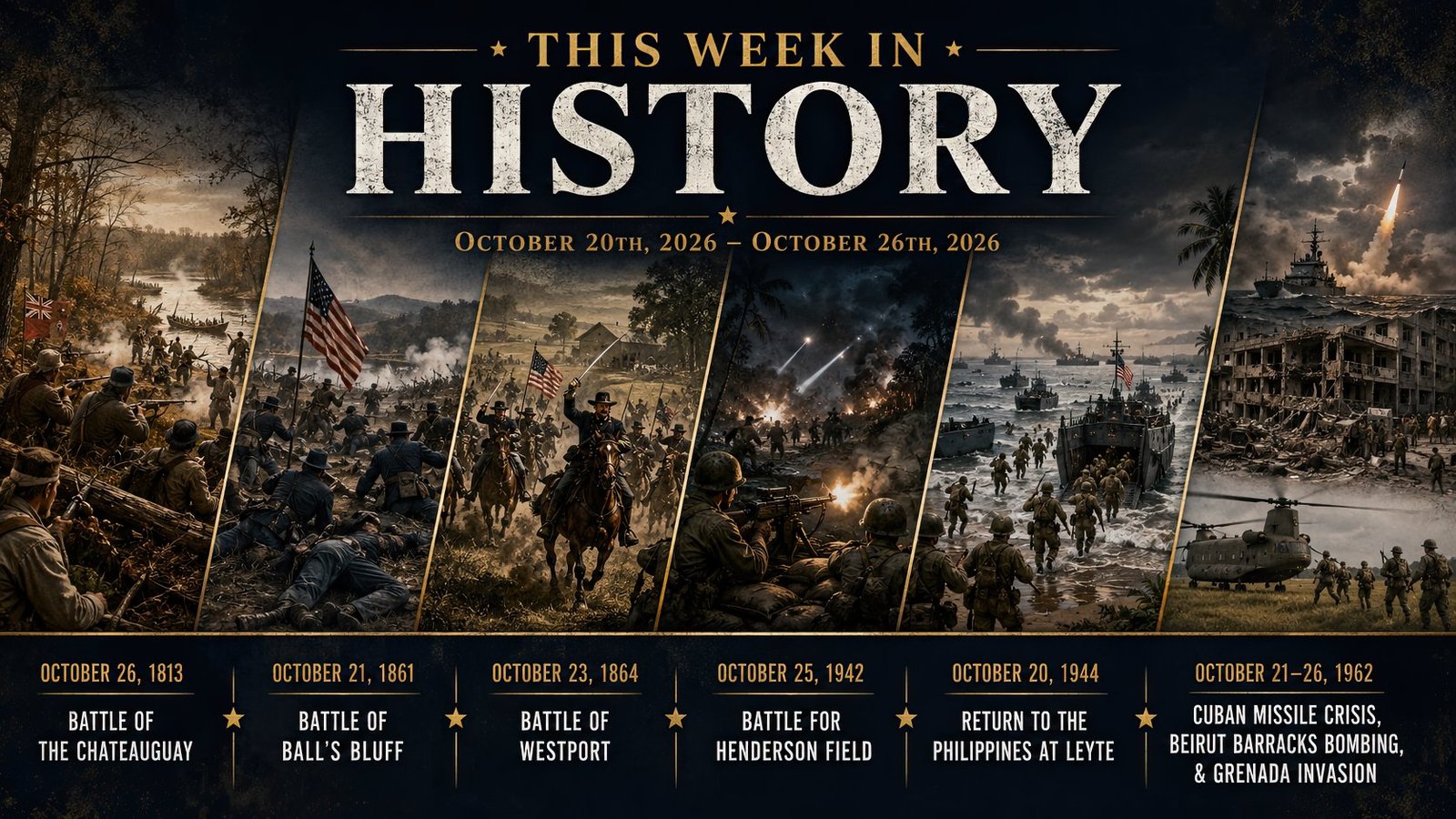
The October 1944 landings restored a major Allied foothold in the Philippines. Fleet battles protected that foothold, but Japanese reinforcement and the struggle for routes toward Ormoc made the ground campaign longer and more difficult than the beach assault alone suggests.
Read Entry →Event · 2026-04-28Liberation of Dachau concentration campOn this date, elements of the United States Seventh Army reached the gates of Dachau, one of Nazi Germany’s earliest and most notorious concentration camps. Soldiers from the 42nd and 45th Infantry Divisions walked into scenes of devastation and horror: emaciated prisoners, mass graves, and railcars filled with bodies from death marches.
On January 9th, 1945, American forces surged ashore along the beaches of Lingayen Gulf on the island of Luzon in the Philippines. Supported by a powerful naval and air armada, soldiers of the United States Sixth Army waded through surf under the threat of mines, artillery, and kamikaze attacks that had already cost the fleet dearly during the approach.
On this date American negotiators in Paris agreed to purchase the vast Louisiana territory from France, a deal that nearly doubled the size of the young republic. For the United States Army, the treaty opened an enormous new frontier to explore, survey, and secure, from the Mississippi River out toward the Rocky Mountains. Army officers and enlisted soldiers would lead reconnaissance missions, escort surveyors, and eventually garrison remote posts that anchored American claims on the plains.
The return to Luzon combined amphibious landings, the destruction and liberation of Manila, the recovery of the bay approaches and months of fighting in mountain defenses. Capturing the capital did not end the island campaign.
Read Entry →Event · 2026-03-10MacArthur Leaves the PhilippinesWhen war came to the Pacific, American and Filipino troops on Bataan and Corregidor fought a desperate delaying action against advancing Japanese forces. By March 1942, the situation had grown dire, and the president ordered General Douglas MacArthur to leave the islands and avoid capture. On the night of March 11th, MacArthur and his party boarded small patrol torpedo boats for a dangerous run through hostile waters to Mindanao, later continuing by aircraft to Australia.
Less than three weeks after North Korean forces crossed the 38th parallel, President Harry Truman moved to unify the international response under a single commander. On July 8th, 1950, General Douglas MacArthur, already commanding United States forces in the Far East, was designated to lead United Nations military operations in Korea.
Less than a year later, American forces were in the thick of combat in France. On June 6th, 1918, United States Marines and soldiers attacked German positions in and around Belleau Wood, a dense patch of forest near the Marne River. German offensives had driven the Allies back toward Paris, and the Americans were thrown into the line to help stop the advance.
Two decades after Remagen and Tokyo, another conflict drew the United States into a deeper commitment far from home. On March 8th, 1965, United States Marines waded ashore near Da Nang in South Vietnam, officially arriving as combat troops to protect the important air base there. Until then, most American personnel in the country had been framed as advisors and support teams, even as their numbers grew and their roles blurred.
In the final year of World War I, the thick tangle of Belleau Wood in France became the proving ground for American forces newly committed to the Western Front. Over weeks of grinding combat alongside French units, Marines from the Fifth and Sixth regiments launched repeated attacks against German machine-gun nests and dugouts that commanded open wheat fields.
As ground combat raged on Okinawa, the United States fleet offshore faced a new and deadly form of air attack in unprecedented numbers. Japanese forces launched a series of large-scale suicide air raids, known as kamikaze attacks, aimed at crippling the invasion armada by sacrificing pilots and aircraft directly against ships. On April 6th, waves of kamikaze aircraft struck radar picket destroyers, carriers, and other vessels, sinking some ships and damaging many more.
Snow hangs heavy in the Ardennes forest, muting sound until a rifle cracks and splinters bark from a nearby tree. Private First Class Melvin Earl Biddle lies pressed into the freezing ground, the lead scout for an American parachute infantry company feeling every heartbeat echo in the stock of his rifle. Somewhere ahead, beyond the dark trunks and tangled undergrowth, German snipers have halted his company’s advance on the road between the villages of Soy and Hotton.
One year later to the day, another daring mission unfolded in the skies over the Pacific. On April 18th, 1943, United States forces executed a carefully planned interception of the aircraft carrying Admiral Isoroku Yamamoto, the architect of the Pearl Harbor attack. Guided by intelligence that revealed his inspection tour schedule, a handpicked group of long-range P-38 Lightning fighters flew at low altitude across open ocean to reach the rendezvous point in time.
A story of scattered night jumps, improvised small-unit fights, and how chaos still helped open the door into Fortress Europe.
After nearly three brutal months of fighting, American commanders declared the island of Okinawa secure on June 22nd, 1945. The campaign had begun with amphibious landings in April, followed by a grinding advance against deeply dug-in Japanese defenses that relied on cave systems, reverse-slope positions, and determined infantry counterattacks.
A story of a nearly lost beach, scattered initiative, and how small groups clawed back the chance to win a war.
A story of stealth jets, precision strikes, and a regime suddenly in the dark, and how it changed the wider war.
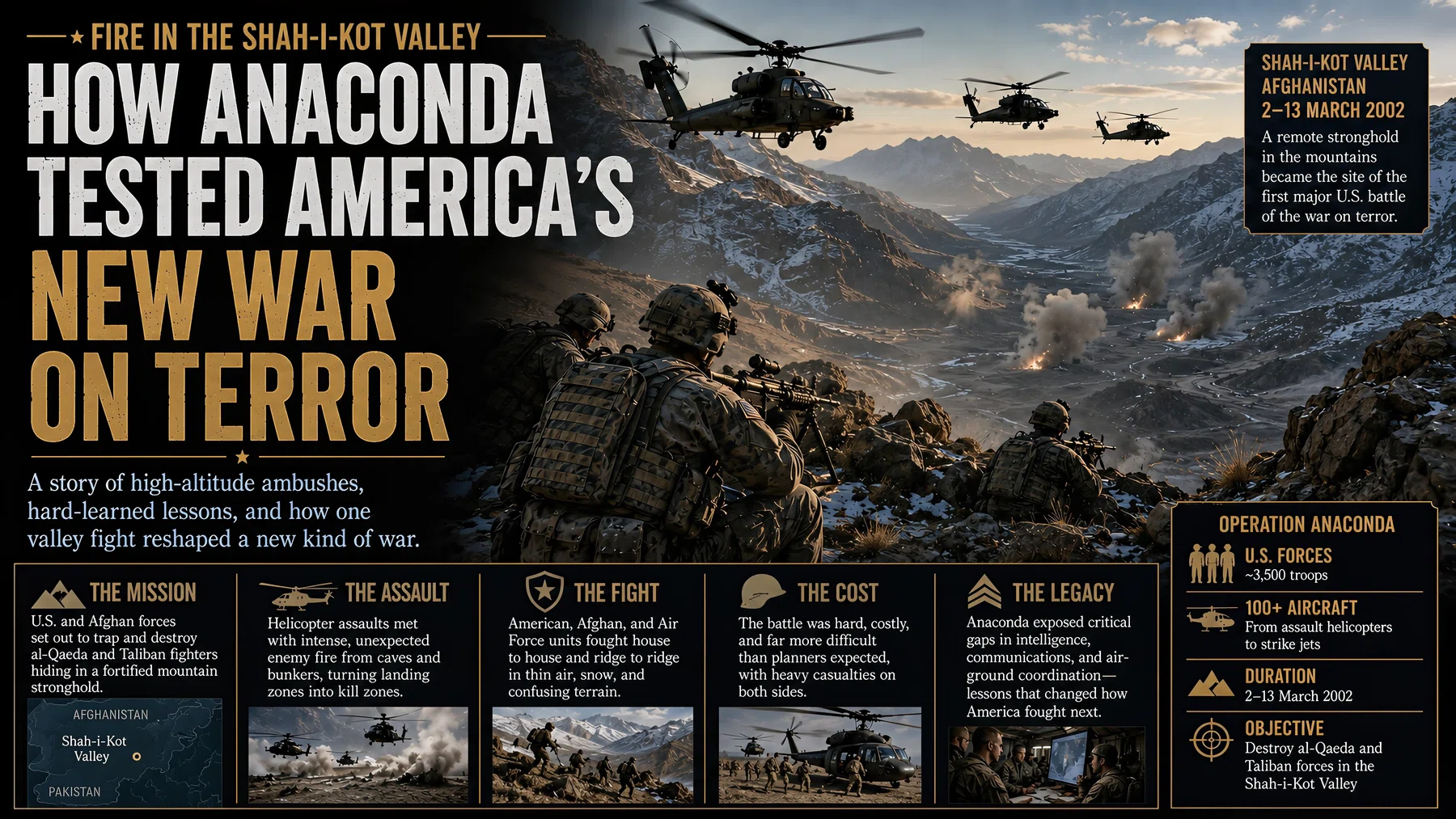
Just over a decade after Desert Storm, United States forces found themselves fighting a very different kind of war in Afghanistan. On March 2nd, 2002, Operation Anaconda began in the Shah-i-Kot Valley and surrounding high ground, as United States and allied troops attempted to encircle and destroy concentrations of al-Qaeda and Taliban fighters. The plan called for Afghan and coalition units to block escape routes while airlifted infantry swept through rugged terrain at high altitude.
On the far side of the world, the same date saw the United States First Army launch a long-awaited breakout from the Normandy hedgerows. After weeks of slow, attritional fighting among the bocage lanes, Operation Cobra aimed to shatter German defenses west of Saint-Lô with a massive aerial bombardment followed by concentrated armored and infantry thrusts.
By August 7th, 1990, Iraqi forces had already invaded and occupied Kuwait, raising fears that they might drive farther south toward the oil fields of Saudi Arabia and disrupt the broader balance of power in the Persian Gulf. On that date, the United States announced Operation Desert Shield, committing air and ground forces to Saudi Arabia at the request of its government and in coordination with other nations.
Related Dispatch
These current Dispatch articles connect directly to records in the Places, Bases & Battlefields directory.