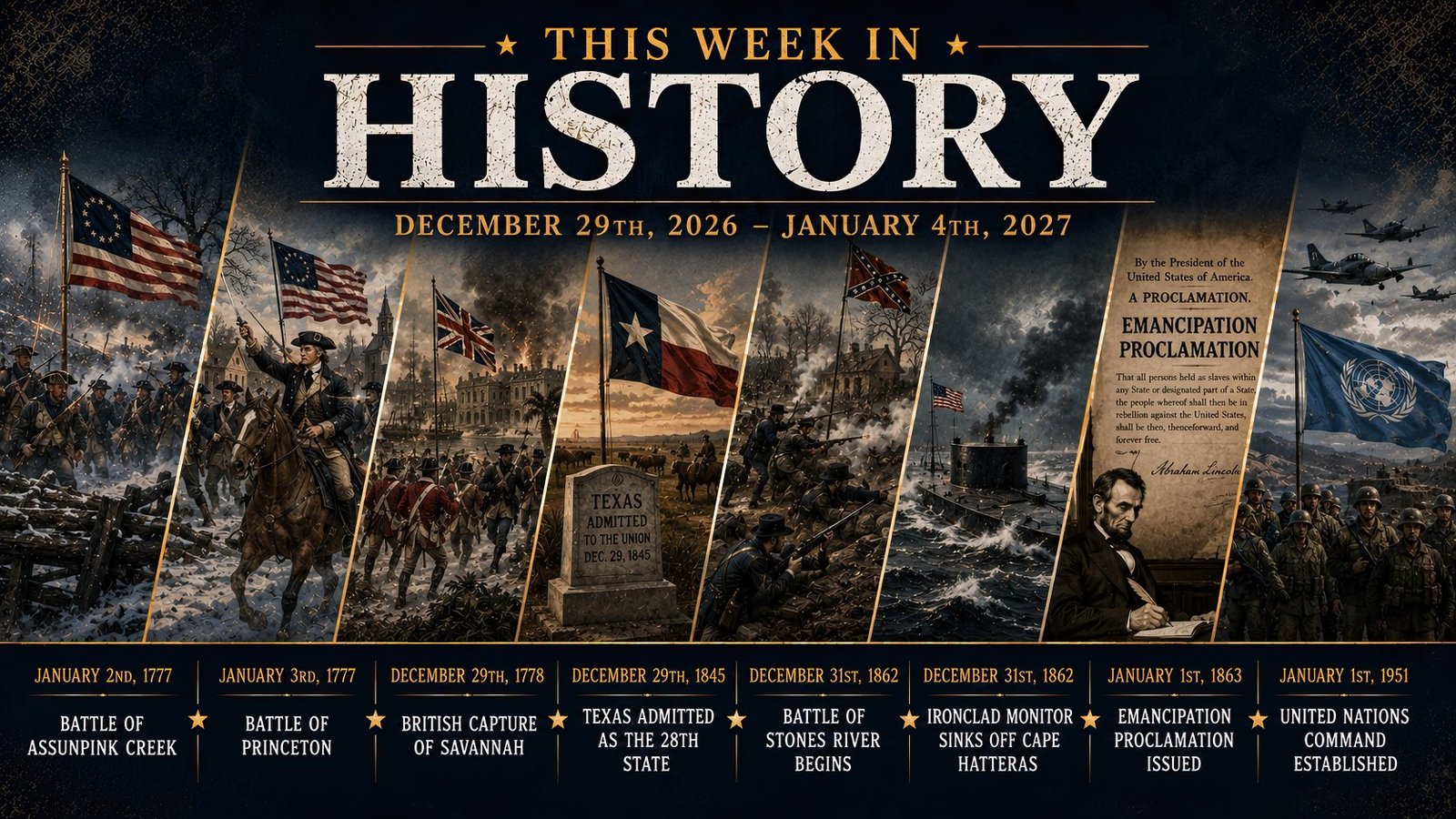
This Week in History · December 29, 2026
100 Populated Entries
How forces prepare, organize, fight, adapt, and learn.
Doctrine, Tactics & Training
Every result opens a permanent subject record with its reference context and connected Dispatch coverage. Filter by record type, editorial collection, or a word in the entry.
100 entries found.
After nearly two years of brutal fighting up the Italian peninsula, German Army Group C formally laid down its arms to the Allied command on May 2nd, 1945. United States Fifth Army and its partners had slogged through mountains, rivers, and heavily fortified defensive lines, from Salerno and Anzio to the Gothic Line in the north.
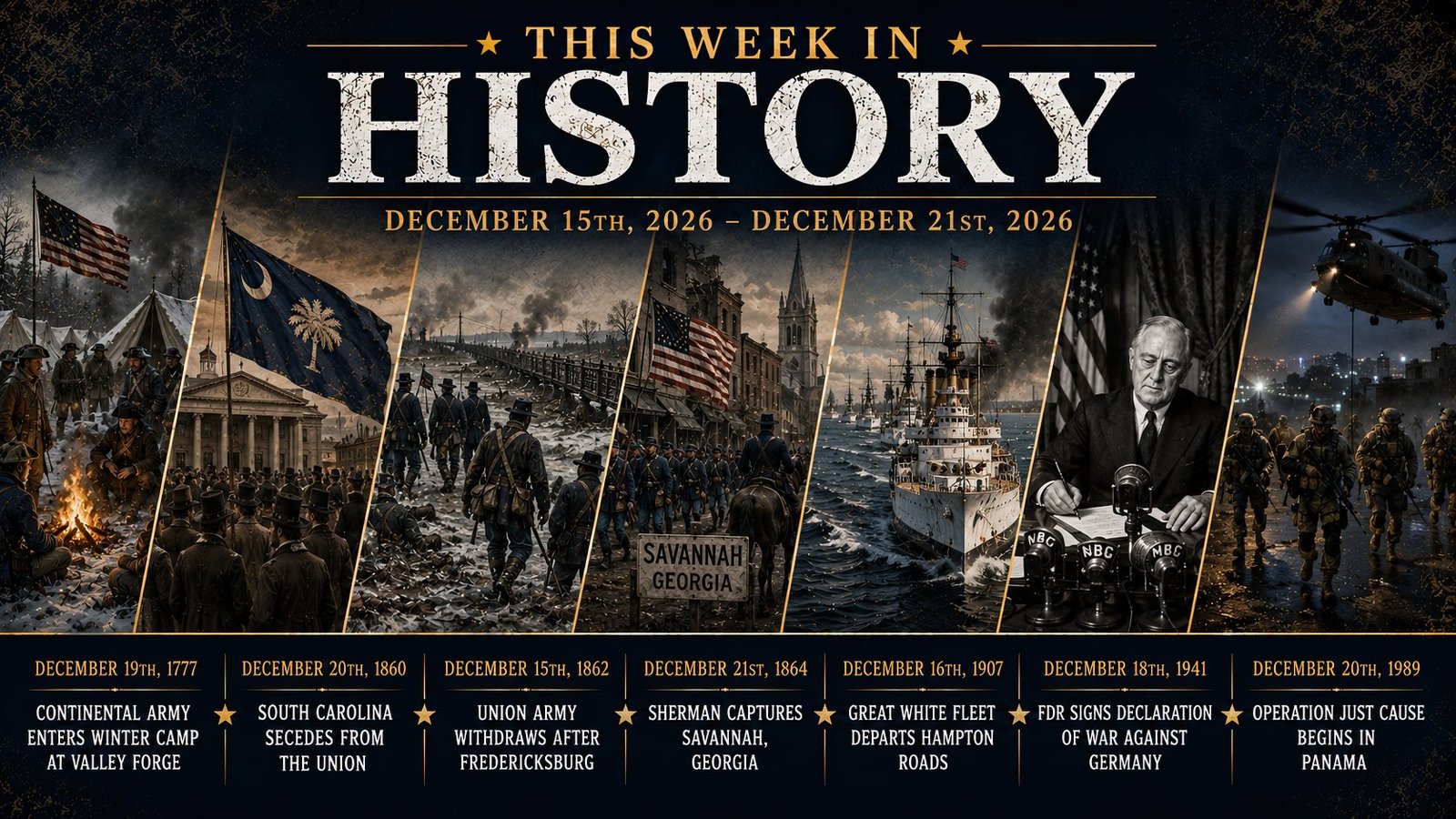
On December 16th, 1907, a column of gleaming white-painted American battleships steamed out of Hampton Roads to begin a world cruise that would last more than a year.
On the night of February 17th, 1864, off Charleston, South Carolina, the Confederate submarine H. L. Hunley moved slowly toward the Union sloop of war USS Housatonic. The Hunley was a dangerous experiment: a hand-cranked, cigar-shaped boat with a spar torpedo mounted on its bow. Its crew had already died in earlier test accidents, but on this sortie the submarine reached its target, detonated its explosive charge, and sent Housatonic to the bottom in minutes.
On February 19th, 1945, the beaches of Iwo Jima filled with landing craft as Marines of the 4th and 5th Marine Divisions came ashore under fire. The island was small but strategically important, lying between the Marianas and the Japanese home islands and hosting airfields that could threaten American bombers.
In the late summer of the Civil War, Confederate General Robert E.
On January 9th, 1945, American forces surged ashore along the beaches of Lingayen Gulf on the island of Luzon in the Philippines. Supported by a powerful naval and air armada, soldiers of the United States Sixth Army waded through surf under the threat of mines, artillery, and kamikaze attacks that had already cost the fleet dearly during the approach.
Just days after Guam, another carefully planned amphibious assault unfolded on the nearby island of Tinian. American planners studied Japanese defenses and concluded that a direct assault on the obvious beaches would be too costly, so they chose two much smaller, less expected landing sites on Tinian’s northwest coast. Marines went ashore across those narrow strips of sand using specialized landing craft and intense naval gunfire to suppress enemy positions above the cliffs.
During the Second World War’s Pacific campaign, the Gilbert Islands became a stepping stone toward the central Pacific.
As ground combat raged on Okinawa, the United States fleet offshore faced a new and deadly form of air attack in unprecedented numbers. Japanese forces launched a series of large-scale suicide air raids, known as kamikaze attacks, aimed at crippling the invasion armada by sacrificing pilots and aircraft directly against ships. On April 6th, waves of kamikaze aircraft struck radar picket destroyers, carriers, and other vessels, sinking some ships and damaging many more.
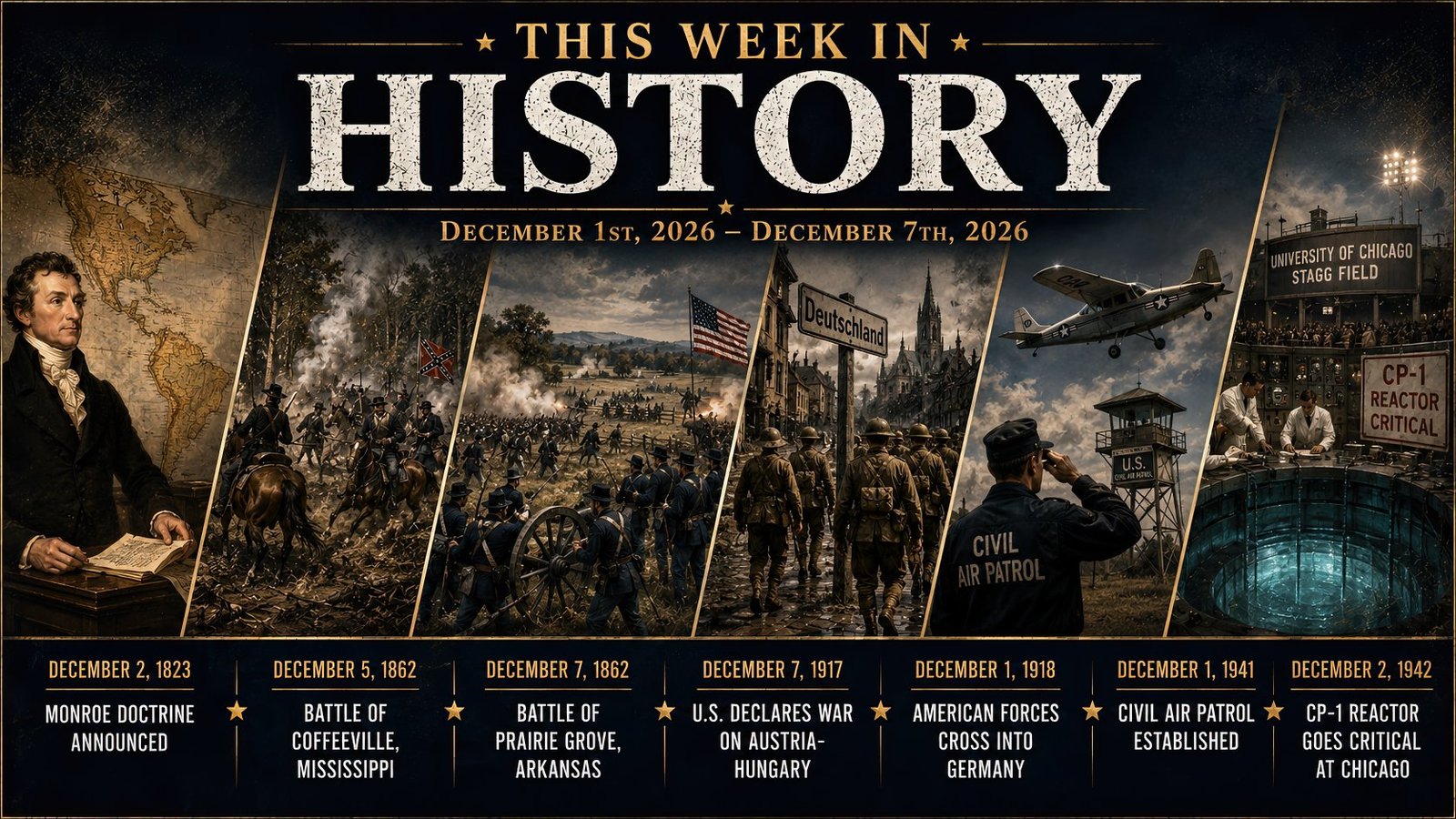
In his annual message to Congress on December 2nd, 1823, President James Monroe drew a bold line through the map of the Western Hemisphere.
A story of scattered night jumps, improvised small-unit fights, and how chaos still helped open the door into Fortress Europe.
After nearly three brutal months of fighting, American commanders declared the island of Okinawa secure on June 22nd, 1945. The campaign had begun with amphibious landings in April, followed by a grinding advance against deeply dug-in Japanese defenses that relied on cave systems, reverse-slope positions, and determined infantry counterattacks.
A story of a nearly lost beach, scattered initiative, and how small groups clawed back the chance to win a war.
A story of stealth jets, precision strikes, and a regime suddenly in the dark, and how it changed the wider war.
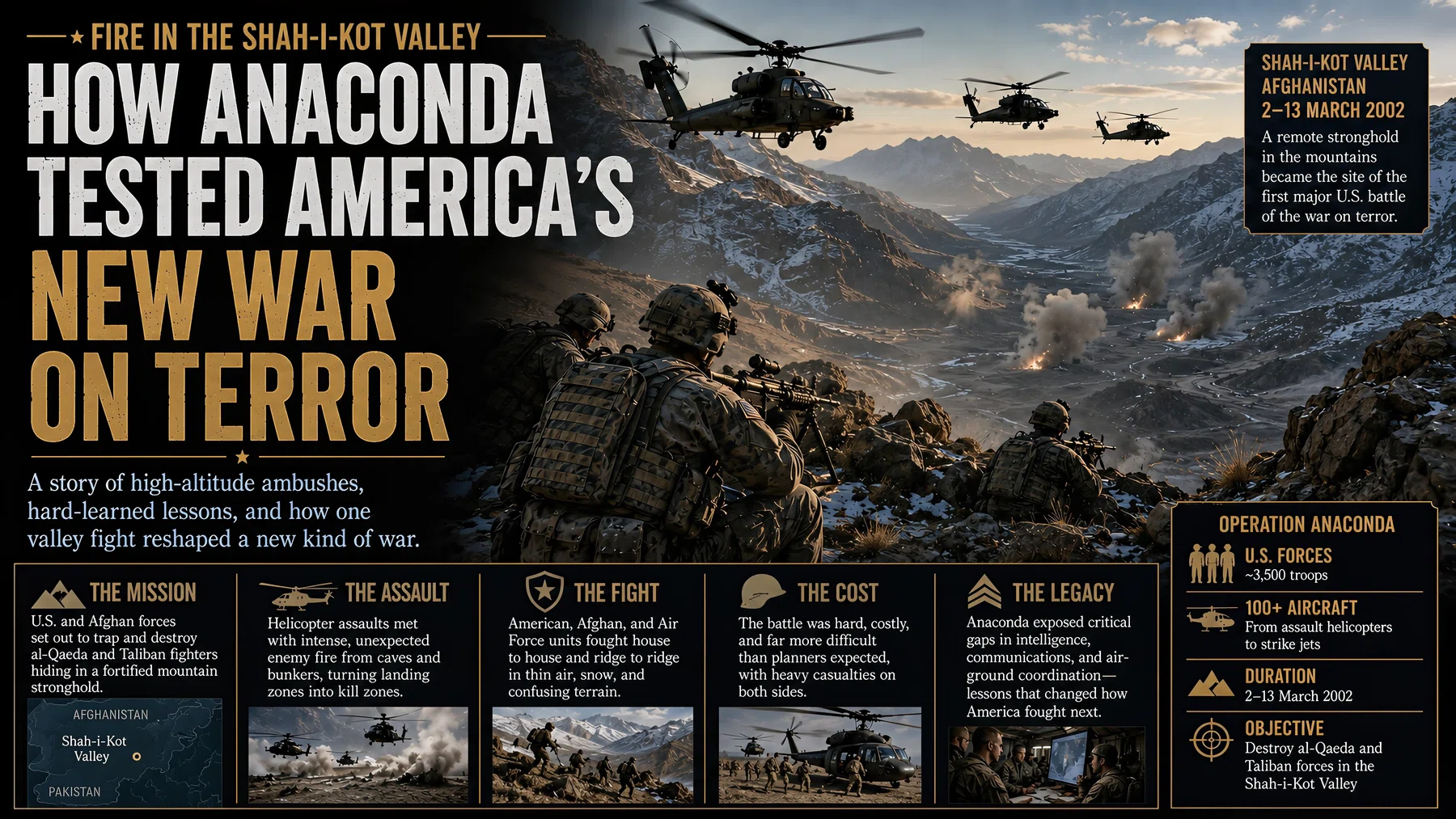
Just over a decade after Desert Storm, United States forces found themselves fighting a very different kind of war in Afghanistan. On March 2nd, 2002, Operation Anaconda began in the Shah-i-Kot Valley and surrounding high ground, as United States and allied troops attempted to encircle and destroy concentrations of al-Qaeda and Taliban fighters. The plan called for Afghan and coalition units to block escape routes while airlifted infantry swept through rugged terrain at high altitude.
By early 1962, American involvement in Vietnam was still officially described in terms of advisors, but the character of that involvement was already changing. On January 12th, 1962, Operation Chopper saw United States Army helicopters lift South Vietnamese troops into action against insurgent forces near Saigon. The mission may have seemed modest at the time, but it showcased the emerging doctrine of air mobility, using rotary-wing aircraft to move infantry quickly over difficult terrain.
On the night of February 23rd into February 24th, 1991, after weeks of intensive air strikes, coalition ground forces launched the main land offensive of Operation Desert Storm. U.S. Marine divisions attacked into Kuwait from the south, while U.S. Army armored corps and allied units executed a broad “left hook” across the desert into western Iraq to outflank Iraqi forces.
Decades later, the United States turned to precision airpower to respond to state-sponsored terrorism. On April 15th, 1986, American aircraft from the Air Force and Navy struck targets in Libya associated with military facilities and leadership protection. Long-range bombers flew from distant bases with multiple aerial refuelings, while carrier-based aircraft launched from the Mediterranean Sea, all timed to hit within a narrow window.
Less than a year after USS Cole, the attacks of September 11th, 2001 brought the war on terror fully into view.
In the early hours of July 10th, 1943, waves of Allied troops, including the United States Seventh Army and the British Eighth Army, began landing along the southern coast of Sicily in Operation Husky. Rough seas scattered many landing craft and airborne units, turning the opening hours into a confused struggle to get ashore and organize.
On December 18th, 1972, United States bombers and supporting aircraft began a concentrated air offensive often known as the “Christmas bombing” of North Vietnam.
Two days after the Peleliu landings, American paratroopers were jumping over the Netherlands as part of an ambitious Allied plan to seize a route across major rivers into Germany.
By March 1945, Allied armies had reached the last major natural barrier in western Germany, the River Rhine. In coordination with a large river crossing called Operation Plunder, planners organized an ambitious airborne assault code-named Operation Varsity, using British and American paratroopers and glider-borne troops.
In the Iraq War, the second battle for the city of Fallujah became one of the most intense urban fights American forces had seen in generations.
Related Dispatch
These current Dispatch articles connect directly to records in the Doctrine, Tactics & Training directory.