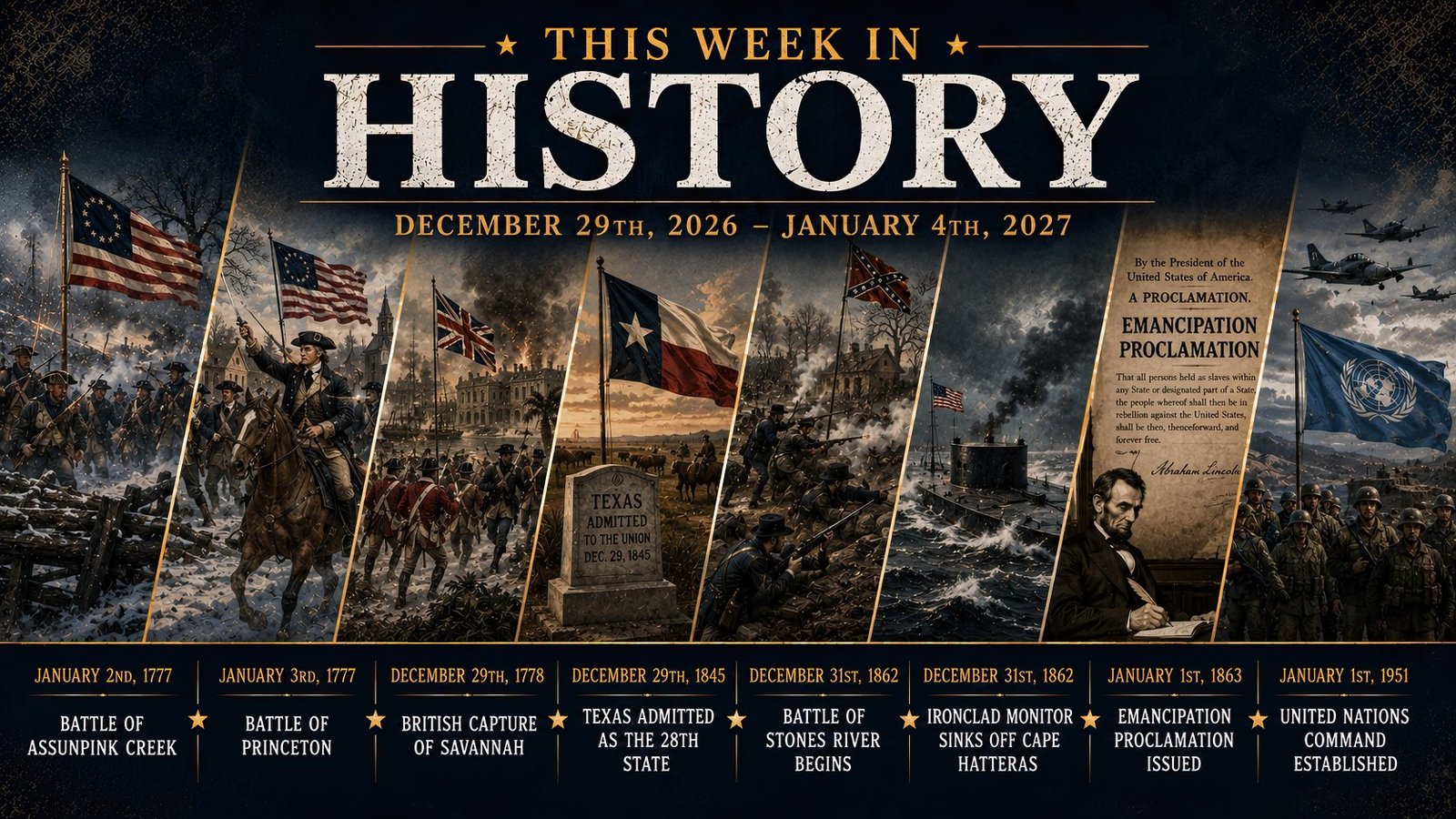
This Week in History · December 29, 2026
100 Populated Entries
How forces prepare, organize, fight, adapt, and learn.
Doctrine, Tactics & Training
Every result opens a permanent subject record with its reference context and connected Dispatch coverage. Filter by record type, editorial collection, or a word in the entry.
100 entries found.
At Pittsburg Landing along the Tennessee River, Confederate forces struck the encamped Union Army of the Tennessee in a surprise attack that opened one of the Civil War’s first truly massive battles. General Ulysses S. Grant’s troops had been gathering for an advance deeper into the Confederate heartland when General Albert Sidney Johnston launched a dawn assault.
A story of a brutal island landing, a coral reef turned killing ground, and how one short battle rewrote amphibious warfare.
A story of a winter surprise offensive and exhausted American units holding the line under crushing odds.
An unfolding story of carrier decks, radio reports, and long-range strikes that reshaped the Pacific war before the fleets ever met face to face.
By mid-1918, German armies in France had driven a dangerous salient across the Marne River, threatening Paris and hoping to win the war before American troops could arrive in strength. In the early hours of July 18th, French and American forces launched a coordinated counteroffensive, striking the exposed flanks of the German position near Soissons and along the Marne.
An air-sea clash where radar, training, and discipline turned a desperate carrier defense into a one-sided hammer blow that reshaped the Pacific war.
In the early 1960s, United States leaders sought to topple the new Cuban government through covert means rather than open war. On April 17th, 1961, a force of Cuban exiles, trained and supported by American agencies, landed along Cuba’s southern coast at the Bay of Pigs. The plan called for air strikes, a beachhead, and hoped-for uprisings inside the country, but execution problems and rapid government response undercut the operation from the start.
Two decades later, American troops faced a different kind of threat while on peacekeeping duty in Lebanon.
At the dawn of a new century, American forces operating far from home faced a different kind of threat.
On December 29th, 1778, British forces returned in strength to Georgia, targeting the port city of Savannah as the opening move in a renewed Southern strategy.
On a gray September morning, British warships and transports massed off the east side of Manhattan and began pounding the American positions at Kip's Bay.
During the opening weeks of the Iraq War, United States Army armored units pushed toward Baghdad in a series of rapid thrusts designed to shock and disorganize Iraqi defenses. One of the most important objectives was Baghdad International Airport, whose capture would provide a major logistical hub and symbolic foothold on the edge of the capital.
On May 18th, 1944, Allied troops finally occupy the shattered ruins of the monastery and town of Cassino in Italy, ending a months-long struggle along the Gustav Line. Earlier attacks in winter and early spring had seen United States and other Allied units bleed heavily against well-prepared German defenses in rough terrain. The controversial bombing of the historic abbey and repeated assaults through mud, rivers, and rubble turned Monte Cassino into a symbol of the grinding Italian campaign.
A story of a shattered defensive line, a race against explosives, and the one intact bridge that cracked open the last barrier into Germany.
More than a century after the Civil War, United States troops were again fighting over steep slopes, this time in the A Shau Valley of Vietnam. From May 10th through May 20th, 1969, airborne infantry and supporting units battled to seize Hill 937, a thickly forested height that soldiers nicknamed “Hamburger Hill” because of the grinding nature of the combat.
Even as Corregidor fell, the fortunes of the Pacific war were beginning to shift at sea. In early May 1942, American and Japanese carrier groups maneuvered through the Coral Sea, each searching for the other’s position with aircraft rather than surface scouts. On May 8th, following the sinking of the light carrier Shoho the day before, the main carrier duel unfolded.
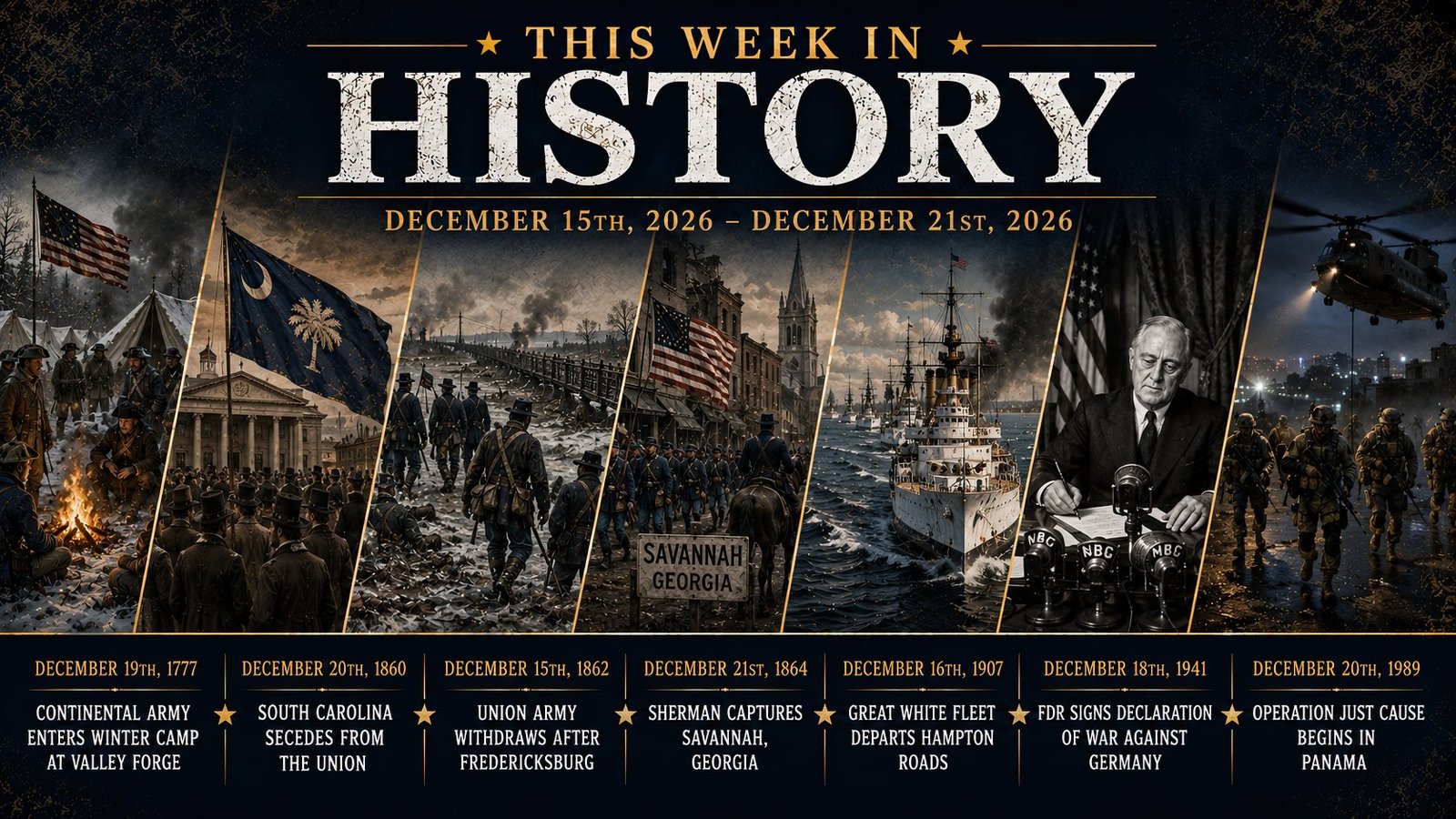
On this day the Continental Army trudged into winter quarters at Valley Forge, west of Philadelphia, after a bruising campaign season.
Two days later, early June turned into one of the most famous dates in world history. On June 6th, 1944, Allied forces stormed the beaches of Normandy in northern France in the opening phase of Operation Overlord. United States troops landed primarily at Utah and Omaha Beaches, facing a mix of flooded terrain, beach obstacles, and entrenched German defenders.
On December 21st, 1945, General George S.
In the early 1960s, as Cold War crises multiplied from Berlin to Southeast Asia, American leaders recognized that military intelligence needed more unified direction.
A story of a desperate hilltop stand, a fixed bayonet charge, and how it helped turn a Civil War invasion back.
A story of a long-shot bombing raid, a borrowed carrier deck, and how one gamble shifted the course of a global war.
Less than two weeks after the attack on Pearl Harbor, on December 18th, 1941, the First War Powers Act dramatically expanded the president’s authority to direct the national war effort.
The Second World War was over by December 5th, 1945, but military aviation remained a dangerous profession even in training.
Related Dispatch
These current Dispatch articles connect directly to records in the Doctrine, Tactics & Training directory.