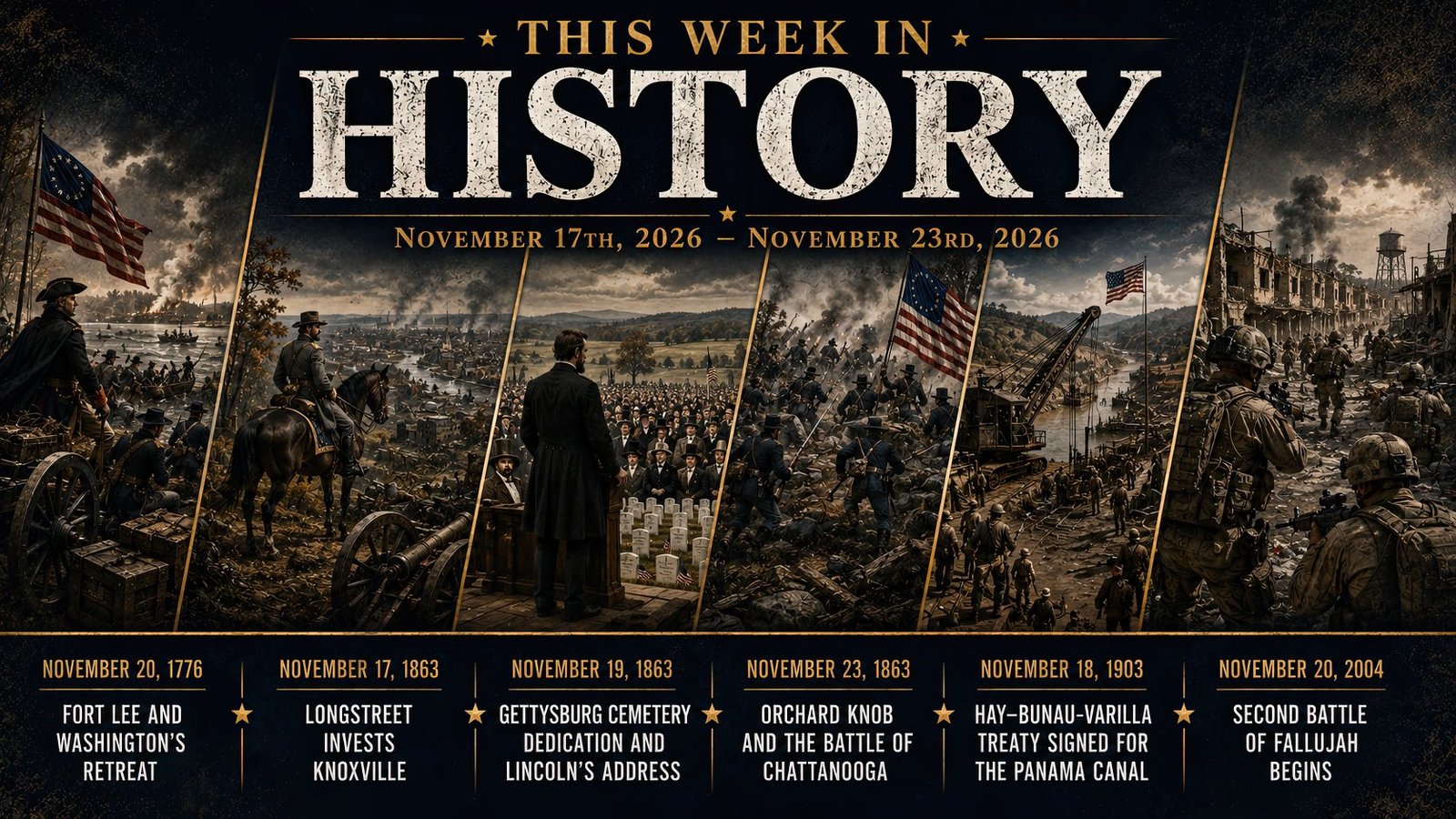
From November 17th, 2026 through November 23rd, 2026, the calendar lines up with a series of moments when American arms, ideas, and institutions faced hard tests. Across these seven days you can trace a line from fragile beginnings in the Revolutionary War, through industrial-age civil conflict, global war, and nuclear confrontation, into the shadowy world of special operations and the brutal street fighting of Iraq. Some of these dates mark famous speeches and courtroom scenes, where words and law tried to make sense of war’s cost. Others belong to muddy hillsides, coral reefs, winter rivers, and cratered city blocks where soldiers and Marines fought yard by yard. Together they show how the United States military has had to adapt to new technology, new enemies, and new expectations from the nation it serves. This week’s selection ties battlefield turning points to the logistical arteries, legal frameworks, and strategic risks that make any victory possible.
Fort Lee and Washington’s retreat
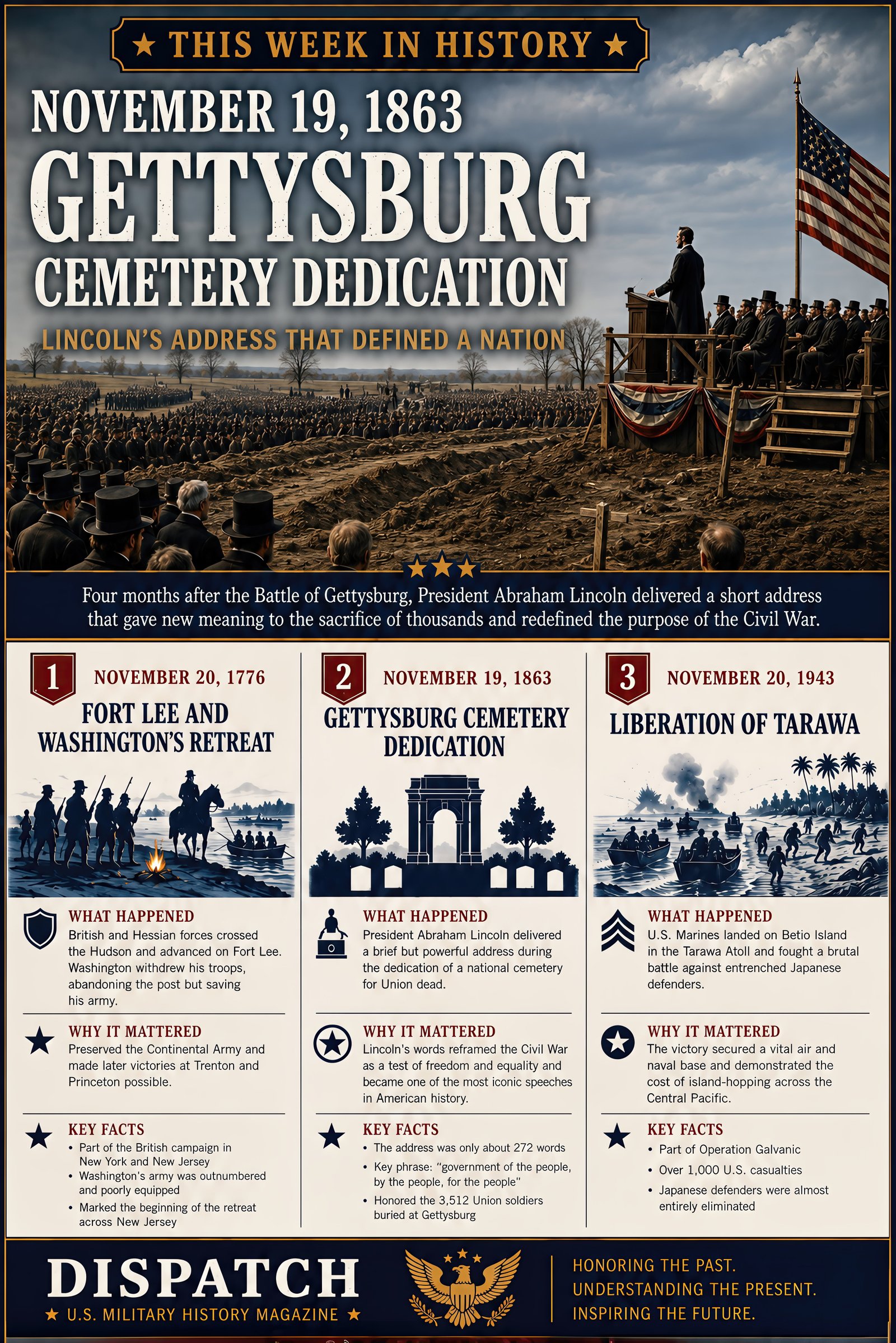
In the autumn of the Revolutionary War, George Washington’s army reeled from defeat around New York City. On November 20th, British and Hessian forces crossed the Hudson River and moved against Fort Lee, a small American position intended to block enemy shipping. Realizing he could not hold the post without risking encirclement, Washington ordered a rapid evacuation, abandoning guns and supplies but saving most of his soldiers. The withdrawal triggered a bitter retreat across New Jersey, with British forces in pursuit and Patriot morale at a low ebb. Yet preserving the core of the Continental Army made later counterstrokes at Trenton and Princeton possible, showing that sometimes survival and mobility are more decisive than standing on doomed ground.
Open the Wiki entryLongstreet invests Knoxville
In the late months of the Civil War, East Tennessee became a contested region where loyalty ran sharply divided. After the Confederate defeat at Chattanooga seemed likely, General James Longstreet was detached with veteran troops to move north against Union forces around Knoxville. On November 17th, his columns closed in and began investing the city, probing its defenses and tightening a siege against General Ambrose Burnside’s men. The Confederates hoped to reclaim a politically and strategically important area, sever Union lines, and regain momentum after earlier setbacks. For the Union, holding Knoxville meant protecting a friendly population, safeguarding transportation routes, and keeping pressure on Confederate resources already stretched thin in multiple theaters. The siege set up later clashes, including the failed assault on Fort Sanders, and demonstrated how the war’s outcome hinged not just on grand battles but on who could control key regions and supply corridors over time.
Open the Wiki entryGettysburg cemetery dedication and address
Four months after the smoke cleared from the fields around Gettysburg, the small Pennsylvania town hosted a ceremony to dedicate a national cemetery for Union dead. On November 19th, politicians, veterans, and citizens gathered to hear long orations and to lay out orderly rows of graves where hastily buried soldiers had fallen. President Abraham Lincoln followed a featured speaker with a brief address that lasted only a few minutes, but his remarks reframed the war in simple, enduring language. He spoke of a nation “conceived in liberty,” the unfinished work of those who fought, and the hope that government “of the people, by the people, for the people” would not perish. For soldiers still in the ranks, the cemetery and the words attached to it underscored that their sacrifices were tied to an idea of the Union and human equality, not just territorial control. The address became a touchstone for how Americans remember military service and the meaning of national survival.
Open the Wiki entryOrchard Knob and Chattanooga
While East Tennessee struggled under siege, another crucial city lay under Confederate observation at Chattanooga, a gateway through the mountains into the Deep South. Union forces trapped there after earlier fighting depended on fragile supply lines, and both sides understood that whoever held the surrounding heights could dominate the region. On November 23rd, General Ulysses S. Grant ordered a limited objective attack on Orchard Knob, a prominent rise in front of Confederate lines. Troops of the Army of the Cumberland surged forward, swept over the objective more decisively than expected, and established a strong foothold. That gain set the stage for the larger assaults on Missionary Ridge and Lookout Mountain that broke the siege and forced Confederate forces back into Georgia. Strategically, the victory opened the way for Sherman’s campaigns and showed how careful coordination and renewed confidence in previously overlooked troops could change the war’s direction in the western theater.
Open the Wiki entryHay–Bunau-Varilla Treaty signed
At the turn of the twentieth century, American leaders viewed an isthmian canal as essential to both commerce and naval strategy. After political turmoil and a revolution in Panama, United States diplomats moved quickly to secure construction and operating rights. On November 18th, 1903, the Hay–Bunau-Varilla Treaty was signed, granting the United States a wide canal zone and long-term control over a strip across the new republic. For the Army and Navy, the agreement promised a faster transfer of ships between the Atlantic and Pacific, shorter reinforcement routes, and a more flexible global posture. Building and defending the canal would draw in engineers, medical officers, Marines, and coastal artillery, turning the zone into a showcase of American power and problem solving. The treaty also carried long-term diplomatic complications, but in purely military terms it marked a major investment in the logistical backbone needed for a modern, ocean-spanning fleet.
Open the Wiki entryMarines assault Tarawa
During the Second World War’s Pacific campaign, the Gilbert Islands became a stepping stone toward the central Pacific. On November 20th, 1943, Marines of the Second Marine Division and soldiers of the Army’s Twenty-Seventh Infantry Division launched amphibious assaults on heavily fortified Japanese positions at Tarawa and Makin. At Tarawa’s tiny Betio Island, coral reefs and misjudged tides forced many landing craft to halt short of the beaches, leaving Marines wading hundreds of yards under intense fire. Casualties piled up, but small groups clawed their way inland, using grenades, flamethrowers, and close-range infantry tactics to clear pillboxes and bunkers. After several days of brutal fighting, the island fell, offering an airfield and a forward base but at a cost that stunned the American public. For planners, Tarawa became a harsh lesson in tides, intelligence, and pre-landing bombardment, influencing how later amphibious operations across the Pacific were conducted.
Open the Wiki entryMetz falls to Third Army
In Europe, the fortified city of Metz had long been viewed as a tough nut to crack, with layers of forts dating back to earlier German rule. Through the autumn of 1944, General George Patton’s Third Army battled both stubborn defenses and miserable weather as it pushed across the Moselle River toward the city. By late November, coordinated attacks, artillery, and careful assaults on individual strongpoints gradually wore down the garrison. On November 22nd, American forces finally secured Metz, taking control of its forts and clearing a major obstacle to further advances into the Saar region. The victory helped stabilize the front before the winter and freed up units for future operations, even as the German army prepared its surprise counteroffensive in the Ardennes. Metz illustrated how, even late in the campaign, seemingly old-fashioned fortress systems could still demand patient, costly work from infantry and engineers.
Open the Wiki entryNuremberg Trials open
With the Second World War over in Europe, Allied leaders grappled with how to respond to the crimes committed by the defeated regime. On November 20th, 1945, judges, prosecutors, and defendants gathered in a bomb-damaged German city as the International Military Tribunal opened its proceedings at Nuremberg. American officers and lawyers played a central role in organizing evidence, presenting captured documents, and establishing legal theories about crimes against peace and humanity. The trial marked a departure from older traditions where defeated leaders might face summary punishment without public examination of their actions. For many veterans, the sessions offered a formal acknowledgment that the war had been fought not only over territory, but over ideas of law and responsibility. The Nuremberg proceedings helped set precedents for later international tribunals and shaped how the world thinks about accountability for decisions that send armies into war and civilians into harm’s way.
Open the Wiki entryCuban quarantine lifted
The nuclear tensions of the early Cold War peaked when the United States discovered offensive missiles being installed in Cuba. After a tense October standoff that included public speeches, secret exchanges, and the deployment of a naval “quarantine” to intercept Soviet shipping, a negotiated settlement emerged. By November 20th, 1962, Soviet missiles were being removed under observation, and President John F. Kennedy ordered the end of the naval blockade. For sailors and aircrews who had spent long days on alert, the lifting of the quarantine signaled that the confrontation had moved away from the brink of war. Strategically, the crisis showed how military posture, especially sea control and ready strategic forces, could support firm diplomacy without tipping into catastrophe. It also led to later measures like direct communication links and test-ban agreements that sought to reduce the chance that misunderstanding or miscalculation might drag both sides into a nuclear exchange.
Open the Wiki entryAmbush near LZ Albany
In Vietnam’s Central Highlands, the fighting around the Ia Drang Valley marked one of the first large-scale clashes between American airmobile forces and North Vietnamese regulars. After days of intense combat around Landing Zone X-Ray, elements of the First Cavalry Division were ordered to move overland toward new pickup points. On November 17th, a battalion-sized column near Landing Zone Albany became stretched out in the tall grass and trees, unaware of a major enemy force nearby. North Vietnamese units launched a devastating ambush, quickly fragmenting the column, isolating companies, and triggering desperate small-unit battles for survival. Artillery and air support eventually helped stabilize the situation, but casualties were severe, and many survivors carried memories of close-quarters fighting and confusion. The ambush underscored the vulnerability of air-mobile infantry during foot movement and forced commanders to refine how they planned marches, reconnaissance, and supporting fires in dense terrain.
Open the Wiki entryHill 875 at Dak To
Two years later, the Central Highlands again saw fierce engagements as American commanders tried to disrupt enemy concentrations near the Cambodian and Laotian borders. Around Dak To, airborne units, including the One Hundred Seventy-Third Airborne Brigade, were ordered to attack a series of hills suspected of sheltering strong North Vietnamese positions. On November 19th, paratroopers advancing up Hill 875 met intense fire from bunkers, trenches, and well-prepared fighting holes camouflaged in the jungle. The steep slopes and interlocking fields of fire turned each yard of progress into a costly effort, with medics working under constant danger and companies struggling to maintain cohesion. Over several days, repeated assaults and supporting fires finally secured the crest, though at heavy cost. The battle showed the determination of both sides and raised questions back home about the price of seizing remote pieces of ground in a war where the enemy could choose when and where to stand and fight.
Open the Wiki entrySon Tay prison camp raid
As the Vietnam War dragged on, reports of American prisoners held deep inside North Vietnam weighed heavily on families, policymakers, and military planners. Special operators from the Army and Air Force spent months rehearsing a daring nighttime rescue mission aimed at a camp near Son Tay, not far from Hanoi itself. In the early hours of November 21st, 1970, helicopters and fixed-wing aircraft thundered low through the dark, inserting a raiding force that swiftly seized the compound, eliminated guards, and searched for captives. To their shock, the camp turned out to be empty, the prisoners having been moved earlier, leaving rescuers with no one to extract. Although the mission did not bring anyone home, it demonstrated the reach, precision, and joint planning that would later define American special operations. North Vietnamese authorities, recognizing what had nearly happened, consolidated prisoners in different facilities, indirectly improving conditions and communication among captives who had long been isolated.
Open the Wiki entryOrganized resistance breaks in Fallujah
In the Iraq War, the second battle for the city of Fallujah became one of the most intense urban fights American forces had seen in generations. Earlier in November, Marines, soldiers, and Iraqi units had launched a coordinated offensive to clear insurgent strongholds block by block, using combined arms in the tight confines of streets and courtyards. By November 23rd, commanders judged that organized resistance within the city had largely collapsed, with remaining fighters scattered or attempting to slip away. The cost had been high, with booby-trapped buildings, snipers, and improvised explosives turning every movement into a potential firefight. Yet the operation disrupted insurgent networks that had used Fallujah as a base for attacks across the region and provided hard-earned lessons in urban tactics, intelligence, and civil-military coordination. For the Marines and soldiers who fought there, the date marked not a clean victory, but a moment when relentless small-unit action finally tipped the balance in a grueling campaign.
Open the Wiki entryAcross the Week
In these seven calendar days, separated by years and wars, American forces and leaders confronted problems that ranged from survival to accountability. Washington’s retreat from Fort Lee, the stubborn stands at Knoxville and Chattanooga, and the speeches and treaties of the nineteenth and early twentieth centuries all dealt with how to hold or extend a fragile position. Tarawa, Metz, and Fallujah highlight the grinding work of closing with fortified enemies and learning how to adapt tactics to unforgiving terrain, whether coral reefs, fortress belts, or concrete neighborhoods. The opening of the Nuremberg Trials and the resolution of the Cuban Missile Crisis show that military power has to be linked to law, restraint, and a clear sense of what peace should look like. In Vietnam and beyond, the ambush near Albany, the struggle for Hill 875, and the Son Tay raid illustrate courage under fire and the evolution of specialized forces. Taken together, these episodes remind us that each generation’s service members inherit both lessons and burdens from those who came before, and that the work of defending the nation never stands still for long.