In Action
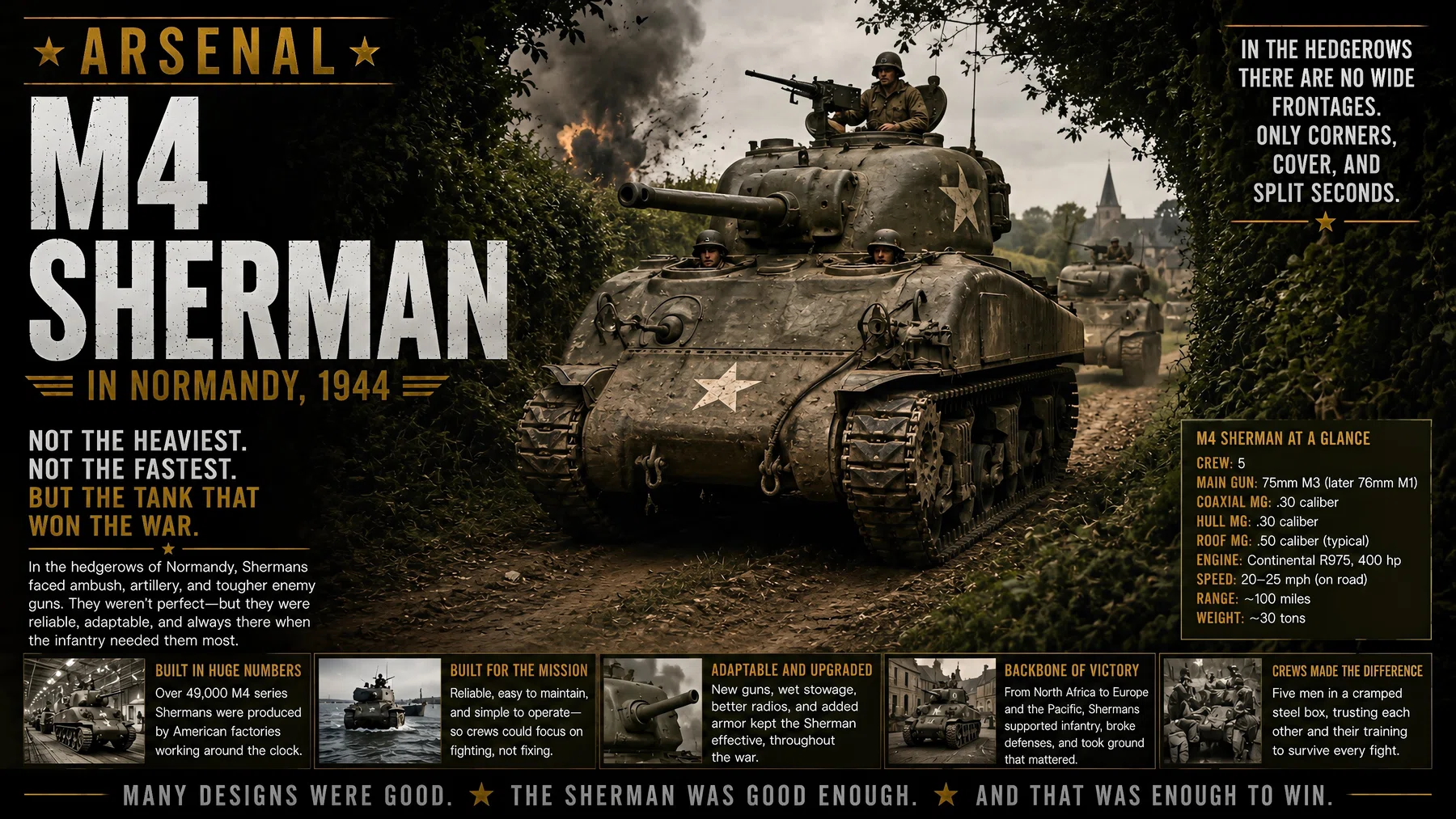
The hedgerows look peaceful from a distance. Low banks of earth and tangled brush divide the Normandy fields, but inside an M4 Sherman they feel like an ambush line. The tank crawls forward in low gear, turret traversing, commander half out of the hatch with binoculars to his eyes. It is July 1944, south of Saint-Lô, and a company of Shermans is edging down a sunken lane that could hide a single gun or an entire German platoon.
Inside, five men work in cramped heat and noise. The driver keeps the nose against the right bank, searching for a gap that will not expose the thinner lower hull. The gunner stares into his sight, right hand resting on the electric trigger for the seventy-five millimeter gun. The loader braces among scattered shell cases, one eye on the ready rack, keeping count of high explosive and armor piercing rounds. The bow gunner listens for threats the others cannot see, hands on the hull machine gun, while the commander tries to keep everyone calm and focused.
The lane bends left. The radio snaps with a warning from up front, cut short by a white flash in the hedgerow. A sharp crack follows, then the heavy thud of impact on armor somewhere ahead. Smoke drifts back over the lane as the commander drops into the turret and swings the gun toward the suspected muzzle flash. In that moment the Sherman feels both solid and vulnerable, a dependable workhorse thrust into terrain and tactics its designers never fully imagined. This is where the M4 will earn its reputation, for good and for ill.
The Problem It Was Built To Solve
The duel in the hedgerows was not the future anyone had in mind when the M4 Sherman was conceived. Before the landings in Normandy, American armored doctrine imagined something more fluid: wide frontages, open country, tanks driving deep to disrupt enemy rear areas while infantry and artillery cracked fixed defenses. In that vision, the main problem was not fighting heavy enemy tanks head-on, but fielding a medium tank that could be built in vast numbers, shipped across oceans, and kept running on distant battlefields.
Early in the war, the United States Army had relied on the M3 Lee, a stopgap design that mounted its main gun in a sponson on the side of the hull. It offered firepower, but its high silhouette and limited gun traverse made it awkward to fight and easy to spot. Commanders knew they needed a more versatile machine: a fully rotating turret for the main gun, better crew layout, and armor that gave at least a fighting chance against contemporary guns without becoming too heavy to move.
Industrial reality shaped every decision. The tank had to fit on existing railcars, through ship hatches, and onto landing craft ramps. It had to use engines and components that American factories could produce at speed, often by adapting designs from the automotive world. The Army wanted a medium tank that was reliable, easy to maintain, and simple enough that new crews could learn it quickly under field conditions. Designers were told, explicitly and implicitly, that a tank in the field this year was more valuable than a theoretically perfect tank arriving late.
The result was the concept that became the M4 Sherman: a standardized, adaptable medium tank meant to be the armored backbone of American and Allied forces. It would not be the heaviest or most powerful tank on the battlefield, but it aimed to solve a different problem—how to bring effective armor and firepower wherever the war might go, and to keep it moving once it got there.
From Design Board To Production
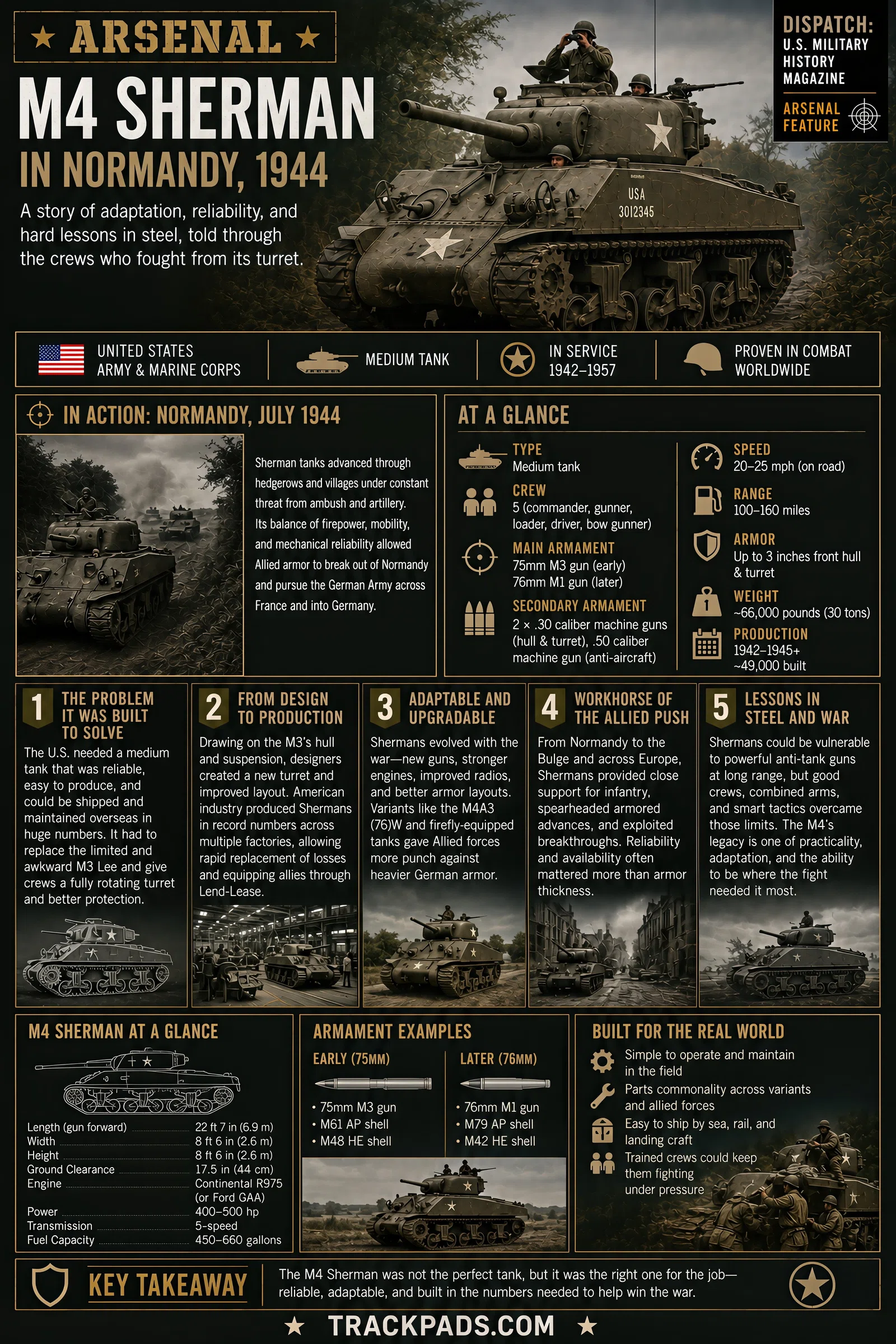
The path from the awkward M3 Lee to the M4 Sherman moved quickly once American planners understood that the war would be fought overseas and in large numbers of machines. Ordnance officers asked for a medium tank with a fully rotating turret, a reliable powertrain, and armor thick enough to stand up to the common anti-tank guns then in service. Engineers reused what they could from the M3 to save time: the lower hull, much of the suspension, and existing engine options were carried over, while a new upper hull and turret were drafted to carry the main gun in a proper fighting position. The goal was not to build an exotic weapon, but a solid, repeatable pattern that factories could turn out by the thousands.
Industrial America answered with a web of plants that treated tanks almost like automobiles. The Detroit Arsenal Tank Plant became a symbol of this approach, but other factories joined in, each building slightly different sub-variants while staying within a common standard. Casting and welding methods varied, as did engine types, yet the Army insisted that a crew trained on one M4 could fight from another without relearning everything from scratch. Tradeoffs were constant: thicker armor meant more weight, which could slow the tank and strain engines; bigger guns promised more punch, but risked crowding the turret and complicating ammunition storage. The designers usually favored reliability, ease of maintenance, and cross-country speed over raw armor thickness.
At a glance, the M4 Sherman was a medium tank of the United States, serving primarily with the Army and Marine Corps from 1942 onward. It carried a crew of five, a seventy-five millimeter main gun in its early forms, a coaxial machine gun in the turret, and another in the hull, with a heavy machine gun often mounted on the roof. On roads it could reach roughly twenty to twenty five miles per hour, with a range suitable for operational marches when fuel and maintenance were available. By the time American forces landed in North Africa, and later in Normandy, thousands of Shermans were already in service or on the way, poised to become the standard armored face of the Allied advance.
Inside The Weapon
Climbing onto a Sherman, the first impression is of a compact, rounded hull with a tall turret that seems almost friendly compared to more angular designs. The glacis plate slopes back from the bow machine gun position, leading up to the driver and bow gunner hatches. On top, the turret sits slightly forward of center, its rounded sides housing the main gun and three of the five crewmen. Stowage brackets, spare track links, and tools crowd the outside, each piece carefully placed but sometimes rearranged by units to suit their own habits. For the crew, this steel shell would be home, workplace, and in bad moments, coffin.
Inside the hull, the driver sits on the left front, hands on levers and feet on pedals that demand muscle and practice. To his right, the bow gunner manages the hull machine gun and the radio in many variants, acting as an extra set of eyes and ears in the chaos of combat. Behind them, beneath the turret, ammunition racks line the sides and floor, early versions storing shells in positions that later proved dangerously exposed when armor was penetrated. The engine, often a converted aircraft radial or a grouped set of smaller automotive engines, roars in the rear compartment, sending heat and vibration through the floor. Mechanics valued the Sherman’s engines for their relative reliability, but crews never forgot they were riding directly in front of a mass of fuel and hot machinery.
In the turret, the commander stands or crouches under his hatch, trying to maintain a full-circle view while also directing the gunner and loader. The gunner sits to the front right, eye pressed to the sight, one hand on elevation and traverse controls, the other ready on the trigger. The loader works to the left of the gun, juggling heavy shells from racks into the breech, then clearing spent cases while keeping track of ammunition types. Communication inside the turret relies on shouted orders and intercom systems, which in theory keep everyone linked, but in practice could be overwhelmed by engine noise, gun blast, and the stress of incoming fire. Training films showed calm, measured commands; combat reports describe hurried, overlapping voices and improvisation.
Subsystems are everywhere, yet each has a human purpose. The main gun and its stabilizer promise a better chance of hitting on the move, though many crews preferred to halt before firing to improve accuracy. Armor thickness varies across the hull and turret, with the front offering the best protection and the sides and rear more vulnerable, shaping how commanders try to angle their tanks in a fight. Suspension units and tracks give the Sherman its surprisingly good cross-country ride, especially compared to some contemporaries, allowing units to maneuver across rough ground and keep pace with offensive plans. Inside, heaters, ventilators, and stowage for personal gear show attempts to make life bearable, but long days still leave crews exhausted, coated in dust and fumes. On the training range the Sherman feels predictable, almost forgiving; in the hedgerows and city streets of Europe, or the volcanic slopes of Pacific islands, crews learn quickly where its promise holds and where its limitations bite hardest.
Baptism Of Fire
The Normandy lane where our Sherman edges forward is part of a much larger struggle: the fight to break out of the bocage and open France. In July 1944, American armored divisions and independent tank battalions are pushing toward Saint-Lô and beyond, trying to punch holes in a German defense that has turned every hedgerow into a miniature fortress. For the crews, the mission is simple to state and hard to execute: keep pace with the infantry, crush strongpoints, and survive long enough to reach the open country commanders believe will finally favor Allied armor.
By the time these tanks are nosing past French farmhouses, the M4 already has real combat history behind it. Its first major battles came with British and Commonwealth units in North Africa, where it entered the line in late 1942 around the Second Battle of El Alamein, giving Allied forces a more modern medium tank with a powerful gun and decent protection for the first time in that theater. In Tunisia and Italy, American crews learned how to march long distances, coordinate with artillery and air power, and work around early mechanical and tactical problems. Those lessons, good and bad, ride with them to Normandy.
In the hedgerows, though, the fight looks very different from the open desert. A Sherman company might advance only a few hundred yards in a day, blasting gaps through earth banks and taking fire from hidden anti-tank guns, hand-held rocket weapons, and the occasional German tank covering a narrow field of fire. At close ranges, the advantages of radio communication, turret traverse, and a good high-explosive shell matter as much as armor thickness. Commanders call for smoke, for artillery to pound suspected gun pits, for engineers to blow lanes, all while the Shermans nose forward a field at a time. A single knocked-out tank can block the lane; a single hit in the wrong place can turn a solid-feeling machine into an inferno.
Yet when the plan comes together, the M4 does exactly what it was meant to do. In one typical attack, a platoon’s fire smashes a farmhouse strongpoint, infantry ride the tank decks to the next hedgerow, and within hours a crossroad that anchored the German line is in Allied hands. Losses are real—burned-out hulls in the fields and stretcher cases on the verges—but the line has moved. Multiply that sequence across Normandy, and the pattern emerges: the Sherman is not a wonder weapon, but a dependable workhorse that, when used in numbers and in combined-arms fashion, helps pry open Hitler’s Atlantic Wall from the inside.
Strengths And Weaknesses
Ask Sherman crews what they valued most and many start with the same points: it usually started, it usually moved, and it was rarely out of action for long. The M4’s reputation for mechanical reliability and ease of maintenance meant units could keep far more tanks running than many of their opponents, and its relatively roomy interior, good optics, and fast turret traverse gave gunners a real chance to get the first effective shot off in a meeting engagement. Its seventy-five millimeter gun, especially in mid-war, offered a flexible mix of armor-piercing and high-explosive fire that made the Sherman a useful tool against infantry, guns, and lighter armor.
The weaknesses, however, weighed heavily on morale, especially in late 1944. The tank’s high silhouette made it easier to spot and hit, and early ammunition stowage arrangements meant that penetrations often led to catastrophic fires, a tendency that crews remembered long after “wet stowage” water-jacketed racks reduced the risk. Against the long-barreled guns of Panthers and Tigers, or well-sited anti-tank weapons, the Sherman’s frontal armor could be defeated at ranges where its own gun struggled. Stories of needing several tanks to bring down a single heavy German machine spread through the ranks, whether or not they were typical.
Enemies developed their own views. German accounts sometimes dismiss the Sherman as inferior in protection and individual firepower, but they respect its numbers, its mobility, and the Allied ability to keep them fueled, repaired, and supplied. On the Eastern Front, Soviet crews who received Lend-Lease Shermans often praised its reliability, radios, and gun, while complaining about its narrower tracks and higher center of gravity in deep mud compared to the T-34. Against all these perspectives, the M4 sits somewhere in the middle: not the best armor or the biggest gun, but a machine that, in practice, could be counted on day after day in the kind of hard, grinding warfare that actually decided campaigns.
Variants And Evolution
Because the Sherman was designed as a standard pattern rather than a single rigid model, it evolved rapidly as the war went on. Different hull types, engine installations, and small detail changes flowed from American factories and Allied workshops, all while the tank retained its basic silhouette and five-man crew. Early M4s with seventy-five millimeter guns were joined by versions carrying the higher-velocity seventy-six millimeter weapon, which offered better armor penetration against later German designs. Other hulls traded welded construction for cast shapes or composite combinations, balancing armor forms with production realities.
Specialized roles drove further change. Assault gun variants mounted a one hundred and five millimeter howitzer in the turret to provide direct high-explosive fire against bunkers and strongpoints, sacrificing some anti-tank punch in exchange for better support to infantry. The heavily armored “Jumbo” assault version added significant frontal protection so that it could lead advances into well-defended positions, even if that extra armor cost speed. Suspension improvements culminated in the horizontal volute spring system seen on the so-called “Easy Eight” Shermans, whose wider tracks and smoother ride improved cross-country performance and crew comfort, especially in bad weather.
Allied partners pushed the design in their own directions. British engineers created the Sherman Firefly by fitting a powerful seventeen-pounder anti-tank gun into a modified turret, giving Commonwealth units a better answer to German heavy armor while still relying on standard Shermans for most tasks. Other variants turned the M4 into an amphibious “DD” swimming tank for beach landings, a mine-clearing “Crab” with flails spinning ahead of the hull, or a dozer, recovery vehicle, and more. In each case, the basic Sherman chassis became a flexible platform for whatever the tactical problem demanded, proof that the original design brief for adaptability had been well chosen.
Legacy And Where To See It Today
When the guns finally fell silent, the M4 Sherman had become more than just a wartime type designation. It was the face of Allied armor in countless photographs and newsreels, the tank most ordinary people imagined when they thought of the Western Front. Postwar, it remained in service with the United States in Korea and with many other nations into the 1950s and 1960s, fighting in conflicts from the Middle East to South America, and influencing the design philosophy of later tanks that tried to blend mobility, firepower, and maintainability in the same way.
Today, the Sherman’s legacy is visible in steel and paint at museums and memorials around the world. in Britain preserves an early M4A1 nicknamed “Michael,” one of the first examples delivered under Lend-Lease, while other Shermans stand guard outside bases, town halls, and regimental memorials across Europe and North America. In Normandy, several towns keep restored Shermans as part of their local remembrance of the summer of 1944, reminders that liberation rolled in not just on the tracks of a single tank, but on the effort of entire crews and units working together.
For readers of Dispatch and followers of Trackpads, the Sherman also lives on through photographs, walk-around videos, and interviews with veterans and museum staff who have spent years preserving these machines. Its story connects naturally to Beyond the Call profiles of Medal of Honor actions where Shermans appear on the edges of the frame, and to Living History conversations with the people who maintained and restored them decades later. However you come to it—through a museum visit, an old film, or a story like this—the M4 Sherman invites us to look past the armor and rivets and remember the men inside, whose lives depended on whether this “good enough” tank was, in their moment of crisis, just that.