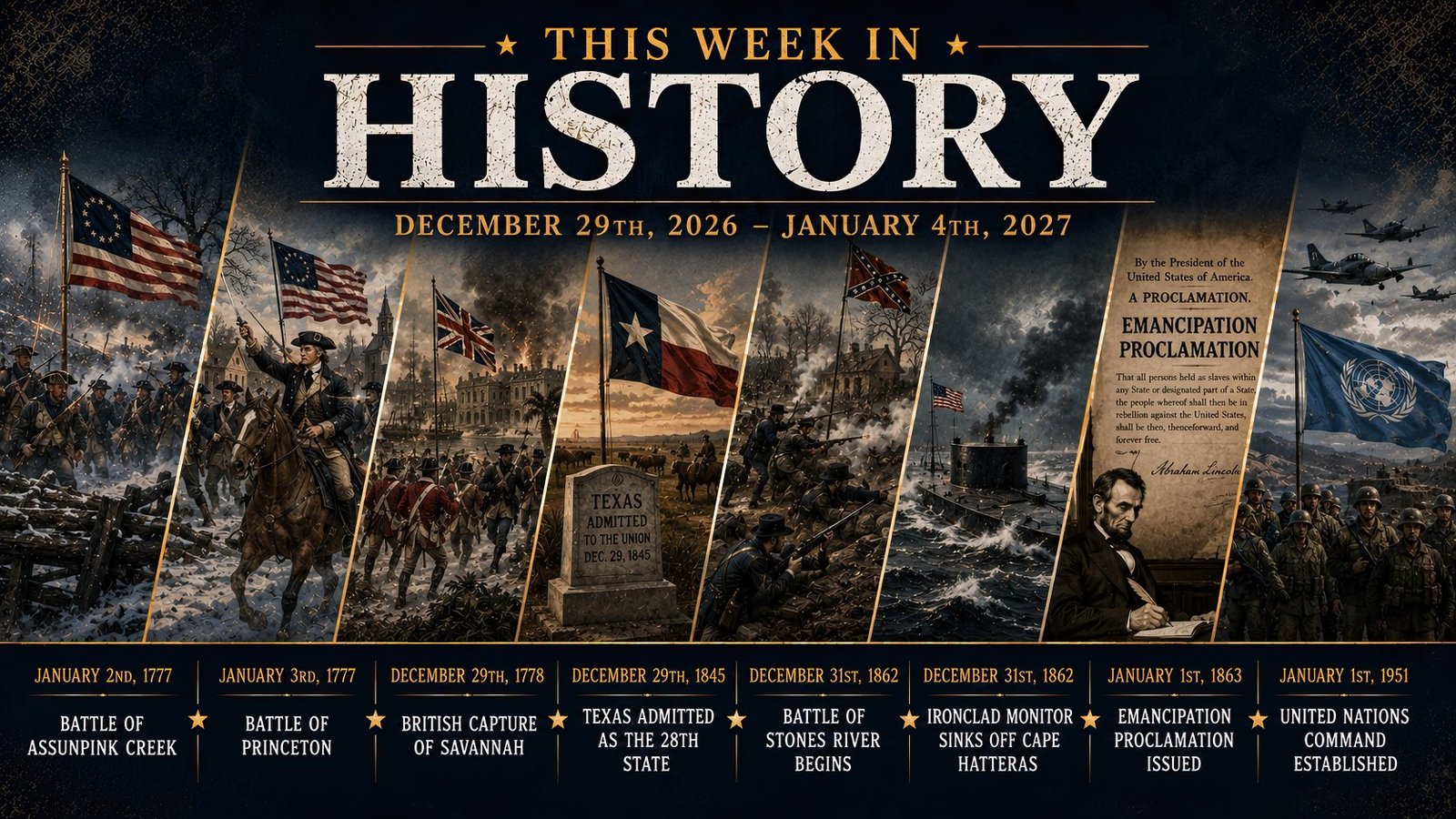
This Week in History · December 29, 2026
100 Populated Entries
How forces prepare, organize, fight, adapt, and learn.
Doctrine, Tactics & Training
Every result opens a permanent subject record with its reference context and connected Dispatch coverage. Filter by record type, editorial collection, or a word in the entry.
100 entries found.
Shortly before the United States entered the First World War, the Army found itself responding to a different kind of threat much closer to home. In the early hours of March 9th, 1916, fighters loyal to Mexican revolutionary leader Francisco “Pancho” Villa crossed the border and attacked the town of Columbus, New Mexico, as well as a nearby Army camp. The raid killed soldiers and civilians, burned buildings, and shocked a country that had long assumed the borderlands were secure.
A story of a shrinking beachhead, exhausted troops, and how their stand kept South Korea from collapsing in 1950.
A story of small ships on lonely stations, taking the worst hits so the Okinawa invasion could hold together under fire.
In the middle years of the Vietnam War, American leaders sought ways to weaken the enemy’s ability to move troops and supplies down long, fragile lines of communication. On June 29th, 1966, U.S. Air Force and Navy aircraft carried out major attacks on petroleum storage facilities near Hanoi and Haiphong, striking targets that had previously been off-limits or only lightly hit.
A story of exposed convoys, hidden fighters, and the soldiers and medics who kept moving through an urban kill zone.
A story of block-by-block urban fighting and the hard decision to take back a city at any cost.
As war raged overseas but before the United States formally entered the Second World War, political leaders grappled with how to prepare a peacetime democracy for potential conflict.
Near the border with North Vietnam, United States Marines at the remote base of Khe Sanh found themselves at the center of a looming storm. On January 21st, 1968, North Vietnamese forces began heavy artillery and rocket bombardments, cutting roads and tightening a ring around the base. The isolated garrison, supported by Army and Air Force aviation, braced for a potential ground assault reminiscent of the French defeat at Dien Bien Phu.
As fighting raged around Okinawa, one of the largest battleships ever built, the Japanese Yamato, steamed south on what was essentially a one-way mission. The plan called for Yamato and a small escort force to reach Okinawa, beach the ship, and fight as a coastal battery in a desperate attempt to blunt the American invasion. United States Navy carrier task forces detected the sortie and launched waves of aircraft that attacked the battleship and her escorts far from their destination.
On May 7th, 1915, the British liner Lusitania approached the coast of Ireland, carrying civilians, including many American passengers, through waters patrolled by German submarines. When a German U-boat torpedoed the ship, the blast and a rapid list sent the liner under in a matter of minutes, leaving thousands in the water and claiming well over a thousand lives. Among the dead were American men, women, and children, whose loss resonated far beyond the Atlantic crossing itself.
In the early hours of October 31st, 1941, the Clemson-class destroyer USS Reuben James was escorting a convoy near Iceland when a German submarine fired a spread of torpedoes into the formation.
In late May of 1754, a young Virginia officer named George Washington led colonial troops and Native allies through the forests of the Ohio Country. Near a small encampment of French soldiers at a place later called Jumonville Glen, his party launched a surprise attack that killed or captured most of the detachment, including its commander.
A story of a precision raid, a missing prize, and how a failed rescue still reshaped a distant war.
On this day a fledgling United States Army marched into disaster along the Wabash River in the Northwest Territory.
During the Tet Offensive, a coordinated series of attacks launched by North Vietnamese and Viet Cong forces, the ancient imperial city of Hue became one of the most hotly contested urban battlefields of the war. By February 8th, 1968, American Marines and soldiers, together with South Vietnamese units, were fully engaged in a block-by-block struggle to retake neighborhoods and key government sites inside the city.
On this date, coordinated terrorist attacks struck the United States homeland in a way not seen before.
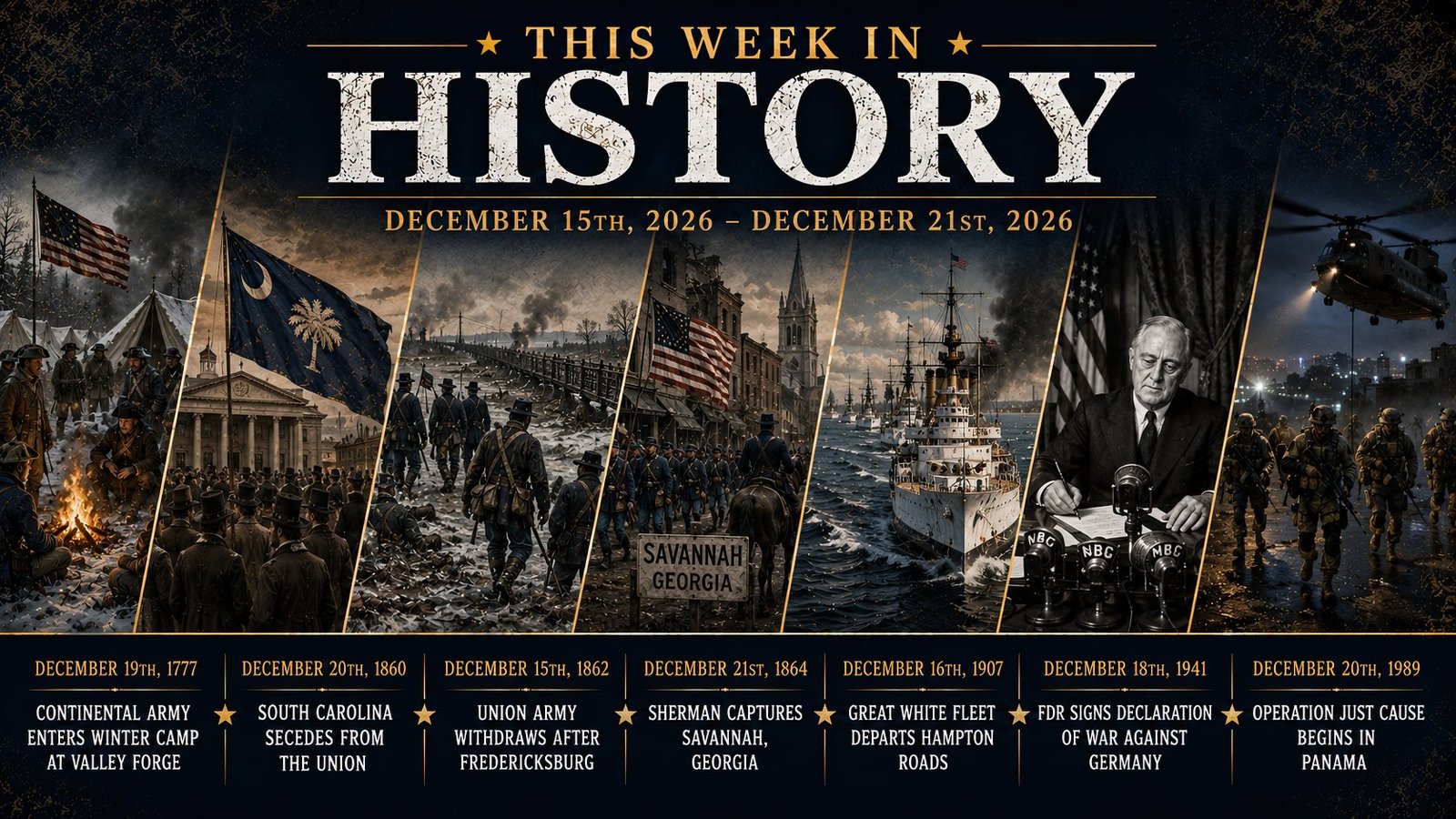
By December 15th, 1862, the Army of the Potomac was pulling back across the Rappahannock River after the bloody defeat at Fredericksburg.
In the aftermath of global war, American leaders restructured their armed forces to meet emerging strategic realities.
On February 1st, 1942, less than two months after the attack on Pearl Harbor, American carrier task forces struck back across the Pacific. The carriers Enterprise and Yorktown launched waves of aircraft against Japanese bases in the Marshall and Gilbert Islands, hitting airfields, shipping, and shore installations. The material damage to the enemy was limited compared with later campaigns, but the raid marked the first offensive use of United States carriers in the war.
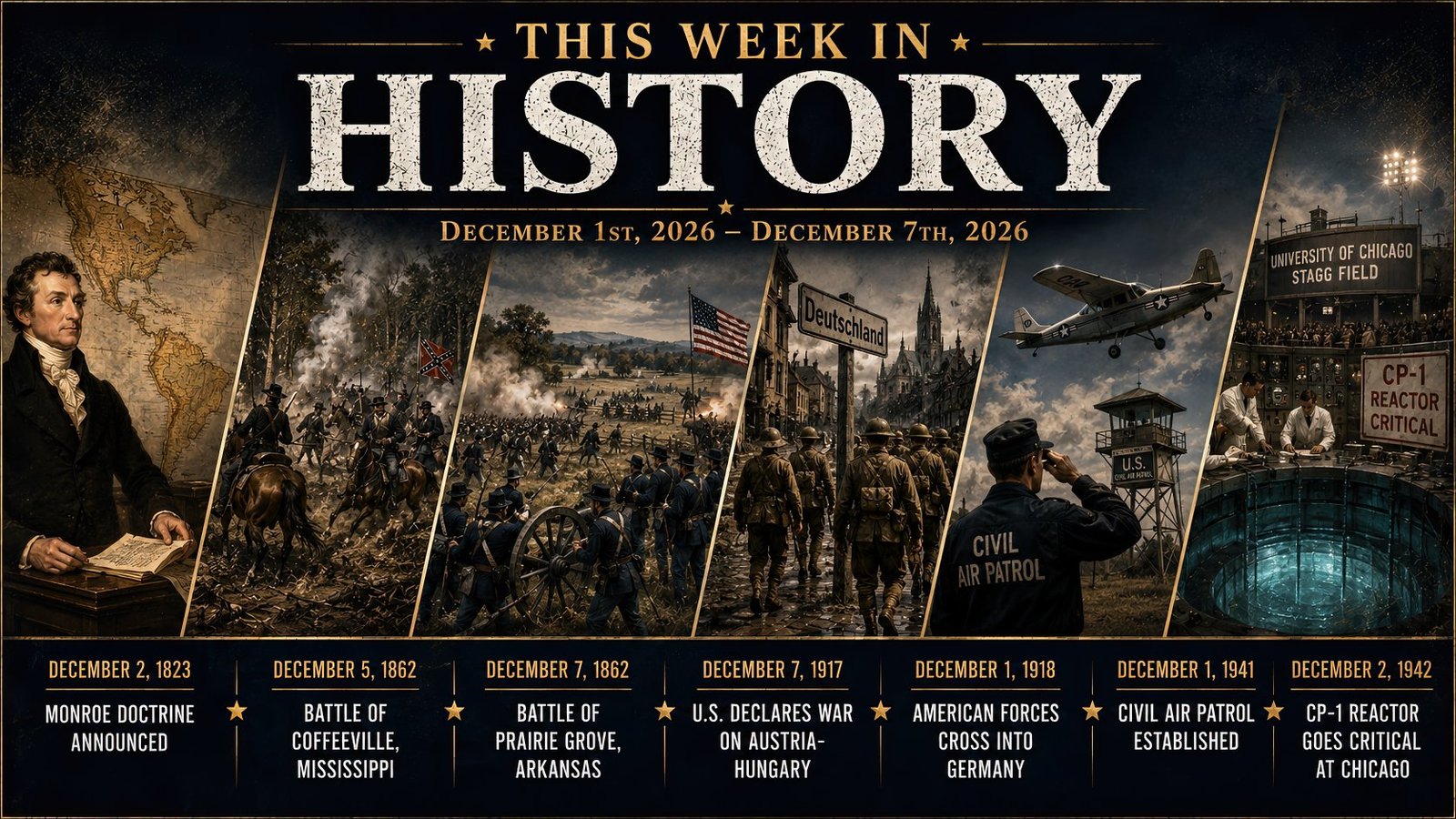
Fifty-five years later to the day, on December 7th, 1917, the United States again made a momentous move, this time with a declaration of war against Austria-Hungary.
Four days after Wilson’s address, Congress approved the declaration of war, formally bringing the United States into World War I on the side of the Allies. The decision triggered a sweeping mobilization effort at home, including the enactment of the Selective Service system to raise a large national army. The American Expeditionary Forces, under General John J.
Not every turning point comes with smoke and cannon fire.
A story of a silent campaign against merchant ships and how it helped choke an island empire’s war effort.
A story of nuclear propulsion, undersea endurance, and how one boat reshaped the Cold War at sea.
Related Dispatch
These current Dispatch articles connect directly to records in the Doctrine, Tactics & Training directory.