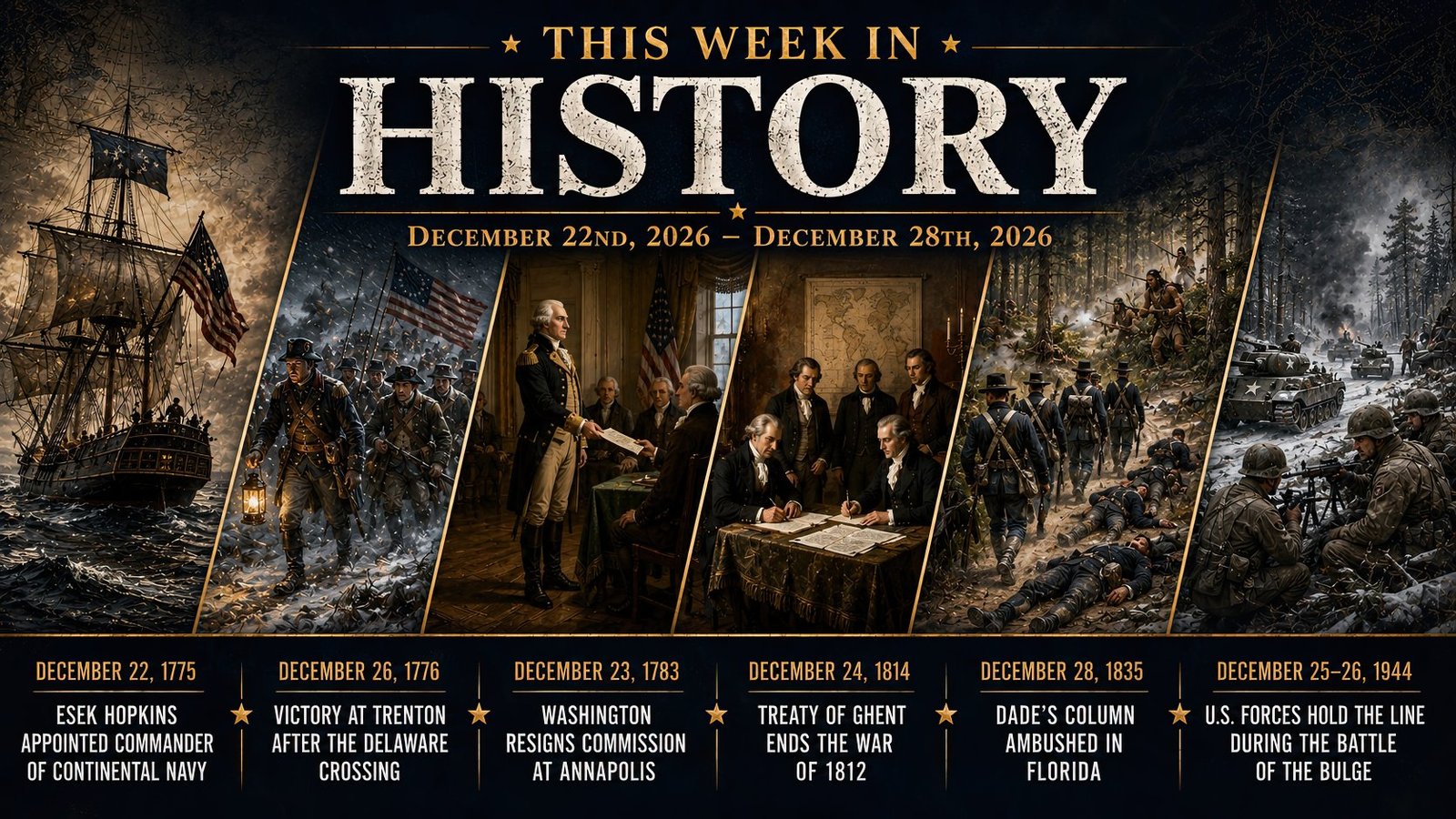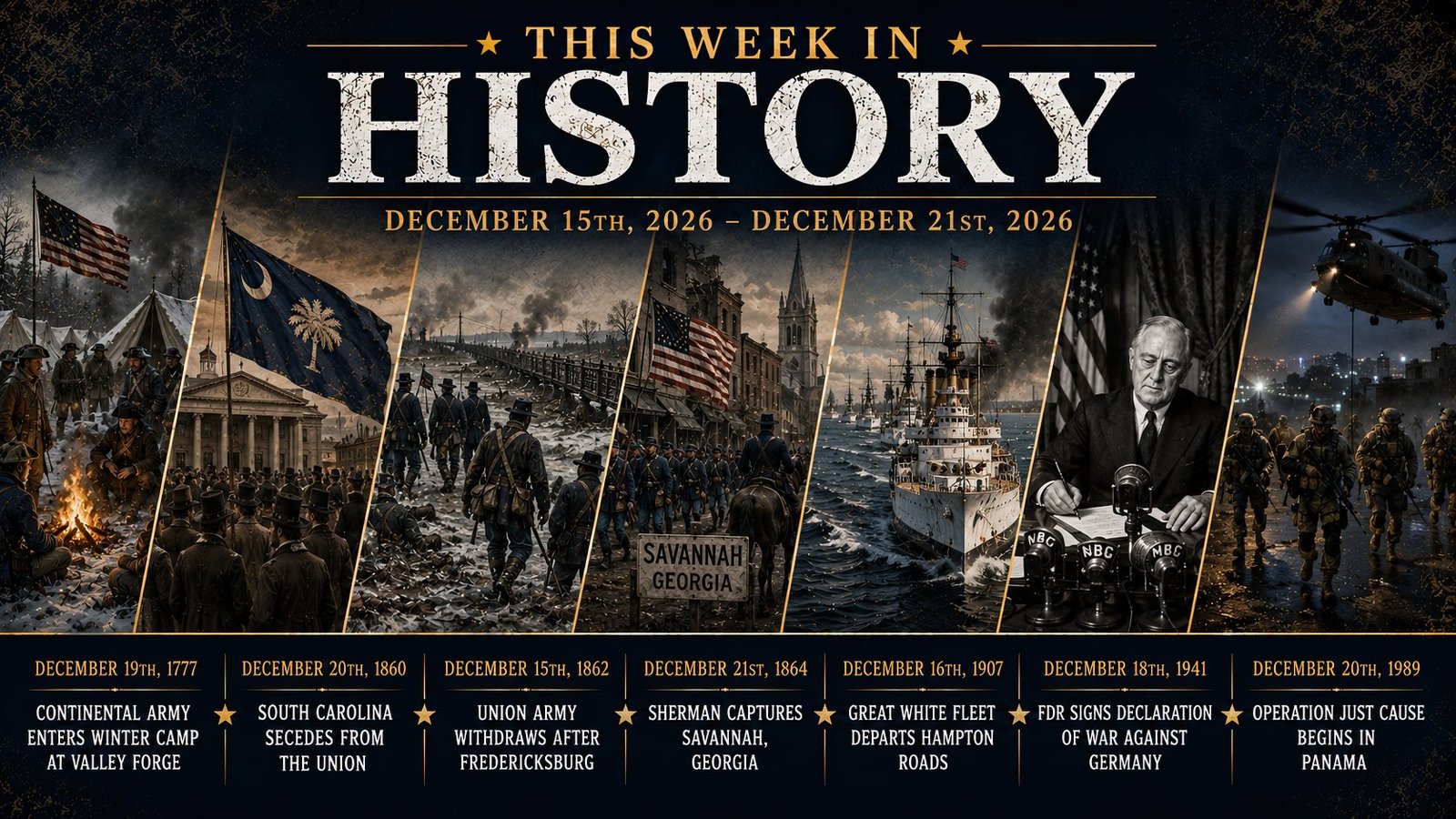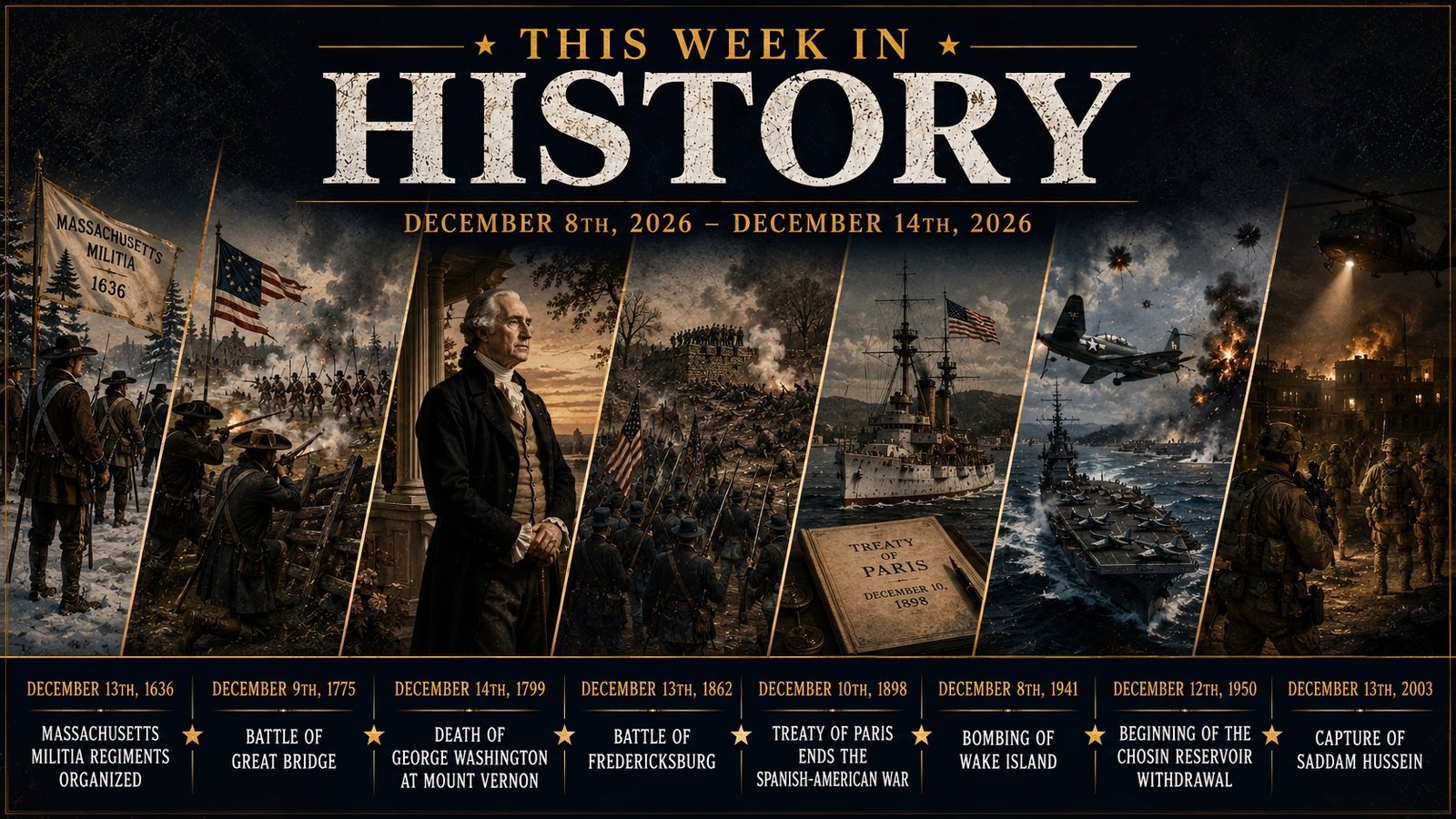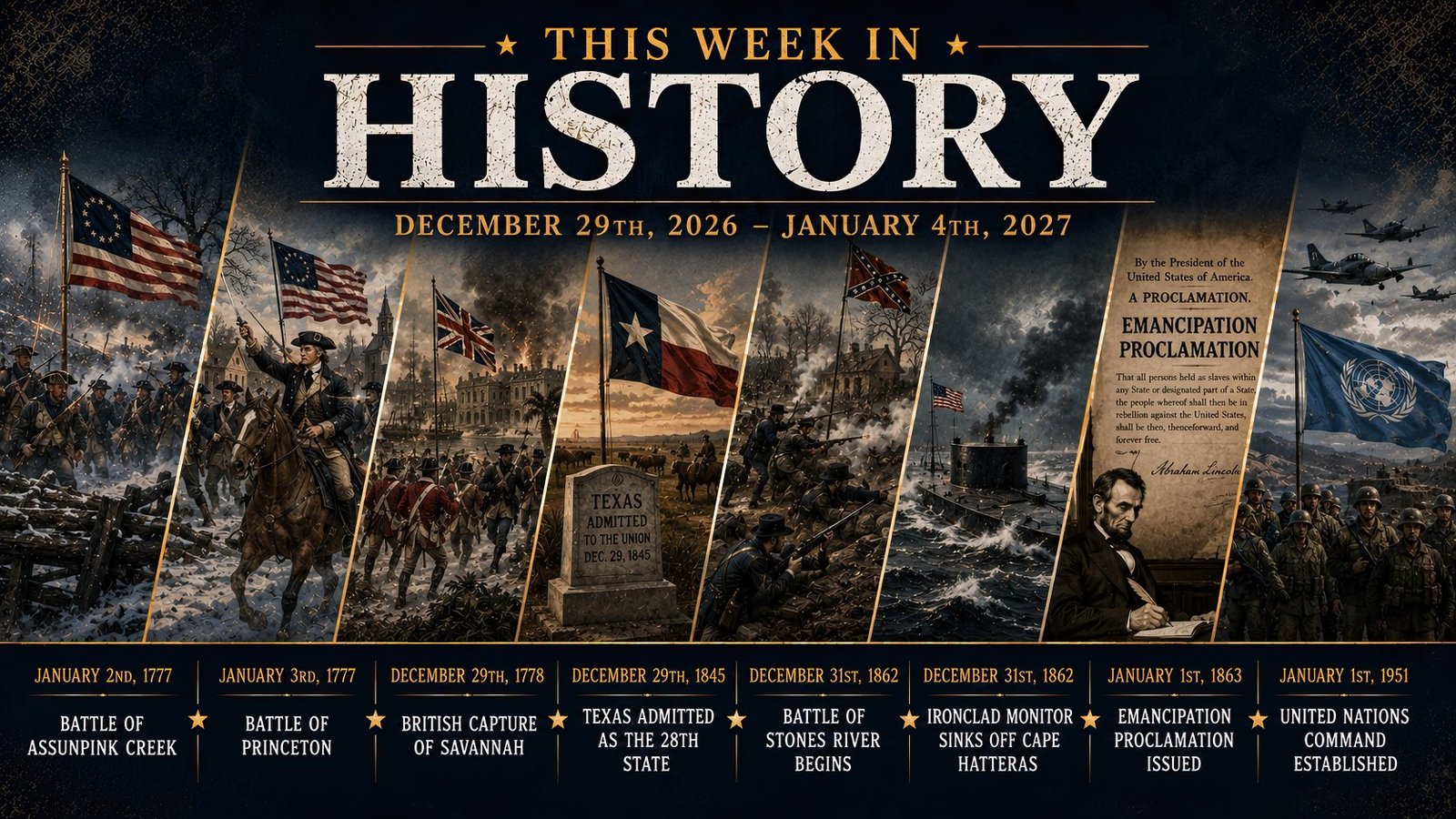
This Week in History · December 29, 2026
489 Populated Entries
Conflicts and historical periods that shaped military institutions and warfare.
Wars & Historical Eras
Every result opens a permanent subject record with its reference context and connected Dispatch coverage. Filter by record type, editorial collection, or a word in the entry.
489 entries found.
The June–July 1944 battle for Saipan joined Marine and Army divisions in a sustained advance across a populated island. Its outcome transformed American air operations while leaving a devastating military and civilian legacy.
Read Entry →Battle · 2026-04-21Battle of San JacintoIn the Texas Revolution, a short, violent clash on the Gulf Coast plains decided the fate of a breakaway republic and, eventually, much of the American Southwest. On April 21st, 1836, General Sam Houston’s Texian army surprised the larger Mexican force of General Antonio López de Santa Anna near the San Jacinto River. Many of the Texian fighters were recent immigrants from the United States, bringing frontier militia habits and a fierce sense of local autonomy.
The Spanish-American War brought United States forces into Cuba, and on July 1st, 1898, American troops attacked fortified Spanish positions at El Caney and along the San Juan Heights outside Santiago. At El Caney, infantry fought for hours to take a stone blockhouse and surrounding works, while other regiments prepared to advance on Kettle Hill and San Juan Hill.
During the early Civil War struggle for control of the South’s key ports, Union commanders targeted Charleston, South Carolina, both for its symbolic role in secession and its practical value as a harbor. On June 16th, 1862, Union forces launched a dawn assault on fortified Confederate positions at Secessionville, on James Island just outside the city. The terrain of marshes, creeks, and narrow causeways forced attacking troops into tight channels under concentrated artillery and musket fire.
As the spring campaigns of the American Civil War unfolded in 1862, Union forces pressed down the Virginia Peninsula toward Richmond. On May 31st, 1862, Confederate troops struck back near the crossroads of Seven Pines and Fair Oaks, launching a fierce assault against elements of the Union Army of the Potomac. Confusion in the swampy terrain and miscoordination among Confederate commanders blunted what might have been a more decisive blow. During the fighting, Confederate commander Joseph E.
At Pittsburg Landing along the Tennessee River, Confederate forces struck the encamped Union Army of the Tennessee in a surprise attack that opened one of the Civil War’s first truly massive battles. General Ulysses S. Grant’s troops had been gathering for an advance deeper into the Confederate heartland when General Albert Sidney Johnston launched a dawn assault.
After the Wilderness, the armies fought for roads, salients and supply routes around Spotsylvania. The Bloody Angle was the most remembered episode, but the battle also included Laurel Hill, Heth’s Salient and later attempts to turn or break the defenses.
Read Entry →Battle · 2026-01-07Battle of TarawaA story of a brutal island landing, a coral reef turned killing ground, and how one short battle rewrote amphibious warfare.
A story of a winter surprise offensive and exhausted American units holding the line under crushing odds.
An unfolding story of carrier decks, radio reports, and long-range strikes that reshaped the Pacific war before the fleets ever met face to face.
Just three days later, another phase of the Guadalcanal campaign played out at sea. In the Battle of the Eastern Solomons, American carriers, including Enterprise and Saratoga, maneuvered against a Japanese task force seeking to reinforce and resupply their troops on the island. Aviators from both sides flew long-range searches and strikes in a complex pattern of blows and counterblows over the open ocean.
Just two days after the Los Angeles scare, a very real crisis unfolded far across the Pacific. On February 27th, 1942, a mixed Allied naval force under Dutch command, including the United States heavy cruiser Houston, engaged a Japanese invasion convoy in the waters of the Java Sea.
In the Second World War, the Aleutian Islands campaign unfolded in harsh seas and fog, far from the better-known fronts of Europe and the central Pacific. On March 26th, 1943, an American cruiser-destroyer force under Rear Admiral Charles McMorris intercepted a Japanese convoy near the Komandorski Islands, northwest of the Aleutians. The enemy escort included heavier cruisers, giving the Japanese an advantage in guns and armor.
By mid-1918, German armies in France had driven a dangerous salient across the Marne River, threatening Paris and hoping to win the war before American troops could arrive in strength. In the early hours of July 18th, French and American forces launched a coordinated counteroffensive, striking the exposed flanks of the German position near Soissons and along the Marne.
An air-sea clash where radar, training, and discipline turned a desperate carrier defense into a one-sided hammer blow that reshaped the Pacific war.
Almost twenty years later, the United States tore itself apart in civil war, and May 5th, 1864 marked the beginning of a grim new phase. That day, Lieutenant General Ulysses S. Grant pushed the Army of the Potomac south across the Rapidan River into a tangle of underbrush and second-growth forest known simply as the Wilderness. In that terrain, visibility collapsed, lines broke apart, and musket flashes set the woods on fire, trapping wounded soldiers in flames.
The failed December 1864 expedition and successful January 1865 assault were separate attempts to close Wilmington’s protected sea approach. This overview distinguishes bombardment, amphibious landings, naval and army assaults, and the later advance on Wilmington.
Read Entry →Event · 2026-04-14Battles of Lexington and ConcordThe next morning, the first shots of the Revolutionary War rang out on Lexington Green as British regulars confronted a small band of armed colonists. The exact origin of the “shot heard round the world” is still debated, but the result was clear: several colonial militiamen lay dead, and the British column pressed on toward Concord. At Concord’s North Bridge, larger militia forces confronted detachments of the regulars and drove them back, forcing a retreat toward Boston.
In the early 1960s, United States leaders sought to topple the new Cuban government through covert means rather than open war. On April 17th, 1961, a force of Cuban exiles, trained and supported by American agencies, landed along Cuba’s southern coast at the Bay of Pigs. The plan called for air strikes, a beachhead, and hoped-for uprisings inside the country, but execution problems and rapid government response undercut the operation from the start.
On January 29th, 1863, amid deep winter cold near the Bear River in what is now southeastern Idaho, a column of California Volunteers attacked a camp of Northwestern Shoshone people. The expedition had been ordered after years of tension along overland routes, where emigrant traffic and military patrols collided with Native communities trying to survive.
In the dark, humid hours before dawn on Okinawa, the American line around Kakazu Ridge was little more than a jagged string of foxholes and shattered stone. Technical Sergeant Beauford “Andy” Anderson and the men of his weapons platoon had spent the night listening to the island—distant artillery rumbled, mortars coughed, and now and then a Japanese flare turned the terraced fields silver for a heartbeat before dropping them back into blackness.
Three years after Saratoga, one of its heroes met secretly with a British officer to betray the very cause he once championed.
Two days after André’s capture, events reached a crisis on September 25th, 1780, when General Washington traveled to inspect West Point and discovered that Benedict Arnold had fled.
In the final spring of the Civil War, Major General William Tecumseh Sherman’s armies marched north from Georgia into the Carolinas, aiming to link up with Union forces advancing from Virginia. Confederate General Joseph E. Johnston gathered what troops he could to strike a concentrated blow against one wing of Sherman’s column near Bentonville, North Carolina.
Related Dispatch
These current Dispatch articles connect directly to records in the Wars & Historical Eras directory.