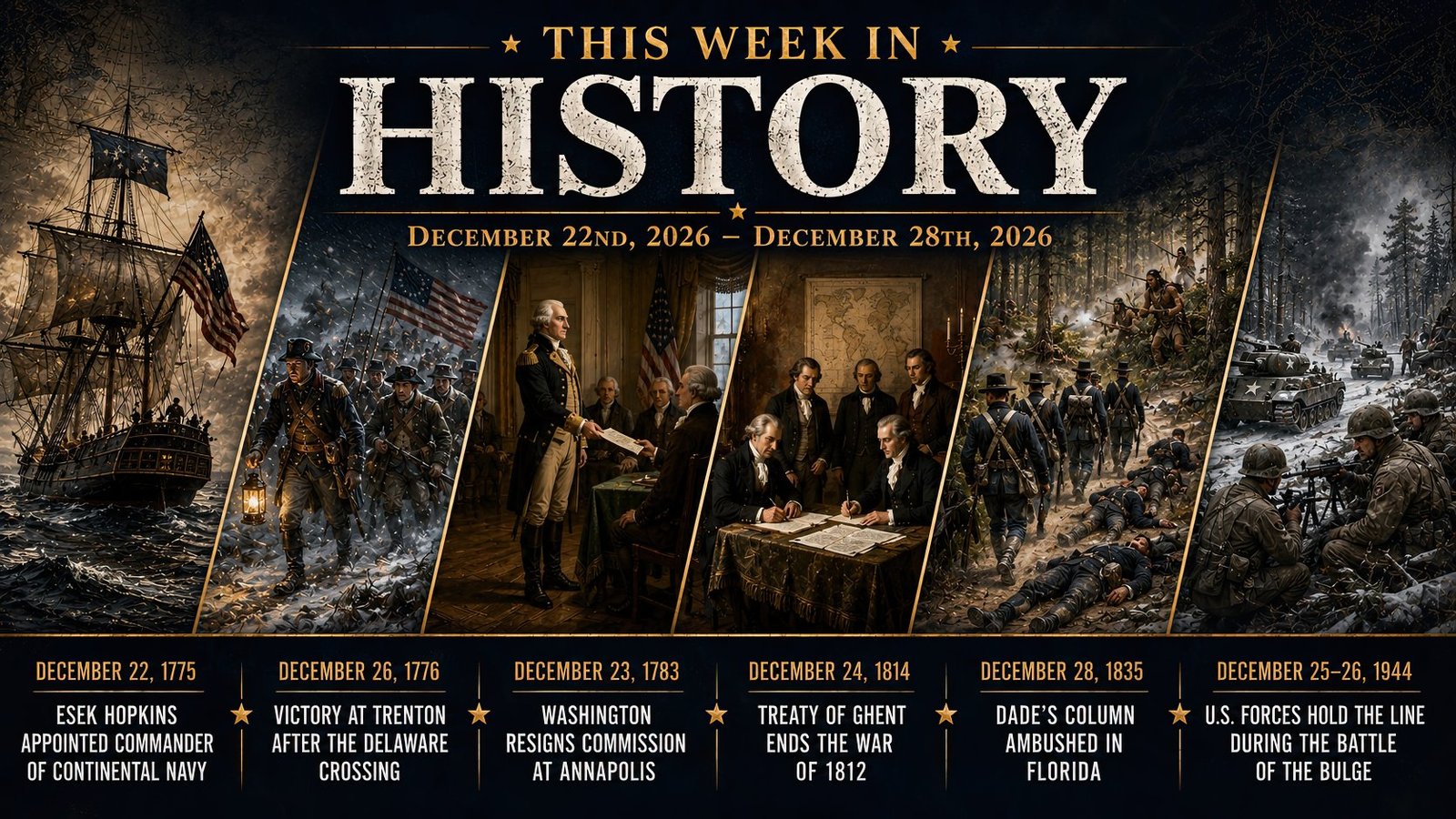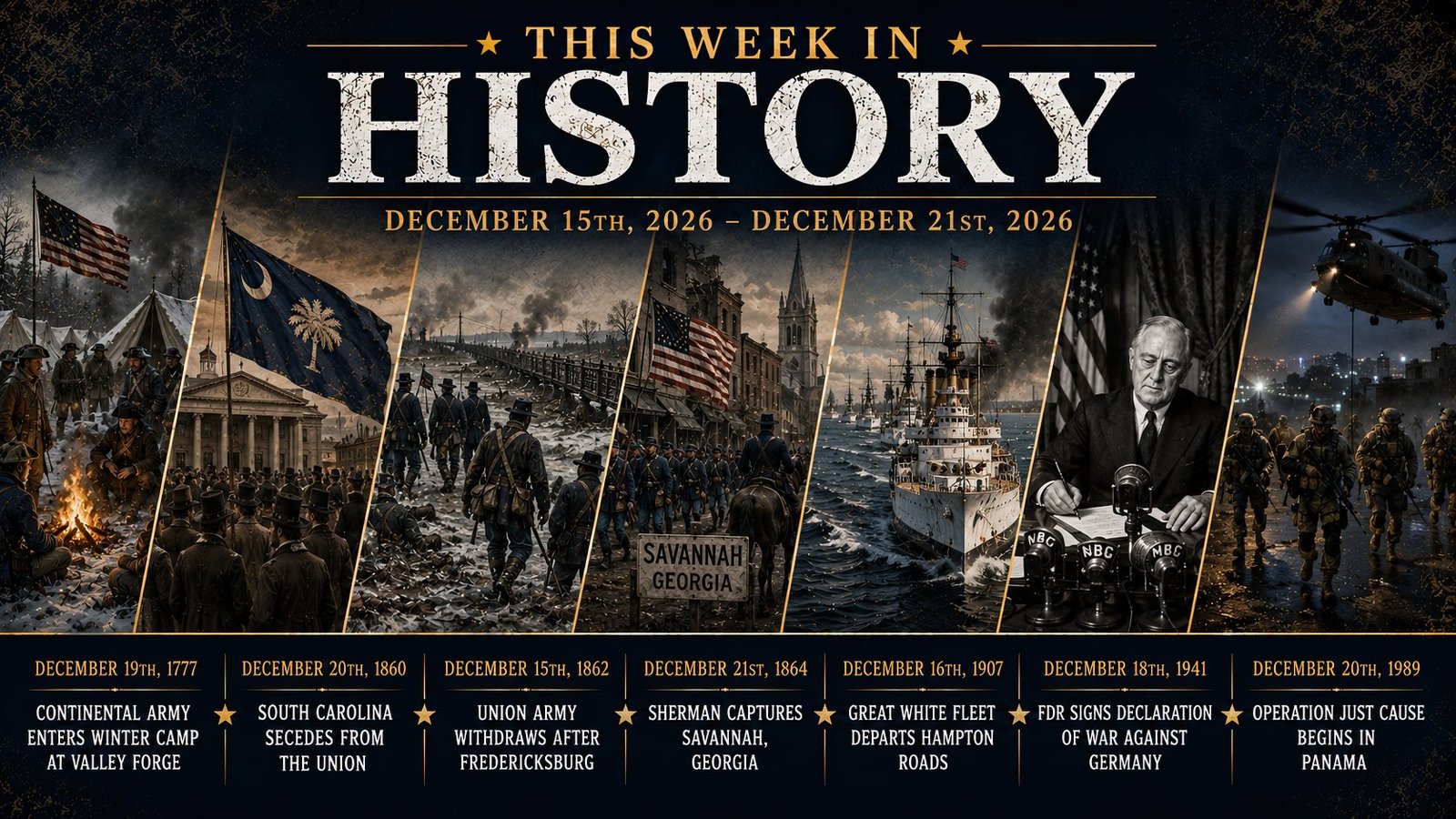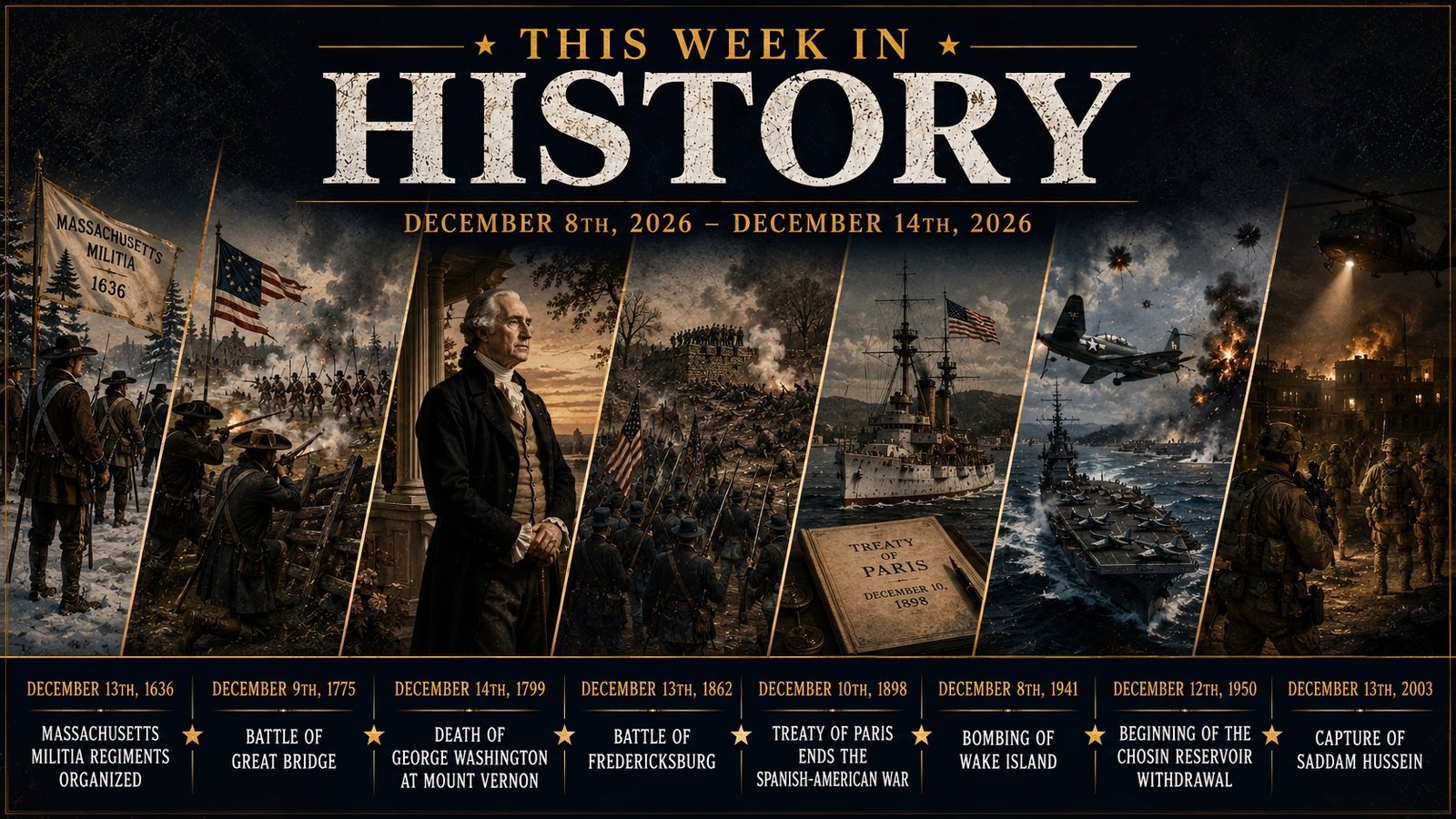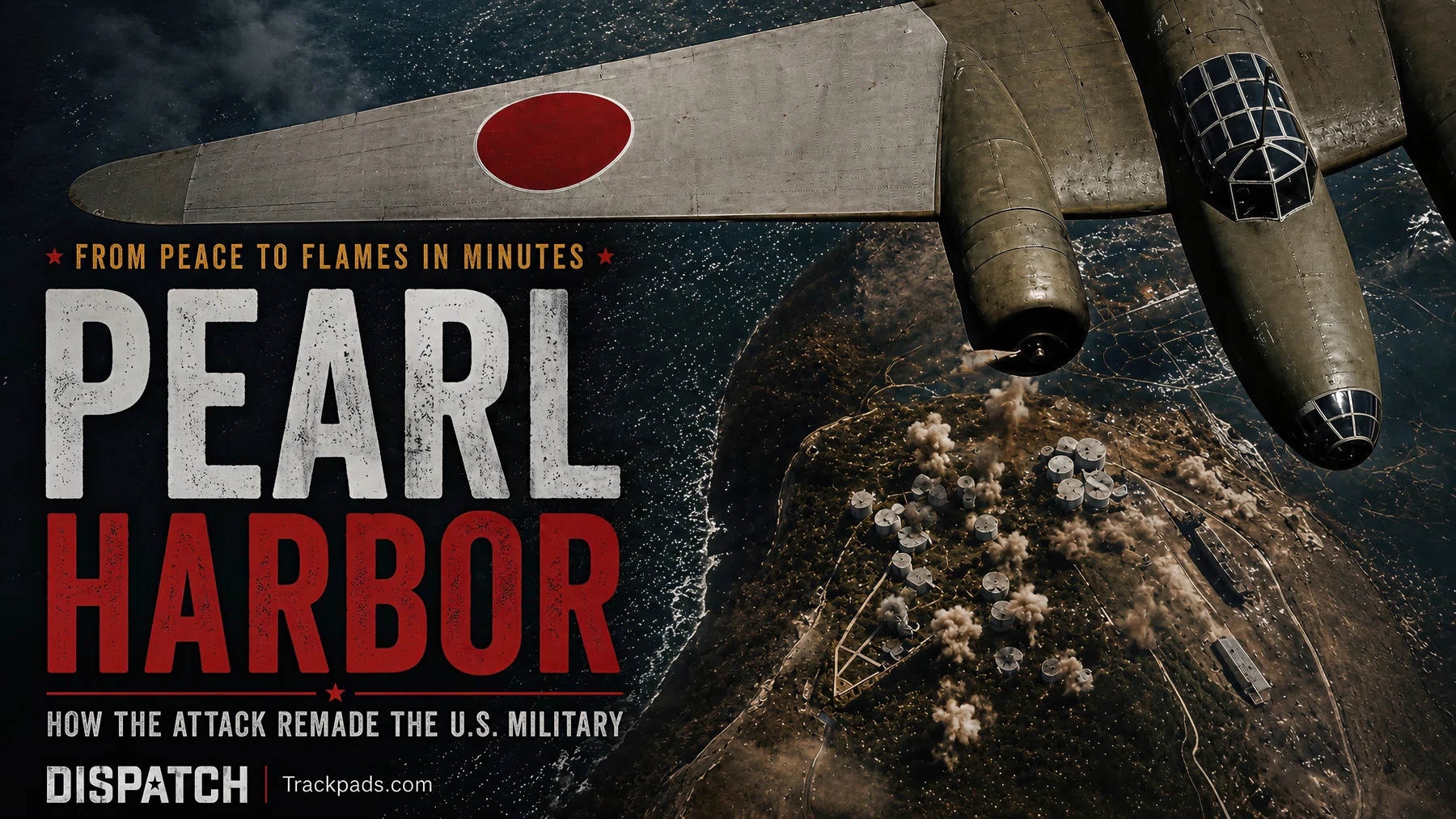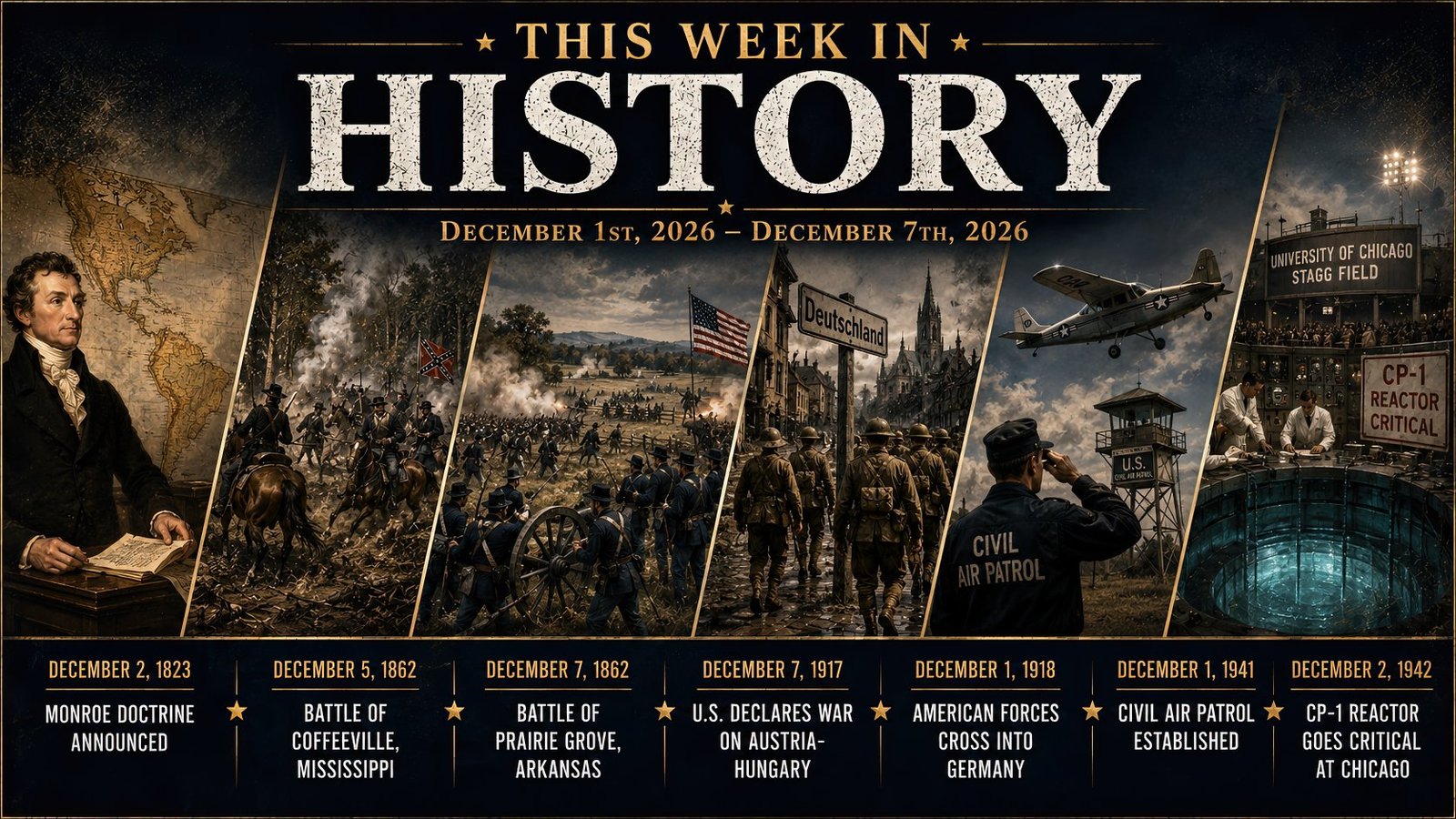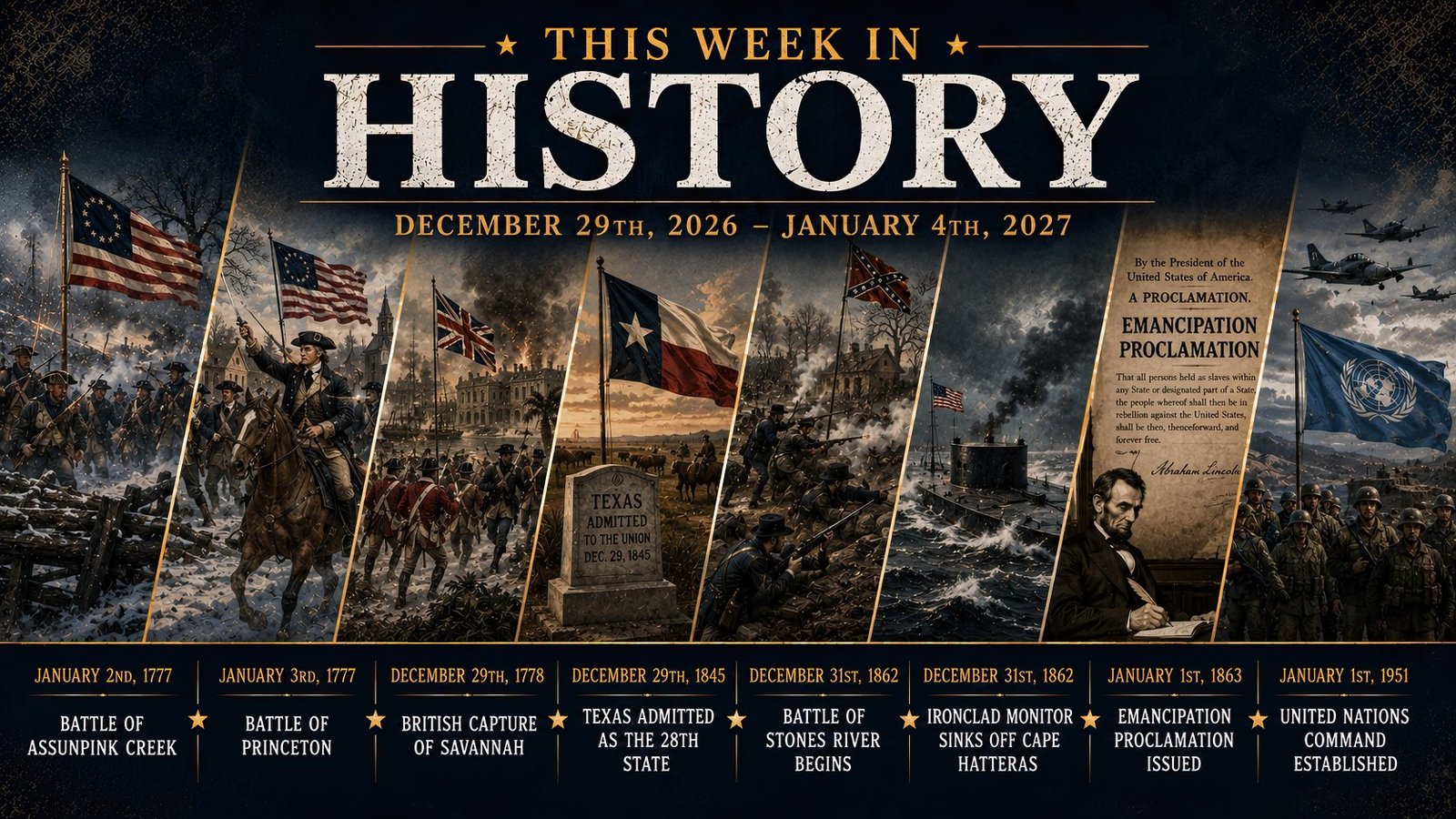
This Week in History · December 29, 2026
489 Populated Entries
Conflicts and historical periods that shaped military institutions and warfare.
Wars & Historical Eras
Every result opens a permanent subject record with its reference context and connected Dispatch coverage. Filter by record type, editorial collection, or a word in the entry.
489 entries found.
Just days after Fort George fell, another drama played out at sea off the American coast. On June 1st, 1813, the American frigate USS Chesapeake sailed from Boston to challenge the British blockading ship HMS Shannon. In a furious, close-range engagement that lasted only minutes, British gunnery and boarding tactics shattered the Chesapeake’s crew, leaving Captain James Lawrence mortally wounded.
Early in the War of 1812, the United States Navy frigate Constitution intercepted the British frigate Guerriere in the Atlantic and accepted battle. In a sharp engagement marked by heavy gunnery and aggressive maneuvering, Constitution’s solid hull shrugged off many British round shot, giving rise to the famous nickname “Old Ironsides.” American broadsides dismasted Guerriere and left her so badly damaged that she had to be burned after the crew was removed.
Off the French port of Cherbourg, two warships met in a duel that captured worldwide attention and helped decide a quieter but crucial front in the Civil War. The Confederate commerce raider CSS Alabama had spent years attacking Union merchant shipping across the globe, forcing the United States to divert warships to hunt her and driving up insurance rates.
As revolt simmered in Spanish-ruled Cuba and American public opinion burned with sympathy for Cuban insurgents, the armored cruiser USS Maine steamed into Havana harbor. Officially, the ship’s mission was to make a friendly visit and protect American citizens and interests in case unrest spilled over. Unofficially, her presence sent a blunt message that the United States was watching events closely and was willing to show the flag in Spain’s troubled colony.
On the night of February 15th, 1898, the battleship USS Maine exploded and sank while riding at anchor in Havana Harbor, killing more than two hundred American sailors. The ship had been sent to Cuba during a period of unrest as a visible symbol of United States interest in the island’s struggle against Spanish rule. When the Maine erupted and settled into the harbor mud, the immediate cause was unclear, and controversy over that cause continues in various forms even today.
A story of nuclear propulsion, undersea endurance, and how one boat reshaped the Cold War at sea.
In the Cold War, geography and technology combined to redefine what counted as a front line. The nuclear-powered submarine USS Nautilus had already shown that a boat freed from the need to surface for air could stay submerged for long periods. In early August 1958, Nautilus undertook a bold transit under the polar ice cap, passing directly beneath the geographic North Pole on August 3rd.
On a winter day on the Potomac River in 1844, the brand-new steam warship USS Princeton hosted Washington dignitaries for a demonstration cruise. The pride of the ship was a massive naval gun nicknamed “Peacemaker,” intended to showcase the Navy’s technical skill and the promise of long-range, heavy artillery at sea.
In the chilly waters off the Korean coast, the lightly armed intelligence-gathering ship USS Pueblo operated under orders to monitor North Korean communications. On January 23rd, 1968, North Korean patrol craft closed in, opening fire and boarding the ship after a tense confrontation in which one American sailor was killed and others wounded. The crew attempted to destroy classified material, but much was seized along with the ship itself.
On the evening of May 17th, 1987, the guided missile frigate USS Stark patrols the Persian Gulf during the long Iran–Iraq War, monitoring traffic in tense and crowded waters. An Iraqi aircraft approaches and launches two anti-ship missiles that strike the ship, causing fires and damage that kill dozens of sailors. In the chaos that follows, the crew fights to control the blaze, tend to the wounded, and keep the ship afloat in darkness and smoke.
The late 1950s saw the opening moves of the space age, with the Soviet Union’s Sputnik launches and the United States racing to orbit its own satellites. On March 17th, 1958, the Navy-managed Vanguard program successfully placed a small, lightweight satellite into orbit, known as Vanguard 1. The satellite carried no weapons, but it featured innovative solar cells and transmitted tracking data that helped scientists refine measurements of Earth’s shape and atmospheric density.
During the Mexican-American War, General Winfield Scott led one of the earliest large-scale amphibious campaigns in United States history, landing an expeditionary force near the port city of Veracruz. After a carefully planned bombardment involving both the Army and Navy, the city’s defenses began to crumble under heavy fire. On March 29th, 1847, Veracruz surrendered, giving Scott a secure deep-water port and a base of operations on Mexico’s Gulf coast.
Grant’s campaign brought a Union army across the Mississippi, isolated Vicksburg, and turned two failed assaults into a sustained siege. This overview connects the river operations, land battles, civilian experience, and recipient citations without treating every action as the same engagement.
Read Entry →Historical Event · 2026-12-22Victory at Trenton after the Delaware crossingOn a bitter, stormy Christmas night, George Washington led a force of Continental soldiers and militia across the ice-choked Delaware River, gambling that a surprise strike could salvage a collapsing cause.
Just three days after Castle Itter, the wider war in Europe officially reached its end for American forces and their allies. An unconditional surrender had been signed by German representatives at Reims on May 7th, but the following day became widely known as Victory in Europe Day, or V-E Day, as the terms took effect and celebrations broke out across liberated cities and Allied capitals.
On November 13th, 1982, after years of debate over how to remember a difficult war, the Vietnam Veterans Memorial in Washington, D.C., was formally dedicated.
The B-17 was almost home when the choice arrived over the radio: bail out, or try to land a dying airplane. The long mission over Leipzig was behind them, but the bomber itself was torn open—control cables shot away, engines coughing, the fuselage peppered with holes where German fighters had raked the formation. In the cockpit, the copilot lay dead. The pilot, badly wounded, had been dragged from his seat and now drifted in and out of consciousness, strapped down behind the controls.
On May 13th, 1846, Congress responds to President James K. Polk’s war message and formally declares that a state of war exists with Mexico. Skirmishes along the Rio Grande have already led to American and Mexican casualties, and the vote unlocks the use of the regular Army and newly raised volunteers on multiple fronts. Over the next two years, United States forces will fight along the border, across northern Mexico, and in a bold amphibious landing and march on Mexico City.
On this day, George Washington formally accepted the appointment that Congress had offered him to serve as commander in chief of the Continental Army. The colonies had already seen bloodshed at Lexington, Concord, and around Boston, but until this point there had been no single figure responsible for coordinating their military effort. Washington’s acceptance signaled that the rebellion would not be a loose collection of local uprisings but a united struggle with a common command.
In the final winter of the Revolutionary War, Continental Army officers encamped at Newburgh, New York seethed over unpaid wages and uncertain futures. An anonymous circular dated March 10th, 1783 urged them to consider a more forceful stand against Congress, raising the specter of a military challenge to civilian authority. On March 15th, George Washington appeared unannounced at their meeting and asked permission to speak.
The morning sky over northern Luzon is deceptively calm. From the cockpit of his sleek reconnaissance Mustang, Major William Arthur Shomo scans the broken clouds, hunting for airfields and antiaircraft positions that his ground commanders need to see. His mission is straightforward on paper: an armed photographic and strafing sweep over the Aparri and Laoag airdromes, far ahead of friendly lines.
How a 22-year-old automatic rifleman kept firing after losing both legs, and saved his platoon in the Philippine mountains of 1945.
In the spring of World War I, President Woodrow Wilson appeared before Congress to request a declaration of war against Germany, a dramatic reversal from his earlier campaign slogan of having kept the country out of the conflict. The decision followed Germany’s return to unrestricted submarine warfare, which had sent American ships and sailors to the bottom, and the revelation of the Zimmermann Telegram, in which Germany encouraged Mexico to consider war against the United States.
After the experience of two world wars, during which women had served in large numbers in temporary or auxiliary roles, the United States took a major step toward making that service permanent. On June 12th, 1948, the Women’s Armed Services Integration Act was signed into law, granting women the right to serve as regular and reserve members of the Army, Navy, Marine Corps, and newly independent Air Force.
Related Dispatch
These current Dispatch articles connect directly to records in the Wars & Historical Eras directory.