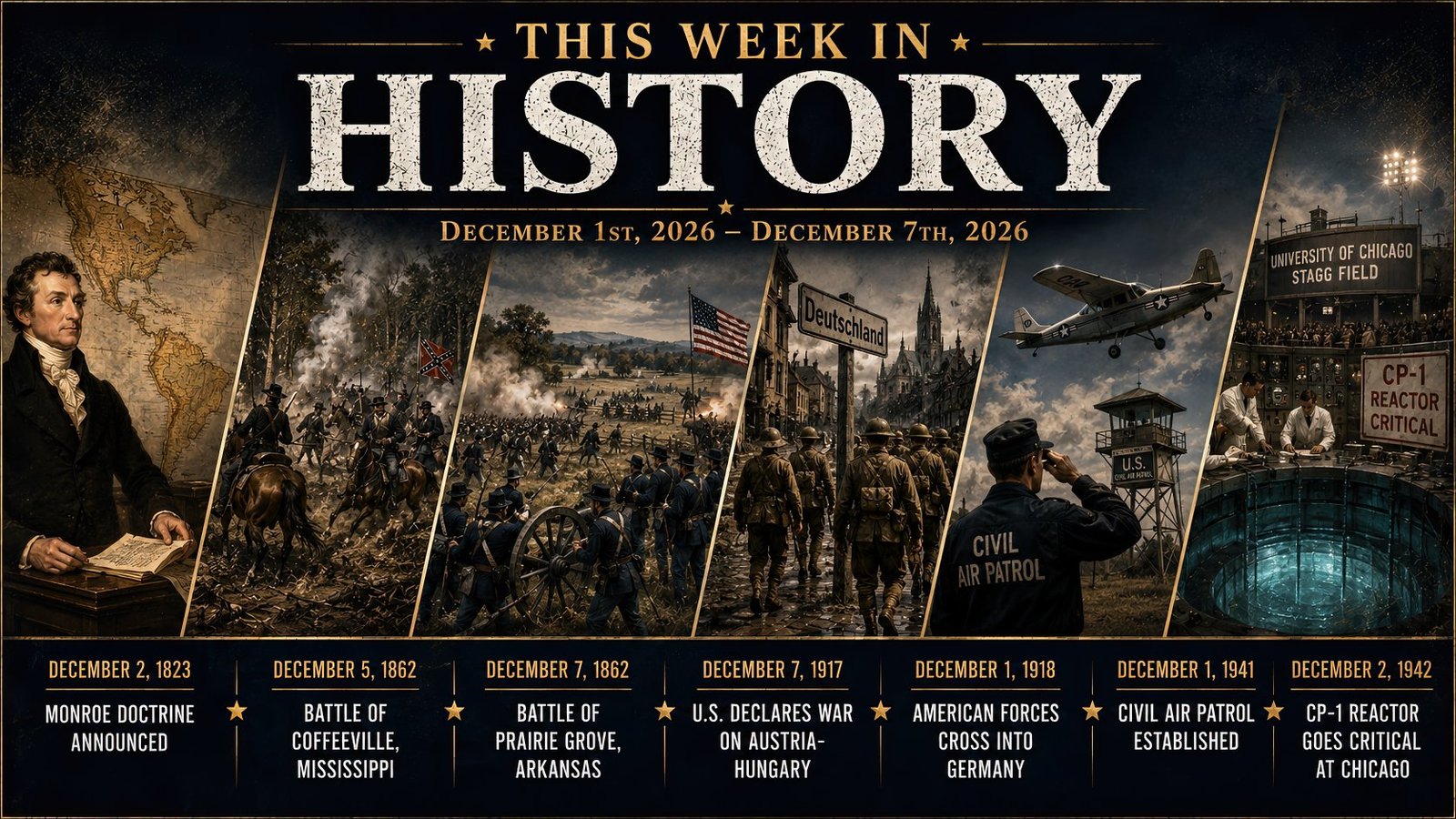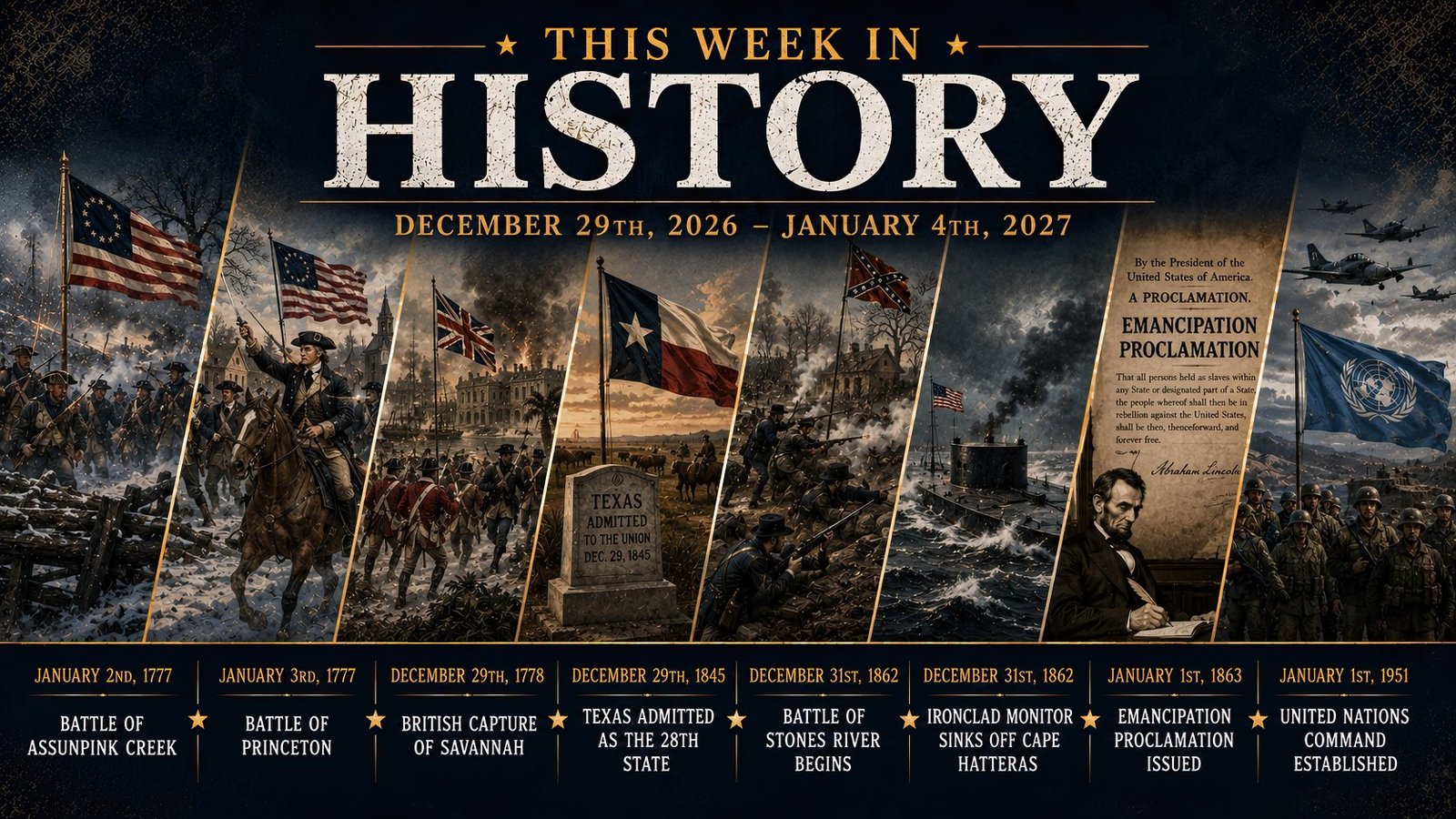
This Week in History · December 29, 2026
489 Populated Entries
Conflicts and historical periods that shaped military institutions and warfare.
Wars & Historical Eras
Every result opens a permanent subject record with its reference context and connected Dispatch coverage. Filter by record type, editorial collection, or a word in the entry.
489 entries found.
On May 14th, 1942, in the midst of global war, the United States formally establishes the Women’s Army Auxiliary Corps. The new organization allows women to volunteer for service with the Army in noncombat roles such as clerks, drivers, telephone operators, and mechanics. While members are not yet fully integrated soldiers, the Corps represents a major change in how the Army taps the skills of the population.
On December 29th, 1890, troops of the 7th Cavalry surrounded a band of Miniconjou Lakota near Wounded Knee Creek in South Dakota, seeking to disarm them amid fears surrounding the Ghost Dance movement.
Even as troops fought through Manila’s streets, the political leaders of the major Allied powers gathered thousands of miles away to shape the end of the war and the uneasy peace to follow. On February 4th, 1945, President Franklin D. Roosevelt, Prime Minister Winston Churchill, and General Secretary Joseph Stalin opened the Yalta Conference in the Crimean resort city of the same name.
As war raged in Europe and Asia, President Franklin Roosevelt took to the radio on December 29th, 1940, to explain why events overseas mattered deeply to American security.
Strategic bombing over Europe reached a grim milestone on October 14th, 1943, when the United States Eighth Air Force sent hundreds of B-17 bombers against ball-bearing plants around Schweinfurt, Germany.
Early in the Second World War’s Pacific campaign, United States and Filipino forces on Bataan and Corregidor fought a desperate defense against Japanese invasion. With the situation deteriorating and Washington determined to preserve a senior commander for future operations, General Douglas MacArthur received orders to leave the Philippines and take up a new post in Australia.
On this date delegates from across Virginia gathered in Richmond, still arguing over how far to push resistance to imperial authority. The colony had seen protests and organizing, but many leaders hoped a last compromise might avoid open war. Patrick Henry rose to argue that the time for half measures had passed, insisting that the colonies must prepare to fight if they wished to preserve their liberties.
During the War of 1812, a newspaper account connected the initials “U.S.” on Army supply barrels with a contractor named Samuel Wilson of Troy, New York.
Before the United States formally entered the Second World War, its leaders faced the challenge of preparing a still-divided public for the scale of the coming struggle. On May 27th, 1941, President Franklin D. Roosevelt used a nationwide address to proclaim an “unlimited national emergency,” warning that Axis victories overseas threatened American security. The declaration did not yet mean war, but it unlocked broader mobilization of industry, shipping, and the armed forces.
Related Dispatch
These current Dispatch articles connect directly to records in the Wars & Historical Eras directory.