Reference Entry
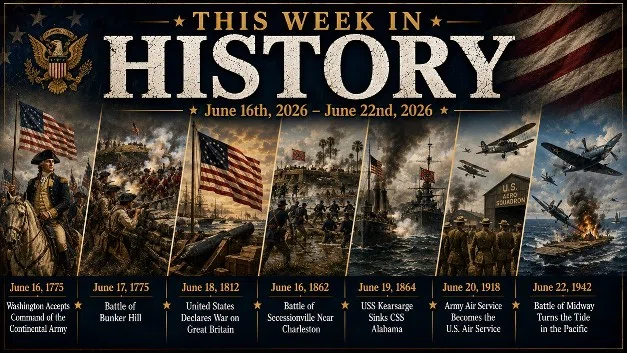
USS KEARSARGE SINKS CSS ALABAMA
Off the French port of Cherbourg, two warships met in a duel that captured worldwide attention and helped decide a quieter but crucial front in the Civil War. The Confederate commerce raider CSS Alabama had spent years attacking Union merchant shipping across the globe, forcing the United States to divert warships to hunt her and driving up insurance rates.
Scope of this history
The June 1864 naval duel, not every action involving ships named Alabama or Kearsarge. Existing dated-entry content and its URL are preserved.
A raider reaches the end of a voyage
Alabama reached Cherbourg on June 11 after a long commerce-raiding cruise. Her need for repairs placed Captain Raphael Semmes in a difficult position when John A. Winslow’s Kearsarge arrived three days later. The port offered facilities and a neutral setting, but it did not remove the opposing warship waiting outside. The confrontation brought an ocean-wide campaign against merchant shipping into a single, closely watched encounter. [1]
The French position mattered as much as the proximity of spectators. Winslow’s report describes drawing offshore before engaging, while the French warship Couronne accompanied Alabama outward to safeguard neutrality. The combatants had to move from a protected harbor into waters where they could fight. Neither the presence of foreign observers nor access to a French port made Alabama a French combatant. [2] [1]
The material contest
Kearsarge carried chain cable over vulnerable portions of her sides. The Navy’s ship history identifies that protection and Alabama’s deteriorated ammunition among the factors in the result. They complemented, rather than replaced, gunnery and maneuver. Chain armor did not make Kearsarge invulnerable, and an apparent similarity between the two sloops concealed important differences in their immediate readiness after very different recent employment. [3]
Charles A. Read worked as first sponger of the pivot gun, while John F. Bickford served as its first loader. George E. Read and John Hayes had separate duties at another gun. Their citations describe a weapon system operated by a team: loading, sponging, aiming and commanding a gun required coordinated work, not simply the presence of a large caliber on an armament list. [4] [5] [6] [7]
The circling fight
Winslow reported that Alabama opened fire before he returned it, and described the ships circling while he sought a favorable range and bearing. His account places the effective exchange at much closer range than the opening shots. Read alongside Semmes’s report, it shows commanders trying to explain both their decisions and their outcomes. These are valuable operational accounts, but neither was written by a disinterested observer. [2]
William B. Poole remained at the helm, helping keep the ship in position while the guns engaged. James Saunders, stationed elsewhere, recognized and reported damage during the fight. Those responsibilities belong in the same narrative as firing the guns: effective maneuver depended on steering orders reaching the helm, and a captain needed information about the damage being inflicted on his own vessel. [8] [9]
Joachim Pease’s citation identifies him as a loader at No. 2 gun and emphasizes his conduct throughout the engagement. Charles Moore, George H. Harrison and James Haley received recognition for their own gun-crew duties. Their records preserve individual contributions without establishing that any one man alone fired the decisive projectile. A ship’s victory was the product of many stations remaining effective under fire. [10] [11] [12] [13]
Surrender, rescue and wounds
Alabama was fatally damaged and sank after surrendering. Kearsarge’s boats recovered survivors, while the British yacht Deerhound took aboard Semmes and a group of his men and carried them away. The escape of the Confederate commander was distinct from the destruction of his ship. The Navy’s Kearsarge history treats both outcomes, reminding the reader that winning an engagement did not mean controlling every neutral vessel nearby. [3]
The surgical report reproduced in the diplomatic correspondence identifies William Gowen, James McBeath and John W. Dempsey among Kearsarge’s wounded. Dempsey required an arm amputation; the others suffered lower-limb wounds. That close reporting of injuries is a useful corrective to a one-sided victory narrative. The ship survived the battle, but survival of the hull should not be confused with a bloodless experience for its crew. [14]
Robert Strahan, Mark G. Ham and Thomas Perry are among the other men whose preserved citations recognize sustained performance in the same action. These short descriptions do not provide a complete deck-by-deck account. Their value lies in connecting an identifiable sailor and duty to the larger operation while leaving details not supplied by the record unstated. [15] [16] [17]
Why the duel mattered
The sinking ended the operational career of a commerce raider whose voyage had carried the Civil War far from American shores. It also produced reports circulated through diplomatic channels, because the battle and its aftermath occurred amid foreign neutrality. The naval and diplomatic records therefore answer related but different questions: how Kearsarge won, what happened to Alabama’s people, and how American representatives understood the conduct of neutral observers. [1] [14]
Source notes
Sources and further reading
Institutional histories establish the battle, incident, or unit context. Linked Trackpads recipient records preserve the award citations used for individual actions. The connections below are a reviewed selection, not a complete historical roll of awards.
- The Battle of Cherbourg ↗
- Official reports of the sinking of CSS Alabama, June 19, 1864 ↗
- Kearsarge I — Dictionary of American Naval Fighting Ships ↗
- Charles A Read — preserved award citation
- John F. Bickford — preserved award citation
- George E Read — preserved award citation
- John Hayes — preserved award citation
- William B Poole — preserved award citation
- James Saunders — preserved award citation
- Joachim Pease — preserved award citation
- Charles Moore — preserved award citation
- George H. Harrison — preserved award citation
- James Haley — preserved award citation
- FRUS 1864, part II, document 87 — Kearsarge reports and casualties ↗
- Robert Strahan — preserved award citation
- Mark G. Ham — preserved award citation
- Thomas Perry — preserved award citation
Dated Historical Context
A RECORDED MOMENT IN HISTORY
USS Kearsarge sinks CSS Alabama
Off the French port of Cherbourg, two warships met in a duel that captured worldwide attention and helped decide a quieter but crucial front in the Civil War. The Confederate commerce raider CSS Alabama had spent years attacking Union merchant shipping across the globe, forcing the United States to divert warships to hunt her and driving up insurance rates. On June 19th, 1864, the Union sloop of war USS Kearsarge, which had been blockading the harbor, accepted Alabama’s challenge to fight offshore. The two ships circled and exchanged broadsides, but Kearsarge’s gunnery was more accurate and her crew had hung chains over vital areas to absorb incoming shot. Alabama was battered, holed near the waterline, and eventually sank, though some of her crew were rescued by neutral observers. The victory removed one of the Confederacy’s most dangerous raiders from the seas and underscored the importance of commerce protection as a strategic mission for the Union Navy.
Read the complete weekly DispatchTrackpads Source Register