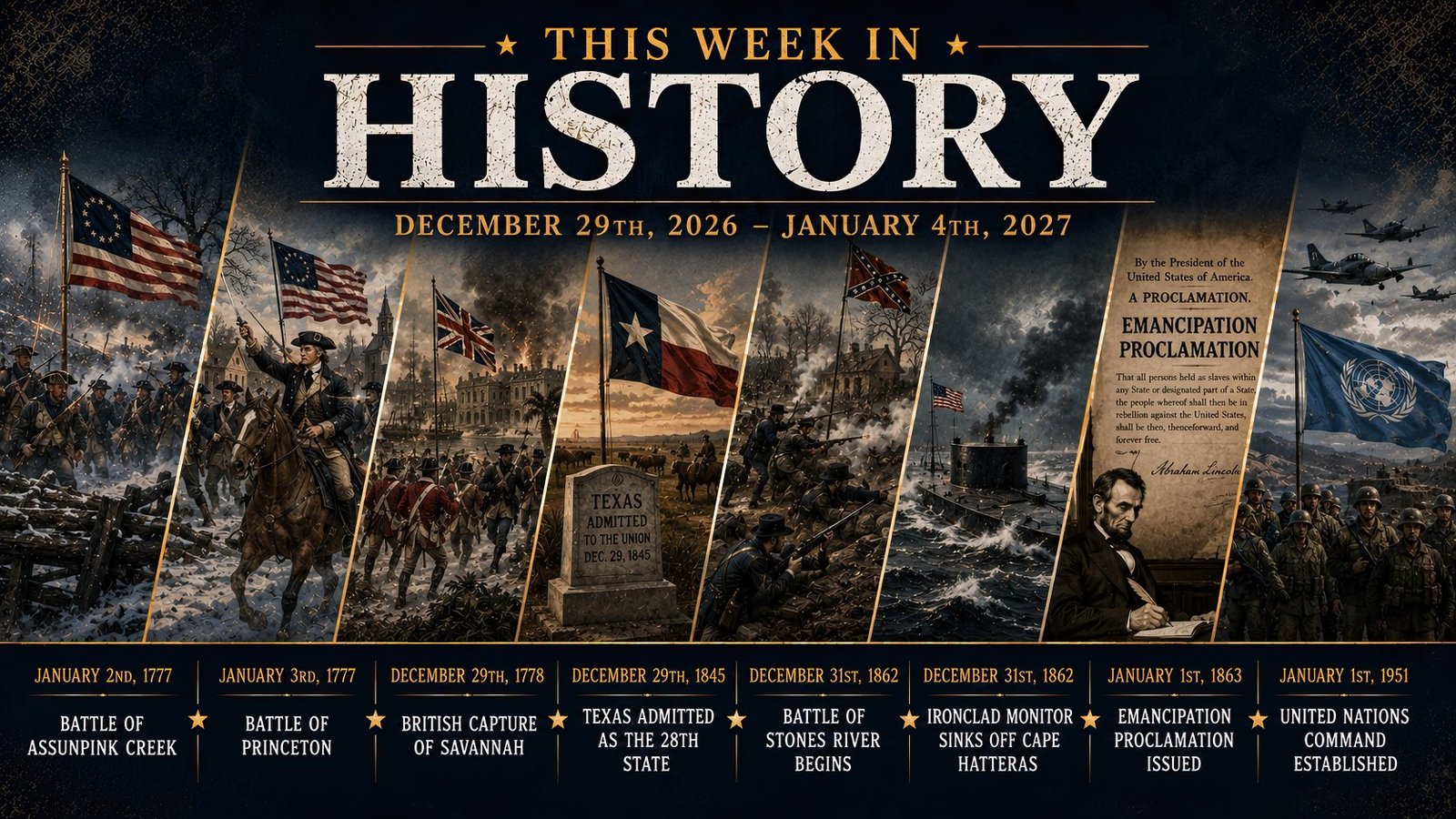
This Week in History · December 29, 2026
100 Populated Entries
How forces prepare, organize, fight, adapt, and learn.
Doctrine, Tactics & Training
Every result opens a permanent subject record with its reference context and connected Dispatch coverage. Filter by record type, editorial collection, or a word in the entry.
100 entries found.
A story of secret overflights, Cold War nerves, and the moment a “untouchable” spy plane finally fell from the sky.
The following summer, August 14th, 1945 became known to many Americans as V-J Day, the day news broke that Japan had accepted Allied surrender terms. After years of island campaigns, submarine warfare, strategic bombing, and the unprecedented use of atomic bombs, word finally spread across ships at sea, foxholes in the Pacific, and hometown streets that the fighting would soon end.
When Alaska entered the Union as the forty-ninth state on January 3rd, 1959, it brought with it a vast expanse of territory that had already played an important strategic role in the Second World War.
A story of high-tech American armor meeting Soviet-designed tanks in the desert and how it reshaped modern ground warfare.
Just a year later in war-time June, Union and Confederate armies were locked in the Overland Campaign, a grinding series of battles as Ulysses S. Grant tried to force Robert E. Lee’s Army of Northern Virginia back toward Richmond. On June 3rd, 1864, Grant launched a massive frontal assault at Cold Harbor, where entrenched Confederate troops held strong positions behind earthworks and rifle pits.
Not all early June anniversaries involve declared wars. On June 8th, 1967, during the Six-Day War in the Middle East, the United States signals intelligence ship USS Liberty was operating in international waters in the eastern Mediterranean. In the confusion of fast-moving ground and air fighting ashore, Israeli aircraft and torpedo boats mistook the ship for a hostile vessel and attacked, inflicting severe damage and killing dozens of American sailors.
A story of a jungle airstrip, thin lines of Marines and soldiers, and how local air power reshaped the Pacific war.
Just two years later, cavalrymen of the Union and Confederacy collided near Brandy Station, Virginia in what became the largest mounted battle ever fought in North America. On June 9th, 1863, Union cavalry crossed the Rappahannock River in a surprise attack aimed at probing Confederate movements as Robert E. Lee’s army shifted north toward Pennsylvania. Throughout the day, sabers and carbines flashed across fields and ridges as Union troopers challenged the reputation of J. E. B.
Before sunrise on November 20, 1917, the British attack began without the usual warning. There was no long preliminary bombardment to announce that an offensive was coming. No days of shellfire tearing the battlefield apart in advance. Instead, the opening movement at Cambrai depended on secrecy, timing, and the strange mechanical presence of hundreds of tanks moving toward the German line.
Two decades later, another critical October engagement unfolded at night near Cape Esperance, off the embattled island of Guadalcanal.
During the Mexican–American War, United States forces under Major General Winfield Scott advanced on Mexico City, meeting fierce resistance at fortified positions west of the capital.
A story of a frozen fighting withdrawal and how it reshaped the war in Korea.
A story of hard lessons, desert tank duels, and a young armor force learning fast enough to change a campaign.
The landings at Cape Torokina invited a swift Japanese response at sea.
A story of a grinding hill assault, exhausted rifle companies, and a single ridge that reshaped the war back home.
A story of street-to-street fighting, shattered assumptions, and how one city battle reshaped the Vietnam War.
A story of air cavalry, hidden armies, and a brutal valley fight that previewed the grinding war still to come.
A story of a risky harbor landing, brutal tides, and how it broke a grinding stalemate in Korea.
A story of a volcanic ridge, two flags in the wind, and a fight that reshaped the Pacific war’s final months.
A story of a painful first defeat and how it forced a new army to relearn leadership, tactics, and trust in combat.
A story of a risky carrier ambush, frantic searches, and a sudden shift in the Pacific war.
A story of an urban raid that turned into a street-by-street survival fight and how it reshaped American intervention abroad.
A story of a lopsided clash where earthworks, frontier rifles, and bad timing shattered a veteran British army and reshaped a young republic’s confidence.
In the spring of 1918, the American Expeditionary Forces were still gaining experience on the Western Front when German troops launched a major raid near the village of Seicheprey. On April 20th, 1918, storm troops attacked positions held by the 26th “Yankee” Division, made up largely of New England National Guard units. The German assault used heavy artillery preparation, infiltration tactics, and gas shells to knock out forward trenches and disrupt communications.
Related Dispatch
These current Dispatch articles connect directly to records in the Doctrine, Tactics & Training directory.