Headline Wednesday · December 30, 2026
248 Populated Entries
Engagements and campaigns examined through objectives, terrain, forces, outcomes, and consequences.
Battles & Campaigns
Every result opens a permanent subject record with its reference context and connected Dispatch coverage. Filter by record type, editorial collection, or a word in the entry.
248 entries found.
Even before a formal declaration of war against Germany, the United States Navy was escorting convoys in the North Atlantic, confronting the realities of submarine warfare.
The jungle pressed in on both sides of the Ormoc Road, a narrow ribbon of mud and broken pavement cutting through the hills near Limon on the island of Leyte. December rain had turned the ditches into brown pools. American infantrymen crouched behind a hasty roadblock of felled trees, sandbags, and wrecked vehicles, listening to the grinding approach of steel.
Barely four months after the attack on Pearl Harbor, the United States planned a strike to carry the war to the Japanese home islands. On April 18th, 1942, sixteen B-25 medium bombers led by Lieutenant Colonel James Doolittle took off from the carrier USS Hornet in the Pacific, a feat never attempted before with aircraft of that size. Spotted early by enemy patrol vessels, the task force launched the bombers farther from Japan than planned, forcing the crews to stretch their fuel to the limit.
By the early 1970s, United States leaders were pursuing “Vietnamization,” reducing American ground forces while training and equipping South Vietnamese units to carry more of the fighting. North Vietnamese commanders sought to test this strategy and change the balance on the ground, planning a large, conventional offensive using tanks, artillery, and massed infantry.
On December 19th, 1944, senior Allied commanders met to assess the Ardennes crisis, and General Dwight D.
The winter sky over the Anzio beachhead was a low, gray lid, pressing the sound of guns back down onto the men below. Along a shallow drainage ditch called the Fossa Femminamorta, muddy water slid past tufts of grass and shattered reeds. Somewhere ahead, beyond the next bend, German machine guns covered the open fields that stretched away from the ditch, anchoring a strongpoint that threatened the entire attack.
On February 19th, 1942, a little more than two months after the attack on Pearl Harbor, President Franklin Roosevelt signed Executive Order 9066. The order authorized military commanders to establish exclusion zones and remove people from them, a power soon applied mainly along the West Coast. In practice, this meant that more than one hundred thousand people of Japanese ancestry, the majority of them American citizens, were forced from their homes and sent to inland camps under guard.
In the early weeks of the Korean War, United States forces rushed to slow a North Korean advance that threatened to overrun the entire peninsula. Around the city of Taejon, elements of the 24th Infantry Division fought a desperate delaying action, outnumbered and facing tanks and artillery in unfamiliar terrain. Over several days of close combat and street fighting, American troops inflicted significant losses but gradually found themselves cut off and forced to withdraw.
On March 6th, 1836, after nearly two weeks of siege, Mexican forces under Antonio López de Santa Anna stormed the old mission compound at the Alamo in San Antonio. The defenders, a mixed group of Texian settlers and volunteers from the United States, had chosen to stand in place despite orders to withdraw, hoping to delay the Mexican advance. In the final assault, the garrison was overwhelmed and killed almost to the last man, including figures such as William B.
Barely seven weeks after the attack on Pearl Harbor, the first major contingent of American ground troops landed in Northern Ireland. Soldiers from the 34th Infantry Division disembarked in cold, damp weather to the sound of bands and the sight of cheering crowds who knew the war in Europe had entered a new phase. Until then, the British had fought on in the west with limited direct American military presence.
A year later and hundreds of miles to the north, American troops faced a British advance aimed at cutting New England off from the rest of the colonies.
In early August 1950, the Korean War had entered a precarious phase as North Korean forces pushed United Nations troops back toward the southeastern tip of the peninsula. On August 7th, the First Provisional Marine Brigade, formed from elements of the First Marine Division, arrived at the port of Pusan to reinforce the hard-pressed defenders.
When the United States entered World War I in April 1917, its small regular army was nowhere near large enough to fight on the Western Front. Congress responded by passing the Selective Service Act, and on June 5th, 1917, the nation held its first massive draft registration day. Across cities, small towns, and rural crossroads, millions of men lined up at local boards, filling out forms under the eyes of community leaders and veterans.
The ramps drop into waist-deep surf and chaos. It is the morning of October 20, 1944, on a stretch of shoreline the maps call Red Beach. Ahead lies a narrow band of sand, beyond it a low palm grove and flooded rice paddies. Somewhere in that green fringe, Japanese guns have the approaches bracketed. As the first waves of soldiers tried to cross, the beach turned into a killing ground.
High over Europe on Christmas Eve 1944, the sky is crowded with contrails. Hundreds upon hundreds of heavy bombers push east toward German airfields, the engines’ steady thunder mixing with clipped radio calls. At their head is a single Flying Fortress, the air commander’s ship, where Brigadier General Frederick Walker Castle studies the instruments and the grey cloud deck below.
The rain-soaked hills of Leyte were already torn open by days of fighting when Company A of the 306th Infantry pushed forward against a Japanese strongpoint that refused to break. Machine guns were dug into the slopes, firing down narrow approaches that funneled every American movement into sheets of bullets. A light tank inched ahead, meant to crack the defenses, but the infantry platoon walking behind it stalled under the storm of fire.
The fields near Anzio were bare and unforgiving—flat, freshly plowed earth broken only by shallow furrows and a few low dikes. On a May morning in 1944, Staff Sergeant George John Hall lay pressed into that thin cover with the rest of his company, the dirt shaking under the hammering of German machine guns. Every time a man tried to crawl forward, grazing fire stitched the ground in front of him. Sniper rounds cracked overhead.
Night on Iwo Jima never really felt dark. The sky glowed faintly from flares and burning wreckage, and the volcanic ash underfoot seemed to swallow every step. In a shallow foxhole—a rough, shoulder-deep fighting position scraped into that ash—Private George Phillips stood watch while the rest of his squad finally slept. They had spent the night trading grenades and rifle fire with Japanese troops slipping through the lines.
On December 16th, 1944, German forces launched a surprise offensive through the forests of the Ardennes, striking thinly held American lines in Belgium and Luxembourg.
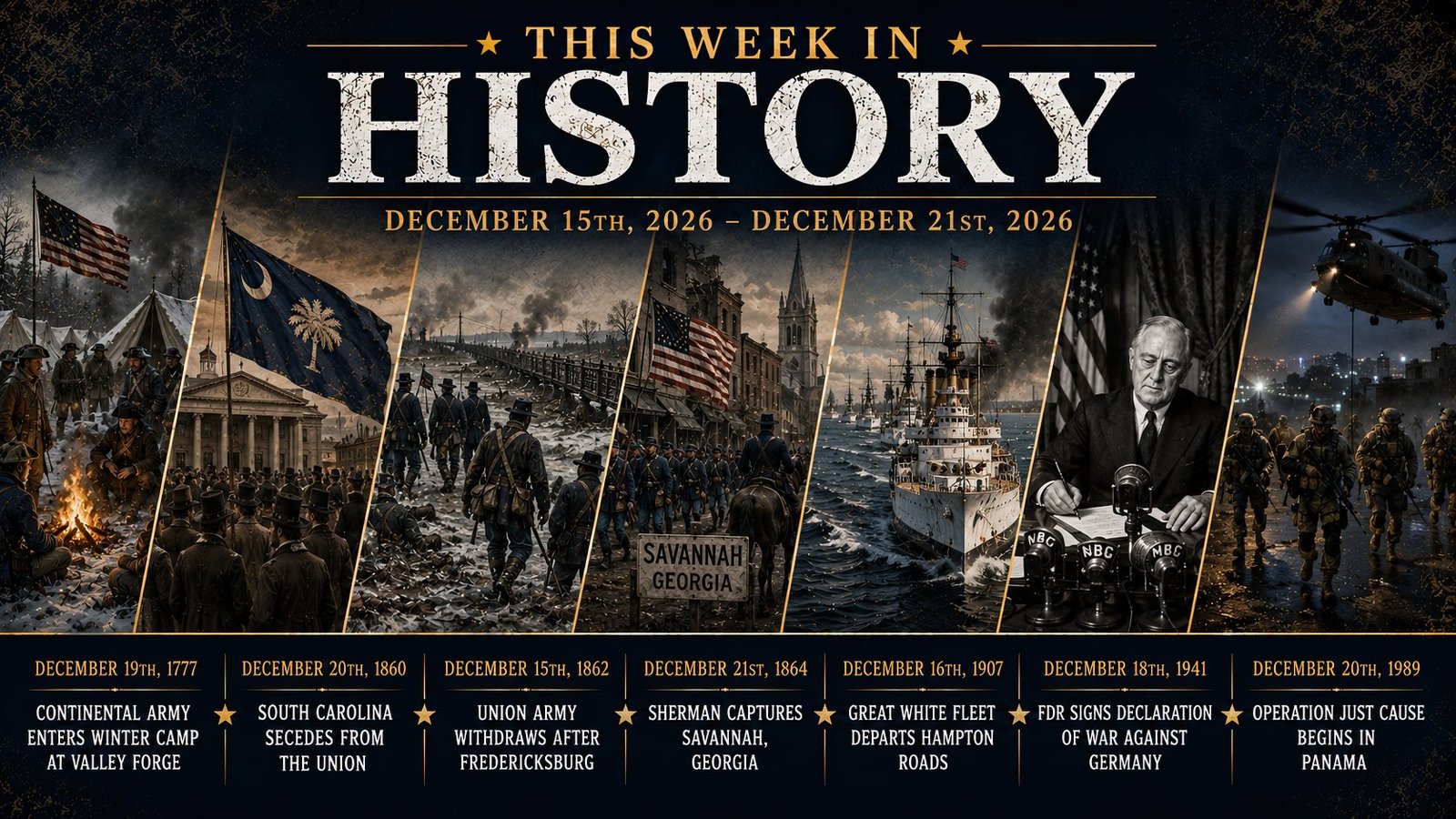
Just three days after Pearl Harbor, Adolf Hitler and Benito Mussolini chose to broaden the conflict by declaring war on the United States on December 11th, 1941.
On July 2nd, 1863, both armies were now largely concentrated, and the second day at Gettysburg turned into a brutal struggle for the flanks of the Union position. Confederates under James Longstreet pushed against the Union left, targeting places that would become famous: Devil’s Den, the Wheatfield, the Peach Orchard, and Little Round Top. Union units shifted under intense pressure, some arriving just in time to plug gaps and counterattack up rocky slopes.
On August 10th, 1944, American commanders declared Guam secured after nearly three weeks of brutal fighting that began with landings in late July. The island, seized by Japan shortly after the attack on Pearl Harbor, lay in a position that made it a natural forward base for the United States in the central Pacific.
A story of high-tech American armor meeting Soviet-designed tanks in the desert and how it reshaped modern ground warfare.
The fuel gauges in Harold Bauer’s Wildcat fighter were already edging toward empty when the coastline of Guadalcanal slid beneath his wings. He had just finished leading a long, tense, overwater flight of Marine fighters up from Espiritu Santo, six hundred miles of nothing but ocean and cloud. Henderson Field, the hard-bitten airstrip the Marines called home, lay ahead as a thin strip of coral and mud, promising rest, repairs, and—most of all—gasoline.
Related Dispatch
These current Dispatch articles connect directly to records in the Battles & Campaigns directory.