Headline Wednesday · December 30, 2026
248 Populated Entries
Engagements and campaigns examined through objectives, terrain, forces, outcomes, and consequences.
Battles & Campaigns
Every result opens a permanent subject record with its reference context and connected Dispatch coverage. Filter by record type, editorial collection, or a word in the entry.
248 entries found.
On a cold October morning, a makeshift American flotilla under Benedict Arnold waited behind Valcour Island on Lake Champlain for a much larger British squadron sailing south from Canada.
By late 1864, Confederate General Sterling Price launched a sweeping mounted raid into Missouri, hoping to capture cities, inspire recruits, and shift attention from collapsing fronts elsewhere.
The shock delivered at Front Royal set the stage for a larger clash two days later. On May 25th, 1862, Union General Nathaniel Banks tried to hold the town of Winchester against Jackson’s advancing Confederates, whose columns converged on the Valley Pike from multiple directions. Through the morning, Union infantry and artillery contested ridges south of the town, but Confederate attacks pressed steadily against their flanks.
The failed December 1864 expedition and successful January 1865 assault were separate attempts to close Wilmington’s protected sea approach. This overview distinguishes bombardment, amphibious landings, naval and army assaults, and the later advance on Wilmington.
Read Entry →Person · 2026-03-02Beauford T. AndersonIn the dark, humid hours before dawn on Okinawa, the American line around Kakazu Ridge was little more than a jagged string of foxholes and shattered stone. Technical Sergeant Beauford “Andy” Anderson and the men of his weapons platoon had spent the night listening to the island—distant artillery rumbled, mortars coughed, and now and then a Japanese flare turned the terraced fields silver for a heartbeat before dropping them back into blackness.
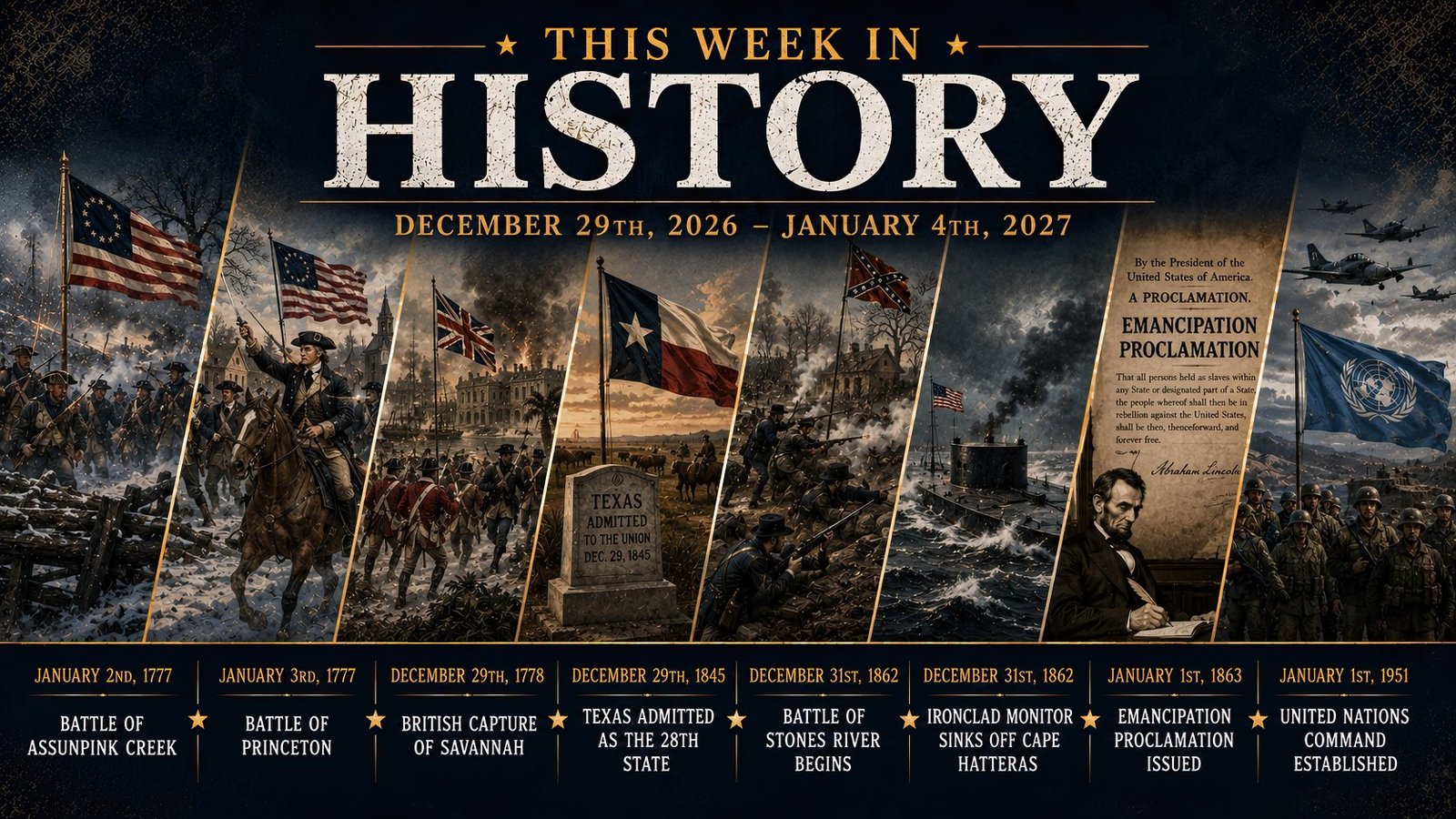
On December 29th, 1778, British forces returned in strength to Georgia, targeting the port city of Savannah as the opening move in a renewed Southern strategy.
On another September 23rd, this time during the critical middle years of the Revolution, a British officer named Major John André was stopped by militiamen near Tarrytown, New York.
On May 18th, 1944, Allied troops finally occupy the shattered ruins of the monastery and town of Cassino in Italy, ending a months-long struggle along the Gustav Line. Earlier attacks in winter and early spring had seen United States and other Allied units bleed heavily against well-prepared German defenses in rough terrain. The controversial bombing of the historic abbey and repeated assaults through mud, rivers, and rubble turned Monte Cassino into a symbol of the grinding Italian campaign.
Nearly nine months after the opening invasion of Iraq, United States forces were still hunting for Saddam Hussein, whose regime had collapsed but whose presence loomed over the growing insurgency.
In Normandy, weeks after the D-Day landings, American forces found themselves locked in a grinding struggle through hedgerow country that favored the German defenders. The town of Saint-Lô, a key road junction, became a vital objective for United States units trying to break out of the constricted beachhead. After days of intense fighting, artillery barrages, and house-to-house clearing, American troops finally secured the shattered town on July 18th, 1944.
A story of a shattered defensive line, a race against explosives, and the one intact bridge that cracked open the last barrier into Germany.
While Dutch Harbor burned, the decisive blows of that wider Japanese plan were being struck far to the south. On June 4th, 1942, United States Navy carriers Enterprise, Yorktown, and Hornet launched waves of torpedo planes and dive bombers against a powerful Japanese carrier force near Midway Atoll. Early attacks by torpedo squadrons suffered terrible losses, but they drew enemy fighters and disrupted Japanese flight decks.
The first explosions rolled across Pearl Harbor like distant thunder, then slammed into the harbor with terrifying clarity. On the repair ship USS Vestal, moored outboard of the battleship USS Arizona, Commander Cassin Young felt his ship shudder as bombs found their mark up and down the fleet. Men sprinted for their battle stations, the air already thick with smoke, the rising whine of diving aircraft cutting through shouted orders and alarm bells.
Union attacks on September 29 broke parts of Richmond’s outer defenses and brought Black troops into a costly assault at New Market Heights. The capture of Fort Harrison survived Lee’s counterattack, but the advance did not take Richmond.
Read Entry →Person · 2026-07-06Charles E. MowerThe jungle ravine near Capoocan, on the island of Leyte, funneled sound like a drum. Machine guns hammered from the slopes, echoing off the trees. A thin stream cut the bottom of the gulch, its surface slapped into white splashes as bullets stitched across the water. Sergeant Charles E. Mower, just nineteen years old, stood in that stream with his squad of Company A, 34th Infantry Regiment, advancing into the teeth of a Japanese defense on a November day in 1944.
The crisis in north China produced several connected operations: defense of the foreign legations, the unsuccessful Seymour expedition, fighting around Tientsin, and the August advance on Peking. Their recipients did not all fight at the same place or on the same day.
Read Entry →Battle Overview · 2026-09-06Cienfuegos Cable-Cutting ActionOn May 11, 1898, crews from Marblehead and Nashville worked close to the Cuban shore under fire to cut submarine cables. The operation damaged communications but did not establish complete isolation of the port.
Read Entry →Battle · 2026-08-25Crisis along the Pusan PerimeterBy August 31st, 1950, United States and South Korean troops clung to a shrinking defensive line around the port of Pusan, the last major foothold on the Korean Peninsula.
The nuclear tensions of the early Cold War peaked when the United States discovered offensive missiles being installed in Cuba.
The snow was hard as concrete on the Belgian hillside, the January cold locking the ground into a sheet of ice. Staff Sergeant Curtis F. Shoup and the soldiers of his company lay sprawled on that frozen slope, their dark uniforms stark against the white as German machine guns raked the hillside. The attack had stalled almost as soon as it began. The enemy gun on the rising ground ahead had perfect fields of fire, sweeping every fold and hollow where the Americans tried to move.
Two days later, early June turned into one of the most famous dates in world history. On June 6th, 1944, Allied forces stormed the beaches of Normandy in northern France in the opening phase of Operation Overlord. United States troops landed primarily at Utah and Omaha Beaches, facing a mix of flooded terrain, beach obstacles, and entrenched German defenders.
The ridge ahead looked less like a battlefield and more like a shattered hillside of rock, clay, and smoke. It was early May 1945 on Okinawa, and the Marines of Company E had stalled below Hill 60. Japanese machine guns chattered from hidden bunkers. Mortar rounds crashed into the slope, showering the men with dirt and splinters of coral. Every attempt to move up the ridge drew a fresh burst of fire that pinned them flat.
On December 21st, 1945, General George S.
A story of a desperate hilltop stand, a fixed bayonet charge, and how it helped turn a Civil War invasion back.
Related Dispatch
These current Dispatch articles connect directly to records in the Battles & Campaigns directory.