Ice, Darkness, and Drums at Trenton
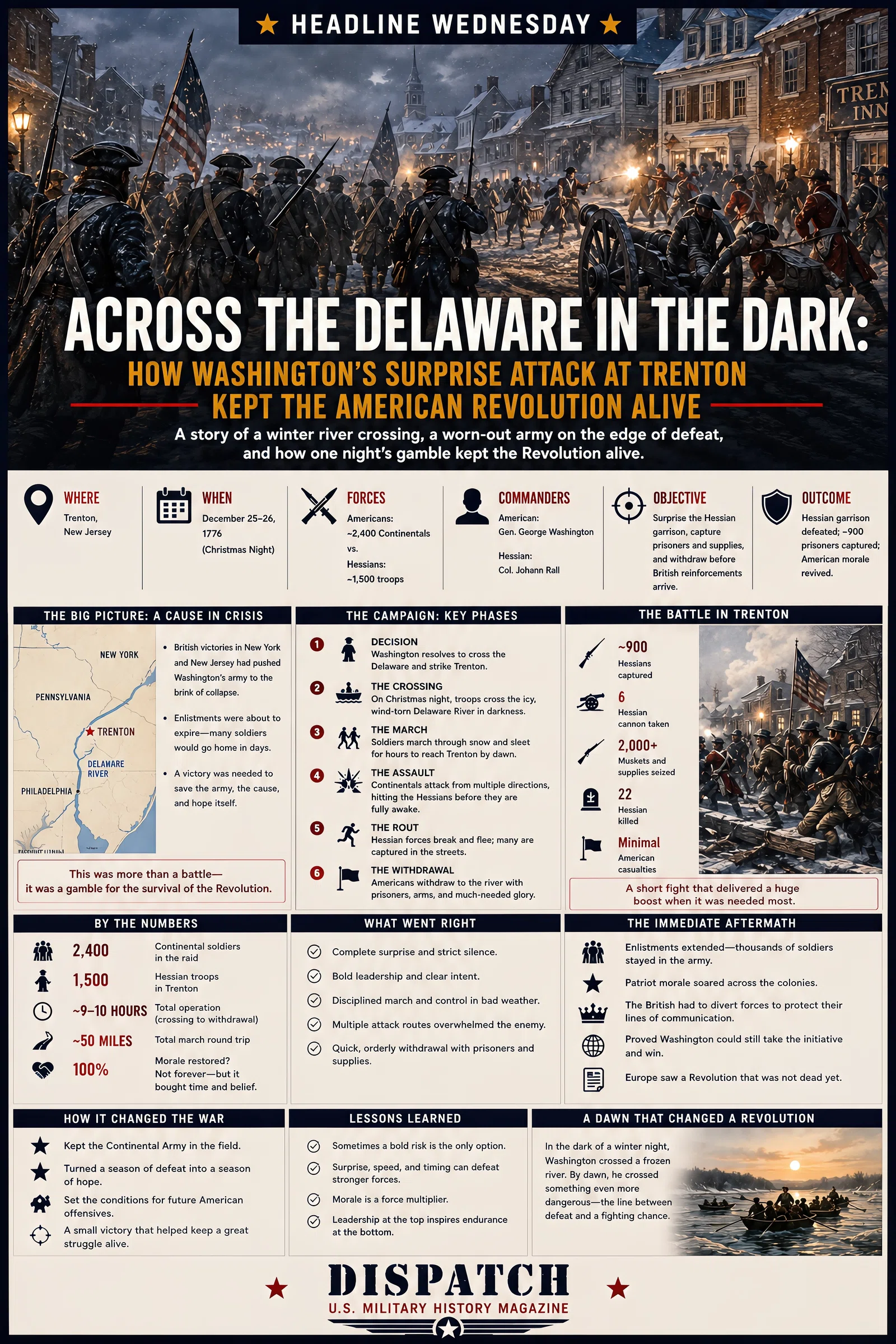
Just before dawn on December 26th, 1776, the streets of Trenton, New Jersey were a mess of slush, ice, and half-frozen mud. Wind cut through the little town, carrying the crack of musket fire and the sharp commands of officers trying to be heard over the storm. Down King and Queen streets, gray-coated Hessian soldiers stumbled from their billets, pulling on boots and coats as they ran toward the sound of alarm drums. Their Christmas night had ended suddenly, with shouted warnings that American troops were pouring into town from the north.
At the edge of Trenton, columns of Continental soldiers pushed forward through the storm. Many of them had marched all night after crossing the Delaware River in boats that bucked and groaned against drifting ice. Their clothes were soaked, their feet numb, and the wool of their coats crusted with sleet. Yet the line kept moving, pushing cannon into position at key crossroads, the iron-rimmed wheels grinding into the frozen ruts. Officers called out hoarsely to dress ranks, keep silence, and hold fire until the word was given.
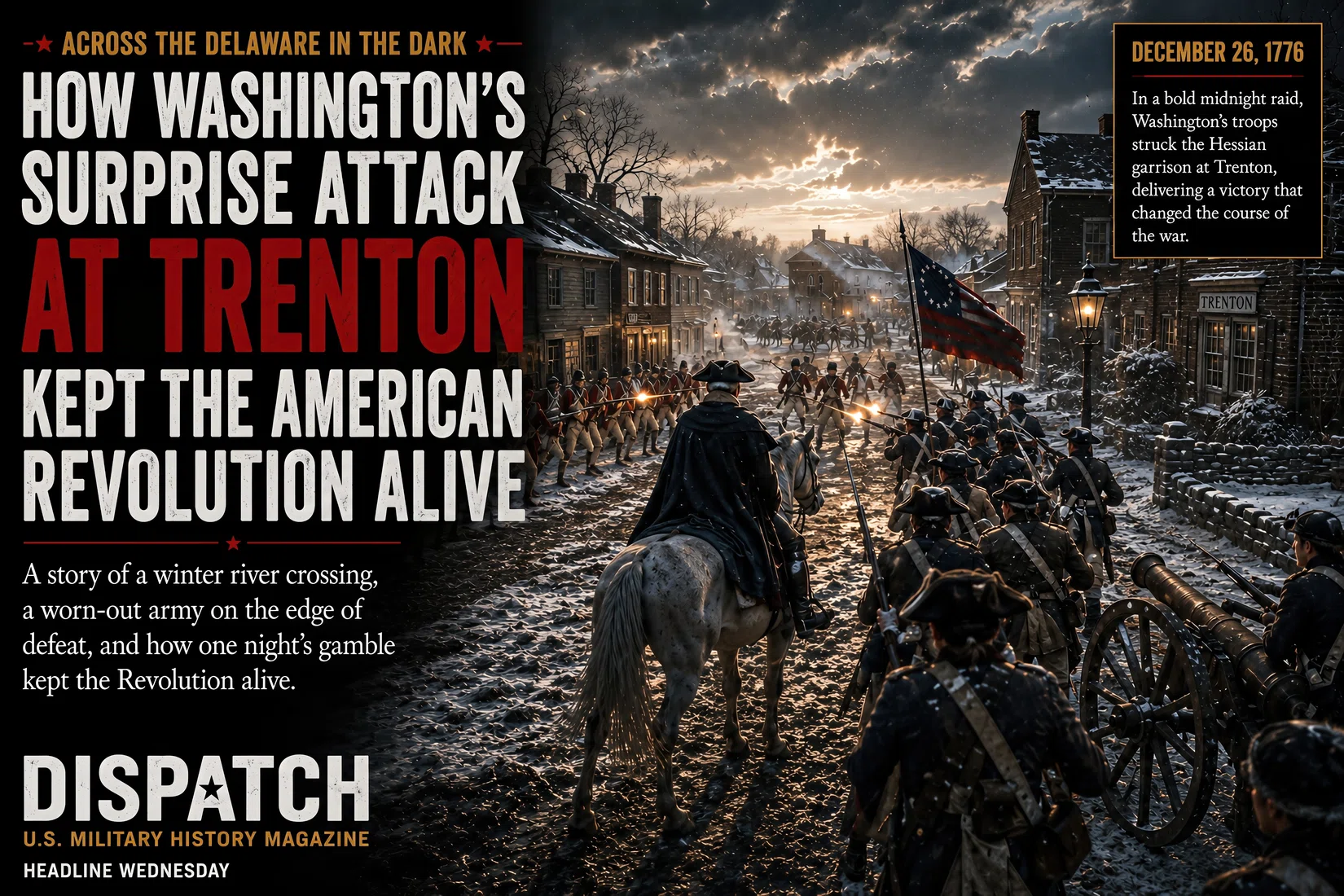
Near the front rode George Washington, wrapped in a heavy cloak, his horse’s sides flecked with frozen sweat. Hours earlier, he had watched as his army fought the river in darkness, ferry after ferry sliding through ice-choked water. Now the crossing was behind them, and the success or failure of the entire operation rested on the next few minutes inside this sleepy New Jersey town. The plan was simple in outline and brutally hard in execution: hit the Hessian garrison before it was fully awake, break it, and get out before British reinforcements could react.
As the Americans surged into Trenton from multiple directions, Hessian officers tried to form lines in the streets and fields around the town. Musket flashes lit up doorways and fences, and cannon posted by the Continentals swept key intersections with grapeshot. Civilians huddled behind shutters or peered from attic windows as the fight rolled past their houses. What had been a quiet holiday town was, for a few hours, one of the most important battlefields in the world.
By the time the smoke began to settle, the once-confident garrison was collapsing in confusion. Hessian units broke and ran, others tried to rally around their colors, and wounded men lay scattered in the snow. For the soaked, exhausted Continentals who had marched through the night, this was more than a rare victory. It was a lifeline thrown to a cause that had been sinking fast. But to understand why this icy morning mattered so much, you have to pull the camera back and see how close the Revolution had come to dying before the year was out.
If This Gamble Fails, So Does Hope
In the closing months of 1776, the American Revolution was in deep trouble. Washington’s army had been beaten out of New York, driven across New Jersey by British regulars and their Hessian allies, and chased to the banks of the Delaware River. Forts had fallen, supplies were short, and the Continental Army’s reputation had taken a pounding. Along the way, soldiers deserted, militia went home, and confidence in the new cause ebbed with every British victory. By December, many in London and Philadelphia assumed the rebellion was nearly finished.
The army that gathered on the west bank of the Delaware was a shadow of the force that had once defended Brooklyn Heights. Numbers were low, morale was shaky, and pay was often late or missing altogether. Many enlistments were due to expire at the end of the year, meaning that in a few days Washington might have had almost no army left on paper or in reality. If his men simply went home when their terms were up, the Continental Congress would be left with bold words but no field force to back them. The Revolution would exist mostly on parchment.
Across the river, British commanders had scattered garrisons through New Jersey, including German troops hired from Hesse and other German states. Trenton was one of those posts, a small town that sat astride key roads linking the interior of New Jersey with the approaches to Philadelphia. Holding it helped the British keep pressure on the rebellious colonies and showed locals that the Crown’s authority still reached deep inland. For Washington, that garrison represented both a threat and an opportunity.
The stakes went far beyond a single small-town fight. If the British and their allies held New Jersey comfortably through the winter, Loyalist confidence would grow and Patriot support would continue to crumble. The Continental Army might melt away to a handful of diehards. Foreign powers watching from Europe would see a lost cause rather than a partner worth backing. On the other hand, a sharp, unexpected victory could jolt both sides. It could convince wavering soldiers to stay, rally civilians who were losing faith, and force British commanders to rethink their safe winter positions.
That is what Washington was really gambling for when he ordered the crossing. He was not just trying to bag a Hessian garrison. He was trying to change the story of the war in a single, daring stroke. If the attack on Trenton failed, he risked losing much of the army he had left, handing the British a clean path toward Philadelphia, and confirming the belief that the Revolution was collapsing. If it succeeded, even on a limited scale, it could buy time, restore belief, and keep the cause alive into a new year. On that icy night and gray morning, the fate of a rebellion rested on cold hands, shaky boats, and a general willing to bet everything on surprise.
Defeat, Retreat, and One Last Plan
The road to Trenton began with a string of defeats that nearly broke the Continental Army. In the summer and fall of 1776, British forces under General William Howe had driven Washington’s troops out of New York, through a series of battles that exposed the inexperience and fragile organization of the new army. Brooklyn, Manhattan, and the forts along the Hudson fell in turn. Each setback meant more lost guns, more prisoners, and a fresh wave of doubt. As the British pushed across New Jersey, Washington’s command posts grew more temporary, his maps more focused on routes of escape than on offensive plans.
The retreat across New Jersey was a long, cold withdrawal that burned away illusions about a quick war. American columns trudged down muddy roads while British and Hessian advance guards pressed them, snapping at their heels. Militia units that had turned out with enthusiasm earlier in the year slipped away to protect their own homes, or simply went back to winter firesides. Newspapers that had once carried bold talk about liberty now reported defeats and retreats, and Loyalist voices grew louder in many towns. The army that finally reached the west bank of the Delaware was tired, shrunken, and deeply aware of its own vulnerability.
Washington understood that he could not simply dig in and wait. Many enlistments were set to expire at the end of December, and men who had endured months of hard marching and hard luck were ready to go home. Without a bold stroke, the army might melt away on paper and in reality. At the same time, British commanders had broken their advance into a chain of winter posts, stretching their line across New Jersey. Trenton, held by Hessian troops under Colonel Johann Rall, sat in the middle of that chain, close enough to the river to tempt a risk-taker with boats and a strong stomach for cold.
From scattered intelligence, captured deserters, and local sympathizers, Washington pieced together a sense of the Trenton garrison’s routines. The Hessians were tough, experienced soldiers, but they were also isolated, overworked by constant patrols and alarms, and confident that winter weather would keep large American forces away. In councils of war on the Pennsylvania side of the Delaware, Washington and his key officers weighed a plan that sounded nearly impossible: cross the ice-choked river at night, march several miles in a snowstorm, and fall on Trenton before dawn. It would be a test not only of courage, but of discipline, logistics, and sheer endurance. With little else left to play, Washington decided to stake his remaining army on that throw of the dice.
Cannon at Trenton’s Crossroads
The operation began on Christmas night, when most armies in that era would have expected quiet campfires and a slower watch. Instead, Washington’s chosen force gathered along the dark banks of the Delaware, where Durham boats and other craft waited in the freezing wind. Artillery pieces were eased onto the boats, horses were coaxed aboard, and men clung to gunwales as crews fought the current. Ice floes bumped and scraped along the hulls, threatening to jam the crossing entirely. The schedule slipped; hours passed, and the storm thickened, but Washington insisted on pressing on rather than canceling the attempt.
By the time the last boat landed on the New Jersey shore, the plan was already behind its intended timetable. The force then had to march miles down rough roads toward Trenton, guided by officers who knew the local lanes and bends. Snow and sleet slashed into faces, coated muskets, and hid landmarks. Some soldiers left bloody footprints where their shoes had worn through. Yet the columns held together, driven by officers walking alongside them and by the grim knowledge that turning back without a fight would mean another wasted effort in a season already full of them. As dawn approached later than expected under the heavy sky, advance elements finally closed in on the outskirts of the town.
Washington’s plan called for the army to approach Trenton from more than one direction, cutting off escape and sowing confusion. General Nathanael Greene’s division moved in from the north, while General John Sullivan’s men swung in from another axis, converging on the town’s main streets and roadways. Forward units pushed small pickets aside and drove deeper into the settlement before full alarm could spread. When American artillery reached key positions along King and Queen streets, gunners unlimbered their pieces and began to fire down the length of the town, turning those streets into deadly channels choked with smoke and splintered wood.
Hessian officers rushed to form their regiments, trying to pull men from houses, barns, and guard posts. Colonel Rall moved to rally his troops, calling them into formation and preparing to counterattack despite the shock of the sudden assault. The town’s narrow streets and fenced yards, however, made it difficult to form clean lines, especially under artillery fire. American infantry pressed forward behind their guns, using fences, buildings, and side lanes to close on Hessian positions. Muskets cracked at close range, and the air filled with shouts in English and German as both sides tried to make themselves heard over the roar of the guns.
As the fighting spread into orchards and open ground beyond the town center, some Hessian units attempted to break out, while others sought to form a coherent defensive line. American detachments moved to block bridges and roads, cutting off routes toward Princeton and the interior. The storm that had made the approach march so miserable now added to the confusion, masking movements and blurring sight lines with swirling snow and smoke. Within a short span of time, organized resistance in many parts of Trenton began to crumble. Yet the full meaning of the morning’s work, and the exact moment when the tide truly turned, would only become clear when the guns finally fell silent and the prisoners were counted.
Street Guns and a Wounded Colonel
What turned Trenton from a desperate gamble into a clear American victory was not a single dramatic charge, but a series of small advantages that added up fast. One of the most important was the way Washington’s officers placed their cannon. Once the guns were dragged into town, crews sited them to fire straight down Trenton’s main streets, where any Hessian attempt to form or maneuver would be raked with solid shot and grapeshot. In a town of narrow lanes and wooden buildings, those well-placed guns turned King and Queen streets into funnels that favored the attackers.
At the same time, American infantry pushed into side streets and back yards, cutting off paths the Hessians might have used to regroup. Instead of a neat formation on an open field, Hessian officers found themselves trying to rally men in cramped alleys and yards, under fire from windows, fences, and corners. Units that did manage to form up were quickly bracketed by artillery from one direction and musketry from another. The same discipline that had carried the Continentals through the night now kept them pressing forward, yard by yard, without losing cohesion in the swirl of smoke and snow.
Colonel Rall tried to seize back the initiative by organizing a counterattack. He had a reputation as a brave front-line commander, and he attempted to gather his regiments and push out of the town to clear a path. In the confusion, with messages delayed and formations ragged, that effort ran into concentrated American fire. Rall himself was mortally wounded while trying to steady his troops, and his fall cut the last threads holding the Hessian defense together. Without their central commander, and with subordinate officers struggling to coordinate under fire, the garrison’s ability to organize a breakout evaporated.
As the Hessians attempted one last effort to escape toward the countryside, they found key roads already blocked. American detachments had moved quickly to choke off bridges and lanes leading out of Trenton, just as the plan required. Surprised, under fire, and unsure where the enemy lines ended, many Hessian companies simply stopped, threw down arms, or accepted that further resistance meant needless casualties. In a matter of hours, the garrison that had once looked like a solid link in the British chain across New Jersey was broken. Washington’s army, which had known almost nothing but retreat for months, now stood in possession of the town, its prisoners, and its guns.
From River Gamble to Revolution’s Rebirth
When the fighting ended, the results were stark. Hundreds of Hessian soldiers were captured, along with their colors, cannon, and stores. American losses were remarkably light by comparison, especially for an assault against professional troops inside a defended town. Washington was careful to move quickly, gathering prisoners and captured equipment and preparing to withdraw before the British could respond in force from nearby posts. The operation had never been meant to hold Trenton at all costs; its aim was to strike, shock, and then slip back across the river with proof that the Continental Army could still win.
The impact on morale was immediate. For soldiers who had spent months falling back, the sight of enemy regiments laying down their arms in the snow was a powerful cure for despair. Word of the victory traveled fast, carried by letters, newspapers, and the stories of men who had been in the streets that morning. Civilians who had begun to doubt the Revolution’s chances now had something solid to point to: a winter victory against trained troops won by an army that had been written off as beaten. The timing mattered, too. With enlistments about to expire, Washington used the fresh triumph to plead with men to stay on a little longer, and many did.
The British response showed that they, too, recognized the blow. Commanders quickly adjusted their winter dispositions, pulling forces closer together and taking American offensive potential more seriously. The victories at Trenton and, days later, at Princeton forced the British out of much of inland New Jersey and disrupted their plan to sit comfortably on the state while planning fresh campaigns. The “safe” chain of posts that had once seemed proof of British control now looked vulnerable to rapid, concentrated strikes. Washington had reminded his enemies that the war was far from over.
In the longer view, the Trenton campaign helped convince observers at home and abroad that the American cause had resilience and leadership. It showed that the Continental Army could recover from disaster, adapt under pressure, and use terrain, surprise, and timing to offset disadvantages in numbers and training. For modern readers, staff-ride groups, and visitors walking Trenton’s streets or standing on the banks of the Delaware, the lesson runs deeper than the image of boats in the ice. It is a story about an army and a commander refusing to let a bad year become the end of a war, and about how one carefully planned winter strike kept a fragile Revolution alive long enough to grow into a nation.