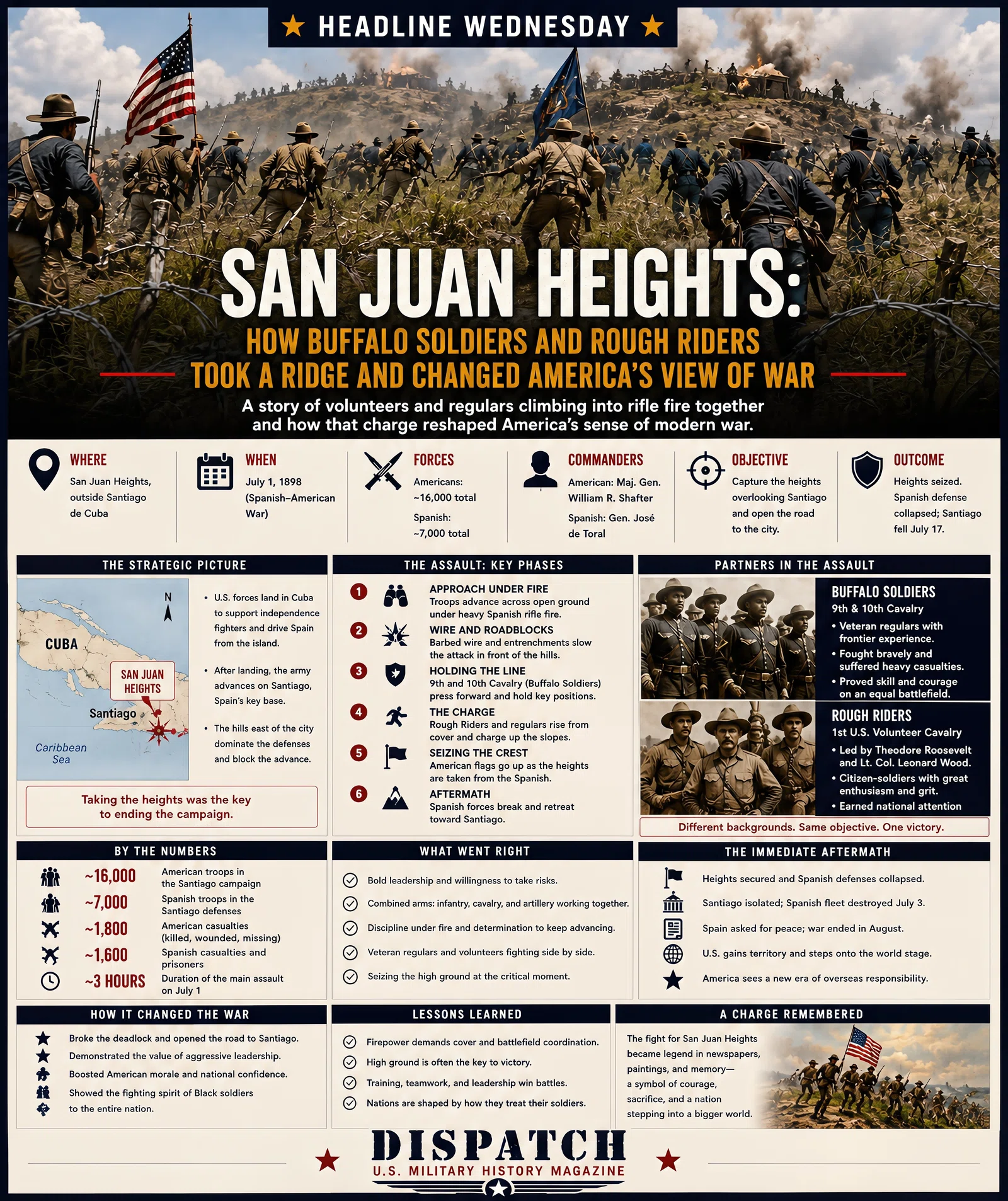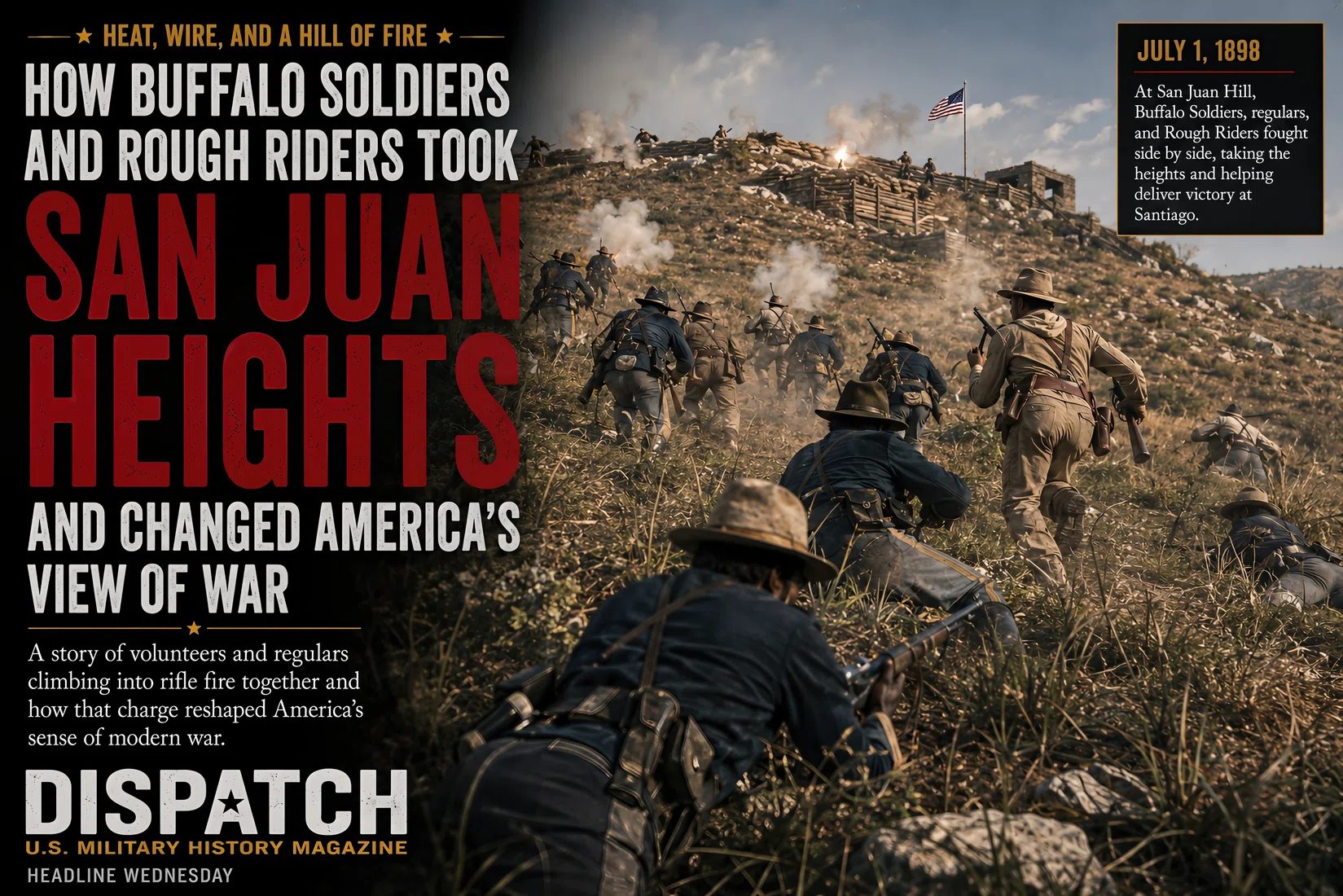
Heat, Wire, and a Hill of Fire
The grass in front of San Juan Heights was waist high and full of hidden wire, and every stalk seemed to twitch under rifle fire. Just after midday on July 1st, 1898, men of the United States Army lay pressed into that grass outside Santiago de Cuba, listening to the snap of Spanish Mauser bullets and the crack of their own officers’ voices trying to cut through the chaos. Somewhere ahead, beyond the shallow creek and the tangle of barbed wire, low blockhouses and trenches lined the ridge the newspapers were already calling San Juan Hill. On those slopes, Spanish soldiers fired from cover while American units hugged the ground with no clear line of advance.
In the jumble and confusion, uniforms told a layered story. Sun-faded blue on the regular cavalry and infantry, rough khaki and mismatched gear on the volunteers of the 1st United States Volunteer Cavalry. The press back home had already named them the Rough Riders, but on this ground they were simply another regiment trying to move under fire. Nearby, Black regulars from the 9th and 10th Cavalry had already pushed forward, trading their years of frontier experience for a few more yards of cover and a little more room to breathe. Bugle calls blurred together, orders crossed, and for long minutes the attack seemed to stall in the killing zone.
Above them the ridge line looked close and impossibly far at the same time. Men could see the white puff of smoke from Spanish rifles, hear the buzz of rounds skimming overhead, and feel the helplessness of lying still while casualties mounted. The plan had been to advance in more orderly lines, but the reality of modern firepower had pinned them to the field. When junior officers and sergeants began to shout to their companies and troops to get up and move, they were not thinking about newspaper headlines or future speeches. They were trying to break a deadly pause that could get the entire assault shot to pieces. The decision to rise and run toward that ridge would turn a confused halt into one of the most remembered charges in American military history, but at this moment it was simply the only way out of the open.
If the Heights Hold, the Campaign Stalls
San Juan Heights was not just another rise of ground outside a distant Caribbean city. Those low ridges, including what Americans called Kettle Hill and San Juan Hill, dominated the eastern approaches to Santiago and the roads that led toward the harbor where Spain’s Caribbean fleet waited. Holding that high ground allowed Spanish forces to watch American movements, direct fire on any advance, and threaten the siege lines that were tightening around the city. If the Americans could not pry the defenders off those slopes, the campaign around Santiago risked grinding into a costly stalemate under tropical sun and disease-laden rains.
This was the key land battle of a short but consequential war. The United States had sent an expeditionary force to Cuba to break Spain’s grip and support a Cuban rebellion that had already bled for years. Around Santiago, regular infantry regiments, seasoned Black cavalry troopers, and hastily organized volunteer outfits all found themselves thrown into the same narrow corridor of advance. The 1st United States Volunteer Cavalry, with Theodore Roosevelt serving under Leonard Wood, brought political attention and eager press coverage. The 9th and 10th Cavalry brought hard-earned discipline from years of service on the frontier, along with the burden of serving a country that still treated them as second class at home.
For the Spanish command, the heights offered their best chance to exact a price that might make Washington think twice about further expansion. A sharp reverse outside Santiago could stiffen Spanish resolve at the negotiating table and temper the American public’s sudden appetite for overseas ventures. For the American leadership, success promised more than possession of a Cuban city. It promised a demonstration that the United States could land forces overseas, coordinate Army and Navy operations, and win on foreign soil in front of a global audience. The men sweating in the grass below San Juan Heights did not choose that stage, but their success or failure would ripple outward into politics, strategy, and national identity. That is why an assault up a sun-baked ridge line became the centerpiece of the war’s story and a headline moment that still shapes how Americans remember this conflict.
From Frontier Posts to Cuban Ridges
The path to San Juan Heights began far from Cuba, on dusty frontier forts and in political debates in Washington. For years before 1898, Black cavalry troopers of the 9th and 10th had ridden the borderlands and plains, escorting wagon trains, fighting small wars, and learning hard lessons about fieldcraft under harsh conditions. Many of the officers who would lead them in Cuba had first come to know their men on long patrols chasing raiders or guarding remote posts. That shared experience built trust at the small-unit level even when the larger Army still reflected the segregation and prejudice of the era. When war with Spain came, these regulars were among the first called to serve overseas, carrying with them both professional pride and the knowledge that success might go unrecognized outside their own ranks.
At the same time, the volunteer regiments that would share the field with them were taking shape almost overnight. The 1st United States Volunteer Cavalry drew cowboys, Ivy League athletes, mining camp toughs, and political allies into one colorful formation. Under Leonard Wood and Theodore Roosevelt, they drilled quickly in Texas and Florida, learning the basics of dismounted action and trying to mold personal bravery into coordinated movement. Newspapers loved them, and their legend grew even before they saw combat. Yet when they reached Cuba, the reality was less romantic. Horses were left behind due to shipping limits, equipment was uneven, and tropical disease stalked the camps. The volunteers would fight as improvised infantry, relying heavily on nearby regulars for guidance on the march and in line.
The larger campaign around Santiago was shaped by these uneven preparations. Intelligence about Spanish positions and exact strength on the heights was incomplete, while maps were often crude. The landing at Daiquiri and the march inland had strained supply lines and left units short of food, medical support, and heavy ammunition. Commanders debated whether to move cautiously and build up more firepower or to push quickly before disease and the tropical climate eroded their strength further. In the end, pressure to act, the desire to support the fleet offshore, and a belief that Spanish positions could be carried by determined assault all pushed the Army toward a direct advance on the heights. That is how regulars hardened on the frontier and volunteers barely a few months removed from civilian life found themselves crowded into a narrow valley, staring at the ridges outside Santiago.
Bugles, Smoke, and a Sudden Charge
When the attack finally began, it did not unfold in the clean waves planners might have sketched on a map. American artillery opened fire on the blockhouses and trenches along the heights, but the guns were light and the Spanish dug in deeply. Shrapnel burst over the ridge tops without fully silencing the Mauser rifles. As infantry and cavalry units moved forward through the jungle and along narrow trails, formations tangled and intermingled. The 9th and 10th Cavalry advanced alongside the 1st Volunteer Cavalry and elements of other regiments, their lines bending around thickets, streams, and unexpected wire. Men tried to keep direction by watching flags, listening for bugle calls, and following whichever officers seemed to know the way.
Soon they found themselves pinned in the low ground, the earlier artillery preparation having failed to clear the way as hoped. Spanish fire swept the open spaces with a sharper, flatter crack than older black powder rifles, and the small-caliber bullets were hard to see but impossible to ignore. The soldiers on the field experienced the modernity of this fire in visceral terms: bullets clipping grass at knee height, snapping past ears, punching into the earth with little warning. Officers on horseback made obvious targets and many went down early, leaving junior leaders to improvise control. The attack stalled, not from lack of courage, but from the sheer weight of accurate fire combined with confusion over who was supposed to move first and where.
The turning point in the unfolding fight came not from a single written order, but from a series of decisions by officers and enlisted men who refused to stay pinned. Black troopers of the 10th Cavalry pushed forward in scattered groups, taking advantage of folds in the ground, small depressions, and any scrap of cover they could find. Their movement gave neighboring units something to align on. Rough Riders nearby saw regulars surging ahead and began to rise and move in short rushes of their own, closing the distance to the wire and the base of Kettle Hill. Bugles sounded more as signals to move than as formal commands from a centralized plan, and soon mixed clusters of regulars and volunteers were edging toward the slopes in front of them.
As the pressure built, the advance took on the chaotic rhythm of a crowd that has collectively decided it will no longer stay still. Men from different regiments shouted encouragement to each other, waved their hats, and pointed toward the ridge. NCOs and officers tried to keep some sense of alignment, but the essential motion was forward. Under the hammer of Spanish fire, these scattered pushes began to cohere into a general movement up the hill. It was not a single, neat line but a series of overlapping surges that carried soldiers through the last stretch of open ground. In that rough, improvised charge, Buffalo Soldiers and Rough Riders were no longer separated by the origin of their regiments. They were fellow assault troops scrambling upward toward trenches and blockhouses, each step bringing them closer to close-range combat and the decisive crest of the heights.
Gatling Guns, Short Rushes, and the Crest
What finally broke the deadlock on the slopes was a mix of technology, timing, and stubborn small-unit leadership. As the scattered surges of infantry and dismounted cavalry edged closer to the base of Kettle Hill and San Juan Hill, a detachment of American Gatling guns poured a steady stream of fire into the blockhouses on the ridge. Unlike the earlier, intermittent artillery, those hand-cranked machine guns could stay on target, hammering the parapets and making it far more dangerous for Spanish riflemen to show themselves. Their chattering fire did not eliminate the defenders, but it gave the attackers a sense that someone was punching back against the ridgeline instead of leaving them exposed under one-way fire.
On the ground, the decisive moves came in short, desperate rushes. Buffalo Soldiers, Rough Riders, and other regulars and volunteers took turns rising from cover, sprinting a few dozen yards, then dropping again to catch breath and aim a few shots upslope. Officers and sergeants led from the front, waving swords, carbines, or even just their hats to keep momentum going. Men who had never trained together found themselves in the same shallow depressions, sharing canteens and cartridges between pushes. The bright colors of unit guidons mattered less than the fact that everyone moving forward shared the same narrow objective: reach the crest before the attack lost its nerve.
When the assault finally crested the defensive line, it did so in overlapping wedges of exhausted men rather than in a single triumphant wave. Small groups reached portions of the trenches almost at the same time, trading close-range fire and forcing Spanish soldiers to decide between holding or falling back. Some defenders fought hard in place, others slid away to secondary positions. The Americans who scrambled into the works planted flags, reorganized their companies as best they could, and turned captured blockhouses into temporary strongpoints. The heights were not secured in an instant, and fire from nearby positions continued to rake the hilltops, but the psychological shift was real. For the first time that day, many of the soldiers who had hugged the ground below the ridge could look outward from the top and feel that the balance of the fight had tilted their way.
A New Flag, Old Divides, Lasting Lessons
Tactically, taking San Juan Heights gave the United States forces the vantage point they needed over Santiago and its harbor. From the captured ridge, American observers could watch roads, adjust artillery, and tighten the noose around the city. Within days, the Spanish fleet attempted its breakout, only to be destroyed by American warships waiting offshore. The fall of Santiago and the loss of that fleet helped bring the war to a close within weeks. A short conflict had reshaped the map, leaving the United States in possession of overseas territories and newly conscious of its role as an emerging power. For many Americans reading the headlines, the image of troops storming San Juan Hill became the emblem of that shift from continental nation to global actor.
For the men who climbed the slopes, the aftermath was more complicated. Rough Riders and their famous lieutenant colonel captured much of the public credit, in part because newspapers had already invested heavily in their story. Black regulars of the 9th and 10th Cavalry, whose steady advance and disciplined fire had been crucial to cracking the defenses, saw their contributions muted or ignored in many early accounts. Within the Army, however, officers who had watched the attack understood that the success on the heights had been a shared accomplishment, built on the experience of regulars, the energy of volunteers, the support of artillery and machine guns, and the grit of mixed groups of soldiers who had refused to stay pinned down.
In a broader sense, San Juan Heights offered early hints of the century of warfare to come. The power of smokeless rifles and entrenched defenders, the importance of good maps and clear orders, and the strain of moving large numbers of troops through constricted terrain all foreshadowed larger, bloodier battles that would follow on other continents. At the same time, the charge exposed the frictions of a society that asked Black troops to fight for a flag that did not yet treat them equally, and then watched as others took the spotlight. Today, staff rides, museum exhibits, and serious reading about the battle increasingly highlight both the shared courage on the slopes and the uneven recognition that followed.
For modern readers, the story of San Juan Heights is a reminder that headline moments in military history rarely belong to a single regiment or a single personality. They are the product of many hands, from the engineers stringing wire and the machine-gunners cranking their weapons to the sergeants pushing squads forward one rush at a time. When we study that climb under Cuban sun, we see not just the birth of a new American role overseas, but also the mix of pride, sacrifice, and unfinished business that still shapes how the nation remembers its wars. The hill remains a symbol, and the full story of who climbed it together is still worth telling carefully, and well.