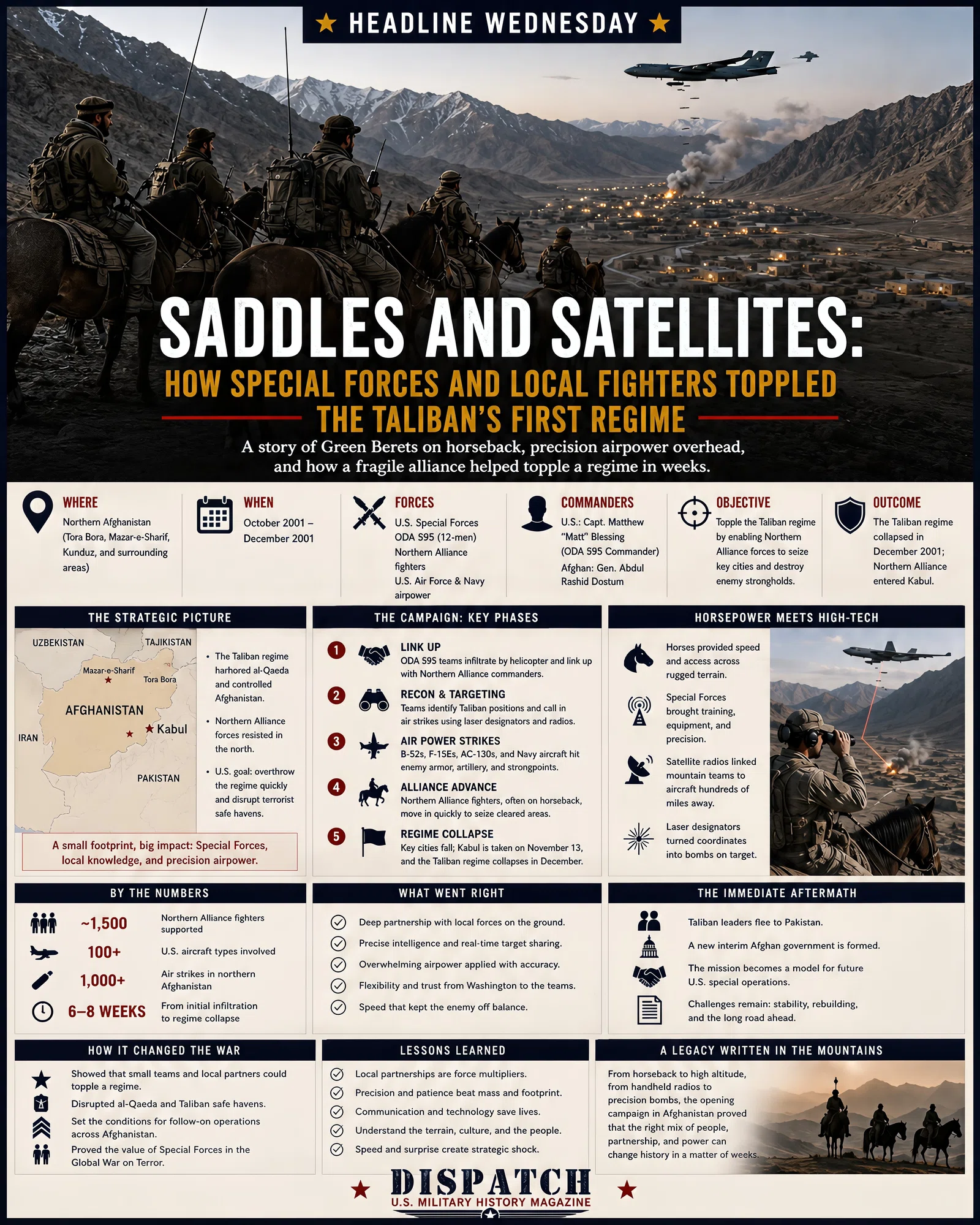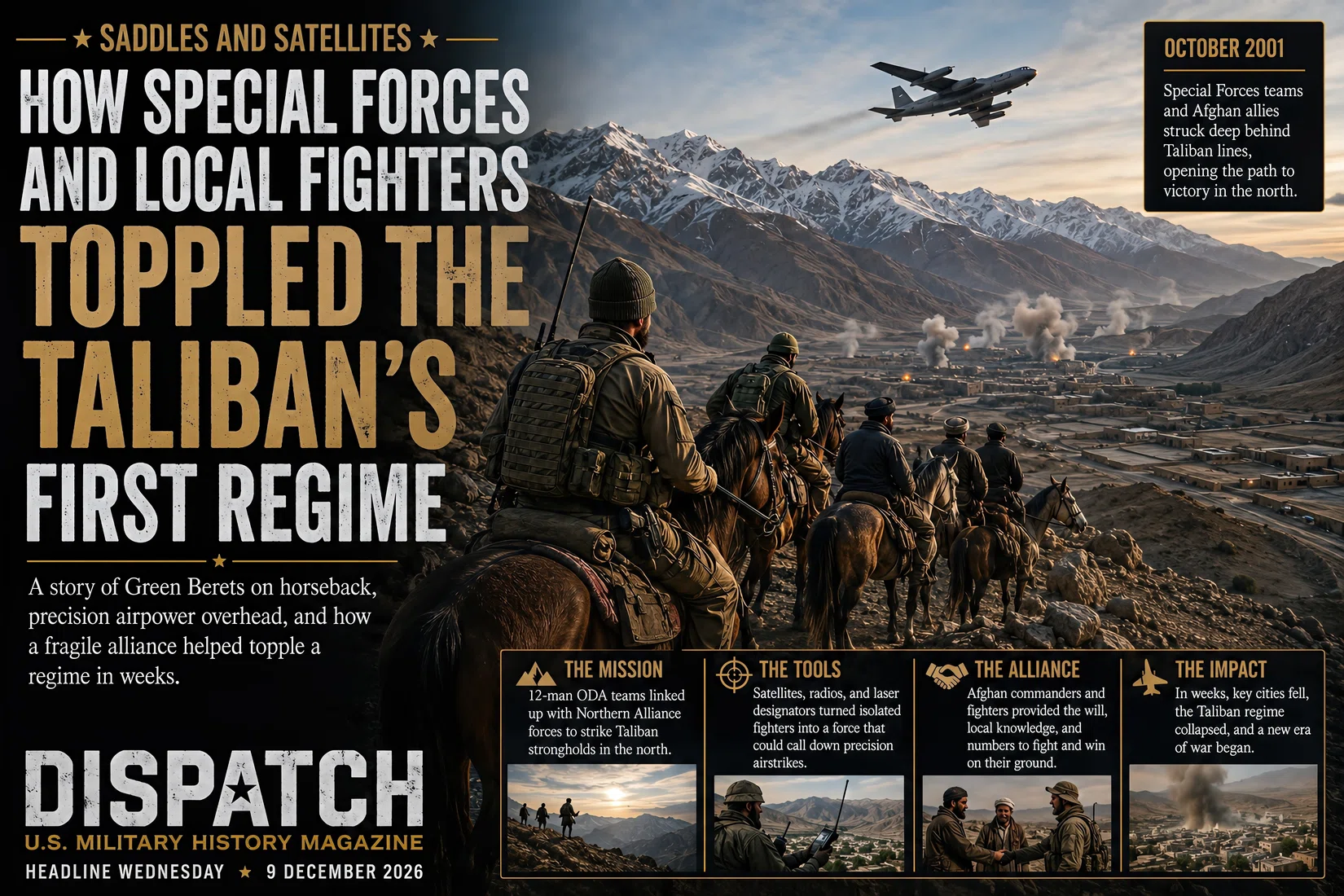
Cold Mountains, Hot Targets
The horses move in single file along a narrow ridge, their hooves knocking loose stones that rattle into the darkness below. The men in the saddles are not seasoned cavalry troopers but Special Forces operators from a twelve-man detachment known as ODA 595, riding borrowed ponies in the broken hills of northern Afghanistan in October 2001. Their saddlebags carry satellite radios, laser designators, and extra batteries instead of sabers or lances. Above the jagged skyline, they know heavy bombers are orbiting, invisible in the thin, cold night air. The Taliban and their armored vehicles sit on the plains beyond, not yet aware that a handful of Americans and their Northern Alliance partners are watching, listening, and preparing to call down steel.
The air smells of dust, sweat, and the faint tang of burned diesel drifting from enemy positions miles away. At this altitude, every breath feels sharp in the lungs, and every movement in the saddle sends a reminder that these are rugged, half-wild horses, not trained mounts from a stateside stable. The Green Berets ride with Afghan commanders who know every fold and crease of the ground but carry their own scars from years of civil war. Short phrases pass back and forth through interpreters, mixing English and Dari, radio brevity codes and rough hand gestures. A few miles away, Taliban positions ring key towns, backed by tanks and artillery pieces captured during earlier fights.
Down in a rocky depression, a team member unfolds a map lit only by a red-lensed flashlight, comparing the contours to what he can see in the faint starlight and through night-vision goggles. Another man adjusts a satellite radio, angling the antenna to catch a clean signal, while a third checks the settings on a laser designator that will mark targets the enemy cannot even see. One misplaced coordinate, one wrong ridge line, and the bombs could fall on the wrong cluster of lights. Tonight’s mission is only one patrol in a campaign that has barely begun, but the combination of saddles and satellites on this ridge hints at something larger taking shape: a new way of fighting a very old kind of war.
If These Valleys Stay Taliban
To understand what is at stake on that cold ridge, you have to widen the map beyond a single Afghan valley. It is October 2001, just weeks after the attacks of September 11, and the Taliban regime still controls most of Afghanistan’s major cities and highway routes. Those cities shelter training camps, safe houses, and leadership circles that have offered sanctuary to the network behind the attacks. The mission given to the small Special Forces teams in the country’s north is not just to survive on horseback. Their job is to help local anti-Taliban forces seize ground, topple a government, and shatter the idea that Afghanistan can remain a safe haven for global terror planners.
In the north, that means partnering with the Northern Alliance, a loose coalition of commanders and factions that has been fighting the Taliban for years. Men like Abdul Rashid Dostum bring cavalry-style maneuver, local intelligence, and thousands of fighters who know every pass, village, and culvert on the road networks. What they have not had is the ability to reach out and touch Taliban armor, artillery, and bunkers with precision from the sky. The twelve-man teams linking up with them carry the radios and the training to do exactly that, tying Afghan fighters on horseback to bombers and strike aircraft cruising far above the cloud deck. If this marriage works, isolated pockets of resistance can suddenly punch far above their weight.
Failure would come with its own costs. If the Northern Alliance collapses in the north, or if these early raids falter, the Taliban could consolidate, dig in, and force a much larger, more drawn-out ground campaign later. The United States would lose the chance to show it can respond quickly and effectively with a light footprint, relying on partners rather than divisions. Inside Afghanistan, that would send a powerful signal to commanders who are watching to see which side has real momentum. Abroad, it would raise doubts about whether the United States can translate technology and elite units into political results on unforgiving terrain. The riders moving through the dark, then, are not just scouting targets. They are testing whether a small team with horses under them and satellites above them can help change the direction of a war in its opening weeks.
From Briefings to Broken Ground
The story of ODA 595 in the saddle began far from Afghan valleys, in briefings and planning rooms where early options after September 11 were weighed. Within days of the attacks, the United States leadership faced a grim map: a landlocked country ruled by the Taliban, hostile to Western forces, and already a graveyard of foreign interventions. The choice was made to avoid a massive conventional invasion at the outset and instead send in small teams from Special Forces and intelligence agencies to work with Afghan factions already fighting the regime. For the 5th Special Forces Group, long focused on the Middle East and Central Asia, years of regional study and language training suddenly moved from the classroom to the top of the tasking list. Detachments like ODA 595 were selected, briefed, and given a mission that sounded simple on paper and daunting on the ground: link up with Northern Alliance commanders, help them survive, and then help them win.
By mid-October 2001, the air campaign over Afghanistan was underway, targeting known training camps, air defenses, and Taliban positions. Still, air strikes alone could not topple a government or seize key cities like Mazar-e-Sharif and Kabul. The missing link was someone on the ground who could talk to Afghan leaders, understand their needs, and put bombs where they mattered most. That meant loading small teams into helicopters, flying them over high mountain ranges in the dark, and inserting them into rough landing zones where the enemy still held the advantage in heavy weapons. ODA 595, carrying just a handful of Americans and their gear, came in this way, stepping off into thin air, rocky soil, and a political landscape stitched together by rivalries older than their unit patches.
Initial meetings with Northern Alliance commanders were as much about trust as tactics. The Americans brought radios, satellite imagery, and access to long-range bombers. The Afghans brought fighters who had bled for years and knew where the Taliban tanks were dug in, which villages were sympathetic, and which passes could be ambushed. Agreements were struck over tea and maps, with interpreters carefully turning promises and warnings into shared plans. The terrain and the limited road network made trucks and armored vehicles scarce and vulnerable, so the Northern Alliance leaned on what they had in abundance: horses and hardy riders. If the Americans wanted to move with their partners and see the front for themselves, they would have to trade Humvees for saddles and accept that the route to the next objective might be a goat track along a cliff rather than a marked road on a map.
Bombs, Hooves, and a Crumbling Front
Once the partnerships were set and the teams were in place, the fight began to change shape day by day. Taliban forces still held key ridgelines and valley mouths with tanks, armored personnel carriers, and artillery captured from earlier conflicts. From those positions they could shell villages, block advances, and threaten any Northern Alliance push toward major cities. The Americans needed to see those positions up close to bring in precision air strikes, but the only way to do it at the right time and place was to ride with the Afghan fighters themselves. That meant long days in the saddle, moving across broken ground, climbing and descending steep slopes as dust clouds from distant shell impacts marked the front. Operators from ODA 595 learned quickly how to ride with one hand on the reins and the other on a radio handset or binoculars, scanning for muzzle flashes and vehicle silhouettes.
When contact came, it often started with artillery or rocket fire erupting from Taliban lines, sending dust geysers and shrapnel through advancing horsemen. Afghan riders would fan out or drop into shallow cover, while the Green Berets looked for stable vantage points where they could see both the enemy and the friendlies. A single accurate grid coordinate, relayed over a satellite radio and confirmed with a laser mark when possible, could bring a bomber overhead onto the right cluster of vehicles or trench line. Minutes later, the sky would roar as bombs fell, turning carefully prepared Taliban positions into smoking craters. Afghan fighters watched as enemy armor that had dominated local battles for years was suddenly rendered useless in a single strike. The psychological effect was as important as the physical destruction, convincing hesitant commanders and fighters that this new partnership could actually break the stalemate.
The advances that followed rarely looked like neat arrows on a map. Some days, progress was measured in a few ridges taken and a town’s outskirts reached before nightfall. Other days, a successful series of strikes and coordinated assaults opened the way for rapid movement across open ground that had been suicidal to cross only a week earlier. In several key engagements, Afghan cavalry charges supported by airpower rolled over Taliban positions that had been considered secure, the thunder of hooves and the crack of small arms fire mixing with the distant rumble of strike aircraft. On the ground, the Americans stayed close enough to keep eyes on targets and friendlies, yet far enough from the front edge to maintain situational awareness and keep communications functioning.
As roads and passes fell into Northern Alliance hands, the pressure on Taliban garrisons mounted. Supply routes grew fragile, morale began to crack, and local commanders started weighing the risks of staying loyal against the option of slipping away before the next bombardment. The same radios that had once been used to call in isolated air strikes now helped coordinate broader pushes, linking separated Afghan formations into something closer to a coherent offensive. Towns that had been out of reach for years suddenly became realistic objectives as armored forces were destroyed or forced to withdraw. In the space of weeks, the combination of riders on the ground and aircraft overhead started to peel open the northern front, setting the stage for the capture of major cities and the wider unraveling of the Taliban’s first regime.
Turning Points in Dust and Smoke
What made the difference on those ridges and plains was not a single dramatic cavalry charge or one perfectly placed bomb, but the way several advantages came together at once. The American teams brought the ability to see the battlefield in layers: what their own eyes and optics showed, what satellite imagery suggested, and what aircraft overhead could confirm. The Afghan commanders added intimate knowledge of ground that did not look like much on a printed map but mattered enormously in practice: a narrow defile that channeled tanks, a dried riverbed that shielded a flanking move, a village whose loyalties would tilt based on who showed strength first. When the two perspectives aligned, artillery batteries and armored vehicles that had once been blunt instruments for the Taliban suddenly became exposed targets. The first time a dug-in position vanished under a string of bombs called in from horseback, everyone watching understood the balance of power had shifted.
Momentum was another turning factor. In the early days, every advance was an experiment, every successful strike a proof of concept that had to be earned again the next day. But as Taliban units saw their armored columns shattered and their fixed positions rolled up, rumors and radio traffic began to tell their own story. Commanders who had once trusted their tanks and guns to anchor a defense now had to reckon with the fact that those assets drew fire instead of providing security. Some chose to fall back before the next bombardment, others bargained, and a few simply melted away with their best fighters. That erosion of confidence mattered as much as any destroyed vehicle. For Northern Alliance fighters, the same events had the opposite effect. They saw long-frustrated offensives suddenly crack through, watched key junctions fall, and began to believe that cities which had been out of reach for years might now be taken.
Leadership decisions on both sides also played a role. Afghan commanders willing to move quickly and accept the risks of advancing under intermittent fire exploited gaps that opened in Taliban lines. The American detachment leaders, for their part, had to balance getting close enough to guide airpower accurately with staying alive and maintaining communications. They chose again and again to ride forward with their partners, accepting the discomfort and danger of the front to keep the link between horsemen and bombers intact. On the Taliban side, the choice to mass forces around certain strongpoints made tactical sense in older fights but turned disastrous when those clusters became magnets for precision strikes. In the end, what turned the campaign was less a single dramatic moment than the steady accumulation of days when saddles, radios, and local alliances combined to make each Taliban position more vulnerable than the last.
A Regime Falls, a Model Endures
The immediate results of this partnership played out quickly on the map. As Taliban positions crumbled in the north, key cities such as Mazar-e-Sharif fell into Northern Alliance hands, ripping open the regime’s control over major routes and supply lines. The loss of these hubs sent shockwaves through the rest of the country, triggering defections, retreats, and hurried attempts to regroup farther south and east. Within weeks, the capital, Kabul, slipped from Taliban control as their fighters abandoned checkpoints and government buildings rather than face a combination of advancing ground forces and relentless air strikes. What had begun with a handful of Special Forces teams linking up with scattered Afghan allies ended with a regime that had sheltered the planners of September 11 pushed out of the country’s major cities.
Yet the larger story did not end with the fall of flags over government compounds. The campaign in northern Afghanistan became a case study in what a small American footprint, paired with local fighters and powerful air support, could achieve in a short time. Military planners and officers took note of how quickly armored units and fixed defenses had been neutralized when targeted by observers on the ground with the right tools. Training pipelines, doctrine discussions, and future plans all absorbed lessons from the months when Green Berets rode with Afghan horsemen, scribbled coordinates under fire, and watched bombs reshape battlefields. In later conflicts and theaters, leaders would reach for similar models, hoping to combine elite teams and partners on the ground with distant strike power to achieve outsized effects.
For students of military history and for veterans who lived the early days in Afghanistan, the image of Americans on horseback calling in strikes remains more than a curiosity. It captures a moment when old and new forms of war collided: leather saddles and steel tank hulls, tribal alliances and satellite links, local grievances and global politics. The long years of conflict that followed would show how incomplete any initial success can be when deeper political and social problems remain unresolved. But the opening weeks still matter, both for what they accomplished and for the questions they raised. When we look back at ODA 595 and their Afghan partners riding toward enemy lines, we see a reminder that technology alone never wins a war, and that even the most advanced tools still depend on small groups of people willing to go forward into the cold, dust, and uncertainty at the edge of the map.