Headline Wednesday · December 30, 2026
248 Populated Entries
Engagements and campaigns examined through objectives, terrain, forces, outcomes, and consequences.
Battles & Campaigns
Every result opens a permanent subject record with its reference context and connected Dispatch coverage. Filter by record type, editorial collection, or a word in the entry.
248 entries found.
After years as a United States territory and a key overseas outpost, Hawaii formally entered the Union as the fiftieth state on August 21st, 1959. Long before that date, the islands had already become central to American strategy in the Pacific, from the attack on Pearl Harbor to the vast network of airfields and naval bases that supported World War II operations.
The black volcanic sand of Iwo Jima offered no cover, only shallow shell holes and the hulks of stalled tanks. Late on February 23, 1945, Marines of the 21st Regiment lay pinned down, staring across a short stretch of open ground that felt a mile wide. Ahead of them, a maze of reinforced concrete pillboxes spat machine-gun fire in crossing patterns, every burst chewing fresh craters into the sand.
The draw is narrow and steep, its sides scoured by months of shellfire and rain. At the bottom, the earth is churned to powder. Above it, hidden in the scrub and broken stone near Cisterna di Littoria, German machine guns wait for anything that moves. Private James Henry Mills can hear them before he sees them—the clatter of automatic fire, the sharper crack of rifles, the dull thump of grenades exploding somewhere ahead.
The ground in front of Sugar Loaf Hill is already chewed into mud and craters when Corporal James Lewis Day crawls forward to look for cover. It is May 1945 on Okinawa, and the Marines trying to cross this open killing ground are being shredded by Japanese mortar and artillery fire. The air is thick with pulverized coral dust. Fragments of shattered ammunition boxes and discarded packs lie where men dropped them running for their lives.
The ridge near San Jose Hacienda rose steep and stubborn out of the jungle, a wall of earth and rock that dominated the valley floor. Somewhere up there, hidden in spider holes—small, camouflaged fighting pits—and pillboxes, Japanese soldiers waited behind interlocking bands of machine-gun fire. To reach the crest, Company I of the 160th Infantry Regiment had only one narrow approach, a trail that funneled men into a killing zone. Staff Sergeant John C.
In a televised address during the Vietnam War, President Lyndon B. Johnson announced a partial halt to the bombing of North Vietnam and, in a stunning closing, declared that he would not seek nor accept his party’s nomination for another term. The speech came in the wake of the Tet Offensive, a widespread enemy campaign that had shaken public confidence despite heavy Communist losses.
The black volcanic sand of Iwo Jima offered no cover, only shallow shell holes and jagged rock. On the morning of March 9, 1945, Platoon Sergeant Joseph R. Julian lay there with the rest of his company, pressed into the ash while enemy fire tore long furrows across the slope. Ahead of them, a line of Japanese trenches and pillboxes guarded a critical rise. Machine guns hammered from narrow firing slits.
On the Korean peninsula, three years of brutal fighting ended with signatures on a document at Panmunjom, not with a victory parade. Delegates representing the United Nations Command, North Korea, and China agreed to a cease-fire that froze front lines near where they had started, around the Thirty-Eighth Parallel. The agreement established the Demilitarized Zone, a fortified strip of land that remains one of the most heavily guarded borders in the world.
By late 1943, Allied planners focused on neutralizing the strong Japanese base at Rabaul without storming it head-on.
Night still clung to the sea when the submarine slid in among the enemy ships. On the open bridge, spray cold against his face, Commander Lawson “Red” Ramage watched the black shapes of freighters and tankers loom out of the darkness. Their wakes glowed faintly, white scars across a heaving Pacific, while bursts of star shell and tracer fire clawed at the sky. Somewhere off Taiwan, a Japanese convoy was trying to slip through before dawn. Ramage intended to stop it.
In the late summer of the Civil War, Confederate General Robert E.
Medal of Honor, U.S. Army, World War II
The October 1944 landings restored a major Allied foothold in the Philippines. Fleet battles protected that foothold, but Japanese reinforcement and the struggle for routes toward Ormoc made the ground campaign longer and more difficult than the beach assault alone suggests.
Read Entry →Battle · 2026-11-17Longstreet invests KnoxvilleIn the late months of the Civil War, East Tennessee became a contested region where loyalty ran sharply divided.
The return to Luzon combined amphibious landings, the destruction and liberation of Manila, the recovery of the bay approaches and months of fighting in mountain defenses. Capturing the capital did not end the island campaign.
Read Entry →Event · 2026-07-07MacArthur Named United Nations Commander in KoreaLess than three weeks after North Korean forces crossed the 38th parallel, President Harry Truman moved to unify the international response under a single commander. On July 8th, 1950, General Douglas MacArthur, already commanding United States forces in the Far East, was designated to lead United Nations military operations in Korea.
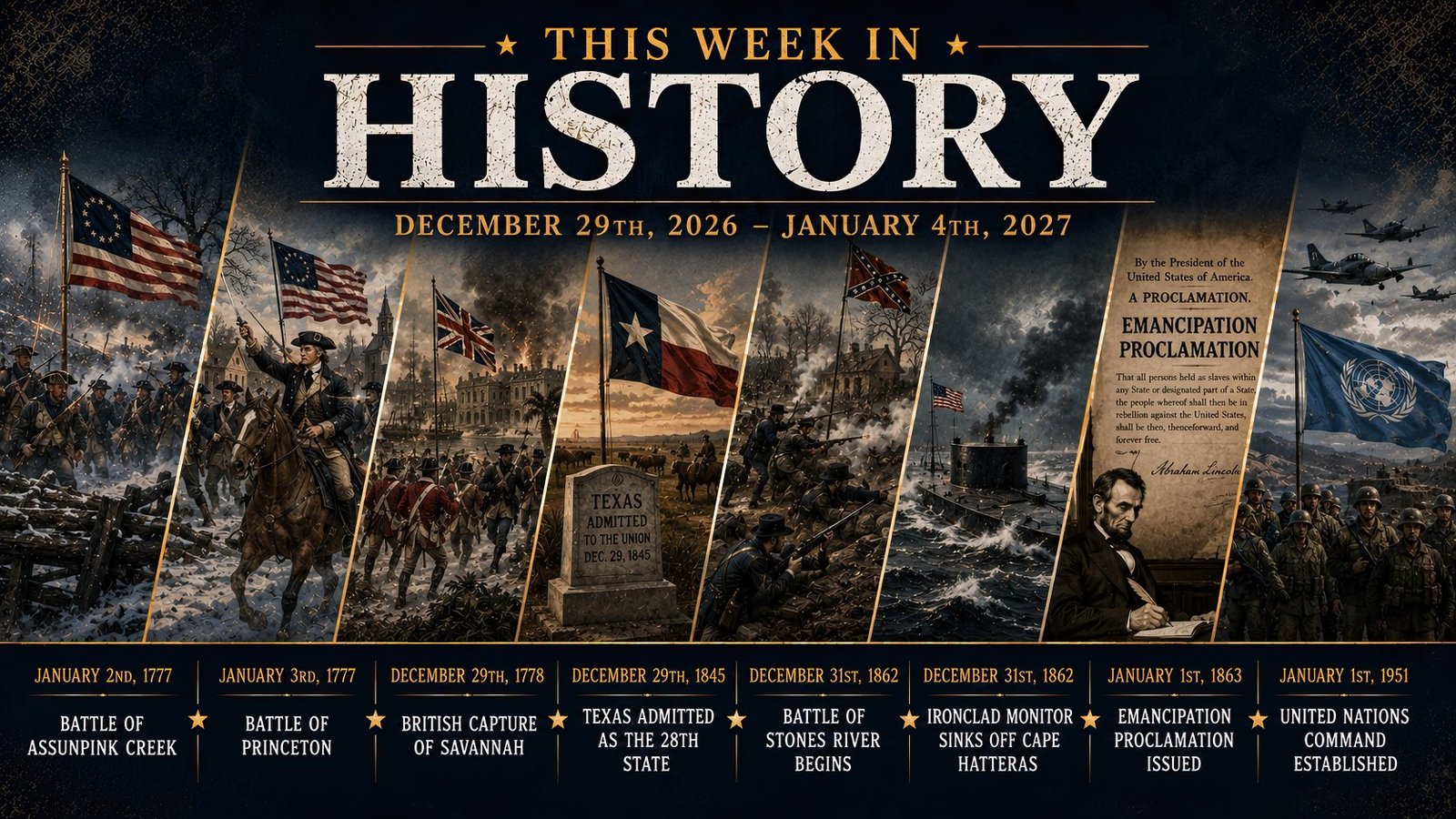
The momentum of Japan’s early offensives reached the Philippine capital on January 2nd, 1942, when Japanese troops entered Manila.
One year later, on September 28th, 1781, a combined American and French army moved out from around Williamsburg and advanced toward British positions at Yorktown, Virginia.
In the final year of World War I, the thick tangle of Belleau Wood in France became the proving ground for American forces newly committed to the Western Front. Over weeks of grinding combat alongside French units, Marines from the Fifth and Sixth regiments launched repeated attacks against German machine-gun nests and dugouts that commanded open wheat fields.
Snow hangs heavy in the Ardennes forest, muting sound until a rifle cracks and splinters bark from a nearby tree. Private First Class Melvin Earl Biddle lies pressed into the freezing ground, the lead scout for an American parachute infantry company feeling every heartbeat echo in the stock of his rifle. Somewhere ahead, beyond the dark trunks and tangled undergrowth, German snipers have halted his company’s advance on the road between the villages of Soy and Hotton.
In Europe, the fortified city of Metz had long been viewed as a tough nut to crack, with layers of forts dating back to earlier German rule.
As the First World War neared its close, American forces in France were still locked in brutal combat.
A story of exhausted infantry, deep woods, and a final push that helped break Germany’s will to fight.
On September 26th, 1918, the American Expeditionary Forces launched the Meuse-Argonne Offensive, the largest United States campaign of the First World War and one of the biggest in the nation’s military history.
Related Dispatch
These current Dispatch articles connect directly to records in the Battles & Campaigns directory.