Headline Wednesday · December 16, 2026
210 Populated Entries
Organizations, structures, lineages, roles, and operational histories.
Units & Formations
Every result opens a permanent subject record with its reference context and connected Dispatch coverage. Filter by record type, editorial collection, or a word in the entry.
210 entries found.
A story of a nearly lost beach, scattered initiative, and how small groups clawed back the chance to win a war.
As the twentieth century neared its end, the United States and its NATO allies faced a different kind of crisis in the Balkans. Tensions and violence in Kosovo, including the expulsion and abuse of ethnic Albanian civilians, raised alarms across Europe and North America. Diplomatic efforts failed to produce a settlement, and on March 24th, 1999, NATO launched Operation Allied Force, an air campaign aimed at pressuring the Yugoslav government to halt its operations and withdraw forces.
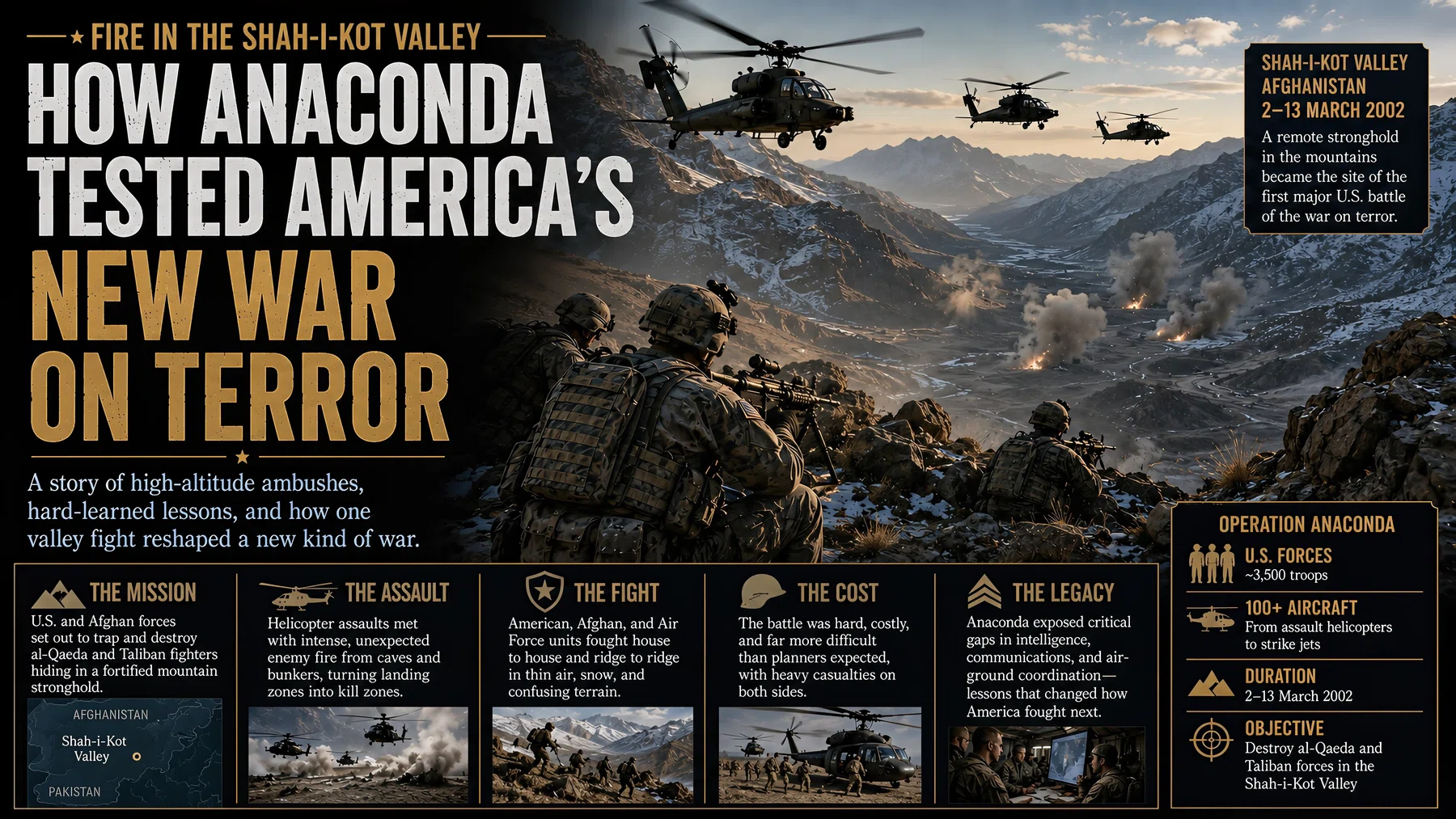
Just over a decade after Desert Storm, United States forces found themselves fighting a very different kind of war in Afghanistan. On March 2nd, 2002, Operation Anaconda began in the Shah-i-Kot Valley and surrounding high ground, as United States and allied troops attempted to encircle and destroy concentrations of al-Qaeda and Taliban fighters. The plan called for Afghan and coalition units to block escape routes while airlifted infantry swept through rugged terrain at high altitude.
By early 1962, American involvement in Vietnam was still officially described in terms of advisors, but the character of that involvement was already changing. On January 12th, 1962, Operation Chopper saw United States Army helicopters lift South Vietnamese troops into action against insurgent forces near Saigon. The mission may have seemed modest at the time, but it showcased the emerging doctrine of air mobility, using rotary-wing aircraft to move infantry quickly over difficult terrain.
On the far side of the world, the same date saw the United States First Army launch a long-awaited breakout from the Normandy hedgerows. After weeks of slow, attritional fighting among the bocage lanes, Operation Cobra aimed to shatter German defenses west of Saint-Lô with a massive aerial bombardment followed by concentrated armored and infantry thrusts.
On the night of February 23rd into February 24th, 1991, after weeks of intensive air strikes, coalition ground forces launched the main land offensive of Operation Desert Storm. U.S. Marine divisions attacked into Kuwait from the south, while U.S. Army armored corps and allied units executed a broad “left hook” across the desert into western Iraq to outflank Iraqi forces.
Two years after Midway, the United States Army Air Forces were striking deep into Axis-held Europe, and June brought another innovation. On June 2nd, 1944, heavy bombers based in Britain launched the first “shuttle bombing” mission of what became known as Operation Frantic. Instead of returning to their original airfields, the bombers hit rail yards and other targets in Eastern Europe and then continued on to land at air bases in the Soviet Union.
In the early hours of July 10th, 1943, waves of Allied troops, including the United States Seventh Army and the British Eighth Army, began landing along the southern coast of Sicily in Operation Husky. Rough seas scattered many landing craft and airborne units, turning the opening hours into a confused struggle to get ashore and organize.
Nearly a decade after the attacks of September 11th, American intelligence and special operations forces converged on a compound in Abbottabad, Pakistan, believed to shelter al-Qaeda’s leader. In a carefully rehearsed nighttime raid, United States Navy special operators flew in by helicopter, breached the walls, and fought their way through the building, killing Osama bin Laden and collecting valuable documents and electronic media.
As the Vietnam conflict deepened, American leaders turned to the air campaign as a tool of pressure and signal. On March 2nd, 1965, the United States began Operation Rolling Thunder, a sustained bombing effort against North Vietnam that was intended to deter aggression, reduce support to Viet Cong forces in the South, and reassure allies of American resolve.
After months of retreat and uncertainty in the Korean War, the Eighth Army under Lieutenant General Matthew Ridgway prepared to strike back. On January 25th, 1951, United Nations forces launched Operation Thunderbolt, an offensive aimed at pushing north from positions south of Seoul and testing the strength of Chinese and North Korean units.
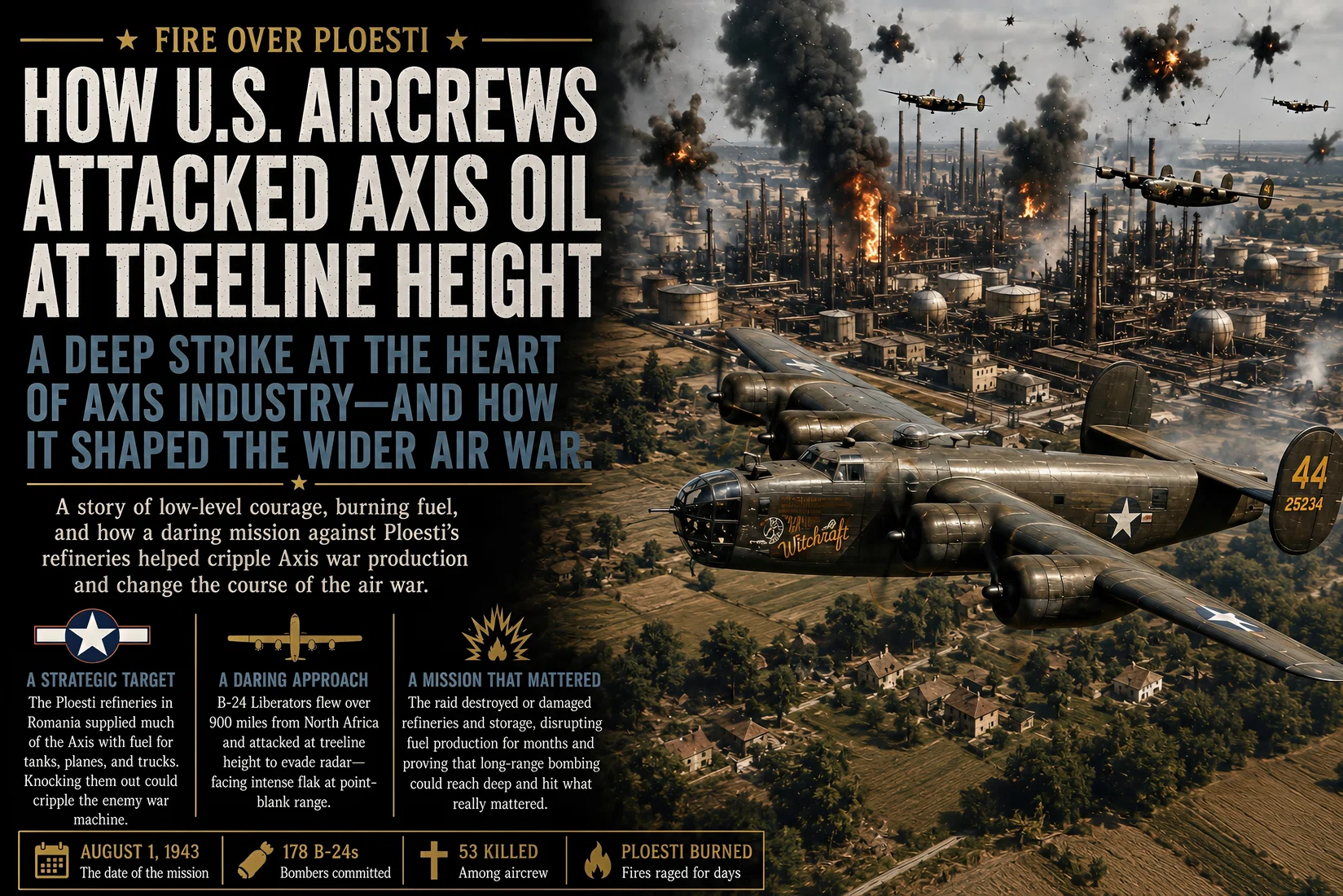
The summer of 1943 found the United States Army Air Forces looking for ways to hit the Axis where it hurt most: oil. From airfields in North Africa, more than one hundred heavy bombers took off for a long-range, low-level mission against refineries around Ploesti, Romania, a key supplier of fuel to Germany. Flying at treetop height to evade radar and fighters, the crews encountered dense flak, smoke, and confusion around the target.
In the second year of the Korean War, United Nations forces under Lieutenant General Matthew Ridgway were pushing north in a series of offensives to reclaim ground lost during earlier Communist advances. As part of this effort, planners designed an airborne operation to cut off retreating North Korean and Chinese units and support the drive across the Han River.
By March 1945, Allied armies had reached the last major natural barrier in western Germany, the River Rhine. In coordination with a large river crossing called Operation Plunder, planners organized an ambitious airborne assault code-named Operation Varsity, using British and American paratroopers and glider-borne troops.
Before dawn on Leyte, the world was reduced to shadows, muzzle flashes, and the flat crack of Japanese rifles. Company A of the 382nd Infantry had clawed its way to the edge of the enemy‑held Buri airstrip, then stalled. Out in front, less than a hundred yards away, Japanese soldiers were dug into bomb craters and a drainage ditch, their machine guns perfectly sighted on every patch of open ground. Anyone who tried to move was met with bursts of fire that snapped past at chest height.
By February 1945, much of Pearl Harbor had returned to the business of war. Battleships and carriers came and went; convoys formed up and headed west toward Iwo Jima and Okinawa. But in a side channel called West Loch, the harbor still hid a graveyard. Months earlier, a chain of explosions had torn through a cluster of tank landing ships loading ammunition for the Pacific campaign.
Decades later, the United States stood on the edge of another conflict as patrols clashed along the disputed border with Mexico. On May 11th, 1846, President James K. Polk addressed Congress and described these incidents as Mexican forces invading American soil and spilling American blood. His message framed the fighting not as a limited frontier skirmish but as a clear act of aggression, urging Congress to recognize that a state of war already existed.
In the summer of the Revolutionary crisis, King George III issued a formal proclamation declaring that the American colonies were in open and avowed rebellion. From London’s point of view, this order framed the fighting around Boston and the other flashpoints not as a political dispute but as treason to be suppressed. For colonial leaders who had still hoped for compromise within the empire, the document made clear that the Crown now saw them as enemies, not petitioning subjects.
In the winter of 1776, the Continental Army still clung to a shaky foothold around Boston, and many colonists remained uncertain whether they wanted a full break with Britain. The publication of Thomas Paine’s pamphlet “Common Sense” on January 10th, 1776 poured fuel on the growing fire for independence. Written in direct, forceful language, it argued that a small island should not rule a vast continent and that monarchy itself was an insult to natural rights.
A story of a shrinking beachhead, exhausted troops, and how their stand kept South Korea from collapsing in 1950.
In the middle years of the Vietnam War, American leaders sought ways to weaken the enemy’s ability to move troops and supplies down long, fragile lines of communication. On June 29th, 1966, U.S. Air Force and Navy aircraft carried out major attacks on petroleum storage facilities near Hanoi and Haiphong, striking targets that had previously been off-limits or only lightly hit.
The first year of the Korean War saw dramatic swings, from the near collapse of South Korean defenses to daring landings and then to sudden counterattacks by Chinese forces. By early 1951, United Nations units, including large American formations, had regrouped under new leadership and planned an offensive to regain the initiative.
When Congress passed legislation on July 11th, 1798 to create a Marine Corps under the Department of the Navy, it gave the new republic a permanent naval infantry force. The Continental Marines of the Revolution had been disbanded after the war, but the growing threat of conflict at sea with European powers pushed leaders to rebuild that capability.
In June 1918, United States Marines and soldiers of the American Expeditionary Forces were committed to stopping a German drive toward Paris near a patch of forest called Belleau Wood. On June 11th, 1918, Marine units launched renewed assaults into the dense, shell-torn woods after earlier attacks had been thrown back with heavy losses.
Related Dispatch
These current Dispatch articles connect directly to records in the Units & Formations directory.