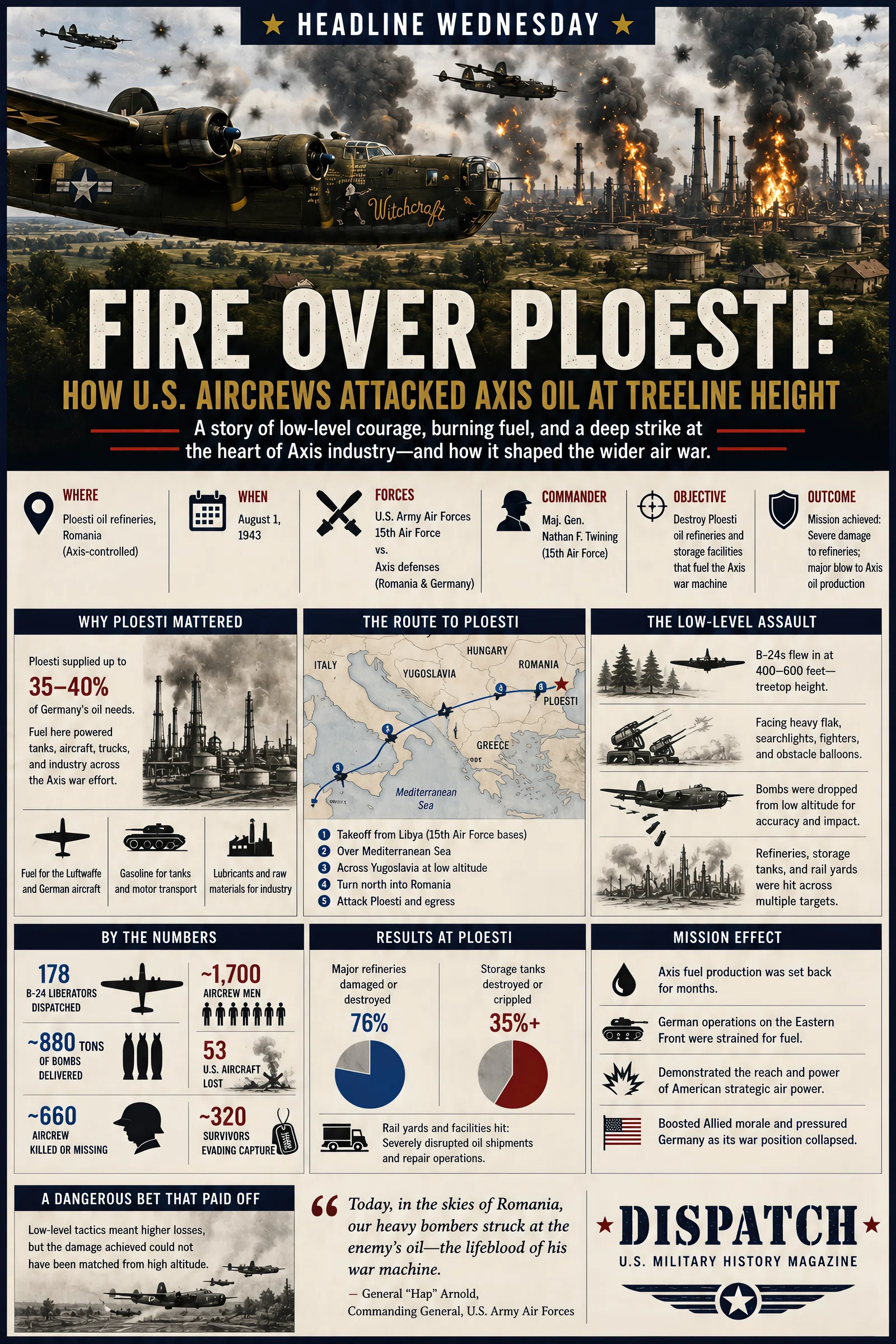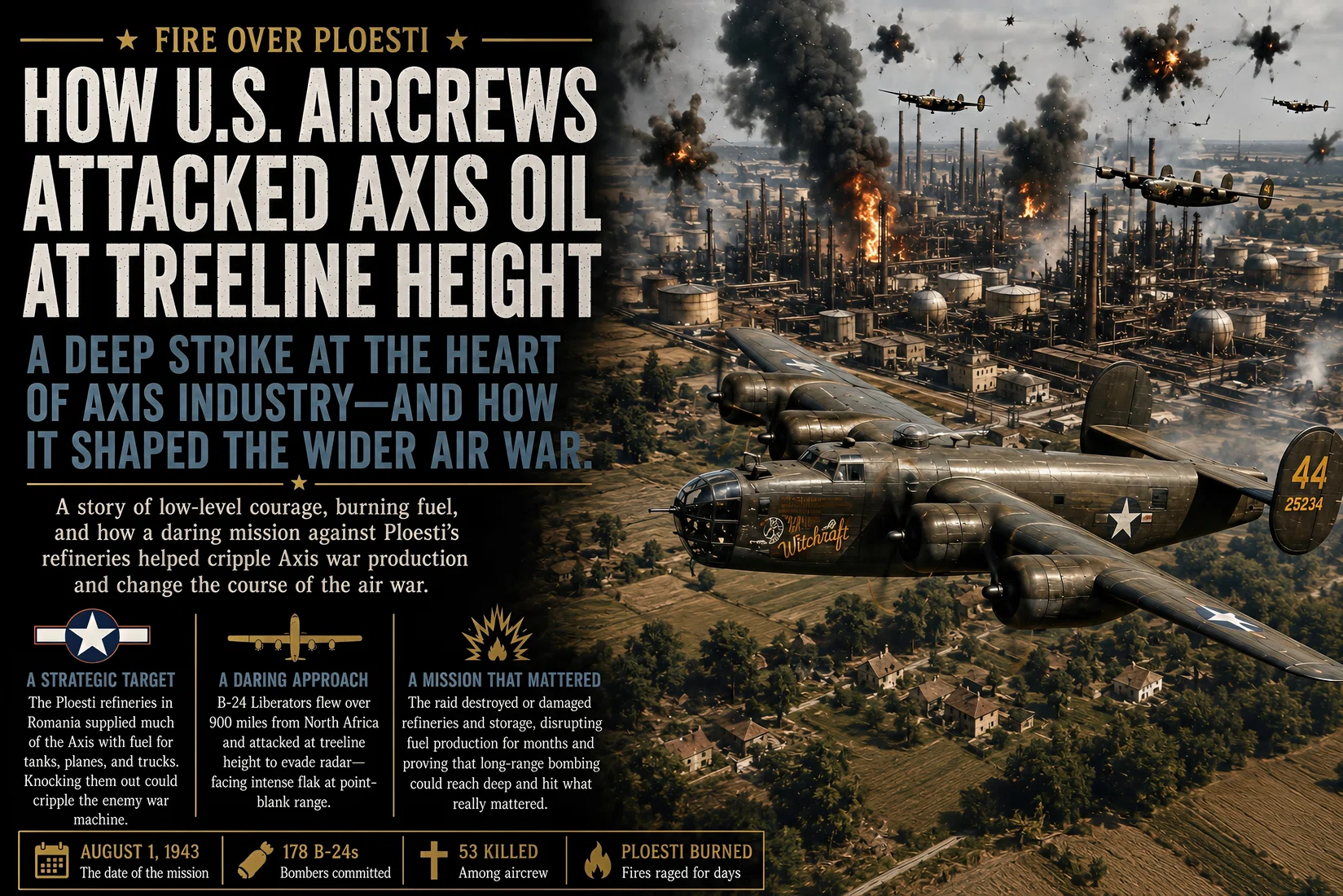
Smoke, Stacks, and Treeline Flight
The first thing the bomber crews see is smoke—thick, oily columns already clawing into the Romanian sky. Below them, at what feels like arm’s reach, the wheat fields and farmhouses outside Ploesti blur past at more than 200 miles an hour. These are heavy B-24 Liberators, long-range bombers designed to fly high and straight, but today they are thundering in at treetop height, so low that gunners can pick out individual faces in farmyards and flak gunners can aim almost by instinct. The target ahead is a maze of refineries, storage tanks, and rail yards feeding the Axis war machine with fuel it cannot easily replace.
Inside each aircraft, the air is hot and tense. Sweat stings eyes, oxygen masks hang unused, and intercom lines crackle with course corrections and warnings. The bomber stream is already stretched and broken by the long flight from North Africa, a curving approach meant to deceive German defenses that has demanded perfect navigation over hostile territory. Now, as the first groups drop to attack altitude, navigators peer through dust-smeared Plexiglas for landmarks that look nothing like they did on the briefing maps. Smoke from earlier strikes and local industry cloaks entire neighborhoods, turning streets and rail lines into guesswork.
Then the flak starts to build. Black puffs and orange flashes snap into being at the same level as the bombers, not far below them as in a typical high-altitude raid. Some guns are so close that crews can see the recoil of each shot before the shells burst around them. The Liberators rock and shudder, metal ringing with each near miss, yet the formation presses on, wings almost level with church steeples and smokestacks. In seconds, the sky over Ploesti becomes a twisted panorama of flame, steel, and screaming engines. This is only the first run into the refineries, but already it feels like a lifetime—and the real test of the mission is only beginning.
Fuel for the Axis War Machine
For the Axis, the oil fields and refineries around Ploesti are more than just industrial targets—they are a lifeline. Romanian production feeds German armies from the Eastern Front to the Mediterranean, supplying gasoline for tanks and trucks, aviation fuel for fighters and bombers, and lubricants for factories and shipyards. Allied planners know the rough proportions even if they lack perfect numbers: knock out Ploesti and you do not simply damage a few plants; you squeeze the entire logistics chain that keeps German campaigns moving. The refineries here have already survived earlier high-altitude raids and local defenses have grown stronger and more concentrated in response.
On the Allied side, the stakes are both strategic and political. American air doctrine has promised that strategic bombing can reach into the enemy’s heart and cripple its capacity to wage war. A deep strike from North Africa against heavily defended refineries in Romania is a test of that theory and a demonstration of commitment to the larger Allied strategy to grind down Germany’s war economy. Thousands of aircrew lives, hundreds of millions of dollars in aircraft and fuel, and the credibility of long-range bombing itself are all part of the wager. If the mission succeeds, it will send a powerful signal about what American air power can do. If it fails, it will be remembered as a costly gamble with little to show for it.
Down at crew level, the stakes are simpler and more immediate. Each bomber holds ten men who understand the odds of making it home from a mission like this. They have flown long over water, across enemy territory, and into a pocket of airspace mapped out in pre-war engineering drawings and reconnaissance photos, now defended by one of the densest flak belts in Europe. Romanian and German gunners have prepared kill zones, ringed the refineries with guns and balloons, and drilled for low-level attacks. As the first bombs tumble toward cracking towers and storage tanks, both sides know that what happens over Ploesti today will echo far beyond the city’s industrial outskirts—into fuel depots, armored spearheads, and the wider course of the war.
Plans Drawn in Desert Dust
Long before the bombers skim the fields around Ploesti, the idea of striking Axis oil has been sketched on maps in hot, cramped briefing rooms across North Africa. By mid-1943, Allied ground forces have fought their way through Tunisia and are establishing airfields in the desert that can support long-range operations. Intelligence officers and planners keep circling the same problem: as long as the Axis can draw fuel from Romanian refineries, German armies will keep finding ways to move tanks, trucks, and aircraft to the front. Earlier high-altitude raids have stung Ploesti, but production has bounced back. A single deep strike from new bases in North Africa, using heavy bombers at low level, promises a harder blow.
The aircraft chosen for the job are B-24 Liberators, long-legged bombers with high aspect wings and spacious bomb bays. They are not designed for hedge-hopping, but their range and payload make them the only practical tools for a daylight raid this deep into Axis-held territory. Crews and ground mechanics modify them for the mission with extra fuel tanks, survival gear, and carefully balanced bomb loads. Every pound of fuel means more miles and less margin for error. Once they launch from Libya, they will have to follow the plan almost to the minute to reach Romania, attack, and still have enough fuel to limp back.
Training for the mission is intense and focused. Out in the desert, aircrews practice low-level formation flying, hurtling just above the ground in tight groups, learning to judge clearance by the feel in their stomachs and the blur at the edge of their vision. Makeshift target ranges stand in for refinery complexes, with crews rehearsing approach routes, turns, and attack runs until they can fly the sequences from memory. Navigation teams learn a complicated path that bends around major defenses, skirts neutral or sensitive borders, and depends on identifying rivers, rail lines, and towns that may look very different under combat haze or Balkan weather.
In the final days before takeoff, the plan hardens into a single, tightly choreographed script. The raid will launch at dawn on 1 August 1943 from multiple desert fields, form into groups over the Mediterranean, and then cross into Europe at low altitude to stay under German radar. Radio silence will be enforced, leaving crews to rely on watches, compasses, and glimpses of terrain to stay on track. At Ploesti, each bomb group has assigned targets and approach headings meant to avoid collisions and concentrate fire on key refineries. The men know that a single navigational mistake could cascade into chaos over the target, but there is no other practical way to reach Axis oil at this depth. When the last briefing ends, the mission is no longer a plan on a wall map; it is a long, dangerous loop from hot desert to fortified industrial city and back.
Low-Level Thunder Over Ploesti
The first phase of the mission is a long, tense climb into the dawn sky over North Africa. One after another, heavily loaded B-24s lumber down dusty runways and lift into the pale light, their wings sagging under fuel and bombs. Crews watch for stragglers, check engine temperatures, and settle into the droning rhythm of a long-range flight. Over the Mediterranean, they form up in groups, their bombers strung out across miles of sky, keeping low enough that whitecaps and coastal villages remain visible. The route bends toward the Balkans, threading between mountain ranges and coastlines marked on maps that many men have only studied for a few days.
As the bomber stream pushes inland, the sense of isolation grows. Radio silence stretches on, broken only by intercom chatter and the occasional call between aircraft in the same formation. Below them, the landscape shifts from sea to rugged hills and then to the flatter farmland that leads toward Romania. German and Romanian radar sites start to pick up traces of the oncoming force, and air defense networks react. Some fighter units scramble, but the bombers’ low approach complicates interception, forcing defenders to find them visually or catch them near the target. Meanwhile, navigation burdens increase. One misread landmark and one early or late turn can throw entire groups off the carefully plotted approach pattern.
Near a critical turning point, that fear becomes reality. A leading element misinterprets the waypoint and turns too soon, drawing a significant portion of the force toward Ploesti on a heading that does not match the briefing map. Crews in trailing formations see the deviation and face a brutal choice: follow the leaders and improvise over the target, or hold to the original route and risk fragmentation. Different groups make different calls, and the once-orderly attack plan begins to fray. Instead of converging on the refineries from well-separated directions at staggered times, Liberators now steer toward the city from multiple angles in a tighter window, multiplying the chance of confusion, overlap, and disaster.
For the defenders on the ground, the first glimpse of the bombers is startling. Instead of thin contrails high overhead, they see blocky silhouettes roaring just over the rooftops and fields. Romanian and German gunners swing into action, manning batteries carefully sited around the refineries, rail lines, and approaches. Smoke generators activate to obscure key complexes, and barrage balloons and obstacles force bombers lower or into narrow lanes of approach. Flak bursts appear at the same level as the attacking aircraft, filling the sky with shrapnel that has almost no time to fall before it meets aluminum skin and spinning propellers. Some gunners can actually track individual aircraft as if they were low-flying attack planes rather than heavy bombers.
Inside the Liberators, the fight over Ploesti feels like flying through a burning factory floor. Pilots yank their controls to avoid smokestacks and balloon cables while trying to keep their planes steady enough for bomb aimers to work. Flames and black smoke from earlier hits or industrial fires boil upward, clawing at wings and obscuring reference points. Some aircraft clip obstacles, losing chunks of wing or tail and plunging into fields or side streets. Others stagger through hit after hit, engines trailing smoke or burning fuel, yet hold formation for one more pass toward their assigned targets. Bomb bays open at treetop height, and strings of bombs walk through cracking towers, storage tanks, and rail sidings.
From above and outside, if anyone could see the whole picture, the attack would look like a furious, improvised brawl rather than the neat patterns drawn in pre-mission briefings. Groups meant to hit different refineries find themselves converging over similar clusters of tanks and piping, forced by smoke and flak to adjust on the fly. Some crews, unable to locate their primary targets in the haze and fire, drop on secondary objectives like marshalling yards and power plants, adding to the destruction but diluting the focus. Others overshoot and circle back, knowing that every extra second over the city gives the defenses more time to aim. By the time the last bombers claw away from Ploesti, the sky behind them is a rolling wall of fire and smoke, but the cost in aircraft and men is climbing with every mile flown home. Only later will planners be able to measure how much of the Axis oil lifeline has truly been cut.
Bravery Against a Hardened Target
What ultimately turns the story of Ploesti is the collision between American determination and a target that is far tougher than most pre-mission maps suggest. On paper, low-level attack offers precision: get under the flak, hit the cracking plants and storage tanks directly, and slip away before defenders can respond. In reality, the defenses around the refineries are layered and rehearsed. Anti-aircraft guns are dug in and camouflaged, barrage balloons anchor steel cables in the air, and smoke generators are ready to blind attacking crews at the worst possible moment. This is not a complacent rear-area industrial district; it is an armed fortress built around oil.
Inside the bomber stream, the turning point is not a single order or signal. It is the sum of individual decisions made in seconds. Pilots see other aircraft misaligned with briefed headings and choose whether to break from the plan or hold course into empty air. Bombardiers decide if the vague shapes ahead are worth a primary run or if they should shift to secondary targets they can actually see. Gunners, staring at tracers coming straight at them, keep firing at gun pits and towers even as their own aircraft shudder under impacts. Some crews line up on the exact complexes they were assigned and drop on target through the haze. Others, cut off from landmarks or scattered by flak, bomb whatever industrial site they can positively identify.
Ploesti’s refineries do burn. Oil tanks erupt in fireballs that dwarf the bombers passing overhead, and entire blocks of pipes, towers, and warehouses vanish into a rolling sheet of flame and smoke. Yet the damage is uneven. Some major plants are heavily hit and suffer real production losses, while others escape with lesser harm or temporary disruptions. The low-level approach produces dramatic scenes of destruction but also exposes every aircraft to point-blank fire. In return for patches of cratered ground and twisted metal, the American force pays with dozens of bombers shot down or too badly damaged to make it back across the Balkans and the sea.
By the time surviving crews nurse their crippled aircraft back toward friendly fields, the shape of the outcome is already set. The raid has proven that heavy bombers can reach deep into Axis territory and actually hit refinery complexes at close range, but it has also revealed just how costly such an attack can be when the enemy is ready. The turning point at Ploesti lies in that tradeoff: the Allies can hurt Axis oil, but not without accepting losses that raise hard questions about how to fight the air war from this point on.
From Burning Refineries to Hard Lessons
In the immediate aftermath, the results are contradictory. On the ground around Ploesti, thousands of workers and soldiers sift through wreckage, fight fires, and try to salvage equipment. Some refineries are out of action for weeks, others for shorter periods, and a few resume partial operations surprisingly quickly. Repair crews patch pipelines, reroute flow, and cannibalize damaged installations to keep fuel moving. Axis commanders feel the shock in their logistics reports and fuel stockpiles, but they also see that the oil lifeline has not been completely severed. Production dips, recovers unevenly, and forces them to work harder to protect and repair what remains.
For the United States Army Air Forces, the cost is immediate and personal. Losses over Ploesti and on the long flight home reduce entire groups by a heartbreaking number of aircraft and crews. Many do not make it back to North Africa at all, forced down in enemy territory, neutral countries, or the sea. Those who return bring back stories of flying through walls of fire, of engines failing one by one, and of friends who simply vanished into the smoke. At the same time, acts of raw courage are everywhere: damaged bombers pressing on to bomb, crews staying at their stations to keep guns firing or to help wounded comrades, pilots coaxing dying aircraft over mountain ridges to reach any kind of safe landing.
Strategically, Ploesti becomes a case study for air planners and a touchstone for debates about how to use heavy bombers. The raid proves that low-level strikes against fortified industrial targets can inflict serious damage, but also that defenses can adapt and extract a terrible price. Over time, the Allied air campaign shifts toward high-altitude bombing, broader targeting of transportation networks, and repeated raids aimed at grinding down the enemy’s entire war economy rather than relying on a single hammer blow. Lessons from Ploesti feed into future missions, training programs, and the development of tactics that balance effectiveness with survivability.
Today, the story of Fire Over Ploesti matters because it captures the tension at the heart of strategic air power. It is about crews who flew long, low, and into known danger to strike at the fuel behind the front lines. It is about the limits of even the bravest mission when intelligence, planning, and defenses collide in unexpected ways. For museum visitors standing under a restored bomber, for staff rides studying air campaigns, and for anyone trying to understand how wars are fought far from the front, Ploesti remains a reminder that technology and planning can never erase the human cost of reaching deep into an enemy’s heartland.