Headline Wednesday · December 16, 2026
210 Populated Entries
The terrain, installations, cities, seas, and landscapes where military history occurred.
Places, Bases & Battlefields
Every result opens a permanent subject record with its reference context and connected Dispatch coverage. Filter by record type, editorial collection, or a word in the entry.
210 entries found.
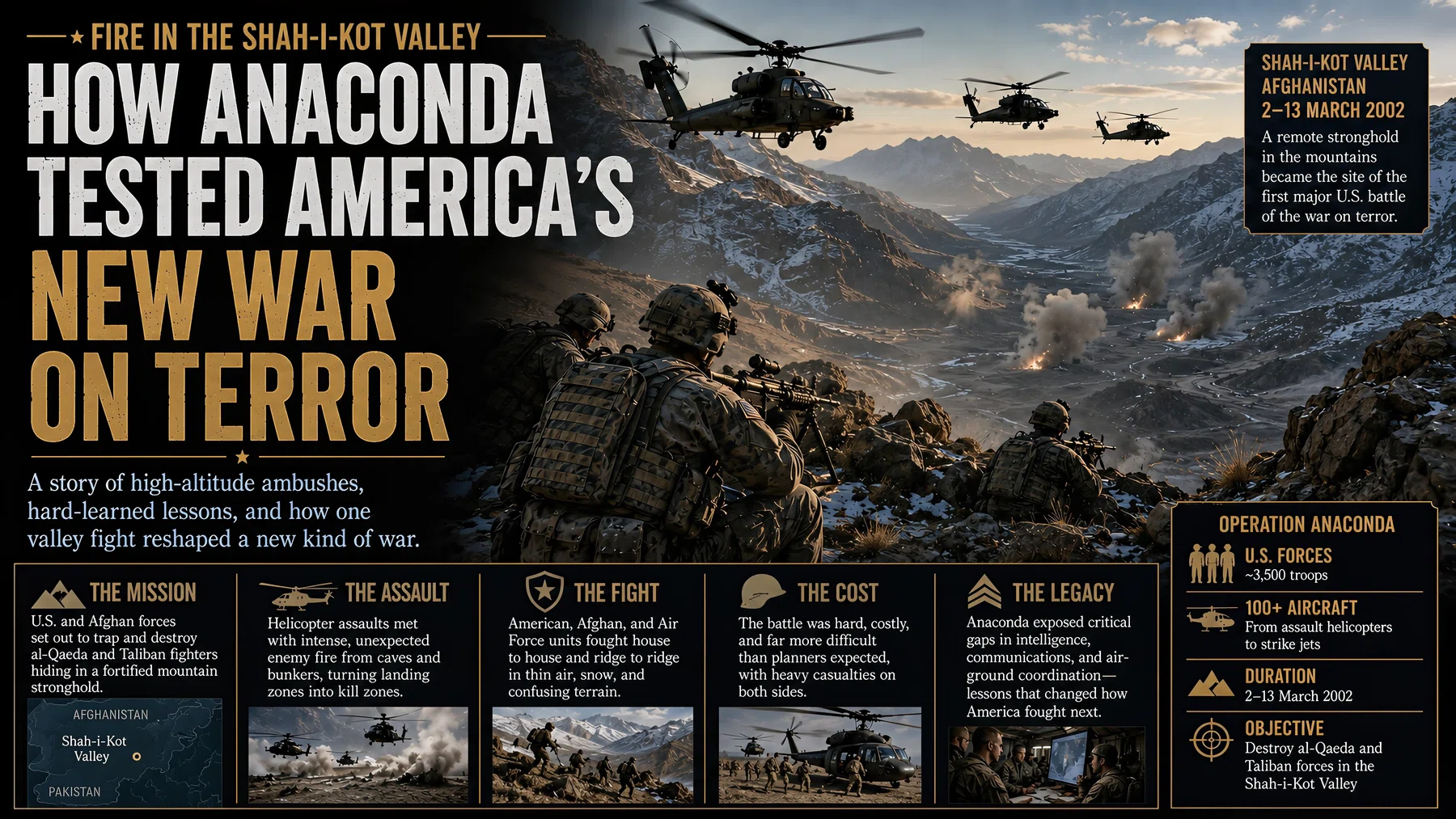
A story of air cavalry, hidden armies, and a brutal valley fight that previewed the grinding war still to come.
A story of a risky harbor landing, brutal tides, and how it broke a grinding stalemate in Korea.
A story of a volcanic ridge, two flags in the wind, and a fight that reshaped the Pacific war’s final months.
A story of a painful first defeat and how it forced a new army to relearn leadership, tactics, and trust in combat.
At the opening of the Spanish–American War, Commodore George Dewey led the United States Asiatic Squadron into Manila Bay to find and destroy Spain’s Pacific fleet. In the pre-dawn darkness his column of cruisers and gunboats slipped past coastal batteries and closed with the anchored Spanish ships. Once in position, Dewey gave his famous order to his flagship’s captain to open fire, unleashing a methodical bombardment that overwhelmed the outgunned enemy squadron.
A story of a risky carrier ambush, frantic searches, and a sudden shift in the Pacific war.
Almost ninety years later, early June once again found American soldiers in desperate combat, this time along the Mississippi River during the Civil War. On June 7th, 1863, Confederate troops attacked Union positions at Milliken’s Bend, a key supply point supporting the siege of Vicksburg. Many of the defenders were newly raised African American regiments, still short on training and equipment but determined to prove their worth.
A story of an urban raid that turned into a street-by-street survival fight and how it reshaped American intervention abroad.
A story of a lopsided clash where earthworks, frontier rifles, and bad timing shattered a veteran British army and reshaped a young republic’s confidence.
Okinawa was a connected land, sea, and air campaign rather than a single beach landing. This overview follows the April assault, northern and southern fighting, offshore defense, civilian experience, and the collapse of organized resistance in June 1945.
Read Entry →Battle Overview · 2026-09-06Battle of PeleliuThe September 1944 landing on Peleliu secured an airfield but opened a much longer struggle against a deeply fortified island. Marine and Army operations continued into November, making the battle more than the familiar story of its first beaches.
Read Entry →Battle · 2026-05-12Battle of RaymondOn May 12th, 1863, Union troops under Major General James B. McPherson clash with a smaller Confederate force near the town of Raymond, Mississippi. The fight is part of Ulysses S. Grant’s bold move inland after crossing the Mississippi River south of Vicksburg, a fortress city anchoring Confederate control of the river.
On April 6, 1865, Union infantry and cavalry struck separated portions of Lee’s retreating army. The fights at Hillsman Farm, Marshall’s Crossroads and Lockett Farm inflicted losses the Confederates could not readily replace and brought the campaign nearer its conclusion.
Read Entry →Battle Overview · 2026-09-06Battle of SaipanThe June–July 1944 battle for Saipan joined Marine and Army divisions in a sustained advance across a populated island. Its outcome transformed American air operations while leaving a devastating military and civilian legacy.
Read Entry →Battle · 2026-06-30Battle of San Juan Hill and El CaneyThe Spanish-American War brought United States forces into Cuba, and on July 1st, 1898, American troops attacked fortified Spanish positions at El Caney and along the San Juan Heights outside Santiago. At El Caney, infantry fought for hours to take a stone blockhouse and surrounding works, while other regiments prepared to advance on Kettle Hill and San Juan Hill.
Two days later, on July 3rd, 1898, the Spanish Caribbean Squadron attempted a breakout from Santiago’s harbor, hoping to escape the blockading United States Navy. As the Spanish cruisers and destroyers emerged, American battleships and armored cruisers moved to intercept, opening fire in a running engagement along the coast. Superior gunnery, armor, and speed allowed the United States ships to rake their opponents, driving them ashore or sinking them one by one.
Just two nights after the Guadalcanal landings, the vulnerability of that new foothold became painfully clear. In the dark early hours of August 9th, 1942, a Japanese cruiser force slipped past Allied picket lines and radar screens to strike the screening cruisers guarding the approaches to Savo Island and the transport anchorage.
After the Wilderness, the armies fought for roads, salients and supply routes around Spotsylvania. The Bloody Angle was the most remembered episode, but the battle also included Laurel Hill, Heth’s Salient and later attempts to turn or break the defenses.
Read Entry →Battle · 2026-01-07Battle of TarawaA story of a brutal island landing, a coral reef turned killing ground, and how one short battle rewrote amphibious warfare.
A story of a winter surprise offensive and exhausted American units holding the line under crushing odds.
An unfolding story of carrier decks, radio reports, and long-range strikes that reshaped the Pacific war before the fleets ever met face to face.
Just three days later, another phase of the Guadalcanal campaign played out at sea. In the Battle of the Eastern Solomons, American carriers, including Enterprise and Saratoga, maneuvered against a Japanese task force seeking to reinforce and resupply their troops on the island. Aviators from both sides flew long-range searches and strikes in a complex pattern of blows and counterblows over the open ocean.
An air-sea clash where radar, training, and discipline turned a desperate carrier defense into a one-sided hammer blow that reshaped the Pacific war.
That same global war saw another crucial August fight half a world away on the island of Guadalcanal. United States Marines of the 1st Marine Division had seized a vital airstrip earlier in the month and were entrenching around it when a Japanese force under Colonel Kiyonao Ichiki was ordered to sweep them away.
Related Dispatch
These current Dispatch articles connect directly to records in the Places, Bases & Battlefields directory.