Headline Wednesday · December 30, 2026
248 Populated Entries
Engagements and campaigns examined through objectives, terrain, forces, outcomes, and consequences.
Battles & Campaigns
Every result opens a permanent subject record with its reference context and connected Dispatch coverage. Filter by record type, editorial collection, or a word in the entry.
248 entries found.
In the narrow streets of Mogadishu, Somalia, an American special operations raid on October 3rd, 1993 turned into one of the most intense urban fights United States forces had faced since Vietnam.
On a sweltering June day in New Jersey, George Washington’s Continental Army met British forces withdrawing from Philadelphia toward New York, and refused to break. The battle opened badly for the Americans as an advance under General Charles Lee faltered and retreated in confusion, but Washington rode forward, rallied the troops, and rebuilt the line near Monmouth Court House.
South of Frederick, Maryland, on July 9th, 1864, Union Major General Lew Wallace assembled a scratch force to block Confederate Lieutenant General Jubal Early’s corps moving toward Washington. Wallace’s men, including fresh militia and detachments from the veteran Sixth Corps, took up positions along the Monocacy River, knowing they were significantly outnumbered. The Confederates eventually outflanked and drove the Union troops from the field, making the day a tactical Southern victory.
A story of a lopsided clash where earthworks, frontier rifles, and bad timing shattered a veteran British army and reshaped a young republic’s confidence.
The following spring in Virginia, Grant and Robert E. Lee continued their brutal series of maneuvers and battles known as the Overland Campaign. After the Wilderness and Spotsylvania, Grant again tried to sidestep Lee’s army by pushing southeast toward the North Anna River and the rail lines that supplied Richmond. On May 23rd, 1864, Union forces moved to cross the river at several points, only to find Confederate troops dug in on commanding ground.
Okinawa was a connected land, sea, and air campaign rather than a single beach landing. This overview follows the April assault, northern and southern fighting, offshore defense, civilian experience, and the collapse of organized resistance in June 1945.
Read Entry →Battle · 2026-12-01Battle of Ormoc Bay, PhilippinesOn December 7th, 1944, as Americans marked the third anniversary of Pearl Harbor, United States forces fought a different battle tied to that first “day of infamy.” Off the Philippine island of Leyte, United States Navy destroyers, escorts, and aircraft struck Japanese…
In early March of 1862, attention in the Civil War was not only fixed on the great rivers but also on the rough Ozark terrain along the Missouri-Arkansas border. On March 7th, 1862, Union forces under General Samuel Curtis met a Confederate army led by Earl Van Dorn near Pea Ridge, in a battle that unfolded over two days in tangled woods and at crossroads such as Elkhorn Tavern.
As Union forces closed in on Atlanta during the summer of the Civil War, Confederate leadership underwent a dramatic change. General John Bell Hood replaced Joseph E. Johnston and immediately sought to seize the initiative with aggressive attacks. On July 20th, 1864, Hood hurled his troops against the Army of the Cumberland as it crossed Peachtree Creek north of the city, hoping to catch Union units strung out and vulnerable.
The September 1944 landing on Peleliu secured an airfield but opened a much longer struggle against a deeply fortified island. Marine and Army operations continued into November, making the battle more than the familiar story of its first beaches.
Read Entry →Battle · 2026-09-08Battle of PlattsburghAs peace negotiations played out in Europe, British commanders attempted a major invasion down the Lake Champlain corridor, hoping to carve off parts of northern New York and influence the terms of any treaty.
As the Civil War entered its first winter, Union planners sought a deep-water harbor along the Confederate coast to support a tightening blockade.
Two days later on the calendar, December 7th, 1862, saw blue and gray forces collide in the hills near Prairie Grove, Arkansas.
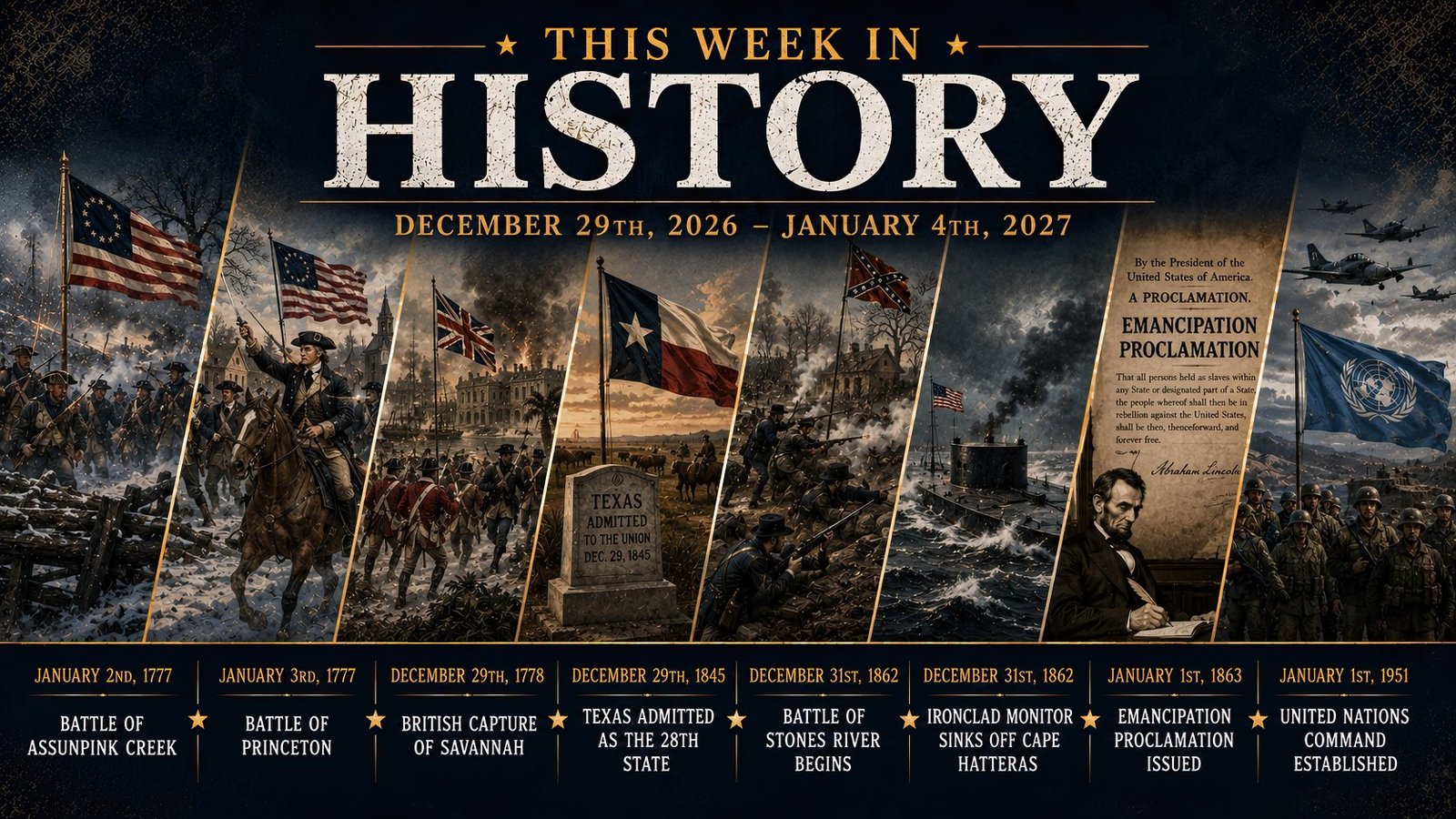
The very next morning, January 3rd, 1777, Washington’s army appeared on the British flank near Princeton, New Jersey, in a bold march that outmaneuvered Cornwallis.
On May 12th, 1863, Union troops under Major General James B. McPherson clash with a smaller Confederate force near the town of Raymond, Mississippi. The fight is part of Ulysses S. Grant’s bold move inland after crossing the Mississippi River south of Vicksburg, a fortress city anchoring Confederate control of the river.
Just two days after Fort Henry, another Union offensive struck along the Atlantic coast, this time aimed at the intricate waterways of North Carolina. On February 8th, 1862, after a day of fighting that began with naval bombardment and continued with infantry assaults, Union forces under Brigadier General Ambrose Burnside secured Roanoke Island.
A story of exposed convoys, hidden fighters, and the soldiers and medics who kept moving through an urban kill zone.
On April 6, 1865, Union infantry and cavalry struck separated portions of Lee’s retreating army. The fights at Hillsman Farm, Marshall’s Crossroads and Lockett Farm inflicted losses the Confederates could not readily replace and brought the campaign nearer its conclusion.
Read Entry →Battle Overview · 2026-09-06Battle of SaipanThe June–July 1944 battle for Saipan joined Marine and Army divisions in a sustained advance across a populated island. Its outcome transformed American air operations while leaving a devastating military and civilian legacy.
Read Entry →Battle · 2026-04-21Battle of San JacintoIn the Texas Revolution, a short, violent clash on the Gulf Coast plains decided the fate of a breakaway republic and, eventually, much of the American Southwest. On April 21st, 1836, General Sam Houston’s Texian army surprised the larger Mexican force of General Antonio López de Santa Anna near the San Jacinto River. Many of the Texian fighters were recent immigrants from the United States, bringing frontier militia habits and a fierce sense of local autonomy.
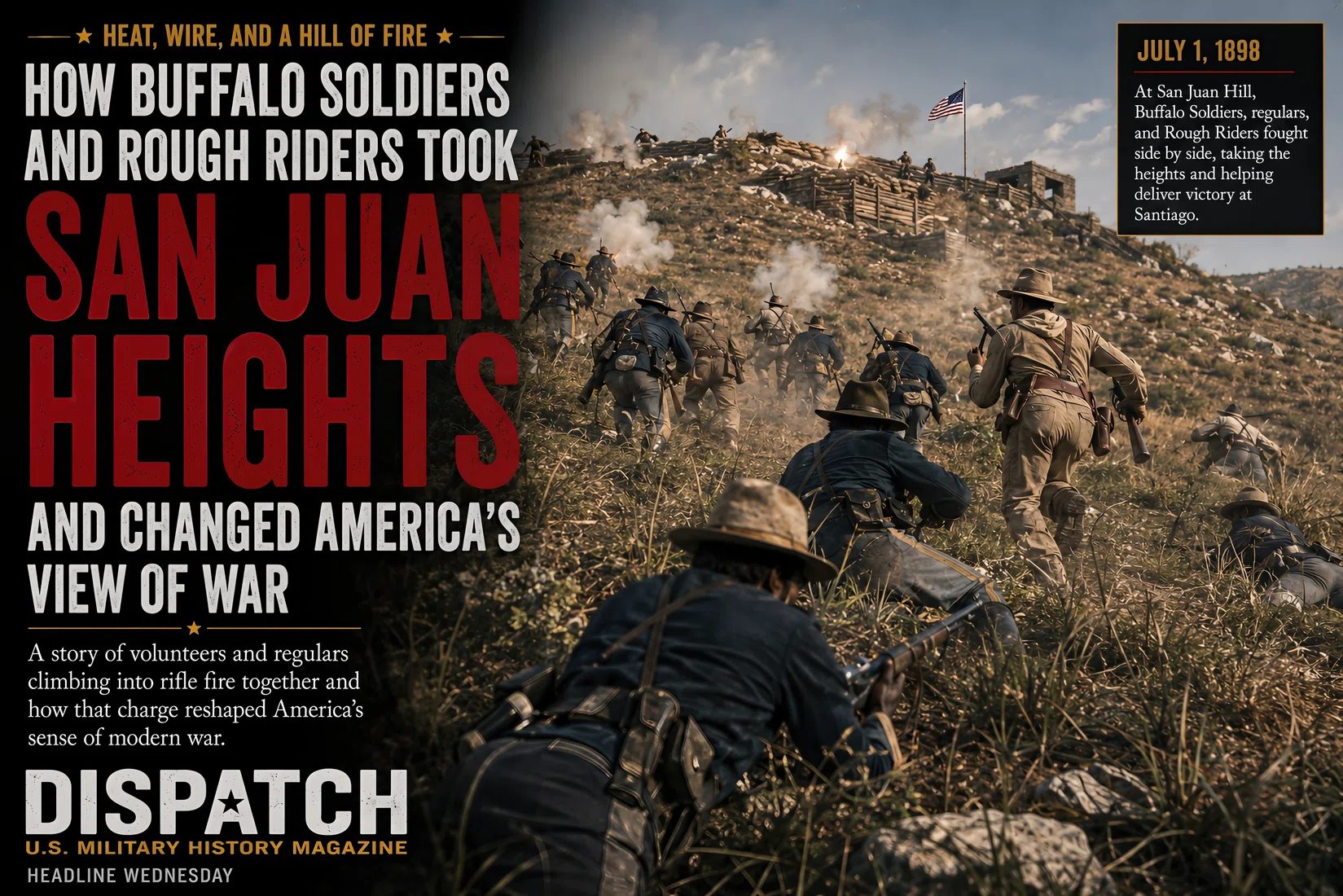
A story of volunteers and regulars climbing into rifle fire together and how that charge reshaped America’s sense of modern war.
The Spanish-American War brought United States forces into Cuba, and on July 1st, 1898, American troops attacked fortified Spanish positions at El Caney and along the San Juan Heights outside Santiago. At El Caney, infantry fought for hours to take a stone blockhouse and surrounding works, while other regiments prepared to advance on Kettle Hill and San Juan Hill.
Two days later, on July 3rd, 1898, the Spanish Caribbean Squadron attempted a breakout from Santiago’s harbor, hoping to escape the blockading United States Navy. As the Spanish cruisers and destroyers emerged, American battleships and armored cruisers moved to intercept, opening fire in a running engagement along the coast. Superior gunnery, armor, and speed allowed the United States ships to rake their opponents, driving them ashore or sinking them one by one.
Just two nights after the Guadalcanal landings, the vulnerability of that new foothold became painfully clear. In the dark early hours of August 9th, 1942, a Japanese cruiser force slipped past Allied picket lines and radar screens to strike the screening cruisers guarding the approaches to Savo Island and the transport anchorage.
Related Dispatch
These current Dispatch articles connect directly to records in the Battles & Campaigns directory.