Headline Wednesday · December 30, 2026
248 Populated Entries
Engagements and campaigns examined through objectives, terrain, forces, outcomes, and consequences.
Battles & Campaigns
Every result opens a permanent subject record with its reference context and connected Dispatch coverage. Filter by record type, editorial collection, or a word in the entry.
248 entries found.
On May 18th, 1917, President Woodrow Wilson signs the Selective Service Act, creating a national mechanism to draft men into military service. The law requires eligible males to register for possible induction, and it lays out how local boards will classify and call individuals. For the United States, whose small prewar Army cannot sustain large operations in Europe, the act is essential to raising a mass citizen force.
Finally, on September 28th, 1950, United Nations forces led by General Douglas MacArthur, alongside South Korean troops, completed the recapture of Seoul during the Korean War.
In the closing weeks of the First World War, American units were grinding forward in the Meuse-Argonne offensive against deeply entrenched German defenses.
The hill had a simple name on the map—Zebra Hill—but nothing about it was simple up close. Ahead of the assault troops the ground rose in a broken, rocky slope, pocked with shell holes and scraps of shattered brush. Hidden in that terrain were Japanese pillboxes and trenches positioned to command every approach. As the American infantrymen pushed forward, the hillside erupted with machine-gun bursts and grenades, turning the advance into a crawl and then into a standstill.
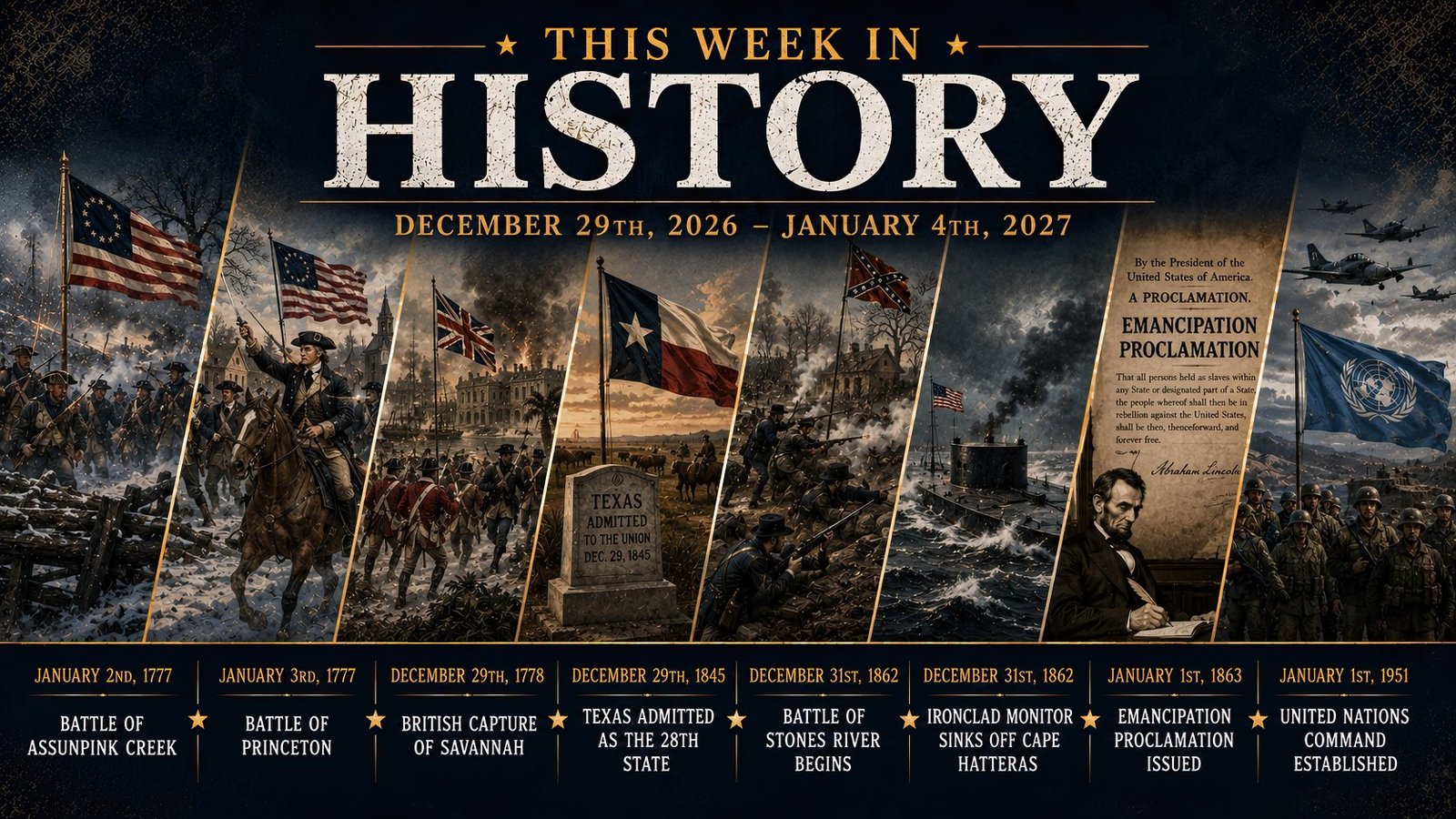
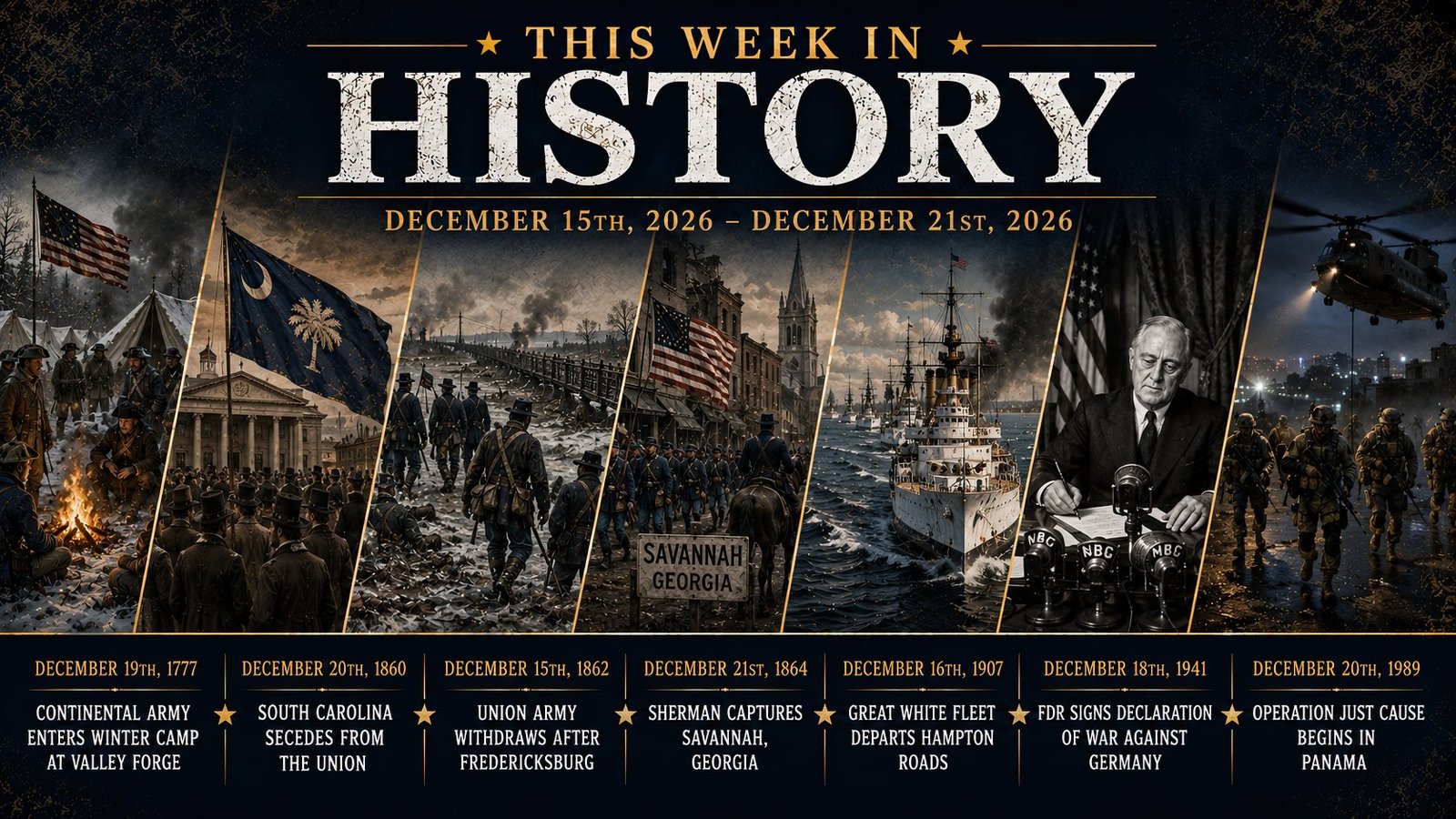
On December 21st, 1864, Union forces under Major General William Tecumseh Sherman entered Savannah at the end of the famous March to the Sea.
As the Pacific war neared its climax, the Battle of Okinawa became one of the bloodiest and most complex operations ever undertaken by American forces. By late May of 1945, United States Army and Marine units had fought their way against layered Japanese defenses centered on the Shuri Line, a fortified belt anchored by Shuri Castle. On May 29th, 1945, Japanese commanders began abandoning this vital position under relentless artillery and air bombardment, slipping southward to new lines.
Near the border with North Vietnam, United States Marines at the remote base of Khe Sanh found themselves at the center of a looming storm. On January 21st, 1968, North Vietnamese forces began heavy artillery and rocket bombardments, cutting roads and tightening a ring around the base. The isolated garrison, supported by Army and Air Force aviation, braced for a potential ground assault reminiscent of the French defeat at Dien Bien Phu.
The struggle for Petersburg combined failed assaults, trench warfare, railway interdiction, and repeated battles on an expanding front. This overview follows the campaign from June 1864 through the April 1865 evacuation, preserving the distinctions between individual award actions.
Read Entry →Battle Overview · 2026-09-06Siege of Port HudsonPort Hudson protected a difficult stretch of the Mississippi River. Farragut’s March passage preceded Banks’s land siege, whose costly assaults and prolonged investment ended with the Confederate surrender on July 9, 1863.
Read Entry →Battle · 2026-02-17Siege of the AlamoOn February 23rd, 1836, Mexican forces under Antonio López de Santa Anna arrived at San Antonio de Béxar and invested the small garrison holding the Alamo mission. The defenders were a mix of local Tejanos and volunteers from the United States who had joined the Texan cause, commanded by figures like William Barret Travis and James Bowie. Their position was poor in purely military terms: a converted mission with incomplete walls, limited artillery, and too few men to cover every approach.
In the early hours of October 31st, 1941, the Clemson-class destroyer USS Reuben James was escorting a convoy near Iceland when a German submarine fired a spread of torpedoes into the formation.
Near the end of the First World War, the American Expeditionary Forces launched their first major offensive as a largely independent army against the German-held St.
During the Tet Offensive, a coordinated series of attacks launched by North Vietnamese and Viet Cong forces, the ancient imperial city of Hue became one of the most hotly contested urban battlefields of the war. By February 8th, 1968, American Marines and soldiers, together with South Vietnamese units, were fully engaged in a block-by-block struggle to retake neighborhoods and key government sites inside the city.
That same global war produced a very different sort of turning point when Franklin Roosevelt, Winston Churchill, and Joseph Stalin gathered in Tehran, Iran, for their first full wartime summit.
On January 30th, 1968, during the lunar new year holiday known as Tet, communist forces launched coordinated attacks across South Vietnam. Viet Cong guerrillas and North Vietnamese Army units struck provincial capitals, district towns, and military bases, often achieving tactical surprise. In the days that followed, the world saw images of fighting near the United States Embassy in Saigon and fierce clashes around Khe Sanh, as well as the long, bloody struggle for Hue.
On November 14th, 1965, helicopters of the United States Army’s 1st Cavalry Division (Airmobile) began landing infantry battalions near the Chu Pong Massif in the Ia Drang Valley of South Vietnam.
It is the early hours of 10 March 1945 on Luzon in the Philippine Islands. The jungle around the Villa Verde Trail is black and close, broken only by a thin ridge that juts out from a larger hill. On that ridge, just ahead of the main American perimeter, three foxholes scrape a shallow line in the earth. In one of them lies Private First Class Thomas Eugene “Gene” Atkins of Company A, 127th Infantry. His job is simple and deadly: watch the trail and buy time if the enemy comes.
Decades later, questions of war and peace shifted to New York, where the United Nations Security Council voted on a resolution addressing Iraq’s invasion of Kuwait.
A story of a silent campaign against merchant ships and how it helped choke an island empire’s war effort.
Five years after the Second World War, the Korean Peninsula had become the center of a new conflict.
On February 1st, 1942, less than two months after the attack on Pearl Harbor, American carrier task forces struck back across the Pacific. The carriers Enterprise and Yorktown launched waves of aircraft against Japanese bases in the Marshall and Gilbert Islands, hitting airfields, shipping, and shore installations. The material damage to the enemy was limited compared with later campaigns, but the raid marked the first offensive use of United States carriers in the war.
Four days after Wilson’s address, Congress approved the declaration of war, formally bringing the United States into World War I on the side of the Allies. The decision triggered a sweeping mobilization effort at home, including the enactment of the Selective Service system to raise a large national army. The American Expeditionary Forces, under General John J.
An American mission seeking diplomatic contact became a punitive naval and amphibious operation. The capture of Korean forts in June demonstrated military power without securing the agreement the expedition sought.
Read Entry →Campaign · 2026-07-01United States submarine campaign against JapanA story of a silent campaign against merchant ships and how it helped choke an island empire’s war effort.
Related Dispatch
These current Dispatch articles connect directly to records in the Battles & Campaigns directory.