Headline Wednesday · December 16, 2026
210 Populated Entries
Organizations, structures, lineages, roles, and operational histories.
Units & Formations
Every result opens a permanent subject record with its reference context and connected Dispatch coverage. Filter by record type, editorial collection, or a word in the entry.
210 entries found.
Just one day after creating a Continental Army, Congress turned to the problem of who should lead it and selected George Washington of Virginia as commander in chief. Washington had experience from the French and Indian War, a reputation for personal courage, and the political advantage of coming from a southern colony at a moment when most fighting was in New England. His appointment helped weld together regional interests by placing a Virginian at the head of largely New England troops.
After nearly two years of brutal fighting up the Italian peninsula, German Army Group C formally laid down its arms to the Allied command on May 2nd, 1945. United States Fifth Army and its partners had slogged through mountains, rivers, and heavily fortified defensive lines, from Salerno and Anzio to the Gothic Line in the north.
A year later to the day, July 1st, 1863, the opening clash at Gettysburg began almost by chance as Confederate troops moving into Pennsylvania met Union cavalry west of town. Brigadier General John Buford’s troopers used dismounted tactics and carbines to delay the advance, buying time for Union infantry of the First Corps to arrive. As more Confederate divisions came onto the field from the north and west, fighting surged along ridges, farms, and the town’s outskirts.
The climactic third day, July 3rd, 1863, is best remembered for the Confederate infantry assault later called Pickett’s Charge. After an intense artillery bombardment meant to weaken Union positions on Cemetery Ridge, several Confederate divisions stepped off from the tree line on Seminary Ridge and marched across open fields under heavy fire. Union cannon and rifles tore into their ranks, yet the attackers closed to the stone wall in places, fighting hand to hand before being driven back.
In the early years of the Cold War’s nuclear standoff, Strategic Air Command kept bombers airborne or on quick alert around the clock. On January 24th, 1961, a B-52 carrying two powerful thermonuclear bombs broke apart in the skies near Goldsboro, North Carolina, after suffering structural failure. The weapons fell to earth, and one descended with its parachute deploying, while the other plunged into soft ground.
Four days after Fort Stedman, the initiative swung decisively to the Union side. On March 29th, 1865, General Ulysses S. Grant launched a wide-ranging offensive west of Petersburg, sending Union corps toward key roads and crossroads along the Confederate right flank. Battles at places like Lewis’s Farm, White Oak Road, and Dinwiddie Court House unfolded over the next days as Union troops pressed around the end of Lee’s line.
Two years later, another turning point arrived when Ulysses S. Grant began work in his new role as general-in-chief of all Union armies. Having made his reputation at places like Fort Donelson, Vicksburg, and Chattanooga, Grant now carried the rank of lieutenant general, a grade not held since George Washington. From this position he could coordinate the Army of the Potomac in Virginia with campaigns in the West, aiming to pressure Confederate forces on every front at once.
On May 10th, 1969, paratroopers of the 101st Airborne Division began a series of assaults against a steep, jungle-covered height in the A Shau Valley that would become known as Hamburger Hill. The Vietnamese Army defenders were dug into bunkers and trenches woven into the slopes, forcing American units to climb under fire again and again through mud, foliage, and concealed obstacles.
The fuel gauges in Harold Bauer’s Wildcat fighter were already edging toward empty when the coastline of Guadalcanal slid beneath his wings. He had just finished leading a long, tense, overwater flight of Marine fighters up from Espiritu Santo, six hundred miles of nothing but ocean and cloud. Henderson Field, the hard-bitten airstrip the Marines called home, lay ahead as a thin strip of coral and mud, promising rest, repairs, and—most of all—gasoline.
The black volcanic sand of Iwo Jima offered no cover, only shallow shell holes and the hulks of stalled tanks. Late on February 23, 1945, Marines of the 21st Regiment lay pinned down, staring across a short stretch of open ground that felt a mile wide. Ahead of them, a maze of reinforced concrete pillboxes spat machine-gun fire in crossing patterns, every burst chewing fresh craters into the sand.
In the Central Pacific, United States forces opened a new phase of the war against Japan with the amphibious assault on Saipan in the Mariana Islands. On June 15th, 1944, Marines of the 2nd and 4th Marine Divisions, supported later by soldiers of the 27th Infantry Division, hit the beaches under fire from well-prepared Japanese defenses dug into coral, caves, and ridges.
On July 3rd, 1988, during tense operations in the Persian Gulf, the guided-missile cruiser USS Vincennes mistook a civilian Iran Air Airbus ascending along a commercial route for a hostile military aircraft. Believing the plane to be an attacking fighter and amid conflicting reports about altitude and identification, the ship fired surface-to-air missiles that destroyed the airliner, killing all passengers and crew.
On February 19th, 1945, the beaches of Iwo Jima filled with landing craft as Marines of the 4th and 5th Marine Divisions came ashore under fire. The island was small but strategically important, lying between the Marianas and the Japanese home islands and hosting airfields that could threaten American bombers.
The draw is narrow and steep, its sides scoured by months of shellfire and rain. At the bottom, the earth is churned to powder. Above it, hidden in the scrub and broken stone near Cisterna di Littoria, German machine guns wait for anything that moves. Private James Henry Mills can hear them before he sees them—the clatter of automatic fire, the sharper crack of rifles, the dull thump of grenades exploding somewhere ahead.
The ground in front of Sugar Loaf Hill is already chewed into mud and craters when Corporal James Lewis Day crawls forward to look for cover. It is May 1945 on Okinawa, and the Marines trying to cross this open killing ground are being shredded by Japanese mortar and artillery fire. The air is thick with pulverized coral dust. Fragments of shattered ammunition boxes and discarded packs lie where men dropped them running for their lives.
Early June took on new meaning in 1942, as the Pacific War reached North American shores. On June 3rd, 1942, Japanese carrier aircraft struck the United States Navy and Army installations at Dutch Harbor in the Aleutian Islands of Alaska Territory. The attack damaged fuel facilities, barracks, and anti-aircraft positions, and it was followed by further strikes the next day.
The ridge near San Jose Hacienda rose steep and stubborn out of the jungle, a wall of earth and rock that dominated the valley floor. Somewhere up there, hidden in spider holes—small, camouflaged fighting pits—and pillboxes, Japanese soldiers waited behind interlocking bands of machine-gun fire. To reach the crest, Company I of the 160th Infantry Regiment had only one narrow approach, a trail that funneled men into a killing zone. Staff Sergeant John C.
In the spring of the Revolutionary War, the Continental Navy’s most famous captain carried the fight directly to Britain’s own shores. Sailing the sloop Ranger, John Paul Jones led a small landing party into the harbor at Whitehaven on England’s west coast. His men spiked coastal guns and attempted to set several ships ablaze, causing little physical damage but a great deal of alarm.
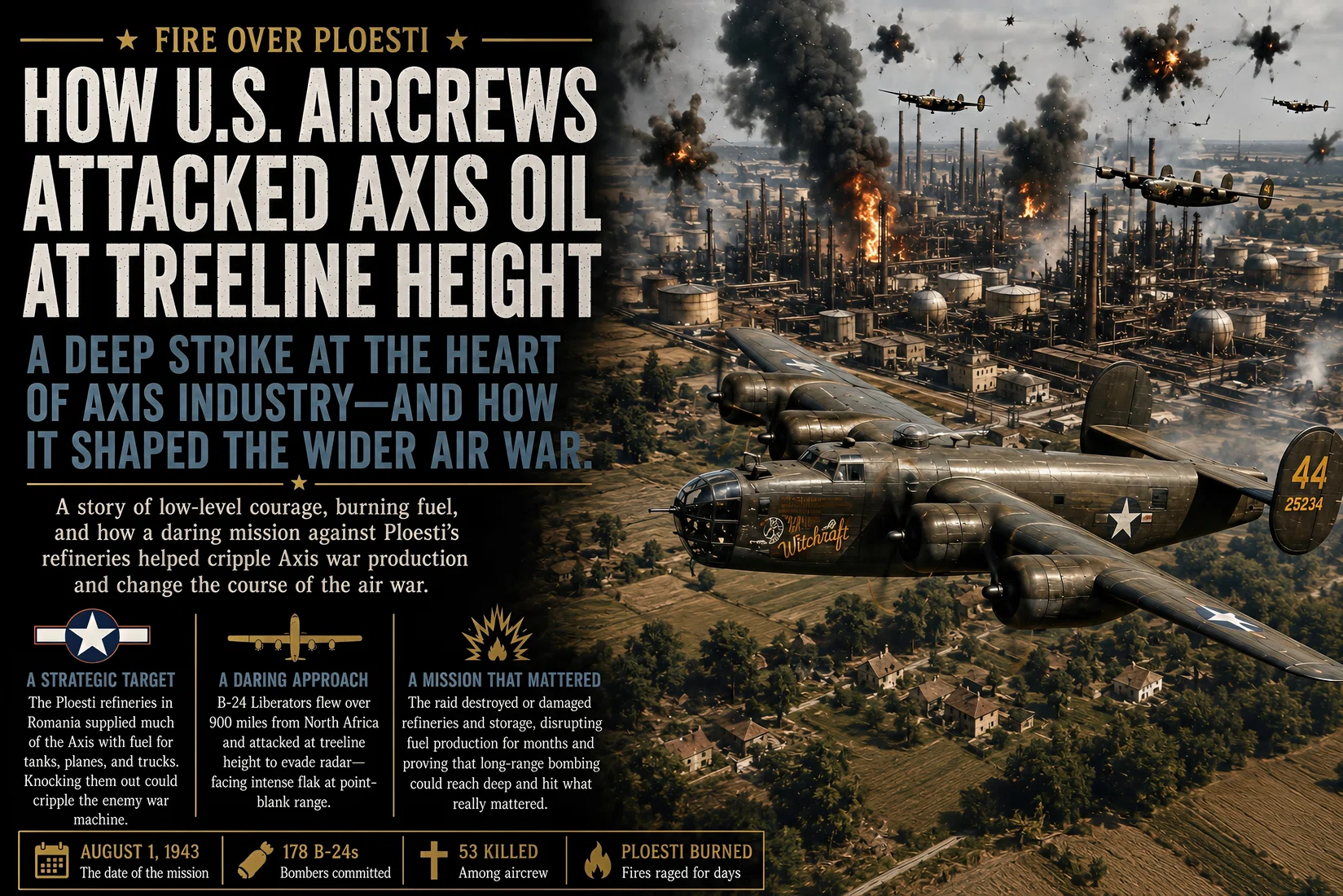
The B-24 shook as it skimmed over the Romanian countryside, treetops flashing beneath the wings and church steeples knifing up toward the formation. Ahead, the sky over Ploesti was already boiling with black bursts of antiaircraft fire and thick columns of oily smoke. Colonel John Riley Kane, commanding the third element of heavy bombers in a massive low-level strike, peered through the haze and realized something was wrong. The main force that should have been ahead of him was gone.
After the disastrous Union defeat at Fredericksburg and the swampy failure of the so-called “Mud March,” President Abraham Lincoln decided he could no longer keep Ambrose Burnside in charge of the Army of the Potomac. Orders issued in late January placed Major General Joseph Hooker, a combative and outspoken corps commander, in charge of the Union’s main eastern field army.
The black volcanic sand of Iwo Jima offered no cover, only shallow shell holes and jagged rock. On the morning of March 9, 1945, Platoon Sergeant Joseph R. Julian lay there with the rest of his company, pressed into the ash while enemy fire tore long furrows across the slope. Ahead of them, a line of Japanese trenches and pillboxes guarded a critical rise. Machine guns hammered from narrow firing slits.
On the Korean peninsula, three years of brutal fighting ended with signatures on a document at Panmunjom, not with a victory parade. Delegates representing the United Nations Command, North Korea, and China agreed to a cease-fire that froze front lines near where they had started, around the Thirty-Eighth Parallel. The agreement established the Demilitarized Zone, a fortified strip of land that remains one of the most heavily guarded borders in the world.
In the turbulence of the Mexican Revolution, the United States undertook a controversial intervention that highlighted both its naval reach and the risks of limited operations ashore. A diplomatic clash known as the Tampico Affair, combined with concerns over an incoming arms shipment to the regime of Victoriano Huerta, led Washington to order a seizure of the port of Veracruz.
On August 7th, 1942, United States forces launched their first major offensive of the Pacific War with amphibious landings in the Solomon Islands. Elements of the First Marine Division came ashore on Guadalcanal, Tulagi, and nearby islets to seize an airfield that Japanese engineers were building, one that threatened the sea lanes linking the United States and Australia.
Related Dispatch
These current Dispatch articles connect directly to records in the Units & Formations directory.