Beyond the Call · December 28, 2026
206 Populated Entries
Leaders, service members, historians, and figures connected to the military record.
People & Commanders
Every result opens a permanent subject record with its reference context and connected Dispatch coverage. Filter by record type, editorial collection, or a word in the entry.
206 entries found.
Barely four months after the attack on Pearl Harbor, the United States planned a strike to carry the war to the Japanese home islands. On April 18th, 1942, sixteen B-25 medium bombers led by Lieutenant Colonel James Doolittle took off from the carrier USS Hornet in the Pacific, a feat never attempted before with aircraft of that size. Spotted early by enemy patrol vessels, the task force launched the bombers farther from Japan than planned, forcing the crews to stretch their fuel to the limit.
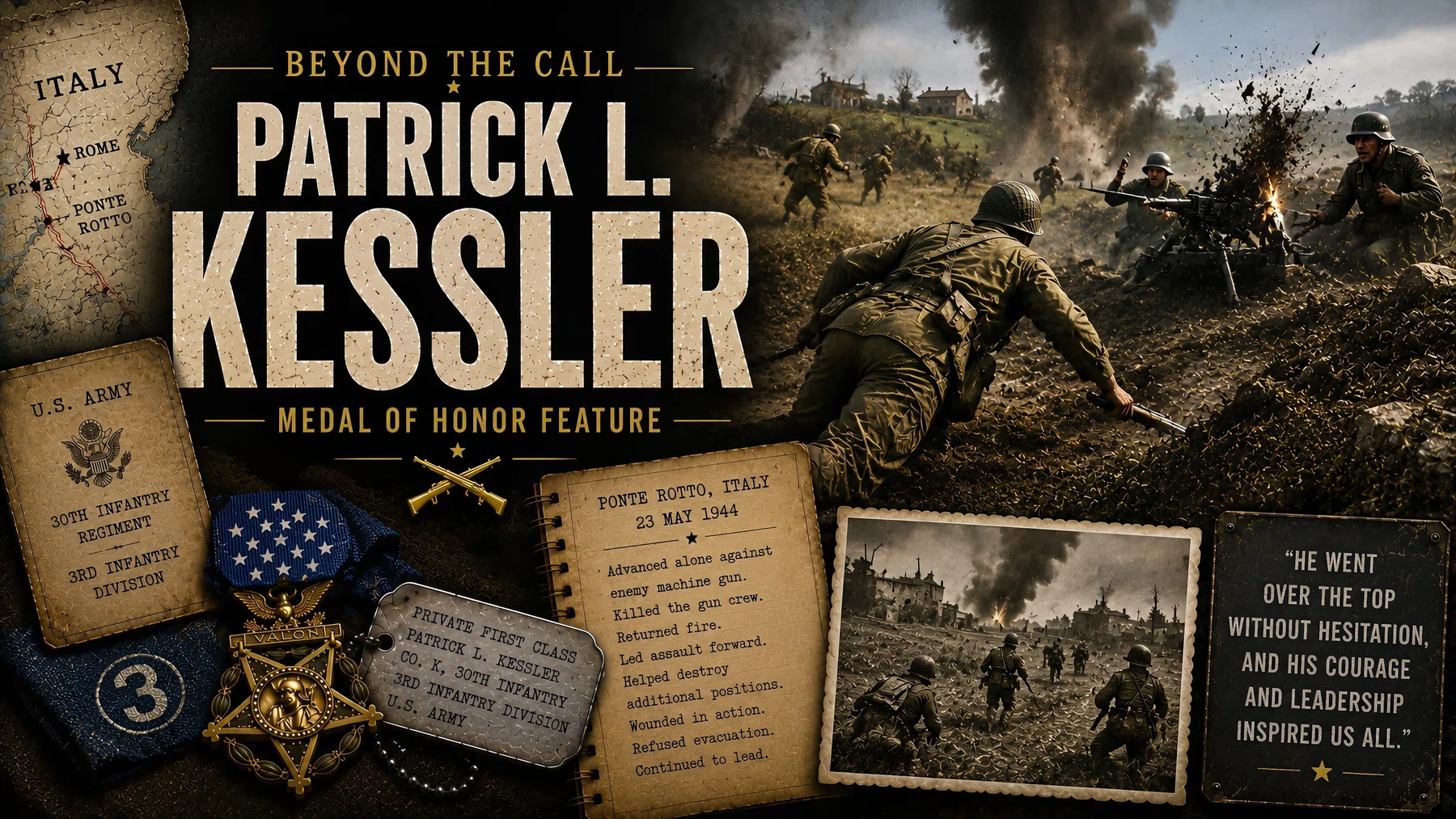
A Medal of Honor story of courage under fire in the Italian campaign of World War II.
The winter sky over the Anzio beachhead was a low, gray lid, pressing the sound of guns back down onto the men below. Along a shallow drainage ditch called the Fossa Femminamorta, muddy water slid past tufts of grass and shattered reeds. Somewhere ahead, beyond the next bend, German machine guns covered the open fields that stretched away from the ditch, anchoring a strongpoint that threatened the entire attack.
Almost a year into the Revolutionary War, the siege of Boston had ground on with neither side able to deliver a decisive blow. General George Washington’s Continental troops ringed the city while British regulars and Royal Navy ships held the harbor and town, each side suffering from supply problems and disease.
On February 19th, 1942, a little more than two months after the attack on Pearl Harbor, President Franklin Roosevelt signed Executive Order 9066. The order authorized military commanders to establish exclusion zones and remove people from them, a power soon applied mainly along the West Coast. In practice, this meant that more than one hundred thousand people of Japanese ancestry, the majority of them American citizens, were forced from their homes and sent to inland camps under guard.
In the early weeks of the Korean War, United States forces rushed to slow a North Korean advance that threatened to overrun the entire peninsula. Around the city of Taejon, elements of the 24th Infantry Division fought a desperate delaying action, outnumbered and facing tanks and artillery in unfamiliar terrain. Over several days of close combat and street fighting, American troops inflicted significant losses but gradually found themselves cut off and forced to withdraw.
Farther west, control of the Mississippi River became a central Union objective. After a bold overland campaign that saw victories at Port Gibson, Raymond, Jackson, Champion Hill, and the Big Black River, General Ulysses S. Grant brought his army up to the defenses of Vicksburg, Mississippi. On May 19th, 1863, he ordered an immediate assault, hoping to capitalize on Confederate disarray and seize the fortress city by storm.
More than half a century later, another presidency faced the task of closing a different conflict. On August 20th, 1866, President Andrew Johnson issued a formal proclamation declaring that the insurrection in the former Confederate states was at an end, effectively marking the official conclusion of the Civil War. The great campaigns and bloody battles were already over, but this act drew a legal line under four years of rebellion and set the context for Reconstruction.
The ramps drop into waist-deep surf and chaos. It is the morning of October 20, 1944, on a stretch of shoreline the maps call Red Beach. Ahead lies a narrow band of sand, beyond it a low palm grove and flooded rice paddies. Somewhere in that green fringe, Japanese guns have the approaches bracketed. As the first waves of soldiers tried to cross, the beach turned into a killing ground.
How a 22-year-old Naval Reserve officer on USS Oklahoma chose his shipmates’ lives over his own at Pearl Harbor
A Medal of Honor story of selfless command in the skies of World War II.
High over Europe on Christmas Eve 1944, the sky is crowded with contrails. Hundreds upon hundreds of heavy bombers push east toward German airfields, the engines’ steady thunder mixing with clipped radio calls. At their head is a single Flying Fortress, the air commander’s ship, where Brigadier General Frederick Walker Castle studies the instruments and the grey cloud deck below.
The rain-soaked hills of Leyte were already torn open by days of fighting when Company A of the 306th Infantry pushed forward against a Japanese strongpoint that refused to break. Machine guns were dug into the slopes, firing down narrow approaches that funneled every American movement into sheets of bullets. A light tank inched ahead, meant to crack the defenses, but the infantry platoon walking behind it stalled under the storm of fire.
A Medal of Honor story of courage under fire and stubborn infantry grit in the Italian campaign of World War II.
The fields near Anzio were bare and unforgiving—flat, freshly plowed earth broken only by shallow furrows and a few low dikes. On a May morning in 1944, Staff Sergeant George John Hall lay pressed into that thin cover with the rest of his company, the dirt shaking under the hammering of German machine guns. Every time a man tried to crawl forward, grazing fire stitched the ground in front of him. Sniper rounds cracked overhead.
Night on Iwo Jima never really felt dark. The sky glowed faintly from flares and burning wreckage, and the volcanic ash underfoot seemed to swallow every step. In a shallow foxhole—a rough, shoulder-deep fighting position scraped into that ash—Private George Phillips stood watch while the rest of his squad finally slept. They had spent the night trading grenades and rifle fire with Japanese troops slipping through the lines.
Just one day after creating a Continental Army, Congress turned to the problem of who should lead it and selected George Washington of Virginia as commander in chief. Washington had experience from the French and Indian War, a reputation for personal courage, and the political advantage of coming from a southern colony at a moment when most fighting was in New England. His appointment helped weld together regional interests by placing a Virginian at the head of largely New England troops.
A year later to the day, July 1st, 1863, the opening clash at Gettysburg began almost by chance as Confederate troops moving into Pennsylvania met Union cavalry west of town. Brigadier General John Buford’s troopers used dismounted tactics and carbines to delay the advance, buying time for Union infantry of the First Corps to arrive. As more Confederate divisions came onto the field from the north and west, fighting surged along ridges, farms, and the town’s outskirts.
Four days after Fort Stedman, the initiative swung decisively to the Union side. On March 29th, 1865, General Ulysses S. Grant launched a wide-ranging offensive west of Petersburg, sending Union corps toward key roads and crossroads along the Confederate right flank. Battles at places like Lewis’s Farm, White Oak Road, and Dinwiddie Court House unfolded over the next days as Union troops pressed around the end of Lee’s line.
Two years later, another turning point arrived when Ulysses S. Grant began work in his new role as general-in-chief of all Union armies. Having made his reputation at places like Fort Donelson, Vicksburg, and Chattanooga, Grant now carried the rank of lieutenant general, a grade not held since George Washington. From this position he could coordinate the Army of the Potomac in Virginia with campaigns in the West, aiming to pressure Confederate forces on every front at once.
A Medal of Honor story of selfless sacrifice and battlefield leadership in World War II.
The fuel gauges in Harold Bauer’s Wildcat fighter were already edging toward empty when the coastline of Guadalcanal slid beneath his wings. He had just finished leading a long, tense, overwater flight of Marine fighters up from Espiritu Santo, six hundred miles of nothing but ocean and cloud. Henderson Field, the hard-bitten airstrip the Marines called home, lay ahead as a thin strip of coral and mud, promising rest, repairs, and—most of all—gasoline.
An Ohio engineer officer who turned a rear-area camp into a last-ditch defensive line
How a Marine Corps fighter pilot sank a destroyer, then picked up a rifle to defend a tiny atoll at the dawn of World War II.
Related Dispatch
These current Dispatch articles connect directly to records in the People & Commanders directory.