The Moment of Decision
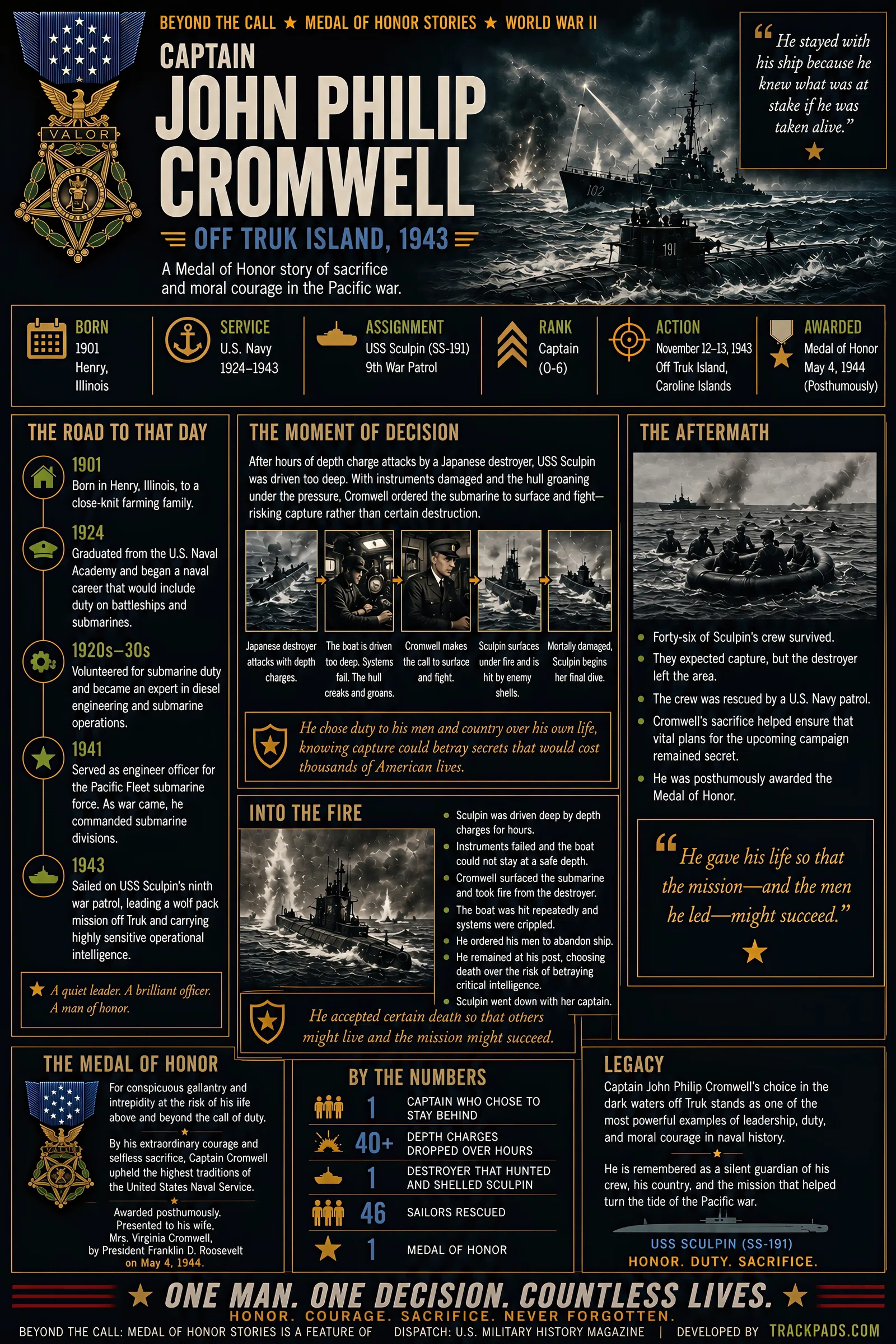
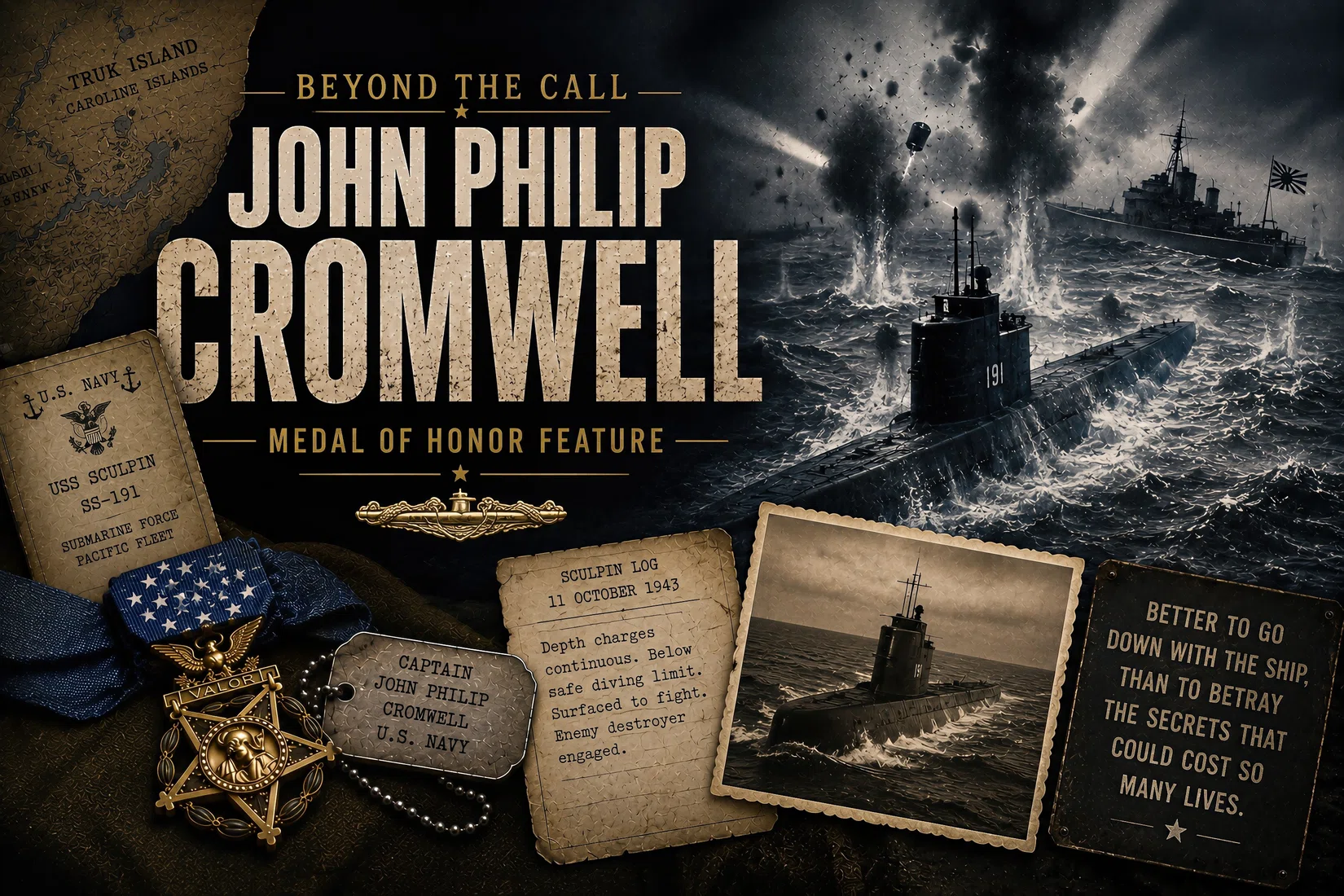
The depth charges had been falling for hours in the dark water off Truk. Each explosion slammed into the steel skin of USS Sculpin, shuddering through the control room where Captain John Philip Cromwell braced himself against the chart table. The air was hot and oily, full of sweat, diesel fumes, and the sharp tang of fear that even seasoned submariners could not quite hide. Somewhere above them, a Japanese destroyer hunted in widening circles, listening for the wounded submarine it had already driven too deep.
Sculpin’s depth gauge was unreliable now, damaged by earlier blasts. The boat had slipped below her safe limit, hull plates groaning as the sea pressed in. To stay down much longer was to invite the ocean to crush them. To surface was to face the destroyer’s guns and, if they survived, capture. Cromwell knew what that meant in a way no one else aboard quite did. In his memory flickered operations schedules, codeword briefs, and the outlines of an impending American offensive that depended on the Japanese never learning how much the Allies knew.
Another pattern of depth charges roared past, closer. Pipes burst. Lights flickered. The submarine struggled to maintain depth, her wounded systems screaming complaints. In that chaos, Cromwell made his call. Better to risk the surface than wait to be crushed or forced, alive, into enemy hands. He authorized Sculpin to surface and fight, buying his sailors a chance to escape a steel coffin at the bottom of the Pacific.
Moments later, battered by shellfire on the surface and mortally damaged, the submarine began to die. The order went out to abandon ship. Men scrambled for the deck and the sea, hoping for any chance at survival—even as prisoners. Cromwell did not move toward the escape route. He stayed below, fully aware that if he were taken alive, even his silence under torture might betray secrets that could cost thousands of lives. As water rushed in and Sculpin started her final dive, he chose to go with her, accepting certain death to protect the men and operations entrusted to him.
The Road to That Day
John Philip Cromwell’s path to that flooded control room began far from the Pacific, in the small river town of Henry, Illinois, where he was born in 1901. A bright, disciplined student from the Midwest, he earned an appointment to the United States Naval Academy in 1920 and graduated with the class of 1924, entering a fleet still shaped by the battleships of the First World War. His early sea duty came aboard the battleship Maryland, but he soon gravitated toward the cramped, experimental world of submarines, volunteering for assignments that demanded both technical skill and steady nerves.
By the late 1920s he was serving in boats like USS S-24 and studying diesel engineering in depth, building an expertise that made him invaluable as submarines became more capable and complex. He cycled through tours below the surface and staff billets ashore, eventually commanding the older S-20 and proving himself as a captain who knew every valve and gauge on his boat. Two years in Washington with the Navy’s engineering and ships bureaus deepened his understanding of how the entire undersea force worked, from design drawings to war plans. In 1941 he became the engineer officer for the Pacific Fleet’s submarine force, and as war came he took on command of multiple submarine divisions, his pennant flying in USS Sculpin.
Those who served with him encountered a reserved officer with a dry, understated sense of humor and a reputation for exacting standards. He was not a headline-seeking personality; he was the sort of leader who appeared in the control room at odd hours, quietly checking bearings, listening to junior officers’ concerns, and asking sharp questions that showed he had already worked through the problem in his head. Off duty, letters home and shore-side routines revolved around his wife and children, the family life he slipped back into between long stretches of sea duty.
By 1943, as American planners prepared for a major assault on the Gilbert Islands, Cromwell’s experience and integrity placed him at the center of sensitive operations. He was briefed on submarine deployments, fleet movement schedules, and the fruits of Allied codebreaking—information that could unravel months of planning if it ever reached Japanese hands. Rather than direct things from a desk, he joined Sculpin’s ninth war patrol as the senior officer and prospective commander of a new wolf pack of submarines guarding the approaches to Truk. He sailed from Pearl Harbor knowing that he carried in his head secrets no notebook could safely hold, and that if the patrol went wrong, the greatest danger might not be the depth charges—but what the enemy could do if they captured Captain John Philip Cromwell alive.
Into the Fire
In the autumn of 1943, the war in the Pacific was reaching a turning point. American forces were preparing their first large offensive across the Central Pacific, and submarines were ordered to form a hidden screen around the Japanese stronghold at Truk. Captain John Philip Cromwell sailed with his flag in USS Sculpin on her ninth war patrol, leading a small group of boats that would lie in wait for enemy ships moving to counter the coming assault. He carried in his head the pattern of submarine patrol lines, the timing of fleet movements, and the fact that American codebreakers were reading portions of Japanese naval traffic. The success of the wider operation, and the secrecy of that intelligence, depended on the enemy never learning how much the Allies knew.
For several days off Truk Island, Sculpin stalked shipping in waters thick with patrol craft and aircraft. On 19 November she made contact with a Japanese convoy and closed in to attack. As Sculpin maneuvered for position, active sonar signaled that the hunter had become the hunted. A Japanese destroyer had detected the submarine and charged in. Cromwell and Sculpin’s commanding officer ordered a deep dive, trading the chance of a torpedo shot for survival. Moments later, the first pattern of depth charges rolled down through the water and erupted around the hull.
The explosions were crushing and relentless. Gauges shattered. Lights flickered and failed. The boat began to leak in several places as valves and fittings gave way under the repeated shock. Worse still, Sculpin’s depth gauge was damaged, leaving the crew uncertain how far they had descended. The submarine slipped below her normal safe limit, hull plates creaking as the sea pressed harder around them. In the control room, Cromwell and the officers wrestled with a brutal choice. If they tried to hold at depth, the next pattern of charges or a few more yards of water could crush them.
They fought to bring the submarine shallower, but the damage made control erratic. At one point Sculpin broke the surface briefly and was forced down again, alerting the destroyer above that its quarry was still alive. At last the decision could not be postponed. With the depth gauge unreliable and the hull already tested past its limits, the officers agreed that they had to surface deliberately and fight rather than wait to be crushed or dragged upward as a helpless wreck. Sculpin blew her tanks and broke through the waves into daylight, emerging near the Japanese destroyer that had been stalking her.
What followed was a brief and desperate surface battle. The submarine’s guns opened fire, but the destroyer’s heavier weapons quickly found the range. Shells tore into the conning tower and bridge, killing and wounding many of the officers topside and wrecking vital equipment. Below, reports came in of flooding that could not be contained. With Sculpin mortally damaged, the remaining officers ordered scuttling measures and told the crew to abandon ship. Men scrambled to the deck, some already wounded, and jumped into seas that were still whipped by nearby shell bursts.
Cromwell did not join them. Fully aware of the classified knowledge he carried, he judged that his own capture would risk revealing submarine tactics, deployment plans, and the extent of Allied intelligence success, whether by interrogation, drugs, or torture. He chose instead to stay aboard as the vents were opened and the wounded submarine slid beneath the surface. His war ended in the black water off Truk, in a decision measured in seconds that would be remembered for generations.
The Citation, Decoded
The official Medal of Honor citation for Captain Cromwell opens with the familiar phrase “for conspicuous gallantry and intrepidity at the risk of his life above and beyond the call of duty.” In plain language, this means his courage was both unmistakable and sustained. The citation identifies him as commander of a submarine coordinated attack group with his flag in Sculpin, a reminder that his responsibility extended beyond one boat to the entire line of submarines guarding the approaches to Truk.
The citation notes that Cromwell alone possessed certain secret intelligence about submarine strategy, fleet movements, and detailed attack plans. The phrase that he moved his undersea flotilla inexorably forward despite savage opposition refers not just to navigation but to nerve. Each contact report, each hint of enemy patrols ahead, was a reason to hesitate. Instead, he kept his command pressing toward waters where detection and attack were more likely, so that the main fleet would have a clearer path in the crucial days to come.
Later lines describe Sculpin being rocked and battered by depth charges, sinking to an excessive depth, and Cromwell authorizing the submarine to surface and engage the enemy in a gunfight. This is the moment when abstract words like “cool and undaunted” acquire weight. The final phrases of the citation explain why his decision to remain aboard mattered. By choosing certain death rather than risk capture, he preserved the secrecy of submarine operations and protected the wider offensive. When the citation speaks of deep integrity and an uncompromising devotion to duty, it points to a kind of moral courage that outlasted the battle itself.
Why It Mattered
On the chart of the Central Pacific, the loss of a single submarine can look like a small marker in a vast ocean. In reality, Sculpin and the attack group Cromwell commanded were woven into a much larger plan. Their patrol line off Truk was part of the shield around Operation Galvanic, the November 1943 assault on the Gilbert Islands that opened the Central Pacific drive toward Japan. Cromwell knew the timing of that invasion and how carriers, battleships, and transports would move, and he knew that United States codebreakers were reading key portions of Japanese naval traffic.
Sculpin’s final fight did not sink the destroyer that hunted her, and the patrol itself ended in tragedy. Yet Cromwell’s decision to remain aboard as she went down ensured that the most sensitive information in his head never came within reach of Japanese intelligence officers at Truk. The Japanese never realized how deeply their communications were being read, and the code systems at the heart of Allied intelligence remained in use. In that sense, his choice in a flooded control room helped keep a crucial edge intact at a turning point in the Pacific war.
The fate of Sculpin’s survivors underlines the stakes. Forty one men were pulled from the water and taken to Truk, then divided between two Japanese escort carriers for transport to the home islands. One of those ships, Chuyo, was later sunk by the American submarine Sailfish, killing most of the prisoners aboard. Only after the war did surviving crewmen return home to tell the full story of Sculpin’s last patrol and Cromwell’s decision.
Leadership and Character
Cromwell’s story is often summarized in a single line about choosing to go down with his ship, but the leadership behind that moment developed over decades. As a young officer he immersed himself in diesel engineering and submarine operations, building a reputation as someone who understood the machinery and the men who served inside it. Those habits of preparation and attention to detail mattered when he was entrusted with multiple submarine divisions and eventually with an entire coordinated attack group.
Another theme is the way he understood responsibility. Cromwell could have remained ashore in a planning role, but instead chose to fly his flag in Sculpin so that he could make decisions on the spot when the group formed a true wolf pack. Even his final act, staying aboard to prevent sensitive information from falling into enemy hands, was rooted in that same acceptance of responsibility. He did not expect his sailors to carry the consequences of secrets that only he had been allowed to learn.
For today’s officers and enlisted leaders, his example points beyond tactics to character. Courage in battle is often thought of in terms of charging forward or holding a position under fire. Cromwell’s courage took the form of quiet, deliberate decisions made in a cramped control room and, finally, in the knowledge that he was sealing his own fate.
Legacy and Memory
Because Cromwell went down with Sculpin and his body was never recovered, there is no grave the crew can visit. His resting place is the deep ocean northeast of Truk, where the submarine lies on eternal patrol. His legacy instead lives in the honors and memories that followed once the survivors’ accounts reached home.
Over the years, the Navy and his hometown found concrete ways to remember him. In 1954 a destroyer escort, USS Cromwell, entered service bearing his name. Later, the headquarters building for the Submarine Learning Center in Groton, Connecticut was named Cromwell Hall, so that generations of submariners in training would pass his name every day and learn the story behind it. In Henry, Illinois, a memorial in the city park carries his citation and draws residents and veterans together for an annual ceremony on his birthday.
Within the submarine community his example sits alongside a small number of Medal of Honor recipients whose stories are told to new sailors as part of their heritage. Remembering Captain John Philip Cromwell as a full person, not only as a citation, keeps his sacrifice connected to the living choices sailors and leaders still face.