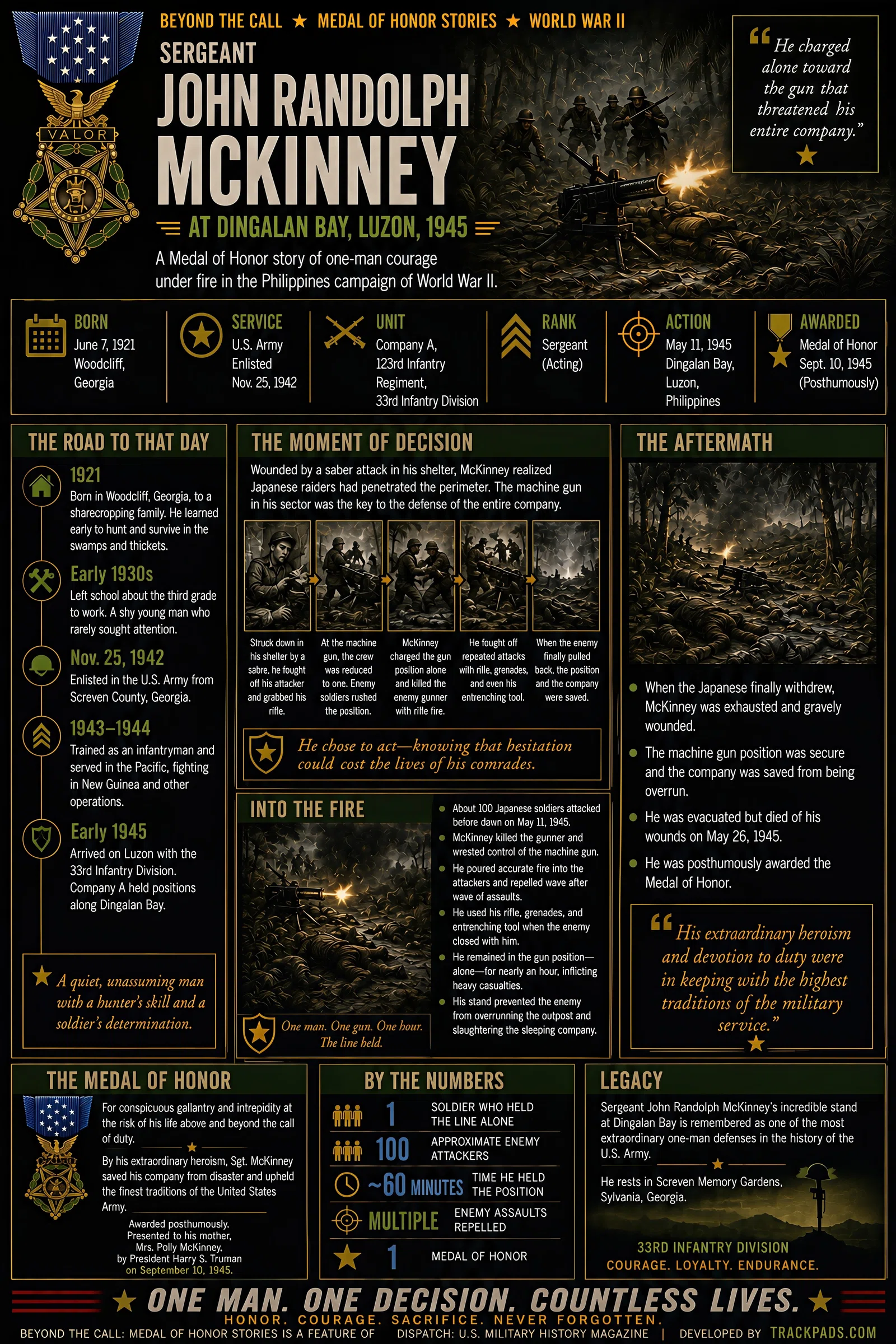
The Moment of Decision
Just before dawn, the jungle around Dingalan Bay was as close to quiet as war ever allowed. In a small outpost cut into the edge of the trees, a three-man light machine-gun crew from Company A, 123rd Infantry, guarded a stretch of perimeter that looked out over dripping foliage and a narrow trail. They had been on that gun for hours, watching shadows and listening to the restless noise of a sleeping company behind them.
A few yards away, Private John Randolph McKinney finally allowed himself to lie down. He had handed the weapon over to his buddies and stepped back to a rough shelter of canvas and bamboo. Boots unlaced, helmet off, rifle within arm’s reach—he was still more awake than asleep, ears tuned to the tiny changes a hunter hears even after exhaustion sets in.
The first warning was not a shout or a shot, but the whip-fast blur of steel in the dark. An enemy soldier ripped open the shelter and brought a saber down across McKinney’s head, a glancing slash that tore flesh and sent him tumbling. There was blood in his eyes, ringing in his ears, and the sickening realization that the Japanese had slipped past the outer posts and were already inside the wire.
Outside, shapes moved fast and low toward the machine-gun position. If they took it and turned it inward, the men still sleeping in their foxholes would never make it to full wakefulness. Dizzy, half-stunned, McKinney had a choice that could be measured in heartbeats: stay down and hope the attack passed over him, or get to his feet, grab his rifle, and charge alone toward the weapon that now threatened his entire company. He chose to move—straight into the gun pit and into a fight that would become one of the most astonishing one-man stands of the war.
The Road to That Day
John Randolph McKinney was born in 1921 in Woodcliff, a tiny community in Screven County, Georgia. His family worked the land as sharecroppers, coaxing what they could from thin soil in the years when the Great Depression made every harvest a question mark. John was not a big or particularly strong child, and the heavy work of plowing and picking often left him spent. Too small for the hardest field labor, he was sent instead into the swamps and thickets with a slingshot and, later, a rifle. His job was simple and unforgiving: bring back something the family could eat.
Day after day he learned to move quietly through knee-deep water, to read tracks in the mud, to pick out the faintest twitch of a squirrel’s tail or the rustle of a quail in the brush. Marksmanship, patience, and the ability to stay calm when the shot mattered—those were survival skills long before they were combat skills. Schooling ended early; by about the third grade, work took priority over classrooms. Neighbors remembered him as shy, polite, and uncomplaining, a young man who rarely sought attention and never spoke loudly about himself.
When war came and the United States went to battle across oceans, McKinney answered the call, enlisting in the Army from Screven County in late 1942. Basic training toughened the farm boy into an infantryman. In Hawaii, New Guinea, and other staging areas, he and the men of the 33rd Infantry Division learned jungle warfare the hard way: long marches in heat and rain, live-fire exercises, endless drills on foxholes, ambushes, and perimeter defense. By early 1945, McKinney’s regiment was on Luzon, part of the campaign to drive Japanese forces from the Philippines.
Into the Fire
By May 1945, the campaign for Luzon had driven Japanese forces back into pockets of rugged jungle and steep coastal hills, but those pockets were still deadly. Along Dingalan Bay, McKinney’s regiment held a sector of the division perimeter, a thin line of foxholes and weapons pits that guarded trails leading inland. Company A’s mission that night was simple on paper: hold the outpost, keep watch for infiltrators, and make sure no enemy force slipped through to strike the rear areas where support troops and supplies were gathered.
Sometime before first light, a Japanese raiding force of roughly one hundred men crept forward through the thick vegetation. Their plan was to hit hard and fast where the line seemed weakest, seize a machine gun, and turn it against the sleeping soldiers behind the perimeter. They found the weapon in McKinney’s sector, a light machine gun dug in to cover a likely avenue of approach.
The attack broke that calm in an instant. An enemy soldier slipped up to McKinney’s small shelter and slashed down with a saber, catching the young private on the head. The blow was glancing but brutal, opening his scalp and knocking him to the ground. McKinney did not stay down. Even dazed, his first instinct was to reach for his rifle. He grabbed the weapon, drove its stock into the attacker who had struck him, and put the man out of the fight in a brief, savage struggle. Another enemy charged him almost at once, and McKinney brought the rifle into action, firing at close range.
At the machine gun, the situation turned critical. One member of the gun crew had been badly wounded and another carried him away toward the rear, leaving the position essentially unmanned. About ten Japanese infantrymen swarmed into the emplacement, wrestled control of the weapon, and began trying to reverse it so they could rake the American foxholes from behind. McKinney saw what was happening and moved toward the danger instead of away from it. Closing the distance alone, he jumped into the gun pit now crowded with enemy soldiers. At a range measured in feet, he fired and swung his rifle, killing multiple attackers in seconds.
The struggle around the gun came at a price. Amid the melee, the machine gun itself was wrecked and rendered useless. McKinney emerged from the pit with only his rifle and whatever ammunition he could carry, now facing the rest of a raiding force that had not yet given up. Grenades began to arc into the perimeter. Knee mortars started dropping shells among the foxholes and brush. Instead of staying in one place, McKinney began to move. He shifted from position to position along his stretch of the line, grabbing ammunition, reloading again and again, and firing into the shapes that appeared in the half-light.
At times the fight closed again to hand-to-hand range. When enemy soldiers broke through or rushed individual foxholes, McKinney met them with the butt of his rifle. Yet each time the raiders tried to push deeper, they ran into the same determined private who refused to fall back. Gradually, the momentum shifted. Other soldiers, now fully awake and aware of the scale of the assault, joined their fire to his. The raiding force had been broken, its survivors slipping back into the jungle or lying still near the shattered machine-gun pit and along the path of their advance. What had begun as a stealthy attempt to crack the perimeter ended as a failed assault stopped largely by one man’s refusal to yield ground.
The Citation, Decoded
The official Medal of Honor citation for John Randolph McKinney begins by saying that he “fought with extreme gallantry” to defend the outpost near Dingalan Bay. In practical terms, it meant staying in a position that had been overrun, while wounded and alone, and choosing to fight rather than withdraw when retreat would have been understandable.
The citation also notes that McKinney faced “approximately 100 Japanese” and that he was alone when confronted by the group that had seized the machine gun. When the citation records that he leaped into the emplacement and shot several men at point-blank range while killing others with his rifle butt, it is describing the brutal reality of close-quarters fighting in a space barely large enough for a handful of soldiers.
Later lines in the citation speak of waves of attackers cut down by his fire, of grenades and knee mortar shells falling into the perimeter, and of McKinney changing position and reloading repeatedly. That is what extraordinary fighting ability looks like when translated from award language into daily soldier skills: marksmanship, ammunition management, movement under fire, and the mental focus to keep going while wounded and under constant threat.
Why It Mattered
On the map, the outpost at Dingalan Bay was just one small bend in a long perimeter. In reality, it was a hinge that helped hold the flank of a regiment in hostile country. The raiding force that slipped through the jungle was trying to punch a hole in the line, seize a key weapon, and turn the American defenses against themselves. If that machine gun had been reversed and brought to bear on the sleeping company, the result would likely have been a sudden, devastating firestorm at close range.
By clearing the gun pit, destroying the raiding party there, and then ranging up and down his sector, McKinney disrupted that plan before it gained full momentum. The enemy attack never achieved the coordinated, rolling advance it needed. Instead of one overwhelming blow, the raiders were broken into smaller, disorganized groups that could be dealt with in turn. The perimeter held, the company was not driven back, and the fragile sense of security in the rear areas was preserved.
Leadership and Character
John McKinney did not wear a high rank when he stepped into the gun pit that morning. At the time of the action he was still a private, and only later would he be promoted to sergeant. His leadership did not come from stripes on his sleeve, but from the way he responded when the situation shattered normal expectations. The habits he had carried from the swamps and fields of Georgia into the Army—patience, marksmanship, and calm under pressure—became the foundation for something more.
The first sign of that character was his immediate reaction to the saber strike. Wounded, stunned, and literally knocked off his feet, he could have crawled away or tried to find safety in the darkness. Instead, he fought the attacker at hand, then moved toward the machine gun, where the real danger lay. As the fight widened, his actions showed another side of leadership: the ability to keep thinking when adrenaline and danger might have driven him to act blindly.
Legacy and Memory
After the war, John Randolph McKinney returned to Georgia, far from the jungle where he had earned the nation’s highest award for valor. In January 1946 he stood at the White House as President Harry Truman placed the Medal of Honor around his neck, a public moment that contrasted with the private, unassuming man who preferred not to talk much about what had happened at Dingalan Bay. Once the ceremonies were over and his service complete, he went back to a simpler life in Screven County, spending his later years farming, hunting, and fishing.
He lived until 1997, passing away in Sylvania, Georgia, and was laid to rest in the same region that had shaped him as a boy. Over time, his story found its way into unit histories, books, and museum displays that tried to convey just how extraordinary his stand on Luzon had been. The state of Georgia honored him by naming a stretch of highway the John R. McKinney Medal of Honor Highway, a reminder to travelers that one of their own had once fought alone in a far-off jungle so that others might live. Remembering John McKinney in that full sense honors not only what he did on May 11, 1945, but also the quieter decades that followed.