The Moment of Decision
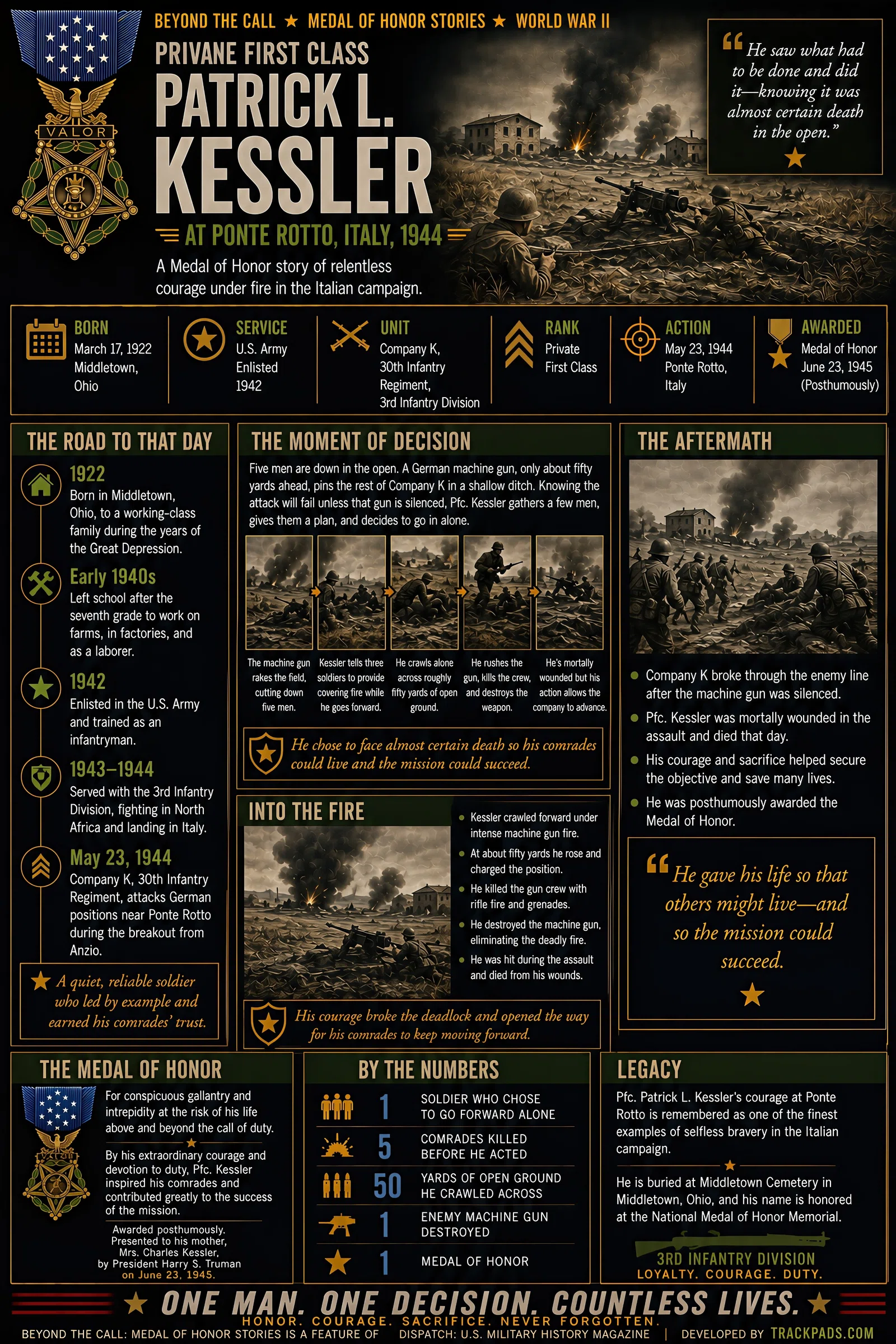
The field near Ponte Rotto is supposed to be just another stretch of ground on the way toward Rome. Low ditches cut across the farmland, offering shallow cover. The air is heavy with the sound of artillery in the distance and the hiss of incoming shells. Company K moves forward in short rushes, men bent under packs and weapons, when a German machine gun rips the air open. In seconds, five Americans are down in the open, and the rest of the company dives into the nearest ditch as bullets stitch the ground around them.
Pinned in the shallow earth, Private First Class Patrick L. Kessler can see too much. The machine gun sits about fifty yards ahead, covering the only workable route forward. Every time someone shifts or tries to crawl, more fire snaps over the ditch bank. The advance has stalled, and with it the fragile momentum of the attack. No one can reach the wounded in the field; anyone who tries will likely join them.
The men around him wait for instructions that are not coming fast enough. Smoke drifts low over the crops, and the metallic chatter of the German gun does not let up. Kessler understands what it means if the company stays where it is: more casualties, the objective lost, and the enemy free to reinforce. In that narrow strip of Italian countryside, a twenty-two-year-old rifleman faces a choice that is not written in any operations order. He gathers a few men close, tells them what he needs them to do, then prepares to leave the thin safety of the ditch. In the next heartbeat, instead of hugging the earth like everyone else, he chooses to move alone toward the gun that is killing his friends.
The Road to That Day
Patrick L. Kessler was born on March 17, 1922, in Middletown, Butler County, Ohio, a Midwestern town shaped by mills, factories, and the long shadow of the Great Depression. Growing up between the world wars meant learning early about hard work and uncertainty. By the time he reached adulthood, another global conflict was already burning overseas, and like many young Americans of his generation he faced a decision about when, not if, he would serve.
The official portrait that survives shows a slim young man in an Army uniform, cap angled just so, looking directly into the camera. He seems younger than his twenty-two years but already carries the serious expression of someone who knows his life is no longer entirely his own. After entering the Army, he trained as an infantryman, learning the fundamentals that would later mean the difference between life and death: how to move under fire, how to read terrain, how to keep a weapon running in mud and rain, how to trust the men in his squad.
Assigned to Company K, 30th Infantry Regiment, 3rd Infantry Division, Kessler became part of a unit that had carved its reputation in earlier fighting across the Mediterranean. By the time he reached Italy, the division had already paid heavily in blood and experience. On the Anzio beachhead and in the rugged countryside beyond, rifle companies like his lived a grinding routine of patrols, night watches, sudden shelling, and quick, violent firefights over anonymous patches of ground. In that world, rank mattered, but so did quiet reliability—the kind of soldier who did his job without fuss, who could be counted on when the situation frayed.
In May 1944, Allied planners finally set the long-awaited breakout from Anzio in motion. The 3rd Infantry Division would drive against German positions guarding the routes inland, clearing farmhouses, canals, and road junctions that formed a defensive web south of Rome. Company K’s orders for 23 May were straightforward on paper and brutal in practice: move forward against prepared positions near Ponte Rotto, break the enemy line, and keep pushing. For Kessler and his comrades, it was one more attack in a campaign that had already taken many friends. None of them could know that before the day was over, his name would be forever linked to that small Italian field.
Into the Fire
The attack toward Ponte Rotto unfolded as part of the hard push inland from the Anzio beachhead, where Allied forces were trying to break through layered German defenses south of Rome. Company K moved out across gently rolling fields broken by drainage ditches, stone farm buildings, and tree lines that masked enemy positions. Somewhere ahead, German machine guns and infantry waited along a series of strongpoints that covered the approaches to the village. The first burst of automatic fire tore through the company as it crossed an exposed stretch of ground, cutting down five men and stopping the advance cold. Everyone who could move dove into a shallow ditch that offered only inches of protection from the bullets raking the field. In that instant, the company’s momentum and survival balanced on a narrow edge.
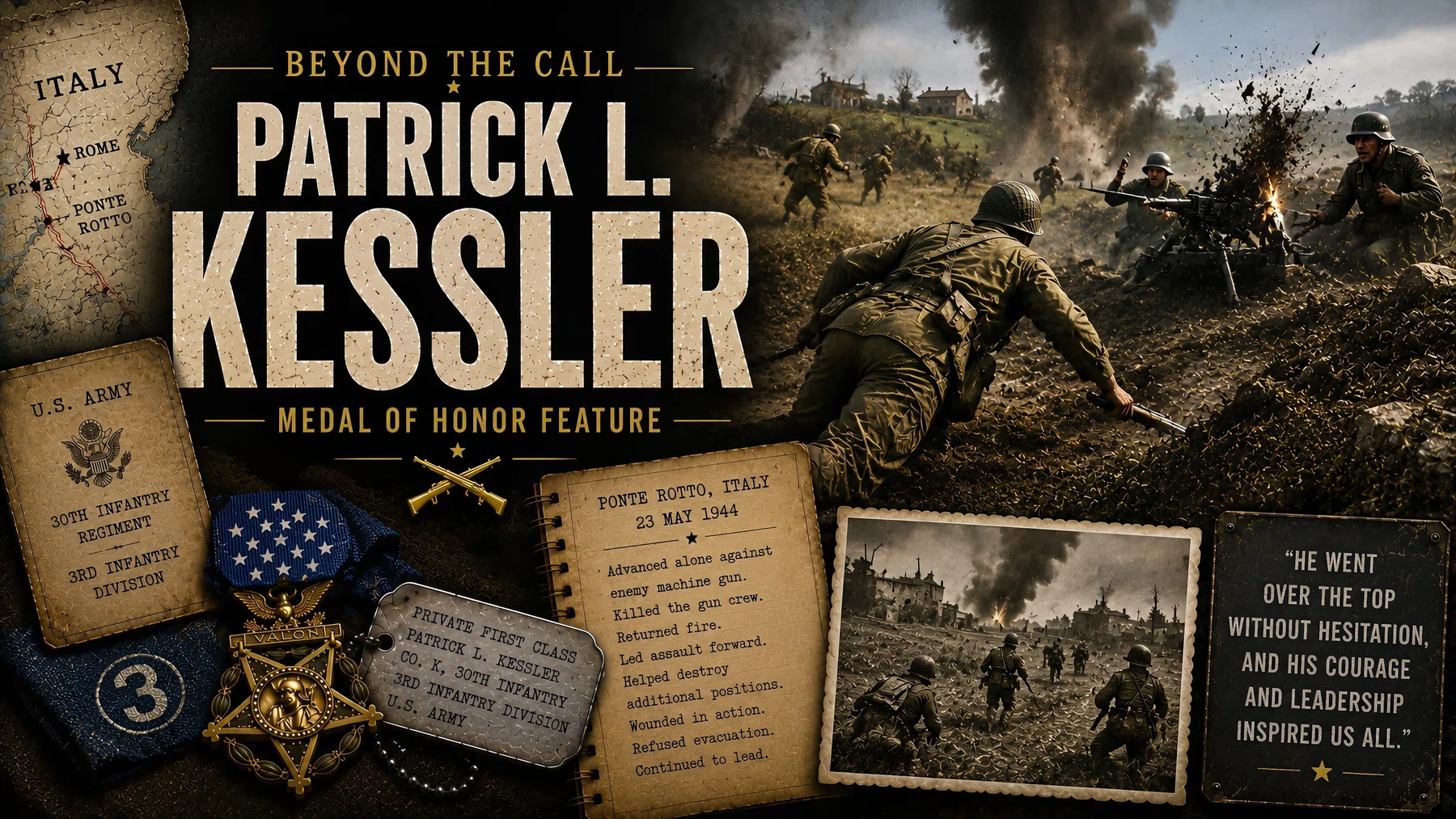
Kessler quickly organized three nearby soldiers to act as a base of fire, directing them to pin down the enemy gun while he went after it. Then he did the opposite of what instinct demanded and left the ditch. Hugging the earth, he crawled forward alone across roughly fifty yards of open ground, inching through dirt and stubble as rounds cracked overhead and snapped into the soil around him. He got within about fifty yards of the weapon before the crew finally spotted the movement and swung their gun toward him. Instead of freezing, he surged forward in a short, violent rush straight into the stream of fire. Closing the last few yards, he rose over the emplacement, shot the gunner and assistant at point blank range, and dropped into the position itself. In the brief struggle that followed he overpowered a third German, capturing him, while a fourth managed to break away and run.
Kessler started back toward friendly lines with his prisoner, moving across the same deadly ground he had just crossed under fire. As he did, he saw two more comrades fall while attacking a second, more heavily defended strongpoint whose guns had already taken a heavy toll on Company K. Passing his prisoner to another soldier, he turned toward this new threat without hesitation. To reach it he had to crawl across more than a hundred yards of terrain under concentrated machine gun and shell fire, threading his way through an antipersonnel minefield that could have ended his advance at any moment. Shells burst close enough to bowl him over, but he kept moving until he reached a firing position within about fifty yards of the strongpoint. There he engaged the enemy machine guns in a grim duel, trading bursts with them and drawing fire away from the pinned infantry behind him.
An artillery round exploded only a few feet from Kessler, showering him with dirt and shrapnel and making any further delay impossible. He rose from cover and began a slow, deliberate walk toward the strongpoint, firing a Browning Automatic Rifle from the hip while bullets and shell fragments whipped around him. He reached the edge of the position, killed the gun crews, and forced more than a dozen German soldiers to surrender. Still under shellfire, he started shepherding his prisoners to the rear. After moving about twenty five yards, two concealed snipers opened fire from roughly a hundred yards away, and some of the captives tried to use the chaos to escape. Kessler instantly dropped to the ground, fired along both flanks of the group to drive the prisoners back to cover, then turned his weapon on the snipers. In the short firefight that followed he silenced them and secured his captives. Only then could Company K resume its advance, capturing its objective without further opposition.
The Citation, Decoded
The official Medal of Honor citation for Patrick L. Kessler uses the familiar but heavy phrase “conspicuous gallantry and intrepidity at the risk of life above and beyond the call of duty.” In plain terms, this means that his actions were not only brave but clearly visible to others, carried out in full awareness of the danger, and far exceeded what any commander could rightly demand of a rifleman. Racing across fifty yards of open ground under a machine gun that had already killed several comrades, he chose to move where any reasonable person would stay flat. The citation’s reference to acting “without orders” underscores that no one sent him forward. He assumed the initiative on his own, assembling a small base of fire and then personally spearheading the assault on an enemy crew that was tearing his company apart.
Later phrases in the citation describe him crawling across mined and shelled ground toward a strongpoint, then advancing “in a slow walk” with his automatic rifle. On paper, those words can sound almost clinical. On the ground near Ponte Rotto, they meant that after being nearly thrown by a shellburst, he stood up and walked toward two machine guns while every weapon in the area tried to kill him. The citation notes that he killed the gunners, captured thirteen enemy soldiers, and then, under new fire from snipers, kept his prisoners from escaping while also eliminating the new threat. Each of those numbers represents lives directly affected: the Americans saved when the guns fell silent, the Germans who laid down their weapons instead of dying in place, and the members of Company K who could move forward because one private refused to let the attack fail. The language of “above and beyond” captures not only extreme courage but a chain of decisions that repeatedly put others’ survival ahead of his own.
Why It Mattered
On the map, the strongpoints near Ponte Rotto were just small symbols in a larger operation to break out of the Anzio beachhead and drive on Rome. On the ground, they were concrete, earth, machine guns, and men determined to hold their line. When Company K was pinned in the ditch and five soldiers lay wounded or dead in the open, the attack threatened to unravel. If the company had been forced to pull back, the gap in the advance would have given the German defenders time to reorganize, bring more fire to bear, and harden their positions along that critical stretch of countryside. Instead, one private changed the course of that short battle.
By knocking out the first gun, Kessler freed his company from the immediate trap that held them in place. His decision to turn toward the second, even stronger position meant that Company K did not simply resume its advance with a dangerous enemy on its flank. Instead, he stripped that position of its guns, forced its remaining defenders to surrender, and cleared the way for the unit to keep moving without further heavy resistance from that direction. The lives saved are impossible to count precisely, but every man who walked past those silent gun pits owed part of his survival to that hour of violence. The larger advance across the Anzio front depended on countless such actions, each one a small but essential piece of momentum. Kessler’s stand at Ponte Rotto is one of those moments when a single soldier’s resolve helped ensure that an entire attack did not fail.
Leadership and Character
Patrick Kessler did not lead from behind a map table or with rank on his collar. His leadership showed itself in the most direct way a front line soldier can demonstrate it. When others were pinned in the ditch, he organized a small group to support him and then took the greatest risk himself. That willingness to shoulder danger rather than spread it marked him in the eyes of his comrades. It also reflected the quiet professionalism that comes from long months of combat, where the men who are trusted most are the ones who move toward the problem instead of waiting for someone else to act.
His decision to abandon the slight safety of the ditch once might have been enough to draw admiration. The fact that he did it twice, first against the initial gun and then across a mined, shelled field toward the second strongpoint, reveals something deeper about his character. He understood that as long as those weapons remained intact, his company would continue to suffer. Even when burdened with prisoners and under renewed fire from snipers, he stayed focused on the mission and on the men around him, keeping his captives under control while eliminating new threats. Modern readers might call this tactical initiative or battlefield leadership. At its heart, it was a simple, hard choice to treat the lives of others as more important than his own safety. That is the standard his story still offers to anyone who has ever worn a uniform or carried responsibility for others.
Legacy and Memory
Patrick L. Kessler did not live to see the final victories in Italy or the celebrations that followed the end of the war. He was killed in action on the day of his great courage near Ponte Rotto, another young life cut short in a campaign that demanded much from the soldiers who fought it. For his actions, he received the Medal of Honor, the highest recognition the United States can bestow for valor in battle. The decoration itself could not replace the son, friend, and comrade that his death took from his family and his unit, but it ensured that the details of his sacrifice would not be lost in the vast sweep of the war.
In the years that followed, his name appeared on honor rolls, memorials, and histories of the 3rd Infantry Division. In his hometown of Middletown and across Butler County, those who knew him remembered more than the official language of the citation. They recalled a local boy who went far from home, faced some of the hardest days of the Italian campaign, and gave everything he had so others might live. Today his story lives on in the records of the Medal of Honor, in the memories of the division that claimed him, and in the quiet places where his name is carved in stone. When readers pause over that name, they are invited to see not just a line on a list but a young man in a muddy field in Italy, walking forward into fire so that his company could move again.