The Moment of Decision
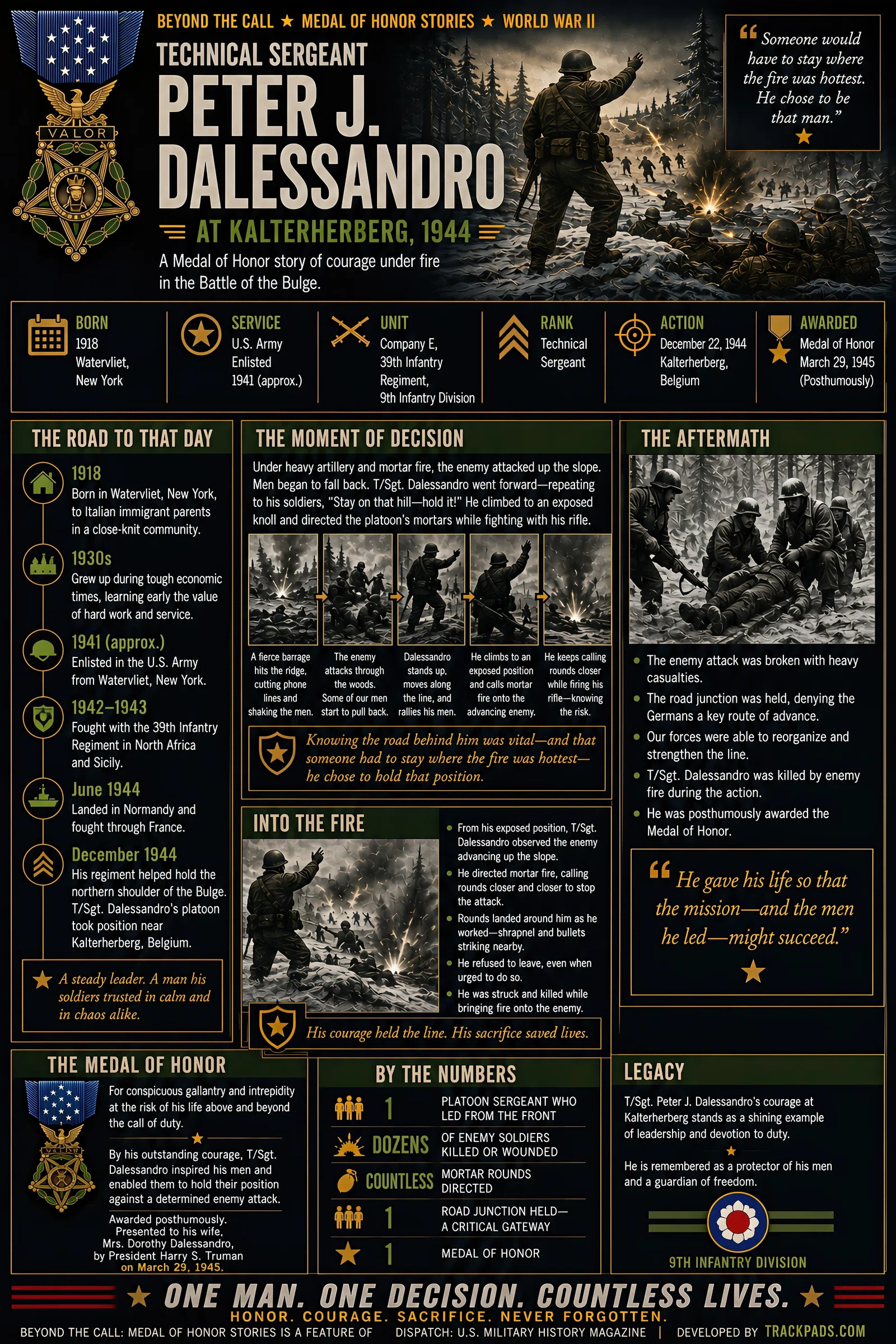
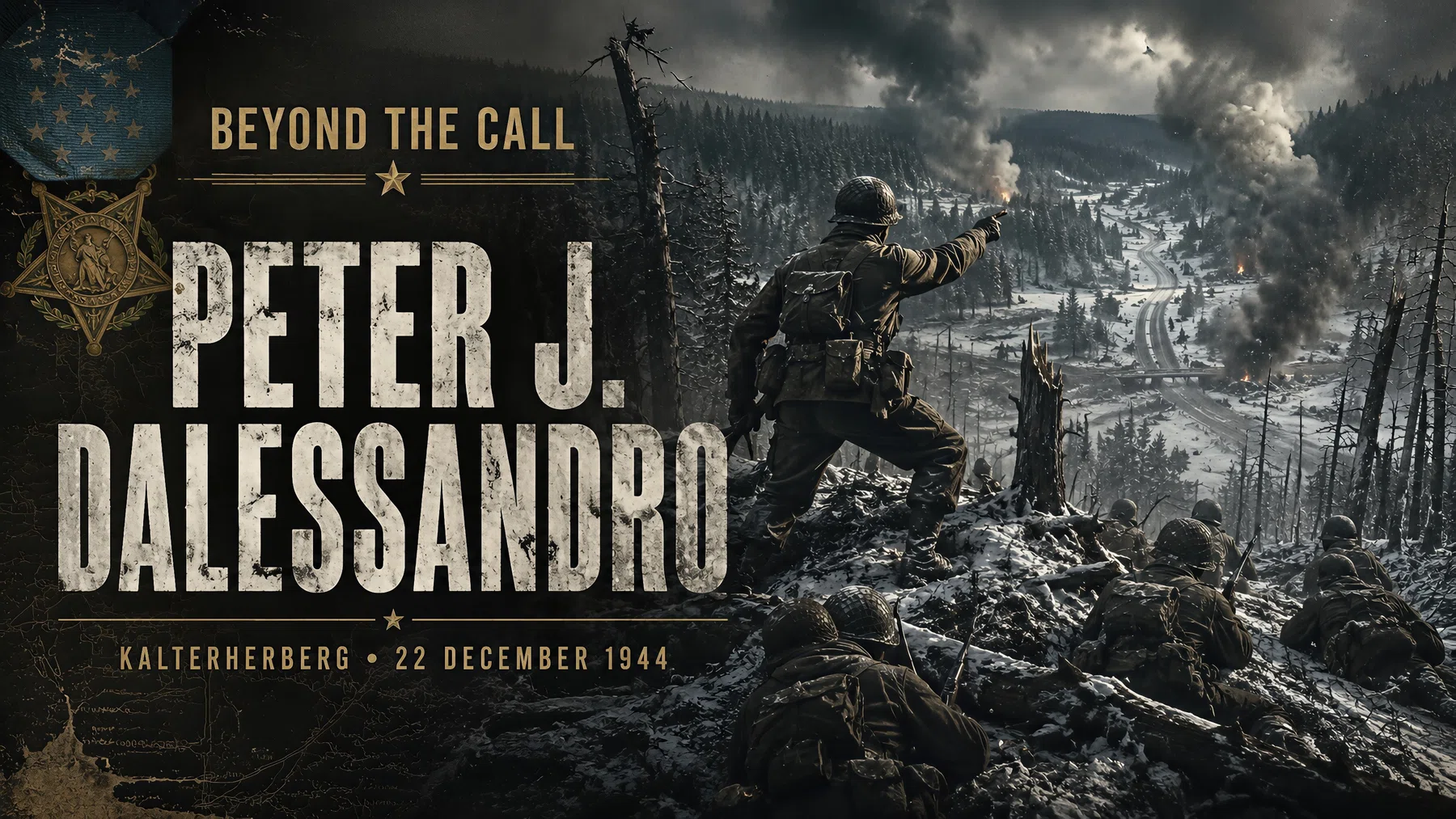
The winter forest around Kalterherberg was still dark when the first shells came in. Snow lay crusted over the foxholes where First Platoon of Company E, 39th Infantry, guarded a lonely road junction on a ridgeline near the German border. It was December 22, 1944, at the height of the Battle of the Bulge, and the road under their guns was one of the few routes the enemy could use to break through to the rear.
A sudden blast of artillery and mortar fire smashed into the ridge, throwing dirt and snow into the air and cutting phone lines. Men hugged the bottoms of their foxholes as shrapnel sliced through the trees. Over the barrage came the sounds of movement in the woods: boots, shouted orders in German, the metallic clatter of weapons being dragged forward. The attack, when it came, was fast and close.
In the chaos, some riflemen began to drift back off the crest, looking for cover behind the ridge. Technical Sergeant Peter Dalessandro, the platoon sergeant, moved the other way. He left what shelter he had and walked the line upright, shouting for his men to stay on the high ground, to keep firing, to hold. Then he climbed to a bare little rise that gave him a view of the slope below—an exposed observation post that every man on the ridge knew was a death spot. From there he began correcting the platoon’s mortar fire, calling rounds closer and closer while working his own rifle.
The enemy was pressing, ammunition was running low, and the road behind the platoon was the last thin barrier to a larger breakthrough. At that moment Dalessandro understood that someone would have to stay where the fire was hottest, directing the mortars and buying time for the rest to survive. He chose to be that man, even if it meant calling deadly fire almost directly onto himself.
The Road to That Day
Peter Joseph Dalessandro was born in 1918 in Watervliet, New York, a compact industrial city on the Hudson River just north of Albany. The town lived in the shadow of the nearby Army arsenal and the smokestacks along the riverbanks. It was the kind of place where service—whether in uniform, at the mill, or in local politics—was woven into everyday life. Growing up there meant knowing people who had served in earlier wars and neighbors who expected younger generations to shoulder their share.
When global war came again, Dalessandro entered the United States Army from his hometown. He was assigned to the 39th Infantry Regiment of the 9th Infantry Division, an outfit that would fight its way from North Africa to Sicily, across Normandy, and into the heart of Europe. By late 1944 he had risen to the rank of technical sergeant and served as platoon sergeant in Company E’s First Platoon. In a rifle platoon—about thirty to forty men—that role meant everything from setting defensive positions and checking ammunition to calming nerves before an attack.
By then the regiment was a hardened unit. Its soldiers had crossed beaches under fire, pushed through hedgerows and French villages, and learned how quickly a quiet sector could turn lethal. Dalessandro’s authority did not come from rank alone. It came from shared hardship: the long marches, the frozen nights, the friends lost along the way. Off the line, he was known as a steady presence, the kind of noncommissioned officer who listened when younger soldiers grumbled and who translated officers’ orders into practical instructions the platoon could follow.
In December 1944, as the German winter offensive surged through the Ardennes, the 9th Infantry Division held part of the northern shoulder of the attack. Company E received orders to occupy the high ground over a crucial road junction near Kalterherberg and hold it as long as possible. For First Platoon, that meant digging in along the crest, stringing telephone wire back to the mortars, and waiting in the snow. For Technical Sergeant Peter Dalessandro, it meant knowing that if things went bad, the responsibility for those men—and that road—would rest squarely on his shoulders.
Into the Fire
In December 1944, the German winter offensive slammed into the thin American lines in the Ardennes, trying to rip open a path toward the Meuse River and beyond. The 9th Infantry Division held part of the northern shoulder of that attack, posted on snow covered ridges and in dark stands of evergreens above small villages and road junctions. Near Kalterherberg, First Platoon of Company E was ordered to dig in around one such junction on high ground and hold it as long as possible. Before dawn on December 22, the silence broke under a violent artillery and mortar barrage that crashed into their ridge, blasting trees apart and collapsing shallow foxholes under showers of earth and snow.
When the barrage lifted, the real test began. From the woods below came German infantry, moving quickly up the slope, shouting and firing as they advanced. Phone lines to supporting mortars had been cut. Some riflemen, stunned by the shelling and the sudden rush of enemy fire, began to drift back off the crest in search of cover. Technical Sergeant Dalessandro moved the opposite way, into the chaos. He walked along the line under direct fire, calling men by name, pointing them back toward their sectors, reminding them that the road behind them led straight to other American positions that had no warning of what was coming.
To bring the mortars back into the fight, Dalessandro knew he needed a vantage point where he could see the enemy clearly, even if that meant giving up the little protection he had. He pushed forward to a small knob of ground that stuck out from the ridge, a place with no foxhole, no tree trunk to hide behind, and an open view of the slope below. From there he shouted corrections to the mortar crews, using hand signals and runners when the phones failed, walking fire from one clump of trees to the next. Mortar rounds began to fall among the attacking Germans, first wide, then tighter, breaking up formations and stalling their rush. At the same time he worked his own rifle, picking out targets, pointing out gaps, and urging his men to keep firing despite the incoming rounds that exploded around his exposed position.
The first assault faltered under this combination of well placed mortars and stubborn rifle fire. For a brief time the ridge quieted. Men in First Platoon checked their ammunition, cleared jams, and patched up shallow wounds. Dalessandro moved among them again, checking on the walking wounded, repositioning weapons, and making sure that every sector of the perimeter had at least one automatic weapon and enough grenades. Everyone on the ridge understood that the enemy had not spent so much artillery on a single attempt. They would be back.
Later in the day, as winter light began to fade, the second assault came. Once more the ridge vanished in concussion and smoke as artillery and mortars pounded the American positions. Dalessandro returned to his forward vantage point, fully aware that the enemy had already learned its location. He again called for mortar fire, asking the crews to bring the bursts in closer and closer to his own position as the Germans closed in. When his rifle ran empty, he crawled across roughly thirty yards of open snow swept ground to reach a light machine gun abandoned near another position, then dragged it back to his exposed post and opened fire almost at point blank range.
The fight at the crest narrowed to a few yards. German soldiers tried to flank his position, closing in through the shattered trees. Dalessandro’s machine gun jammed under the strain of constant firing and the cold, so he cleared it as best he could, forced one final burst from the weapon, and dropped several attackers who had reached the edge of a nearby foxhole where an aid man worked over two wounded Americans. With his last bullets gone, he turned to grenades. At the same time he called again for mortar fire and did not ask for it to be lifted. Instead he gave his own location as the aiming point, demanding that the rounds fall directly onto the spot where he stood so that his platoon could pull back to a secondary line of defense.
As the platoon withdrew, carrying what wounded they could, Dalessandro stayed forward alone. The enemy nearly surrounded him, closing in through drifting smoke and snow, yet he kept throwing grenades and shouting corrections for the incoming shells that now crashed frighteningly close. Those few minutes of resistance bought First Platoon the time it needed to establish its second position, reorganize, and hold the road behind the ridge. When the smoke finally cleared, Dalessandro was captured, a prisoner of war. But the company had avoided collapse, and the road junction that anchored their part of the line remained in American hands.
The Citation, Decoded
The official Medal of Honor citation for Technical Sergeant Peter J. Dalessandro compresses this long, desperate fight into a handful of formal sentences. It notes that he was with First Platoon holding an important road junction on high ground and that an intense artillery and mortar barrage was followed by an all out attack. In everyday terms, that phrase describes a small group of infantrymen perched on a ridge with the enemy below them and explosive rounds bursting in the trees overhead, showering them with splinters and earth.
The citation mentions that Dalessandro advanced to a fully exposed observation post where he adjusted mortar fire while encouraging his men. For a rifle platoon that meant deliberately stepping out from cover to a spot where anyone on the slope below could see and shoot at him. From there he used what he knew of the ground, the line of the ridge, and the pattern of trees to bring indirect fire down on the attackers with enough precision to break up their cohesion. The formal words “conspicuous gallantry” and “intrepidity” refer to this kind of action.
Later phrases in the citation explain that after exhausting his rifle ammunition he crawled over exposed ground to secure a light machine gun, returned to his post, and kept firing until the weapon jammed. They record that he killed several enemy soldiers at almost point blank range who were about to murder an aid man and two wounded comrades, then stayed alone at his forward position, calling for mortar fire closer and closer as his platoon withdrew. In a situation where surrender or retreat might have seemed reasonable, Dalessandro chose instead to use his last weapons and his own life as a shield for his men and for the mission.
Why It Mattered
On the snowy ridge above Kalterherberg, the fight around First Platoon could have been dismissed as just one more small clash in a vast winter offensive. In reality, the stand that Technical Sergeant Peter Dalessandro and his men made at that road junction helped hold together a fragile line at a dangerous moment. The platoon’s position dominated a route the enemy needed to push deeper toward the interior of the Allied front.
By stabilizing the crest under repeated attacks, Dalessandro bought time in the most literal sense. His insistence on staying forward, directing mortar fire and rallying riflemen, slowed and then broke up assaults that might otherwise have rolled past a shaken platoon. The company did not disintegrate under pressure. The road behind them did not fall into enemy hands. The battalion maintained a coherent defensive line instead of coping with a sudden, unexplained collapse on its flank.
Leadership and Character
Peter Dalessandro’s conduct on that ridge is often remembered in a single scene, the lone noncommissioned officer standing on a bare rise under direct fire. Yet the leadership on display began long before he stepped into the open. As a platoon sergeant, he had to know each soldier’s strengths and fears, to arrange the defense so that automatic weapons covered the right avenues of approach, and to build enough trust that men would respond when he shouted for them to move back into danger.
In the crisis, several themes stand out. First was responsibility. Dalessandro could see that if no one held the forward ground and directed the mortars, the platoon would be overwhelmed. Instead of searching for safety, he accepted that the dangerous position belonged to him. Another defining trait was his refusal to abandon the wounded or the aid man who was treating them. Finally, his decision to call mortar fire onto his own location so that others could withdraw showed moral courage as much as physical bravery.
Legacy and Memory
After the war, Peter Dalessandro returned to Watervliet as more than a decorated veteran. He carried with him the experience of harsh campaigns across two continents, the memory of a brutal winter on the German border, and the knowledge of what his platoon had endured. In the years that followed, he moved into public life, serving his community in local roles and later in the New York State Senate.
Dalessandro’s Medal of Honor ensured that his name would not fade from official records. His story appears in educational materials, museum displays, and commemorations of the Battle of the Bulge, where it stands as a concrete example of what determined leadership can achieve even when the odds are poor. His grave in New York offers a quieter reminder, a single headstone among many, linking his public honor to a private life rooted in family and community.